
What is thermal insulation? Thermal insulation means applying materials with low thermal conductivity to external walls, roofs, floors and building services to slow the flow of heat from a warm space to a cold one. It reduces heat escaping from inside in winter and heat entering from outside in summer. Stone wool, EPS and XPS boards are widely used for this in buildings.
This definition usually leads to further questions: which material, where, and how thick? In this guide you will find the types of insulation, the ways heat travels through a building, the types of thermal insulation by area of application, and the values of stone wool, EPS and XPS from Mega technical data sheets in one place. We also summarise the five criteria for choosing a material and what the regulations require.
What is insulation? The difference between thermal, sound and water insulation
Insulation is the general term for materials and systems applied to limit the passage of heat, sound or water through a building element. All three types can exist in the same building, but each solves a different problem and is made with its own materials.
| Type of insulation | What does it limit? | Examples from Mega products |
|---|---|---|
| Thermal insulation | The passage of heat from a warm space to a cold one | Stone wool, XPS and EPS thermal insulation boards |
| Sound insulation | The passage of sound from one room to another | Partition and floating floor boards, DesiWool, MegaBlock Acoustic |
| Waterproofing | Water and moisture penetrating the building element | Fullback waterproofing products |
This article is about thermal insulation. For noise from neighbours and between rooms, see our article on wall sound insulation; for wet rooms, balconies and foundations, see our waterproofing material page.
What is thermal insulation and why is it needed?
Thermal insulation is the sum of the layers that reduce heat flow through the external walls, roof, floors and foundations that make up the building envelope. It is needed because, in an uninsulated envelope, the heat produced by the heating system flows out through these surfaces all the time, and more energy is spent to keep the same indoor temperature.
The benefits of thermal insulation fall under three headings:
- Energy: Heating and cooling demand falls. How much it falls depends on the building’s climate, its envelope and the insulation thickness, so a savings rate can only be stated through a design calculation.
- Comfort: The inner surface of an externally insulated wall cools down less in winter; the feeling of a cold wall is reduced and the temperature is spread more evenly in the room.
- Building health: When the inner surface stays warm, moisture in the air is less likely to condense on the wall, and the risk of mould fed by condensation also falls.
How does heat pass through building elements?
Heat always flows from the warm side to the cold side, and it does so in three ways: conduction, convection and radiation. According to the building science resources of the U.S. Department of Energy, heat passes from the warmer material to the cooler one until a balance is reached.
- Conduction: When two surfaces at different temperatures are in direct contact, heat passes through the material. The concrete, brick and plaster of a wall carry heat this way.
- Convection: Heat is carried by moving air. Air currents in wall cavities and leaks around window frames fall into this group.
- Radiation: Heat travels as energy without needing a medium. The sun heating a roof is the most familiar example.
Insulation materials work by trapping air in small, still pockets. Stone wool does this with the spaces between its fibres, while EPS and XPS do it with the small cells of the foam. Because the air cannot move, convection stops, and the material’s low thermal conductivity reduces the heat passing by conduction. We explain an everyday example of the same principle in our article how does a thermos work.
What are the types of thermal insulation by area of application?
The answer to how thermal insulation is installed depends on where it is applied. In a building, insulation is considered in four main areas: external walls, roof, floors and foundations, and building services. Each area has different load, moisture and temperature conditions, and therefore different materials.
External walls and facades
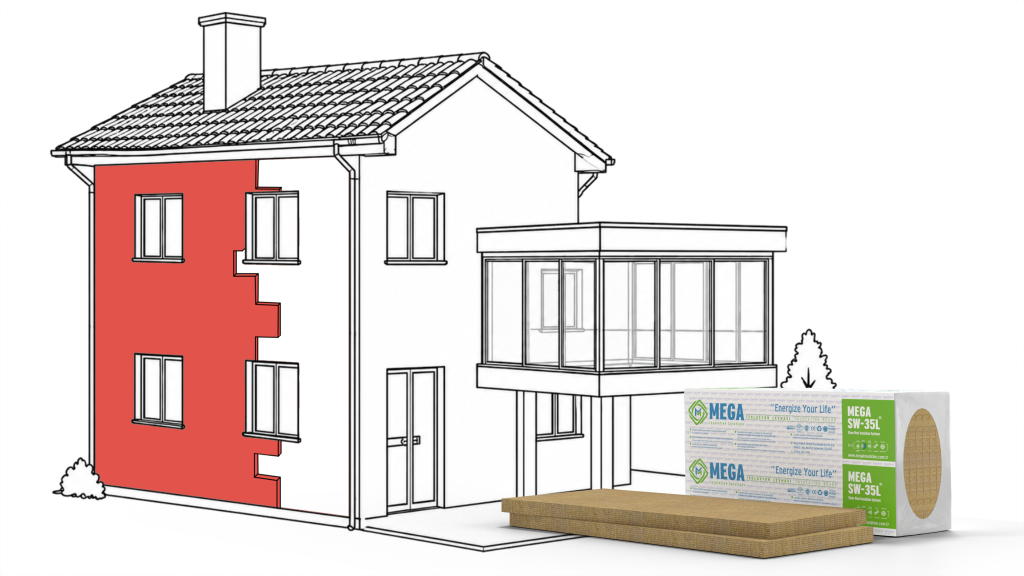
External walls are mostly insulated with ETICS (known in Türkiye as “mantolama”): the insulation board is fixed to the outer face of the wall with adhesive and anchors, then covered with a mesh-reinforced base coat and a finish. ETICS uses stone wool ETICS boards, white or grey EPS, and XPS boards with a rough surface. We explain the layers of the system in detail in our guide what is ETICS.
In ventilated (rainscreen) facades, stone wool boards are fixed to the facade wall or placed between the supporting profiles. Where the wall cannot be insulated from outside, it can also be insulated from inside; you will find these options in our article on internal wall insulation and a comparison of the methods in our article on types of external wall insulation.
Site note from MegaUsta: Do not insulate only the flat wall surface and leave columns, beams, slab edges and window reveals exposed. Every uninsulated reinforced concrete element in the envelope creates a thermal bridge; heat passes most easily through these points, and they also become the coldest spots on the inner surface.
Roofs and terraces
On pitched roofs, insulation can be applied to the attic floor or under the rafters; Mega flat XPS boards are used in both applications. On flat roofs, the board lies beneath the protective and finishing layers, carries their load and may come into contact with rainwater. That is why compressive strength and water absorption matter most on a terrace.
According to Mega data sheets, the stone wool flat roof board is available in five compressive strength options from 30 kPa to 70 kPa, with a λD value of ≤0.039 W/mK. For the layer sequence and inverted roof details, see our guide on flat roof insulation.
Floors, ground and foundations
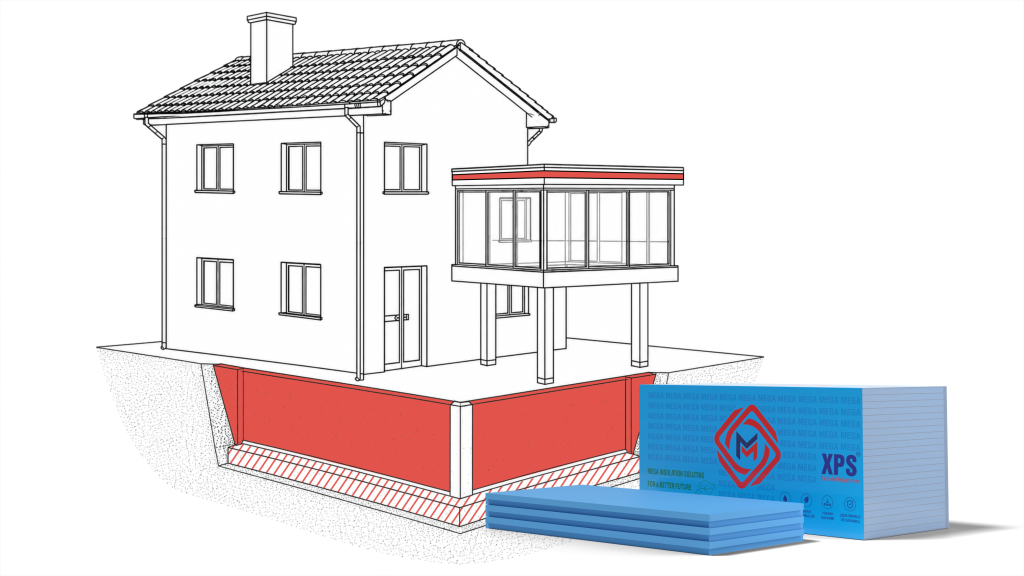
Floors above an unheated basement, car park or open passage, and floors resting on the ground, are also insulated because they lose heat. In foundations and basement walls in contact with the ground, the board works under both moisture and soil pressure; here XPS, with its low water absorption and high compressive strength, stands out. The Mega flat XPS board is used in foundations, below-ground basement walls, floors and under parquet.
To provide thermal and sound insulation together under a screed, a stone wool floating floor board can be used. According to the Mega data sheet, this board is produced in a 30 mm thickness and has a λD value of ≤0.036 W/mK.
Building services and technical equipment
Hot and cold water pipes, air-conditioning and ventilation ducts and industrial installations are also insulated; the aim here is to keep the temperature of the fluid carried in the pipe or duct. Mega’s stone wool technical products include an air-conditioning board with aluminium foil on one face and foil-faced and unfaced preformed pipe insulation sections. XPS and EPS boards are used in cold stores.
What are thermal insulation materials? Stone wool, EPS and XPS
The main thermal insulation materials used in buildings are stone wool, EPS and XPS boards. Stone wool belongs to the mineral wool family and is made to TS EN 13162, EPS (expanded polystyrene) to TS EN 13163 and XPS (extruded polystyrene) to TS EN 13164. The table below compares the three materials using example types selected from Mega technical data sheets.
| Property | Stone wool (MEGA SW F150) | EPS (EPS 50W white · EPS 70 (G) grey) | XPS (MEGA XPS T3000) |
|---|---|---|---|
| Thermal conductivity, λD (W/mK) | ≤0.037 | 0.040 · 0.031 | 0.035 |
| Reaction to fire class (TS EN 13501-1) | A1 | E | E |
| Water absorption | Short-term ≤1 kg/m², long-term ≤3 kg/m² | Long-term, by immersion: 5% · 4% | Long-term, by immersion: ≤0.7% |
| Compressive strength (kPa) | At least 40, 45 or 55, depending on sub-type | 50 · 70 | 300 |
| Service temperature | Up to +750 °C | -50 / +70 °C | -50 / +75 °C |
| Board size (mm) | 1200 × 600 | 500 × 1000 | 600 × 1200 |
| Product standard | TS EN 13162 | TS EN 13163 | TS EN 13164 |
Source: Mega technical data sheets (MEGA SW F150, EPS 50W, EPS 70 (G), MEGA XPS T3000). Water absorption values are measured with different test methods, so they should not be compared directly across columns. The reaction to fire classes refer to the board itself: stone wool boards are class A1, while EPS and XPS boards are class E, which means they are combustible.
These values also explain where each material stands out. XPS, thanks to its closed-cell structure and low water absorption, is preferred in damp and load-bearing areas such as foundations, below-ground basement walls and flat roofs; EPS is preferred for ETICS because it is lightweight; and stone wool, with its A1 reaction to fire class and contribution to sound insulation, is preferred where there are fire and acoustic requirements. For side-by-side comparisons, see our articles stone wool or EPS and XPS or EPS, and for what the standard codes mean, our guide to insulation standards.
Mega Insulation Solutions (Mega Yalıtım) is a Turkish manufacturer of insulation materials with its head office in Kavacık, Istanbul, and its factory in Elazığ. Alongside stone wool, XPS and EPS thermal insulation boards, it offers MegaBlock, MegaLento, DesiWool, MegaTech construction chemicals and Fullback waterproofing products under the Mega brand. All board types are listed with their technical data sheets on the stone wool, EPS board and XPS board category pages.
Which 5 criteria matter when choosing a thermal insulation material?
The right material is chosen by assessing thermal conductivity, reaction to fire class, water absorption, water vapour permeability and compressive strength together.
- Thermal conductivity (λ): Shows how easily the material conducts heat. Its unit is W/mK; the lower the value, the better the insulation at the same thickness. More in our article on thermal conductivity.
- Reaction to fire class: Classifies the material’s contribution to fire as A1, A2, B, C, D, E or F under TS EN 13501-1. Türkiye’s Regulation on the Protection of Buildings from Fire counts A1 as “non-combustible” and E as “normally flammable”. Details are in our article on fire class of insulation materials.
- Water absorption: Shows how much water the board takes up when in contact with water. It is a decisive criterion in areas in contact with the ground and on terraces.
- Water vapour permeability: Expressed by the water vapour diffusion resistance factor (μ); the lower μ is, the more easily the material lets vapour through. Mega stone wool board data sheets give a μ value of 1. We explain why vapour movement matters in a wall in our article what is condensation.
- Compressive strength: The board’s resistance to crushing under load, given in kPa. It matters in load-bearing applications such as terraces, floors and foundations; in Mega data sheets the value is at least 40, 45 or 55 kPa for MEGA SW F150, depending on sub-type and 300 kPa for MEGA XPS T3000.
Thickness is also part of the calculation. The thermal resistance (R) of a layer is found by dividing its thickness by its λ value: R = d/λ. For example, a 50 mm MEGA XPS T3000 board (λD 0.035) provides about 1.4 m²K/W and a 100 mm MEGA SW F150 board (λD 0.037) about 2.7 m²K/W. We discuss how the thickness a building needs is determined in our article on insulation thickness.
How does thermal insulation work in summer and winter?
Thermal insulation does the same job in both seasons: it slows the heat flowing from the warm side to the cold side. In winter the warm side is the inside of the home, so heat escapes outwards; in summer the direction reverses and the heat outside tries to get in.
In winter, insulation slows the loss of heat produced by the heating system through the walls, roof and floor; we look at where heat escapes from a home in our article on heat loss at home. In summer, it limits the heat passing inside from a sun-heated roof and facade. Indoor spaces heat up more slowly and the cooling load is lighter; you will find practical tips in our article on keeping the house cool in summer. The Regulation on Energy Performance in Buildings also requires heat gains to be calculated together with heat losses in the thermal insulation design.
Can paint, plaster or brick alone provide insulation?
In most cases, no. Plaster and paint are thin layers, so the thermal resistance they add to a wall is small; the contribution of wall materials such as brick, pumice block or concrete varies with their type, void structure and thickness. Whether the wall is sufficient is shown by the calculation in the thermal insulation design.
The difference can be seen with values from Mega data sheets. The thermal conductivity of the cement-based hand plaster MTP-7111 is at most 0.67 W/mK; using this upper value, 2 cm of plaster gives a thermal resistance of about 0.03 m²K/W. With the same formula, a 5 cm MEGA SW F150 stone wool board (λD 0.037) provides about 1.35 m²K/W.
The same formula applies to products sold as thermal insulation paint: thermal resistance increases with thickness and decreases as the λ value rises. Because a paint film is very thin compared with an insulation board, assessing its contribution requires looking at the thermal conductivity value in its documentation and the thickness to be applied. The thermal insulation design likewise calculates the layers, thicknesses and U-value of the external wall using such declared values.
The picture changes for wall units with an insulation layer built in. For the MegaBlock Thermal thermal insulation block, made of pumice, cement and stone wool, the data sheet gives a wall λ value of 0.07 W/mK and an unplastered wall U-value of 0.35 W/m²K for the 195/90SW series. Whether this value is sufficient for a particular building is again decided by the design calculation. We describe the product’s structure in our article what is MegaBlock.
How is thermal insulation regulated?
In Türkiye, the thermal insulation of buildings is regulated through the Regulation on Energy Performance in Buildings and the TS 825 standard. Article 10 of the regulation makes it mandatory to prepare a thermal insulation design according to the calculation method in TS 825, and the relevant authority requests this design at the building permit stage.
According to the regulation, the design includes the following information:
- The building’s heat losses and gains and its monthly and annual heating energy demand; the annual demand may not exceed the limit calculated according to TS 825.
- The material, layer sequence, thickness, area and U-value of external walls, roofs and floors.
- The glass and frame type, area and U-value of windows.
- A condensation check on heat-losing surfaces.
TS 825 is a calculation standard that sets the rules for thermal insulation in buildings; it is not a product certificate. If a material’s thermal conductivity value is not listed in the standard’s tables, the design value determined by a TSE National Technical Approval (UTO) can be used. We cover the scope of the standard and its climate zones in our article on TS 825.
Frequently Asked Questions
What are the most common thermal insulation materials?
The three board materials widely used for thermal insulation in buildings are stone wool, EPS and XPS. Stone wool belongs to the mineral wool family and, according to Mega data sheets, has reaction to fire class A1. EPS and XPS are polystyrene foams and are class E. Each has its own product standard: TS EN 13162 for stone wool, TS EN 13163 for EPS and TS EN 13164 for XPS.
Which insulation material should be used where?
The conditions at the point of use decide. XPS, with its low water absorption and high compressive strength, stands out for foundations and basement walls in contact with the ground and for flat roofs. EPS is often used for ETICS facades because it is lightweight. Stone wool, class A1, is preferred for facades and partition walls with fire and acoustic requirements. Thickness and the final choice follow the calculation in the building’s thermal insulation design.
Does thermal insulation work in summer too?
Yes. Heat always flows from the warm side to the cold side; in summer, when it is hotter outside, heat tries to move from outside to inside. The insulation layer in the roof and facade slows this flow just as it does in winter. Indoor spaces therefore heat up more slowly and the load the cooling system has to meet is reduced. The size of the effect depends on the building’s orientation, shading and insulation thickness.
Is a thermal insulation design mandatory?
Yes. Under Article 10 of Türkiye’s Regulation on Energy Performance in Buildings, a thermal insulation design must be prepared using the calculation method in TS 825, and it is requested at the building permit stage. The design shows the layers, thicknesses and U-values of external walls, roofs and floors, and the building’s annual heating energy demand. Insulation thickness and material choice are based on this calculation.
Sources
- Regulation on Energy Performance in Buildings, Article 10 (Official Gazette, 05.12.2008, No. 27075)
- Regulation on the Protection of Buildings from Fire, Annex 2/Ç combustibility classes (mevzuat.gov.tr, PDF)
- U.S. Department of Energy, Building Science Education: Heat Flow
- Mega MEGA SW F150 ETICS Board technical data sheet (PDF)
- Mega EPS 40W / 40U-W / 50W technical data sheet (PDF)
- Mega EPS 50 / 60 / 70 (G) technical data sheet (PDF)
- Mega MEGA XPS T3000 technical data sheet (PDF)
- Mega Yalıtım technical documents
You can browse all our product groups on the insulation products page. If you would like support choosing materials for your project, you can write to the Mega Yalıtım technical team through our contact page.