
A thermos works thanks to two nested walls and the vacuum between them. Because almost no air is left in the vacuum to carry heat, conduction and convection largely stop, while the shiny, silvery coating on the walls reflects radiation back. As a result, a hot drink stays hot and a cold drink stays cold. Heat escapes most easily through the neck where the two walls meet and through the lid.
We take it for granted that coffee poured on a winter morning stays hot until noon, or that iced water stays cool until evening on a summer day. Behind it lies an invention that came out of the laboratory and closes all three escape routes of heat at once. In this article we explain how the thermos was invented, how a thermos works and why vacuum insulation is so effective, and we show what the same physics means for buildings. A thermos is, in fact, a small-scale lesson in insulation.
How was the thermos invented? The story of the Dewar flask
The ancestor of the thermos is the vacuum glass vessel that Scottish scientist James Dewar designed in 1892 to store liquefied gases at very low temperatures. In laboratories, such vessels are still called Dewar flasks.
Dewar was studying how matter behaves at low temperatures at the Royal Institution; he was also the one who succeeded in liquefying hydrogen in 1898. The biggest problem in this kind of work was that the cold liquid absorbed heat from its surroundings and evaporated quickly. Dewar’s solution rested on a simple idea: he placed two glass flasks one inside the other, joined and sealed them at the neck, and pumped out most of the air between them. He then coated the glass with silver to reduce heat loss even further. According to the Royal Institution’s records, the flask was first exhibited there on Christmas Day 1892.
Dewar never patented his invention. It was the Thermos company, set up by two German glassblowers, that brought the flask into everyday use, patenting it in 1904 and launching it under a new name. The product became so widespread that the company’s name gradually turned into the generic name for such vessels; in Turkish, too, they are called termos.
What is the working principle of a thermos? The ways heat is transferred
The working principle of a thermos is to weaken, at the same time, the three ways in which heat passes from one place to another. As the building science resources of the U.S. Department of Energy also explain, heat flows by conduction, convection and radiation:
- Conduction: When two surfaces at different temperatures are in direct contact, heat passes from the warmer to the cooler one. The handle of a spoon warming up in a glass of tea is an everyday example.
- Convection: Heat is carried by moving air or liquid. Warm air rises, cooler air sinks, and a circulation forms.
- Radiation: Heat travels through space as waves and is absorbed by cooler objects. The largest source of radiation is the sun.
A thermos deals with these three paths one by one. The table below summarises how each path is cut off in a thermos and what the same path corresponds to in a building.
| Heat transfer path | Solution in a thermos | Equivalent in a building |
|---|---|---|
| Conduction | The vacuum between the two walls; the walls meet only at the neck | Insulation boards with low thermal conductivity (λ) |
| Convection | There is almost no air in the vacuum that could move | Boards that keep air still in small cells or between fibres, and airtight joint details |
| Radiation | Silver-coated, shiny surfaces reflect heat back | A continuous insulation layer that slows the heat passing indoors from sun-heated roof and façade surfaces |
Why is vacuum insulation so effective?
What makes vacuum insulation effective is that the matter which could conduct or carry heat has largely been removed. With almost no air molecules left, conduction through the gas and convection by air currents both largely stop; what remains is mainly radiation, and the silver coating turns most of that back.
There are also places the vacuum cannot cut off. Because the two walls meet at the neck, heat travels by conduction through the glass or metal in this narrow band. The lid is another weak point; a thermos whose lid does not close fully or whose seal is worn cools its contents much faster. Dewar’s flask did not contain a perfect void either, only a partial vacuum; even so, it was effective enough to preserve liquefied gases.
Something similar happens in buildings. However well a wall is insulated, points where the insulation is interrupted, such as columns, beams or slab edges, open a shortcut for heat. We explained how these points are dealt with in our article on thermal bridges.
What does this mean for your building?
A well-insulated building works like a large thermos: in winter it keeps the warmth inside, in summer it keeps the heat outside. The difference is this: instead of a vacuum, boards that trap still air are placed in the walls, and the points where air could leak are sealed separately.
According to the U.S. Department of Energy, a large share of the energy used in homes goes to heating and cooling; air leakage and too little or improperly installed insulation account for a large portion of this consumption. Insulation slows the passage of heat through walls, ceilings and floors by trapping air in small pockets. The building equivalents of the three measures used in a thermos are set out below.
Conduction: the λ value of the board
How easily a material conducts heat is expressed by its thermal conductivity (λ, W/mK); the lower λ is, the better the insulation achieved at the same thickness. The thermal resistance of a layer is found by dividing its thickness by its λ value (R = d/λ). The table below shows the values of a vacuum insulation panel side by side with the declared values of Mega boards from their technical data sheets.
| Material | Thermal conductivity λ (W/mK) | Source |
|---|---|---|
| Vacuum insulation panel (VIP), value right after production | About 0.004 | IEA EBC Annex 39 |
| Vacuum insulation panel (VIP), value the report recommends for design calculations | 0.006–0.008 | IEA EBC Annex 39 |
| Stone wool ETICS board, MEGA SW-35L | ≤0.035 (λD) | Mega technical data sheet |
| Stone wool ETICS board, MEGA SW F150 | ≤0.037 (λD) | Mega technical data sheet |
| Grey EPS ETICS board, EPS 70 (G) | 0.031 (λD) | Mega technical data sheet |
| XPS board, MEGA XPS T3000 | 0.035 (λD) | Mega technical data sheet |
The Mega values are declared values at 10 °C (λD). According to the Annex 39 report, air and moisture slowly permeating the panel raise a VIP’s thermal conductivity over its service life. The report therefore recommends using 0.006–0.008 W/mK in design instead of the value just after production, and gives the service life of the panel type it examined as 30 to 50 years.
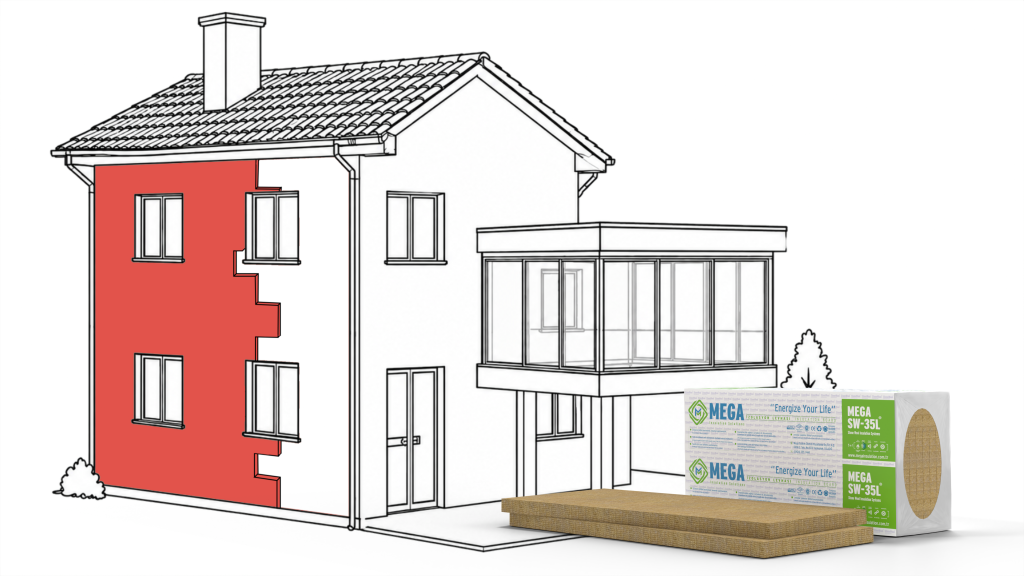
Mega Yalıtım applies this principle with different materials. The stone wool ETICS board is an uncoated board that holds air between stone fibres and is used in rendered external wall insulation systems. The grey EPS ETICS board is made of carbon (graphite) enhanced expanded polystyrene; according to Mega’s technical data sheets, its λD ranges from 0.031 to 0.036 W/mK depending on the type. The flat XPS board, with its closed-cell structure, absorbs very little water; according to its data sheet, its long-term water absorption by total immersion is at most 0.7 per cent. That is why it stands out on flat roofs, below-grade basement walls and foundations in contact with soil. You can find the full stone wool range on the stone wool boards page.
Convection: airtightness
In a thermos, the vacuum stops air movement; in a building, two measures do this job together. The first is the insulation material keeping air still in small cells or between fibres. The second is sealing the openings in the envelope: board joints, the surrounds of windows and doors, and service penetrations. A gap left between boards or a leak at a window edge is like leaving the lid of a thermos ajar. Warm air finds the easiest way and escapes.
Radiation: heat that comes with the sun
The largest source of heat reaching a building by radiation is the sun. In summer, the heat passing indoors from sun-heated roof and façade surfaces is slowed down in the insulation layer. In this way a well-insulated home keeps its interior cool for longer, just as a thermos protects a cold drink. We have brought together the basic concepts of thermal insulation and material selection in our guide what is thermal insulation.
Application note from MegaUsta: Lay insulation boards tightly against each other with staggered joints, and keep the insulation continuous around windows and doors. Air circulates through an open joint, and heat escapes at that point however low the board’s λ value is.
Mega Insulation Solutions (Mega Yalıtım; trade name Mega Yalıtım Üretim Pazarlama Dış Ticaret A.Ş.) is a Turkish manufacturer of insulation materials with its head office in Kavacık, Istanbul, and its factory in Elazığ. In addition to stone wool, XPS and EPS thermal insulation boards, it offers MegaBlock, MegaLento, DesiWool, MegaTech construction chemicals and Fullback waterproofing products under the Mega brand.
If you are curious about examples of insulation in nature, in space and in history, take a look at our articles what is an igloo, NASA heat shield and the history of insulation.
Frequently Asked Questions
Why does a thermos keep drinks hot?
A thermos keeps drinks hot because the vacuum between its two walls prevents heat from escaping by conduction and convection. The silvery, reflective coating on the walls also turns back the heat that would be lost by radiation. Heat still escapes slowly, mainly through the neck where the two walls meet and through the lid. That is why a tight lid and an intact seal are decisive in keeping a drink hot.
How is heat transferred?
Heat is transferred in three ways: conduction, convection and radiation. In conduction, heat passes from hot to cold between surfaces in contact with each other. In convection, heat is carried by moving air or liquid; warm air rises and cooler air sinks. In radiation, heat travels as waves through space, and its largest source is the sun. Good building insulation takes all three paths into account.
Is vacuum insulation used in buildings?
Yes, vacuum insulation panels (VIPs) are used in buildings, especially where space is tight: flat roofs, doors, interior wall insulation and the renovation of floors with underfloor heating. According to the IEA’s Annex 39 report, they insulate five to ten times better than conventional insulation of the same thickness. Because they cannot be cut on site and must be protected from screws, nails and similar penetrations, they are installed to a laying plan prepared in advance.
Sources
- Royal Institution: Dewar flask (1892), collection record
- Royal Institution: James Dewar (1842-1923)
- U.S. Department of Energy, Building Science Education: Heat Flow
- IEA EBC Annex 39 (2007): Vacuum Insulation Panel Properties and Building Applications, project summary report (PDF)
- IEA EBC Annex 39: High Performance Thermal Insulation (HiPTI), project page
- Mega Yalıtım: MEGA SW-35L stone wool board technical data sheet (PDF)
- Mega Yalıtım: MEGA SW F150 stone wool ETICS board technical data sheet (PDF)
- Mega Yalıtım: EPS 50 / 60 / 70 (G) grey ETICS board technical data sheet (PDF)
- Mega Yalıtım: MEGA XPS T3000 technical data sheet (PDF)
- Mega Yalıtım: Product documents
Choosing the right board to build your building’s envelope like a thermos depends on where it is used and on the thermal insulation design. You can review suitable products for façades, roofs or foundations in our stone wool, XPS and EPS product ranges, and contact our technical team for an assessment of your project.