

In short: Condensation is water vapour in the air turning into liquid when it meets a surface colder than its dew point. At home it appears most often in winter, on the inner face of external walls, in corners and around windows; in Turkey this is commonly called wall sweating. The lasting fix is to lower indoor humidity and keep the inner wall surface warm with thermal insulation.
The droplets on the inside of a window on a cold morning and the damp patch behind a wardrobe are the result of the same physics. Mist on glass usually dries during the day, whereas the wall behind furniture gets wet again before it has a chance to dry. Below we explain the dew point, the causes of condensation, how it differs from leaks and the effect of insulation.
What is condensation?
Condensation is the process in which water vapour cools down and turns into liquid water. Warm air can hold more water vapour; when this air touches a cold surface and cools, the amount of vapour it can hold drops and the excess collects on the surface as droplets.
Buildings experience two forms of condensation. Surface condensation forms on the room side of a wall, window or ceiling and is visible. Interstitial condensation forms when vapour moving into the wall turns into water within one of its layers, and it cannot be seen from outside. Simplified calculation methods for both risks are given in EN ISO 13788.
What is the dew point and how does it form on a wall surface?
The dew point is the temperature at which air, cooled with constant moisture content and pressure, reaches saturation. When the inner surface temperature of a wall falls to or below the dew point of the room air, condensation starts on that surface.
Two values determine the dew point: room temperature and relative humidity. The values below were calculated with the vapour pressure and relative humidity formulas published by the U.S. National Weather Service (NWS).
| Relative humidity of room air | Dew point in a 20 °C room | Dew point in a 22 °C room |
|---|---|---|
| 40% | approx. 6 °C | approx. 8 °C |
| 50% | approx. 9 °C | approx. 11 °C |
| 60% | approx. 12 °C | approx. 14 °C |
| 70% | approx. 14 °C | approx. 16 °C |
Source: values calculated with the NOAA NWS vapour pressure formulas, rounded to the nearest whole degree.
Take an example: in a bedroom at 20 °C with 60% relative humidity, a wall corner whose inner surface cools to about 12 °C starts to sweat. If humidity in the same room drops to 40%, the surface has to cool to about 6 °C before condensation forms. That is why tackling condensation works on two fronts: reducing moisture in the air and keeping the surface warm.
5 common causes of condensation on walls
Condensation on walls can appear wherever the inner surface stays cold and the indoor air is humid. The five most common causes are:
- Thermal bridges: Columns, beams, slab edges and window surrounds lose heat faster than the rest of the wall. The inner surface stays colder at these points, and stains often appear here first; our article on the thermal bridge covers the topic in detail.
- Insufficient or no thermal insulation: The inner face of an uninsulated external wall gets colder as the outdoor air cools. According to UK Government guidance, condensation on the inside of external walls and windows is more likely in homes that are insufficiently insulated and heated.
- Moisture generated at home: Cooking, showering, washing and drying laundry add water vapour to the air. Vapour that is not removed collects on the coldest surface in the home.
- Insufficient ventilation: In rooms with airtight windows that are not aired regularly, humid air cannot escape on its own and moisture builds up throughout the day.
- Furniture against external walls: Wardrobes, cupboards and sofas placed against external walls stop the wall behind them from warming up and being ventilated. The same guidance lists low wall areas behind sofas and wardrobes among the places where condensation commonly forms.
These causes often occur together. If the stains have turned into mould, our guide why mould grows on walls explains the next steps.
The difference between condensation, rising damp and water leaks
Not every wet patch on a wall is condensation. Rising damp from the ground and water leaking in from outside or from plumbing leave similar stains, but the fixes are different. The simple checks below help you make a first distinction.
| Check | Condensation | Capillary (rising) damp | Water leak |
|---|---|---|---|
| Source of moisture | Water vapour in indoor air | Water absorbed into the wall from the ground | Water entering through a defect in the roof, facade, window or plumbing |
| Where does it appear? | Inner face of external walls, corners, around windows, behind furniture | Lower part of walls in contact with the ground | Around and below the defective spot |
| When does it get worse? | In cold weather, after cooking and showering | Continues as long as the ground stays wet | After rain or when plumbing is in use |
| Simple check | Is there also mist on the windows, and does it ease with ventilation? | Is the stain spreading upwards from the base? | Is the stain at a specific spot, and does it grow with rain? |
| Direction of the fix | Reduce humidity, ventilate, warm the inner surface with insulation | Ground and foundation waterproofing, drainage | Repair the defect, then dry the wall |
UK Government guidance notes that rising damp is usually found in older properties and is often misdiagnosed; although it can be spotted by visual inspection, chemical testing is recommended to confirm it. If you are unsure, have a specialist identify the source of moisture before deciding on insulation. In older buildings this step is also part of the pre-checks before insulating an old building externally.
How does insulation prevent condensation?
Thermal insulation brings the inner surface temperature of the wall closer to room temperature and keeps the surface from falling below the dew point. As long as the surface stays above the dew point, water vapour does not turn into liquid there.
In external insulation, that is, an ETICS application, the boards sit on the cold side of the wall; the wall mass stays on the warm side, and columns, beams and slab edges are covered by the same layer. You can find the basics of heat loss in our article what is thermal insulation and pre-winter checks in our guide on heat loss at home.
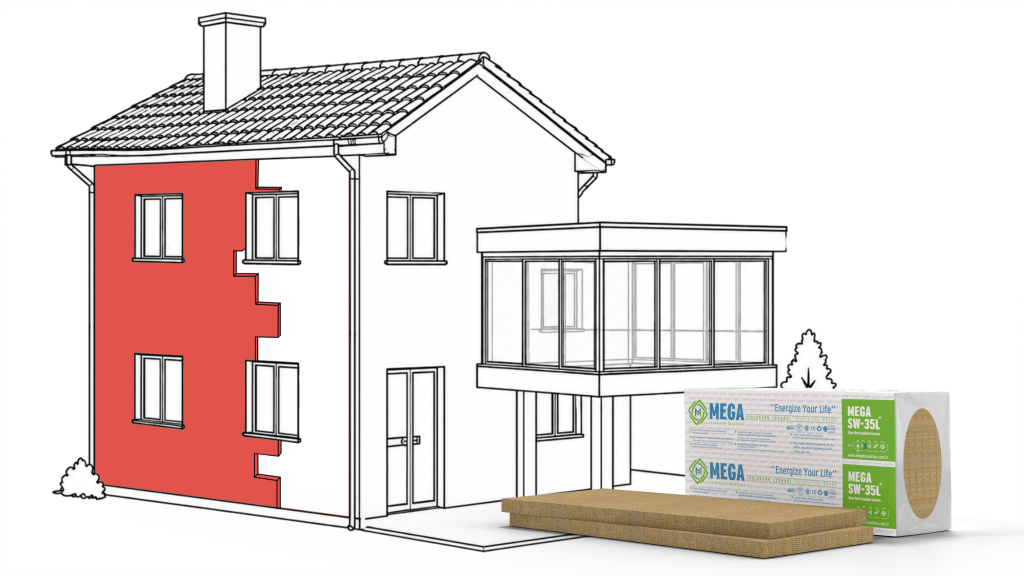
The second point is that water vapour entering the wall must be able to escape. Data sheets express this property as the water vapour diffusion resistance factor (μ): the lower the value, the more easily the material lets vapour through. The values in Mega data sheets are:
| Product | Role in the system | Water vapour diffusion resistance (μ) | Source |
|---|---|---|---|
| Stone wool ETICS board (MEGA SW F150, F120, PLUS, ULTRA, SW-35L) | External thermal insulation layer | 1 | Mega stone wool data sheets (TS EN 13162+A1) |
| MTP-3344 insulation board render | Mesh-reinforced base coat | max. 15 (EN 1015-19) | MTP-3344 data sheet |
When the stone wool ETICS board and insulation board render are used together, these two layers do not hinder moisture in the wall from drying outwards; vapour permeability should also be considered when choosing the finishing render and paint. EPS and XPS boards are not listed in the table because Mega data sheets give no μ value for them; external insulation with these boards also reduces surface condensation by warming the inner surface.
Columns and beams need separate attention. According to its product page, MegaBlock BC is offered as a stone wool element faced with acrylic render for columns, beams and other areas where thermal bridges may form. Mega Insulation is a Turkish manufacturer of insulation materials with its head office in Kavacık, Istanbul, and its factory in Elazığ; alongside stone wool, XPS and EPS boards, it offers MegaBlock, DesiWool and MegaTech construction chemicals under the Mega brand.
Application note from MegaUsta: The wall must be dry before insulation; boards bonded before the source of moisture is removed trap the wetness inside the wall. Window reveals and the areas under sills should also be included in the insulation layer. If these narrow strips are skipped, the window surround stays cold and sweating continues there.
Ventilation and everyday habits
Keeping indoor humidity under control is the first step in preventing condensation, even in an insulated home. The U.S. Environmental Protection Agency (EPA) recommends keeping indoor relative humidity below 60 percent if possible, ideally between 30 and 50 percent.
- Run the bathroom fan or open the window when showering; use an extractor fan when cooking (EPA).
- Keep lids on pans and close internal doors while cooking or showering (UK Government guidance).
- Vent moisture-producing appliances such as clothes dryers to the outside where possible (EPA).
- Air rooms by opening windows at regular intervals.
- Leave a gap between furniture and external walls.
- When you see condensation on windows, walls or pipes, dry the wet surface promptly (EPA).
- Heat the home adequately; the EPA also recommends increasing air temperature to reduce condensation.
Monitoring the room’s relative humidity with a hygrometer for a few days makes it easier to see whether the problem comes mainly from indoor moisture or from a cold surface.
The condensation risk of internal insulation
Internal insulation can reduce surface condensation, but if detailed incorrectly it moves the risk inside the wall. Because the insulation is placed on the room side, the existing wall ends up on the cold side; humid air reaching the back of the board can condense on this cold wall.
The UK Government’s guide to internal wall insulation states that external insulation is preferable for protecting the building fabric and reducing moisture risk, and that if recommendations are not followed with internal insulation, the risk of interstitial condensation and mould can be high. According to the guide, indoor air leaking behind the insulation significantly increases this risk.
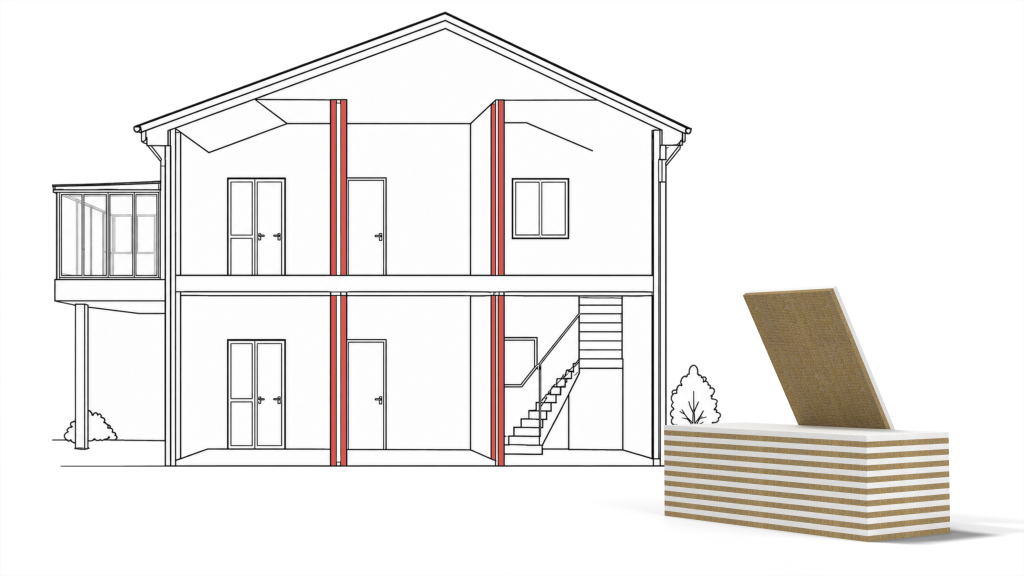
If the facade cannot be changed, or only one flat is being insulated, internal wall insulation is an option. DesiWool, made of stone wool and gypsum board, has a λD of ≤0.035 W/mK according to the Mega data sheet. The key conditions for this application are leaving no air gap between the panel and the wall, not covering a damp wall, and deciding whether a vapour control layer is needed through a condensation calculation based on the wall section. If renovation of the whole building is planned, our building renovation guide covers insulation together with the other works.
Frequently Asked Questions
Why do walls sweat?
A wall sweats when water vapour in the room air turns into liquid on a wall whose inner surface temperature has dropped below the dew point. It is most common on uninsulated external walls, in front of columns and beams, in corners and behind furniture placed against external walls. Sweating becomes more visible when cooking, showering and drying laundry raise indoor humidity and ventilation is poor.
Does condensation cause mould?
Yes, recurring condensation creates favourable conditions for mould. Mould can grow on a wall surface that gets wet often and never dries out fully; patches usually start in corners, around windows and behind furniture. According to UK Government guidance, damp and mould primarily affect the airways and lungs. Cleaning the mould is not enough on its own; if the source of condensation is not dealt with, mould can return.
Does external wall insulation prevent condensation?
Correctly installed external wall insulation (ETICS) reduces surface condensation by warming the inner surface of the wall. For this, the boards must cover columns, beams and slab edges without gaps, and window reveals must not be skipped. External insulation does not reduce the moisture in indoor air; if the home is very humid, ventilation habits must also change. Rising damp or water leaks must be fixed first.
What should the ideal humidity level at home be?
The U.S. Environmental Protection Agency (EPA) recommends keeping indoor relative humidity below 60 percent if possible, ideally between 30 and 50 percent. As relative humidity rises, the dew point rises too and cold surfaces sweat more easily. Monitoring room humidity with a hygrometer, using fans in the bathroom and kitchen and airing rooms regularly make it easier to stay within this range.
What is the difference between condensation and damp?
Condensation is water vapour in indoor air turning into liquid on a cold surface; in everyday Turkish, “rutubet” (damp) is a general term for any persistent moisture in a wall. The source of damp may be condensation, but it may also be rising damp from the ground or water leaking in from the roof, facade or plumbing. The right fix starts with identifying where the moisture comes from.
Sources
- NOAA National Weather Service: Vapor Pressure, formulas for saturation vapour pressure and relative humidity
- NOAA NWS glossary: definition of dew point
- U.S. Environmental Protection Agency (EPA): A Brief Guide to Mold, Moisture and Your Home
- UK Government: Understanding and addressing the health risks of damp and mould in the home
- UK Government: Retrofit Internal Wall Insulation, Guide to Best Practice (September 2021)
- EN ISO 13788:2012 Hygrothermal performance of building components: internal surface temperature and interstitial condensation, calculation methods (standard record)
- Mega data sheet: MEGA SW F150 ETICS Board
- Mega data sheet: MEGATECH MTP-3344 Insulation Board Render
- Mega data sheet: DesiWool
- Mega Insulation technical documents and certificates
Once you have identified the source of moisture, you can review the data sheets on the stone wool boards and DesiWool pages to choose the right solution for your wall, or contact Mega about your project.