

Interior wall insulation is done by adding a thermal and acoustic insulation layer to the room-side face of an external wall. First any damp problem in the wall is solved and the surface is levelled; then the insulation panel is fixed to the wall, the joints are closed and the surface is prepared for paint. DesiWool, with gypsum board on one face and stone wool on the other, combines insulation and wall lining in a single application.
In buildings where external insulation cannot be applied to the facade, moving the insulation to the room side of the wall is the most direct way to reduce heat loss and the sound coming through the wall. In a building renovation plan, interior wall insulation is one of the practical ways to improve comfort without touching the facade. In this guide we cover DesiWool’s applications, installation steps, sound test results and the condensation risk of internal insulation.
When is interior wall insulation the right choice?
Interior wall insulation is chosen when insulating from outside is not possible or when a single flat is to be insulated on its own. The internal wall insulation guide published by the UK Government also states that internal insulation may be the preferable or even the only option in buildings where the facade must be preserved, or where neighbouring buildings or complex facade geometry prevent external insulation.
- If the facade cannot be changed: In historic or listed buildings, the inner surfaces can be insulated while the external appearance is preserved.
- If the apartment block cannot reach a joint decision: You can insulate the external walls of your flat from inside without waiting for the whole building.
- If the problem is in one room: A bedroom that stays cold in winter or a wall that lets in noise from the neighbours can be treated on its own.
- If noise is a problem as well as heat: The stone wool layer also helps reduce the sound passing through the wall.
Where a decision can be taken for the whole building, external insulation should always be considered as well; the differences between the two methods are set out in the comparison table at the end of this article.
What is DesiWool and what layers does it consist of?
DesiWool is a composite sound and thermal insulation panel with gypsum board on one face and stone wool on the other. Mega’s technical data sheet states that the product consists of stone wool and gypsum board; no foil or separate vapour barrier layer is specified. The stone wool face provides the insulation, while the gypsum board face forms the new wall surface of the room.
According to Mega’s product page, this composite structure allows stone wool and gypsum board to be installed in a single application; since insulation and lining do not need separate labour, installation time is shortened. If you would like to know more about the stone wool layer, see our guide what is stone wool.
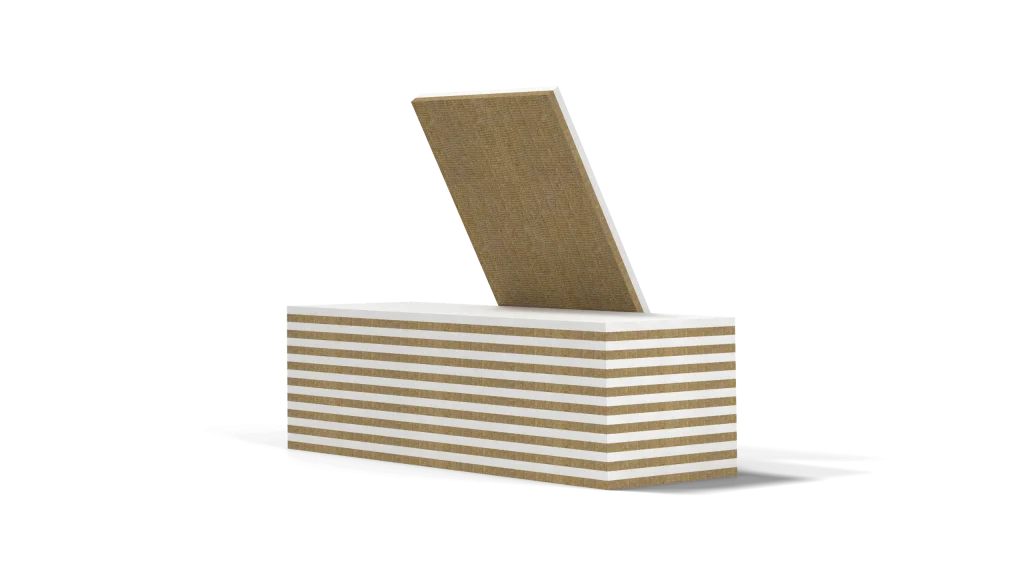
According to Mega’s DesiWool technical data sheet, the panel’s key values are as follows:
| Property | Value (Mega DesiWool TDS) |
|---|---|
| Material | Stone wool (MW, TS EN 13162) and gypsum board |
| Dimensions | 2700 x 1200 mm |
| Thickness | 15, 20, 30, 40, 50 and 80 mm |
| Declared thermal conductivity, λD (10 °C) | Max. 0.035 W/mK |
| Declared thermal resistance, RD | 0.40 / 0.55 / 0.85 / 1.10 / 1.40 / 2.25 m²K/W, in order of thickness |
| Reaction to fire class (TS EN 13501) | A1-s1-d0 |
| Thickness class and dimensional stability | T4; DS(70,-) max. 1% |
Under the Turkish Regulation on Fire Protection of Buildings, class A1 materials do not contribute to fire at any stage of combustion; s1 denotes the strictest smoke class and d0 means that no flaming droplets are produced.
DesiWool is one of the products that Mega Insulation Solutions (Mega Yalıtım), a Turkish manufacturer of insulation materials headquartered in Kavacık, Istanbul, offers under the Mega brand together with its stone wool, XPS and EPS boards. According to the note in the technical data sheet, the product is manufactured in accordance with TS EN 13162+A1 at the facilities of the group company Megataş A.Ş.
DesiWool applications: which walls is it used on?
According to Mega’s product page, DesiWool is used on four types of walls in buildings that need sound and thermal insulation: the inner faces of external walls, interior partition walls, party walls between adjoining flats, and walls adjacent to stairwells or lift shafts.
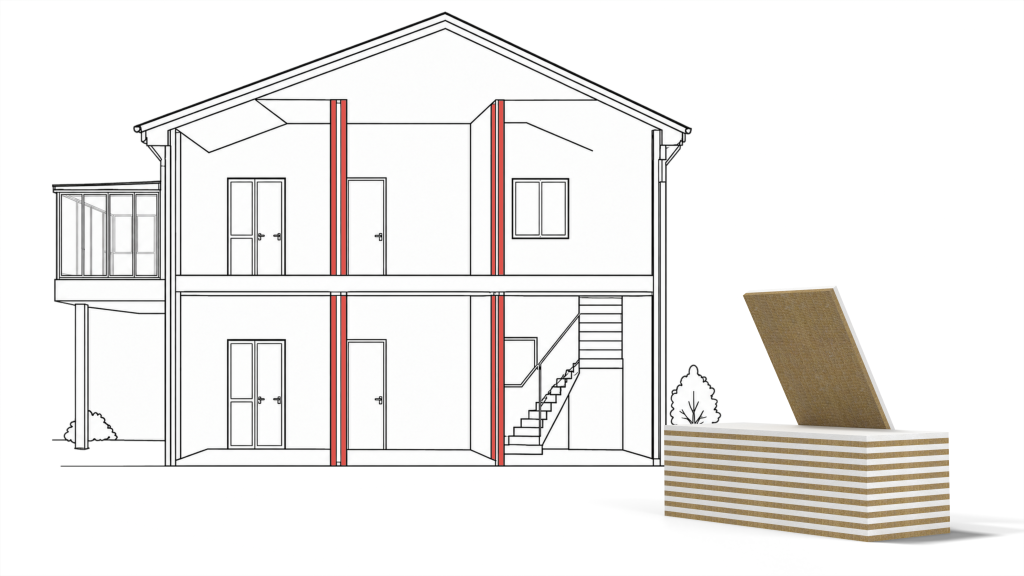
Inner face of external walls
External walls are among the largest surfaces of a building in contact with outdoor air. In flats where the facade cannot be touched, DesiWool is applied to the room side of the external wall: the stone wool layer provides thermal insulation and the gypsum board forms the new wall surface. How the panel will be finished at window and door edges should be planned before installation.
Party walls between adjoining flats
Speech, television and music from the neighbours are airborne sounds and can pass through the shared wall. DesiWool can be applied to one or both faces of this wall; applying it to both faces is only possible if work can be done in both flats. In laboratory tests carried out with DesiWool W15, R’w 42 dB was measured for two-sided application and R’w 29 dB for one-sided application. We cover the causes of neighbour noise and ways to solve it separately in our guide on wall sound insulation.
Interior partition walls
On partition walls between a bedroom and a living room, or between a meeting room and a work area in an office, DesiWool is used to improve sound insulation without demolishing the existing wall. Mega’s product page also lists the panel’s light weight among its advantages.
Walls adjacent to stairwells and lift shafts
Conversation, door noise and lift noise in common areas can reach a flat through the walls facing the stairwell and lift shaft. DesiWool applied to the flat side of these walls is intended to reduce airborne sound passing through the wall; additional measures may be needed for vibrations transmitted through the structure.
If a new wall is to be built, sound insulation can also be achieved within the wall itself: a sound insulation block can be used for masonry walls, and a stone wool partition wall board placed between the studs for plasterboard partitions. DesiWool comes to the fore mainly in improving existing walls. Mega’s product page defines DesiWool for wall applications; ceilings and lofts fall outside that definition.
How is internal thermal insulation done? Installation steps
Internal thermal insulation is done by checking the wall for moisture, preparing the surface, fixing the panel without leaving an air gap, closing the joints and preparing the surface for paint. The steps below are general installation principles for internal insulation; the type of adhesive and the fixing detail are chosen according to the condition of the wall; the DesiWool data sheet gives no separate value for them.
- Check the wall: If there is damp, blistering plaster, mould or a water leak, first remove its source and let the wall dry. A damp wall must not be covered.
- Prepare the surface: Remove loose plaster, old wallpaper, dust and dirt; repair cracks and hollows to make the wall flat and sound.
- Plan the services: Mark sockets, switches, radiators and pipe penetrations, and decide in advance how they will be reinstated after the panels are fitted.
- Cut the panels to size: Cut the 2700 x 1200 mm panels to suit the storey height and the window and door openings; transfer socket positions onto the panel.
- Fix the panel: Place it with the stone wool face against the wall and the gypsum board face towards the room. No air pockets should remain between panel and wall; the UK Government’s internal insulation guide identifies dot-and-dab bonding, which leaves gaps behind the board, as the method with the highest risk of interstitial condensation and recommends a continuous layer of adhesive where possible.
- Seal the junctions: Leave no gaps between panels or at ceiling, floor and side wall junctions; fill around socket and pipe holes.
- Finish the surface: Close the panel joints with joint tape and filler, sand them once dry, then finish with primer and paint.
Application note from MegaUsta: Keep the hole you cut in the panel for a socket box tight to the size of the box and fill the remaining gap. Both sound and heat find the weakest point of the insulation; a single open socket gap can reduce the performance of the whole wall.
How much sound insulation does DesiWool provide?
According to Mega’s product page, in tests carried out with DesiWool W15 the sound insulation is at least 29 dB for one-sided application and at least 42 dB for two-sided application. The tests were performed to EN ISO 10140-2 and rated to EN ISO 717-1 at Ticem İleri Yapı Teknolojileri, a laboratory accredited under ISO/IEC 17025.
| Application | R’w (C;Ctr) | Dn,w | DnT,w |
|---|---|---|---|
| One-sided (DesiWool W15) | 29 (-1;3) dB | 29 dB | 32 dB |
| Two-sided (DesiWool W15) | 42 (-3;-9) dB | 42 dB | 45 dB |
The Turkish Regulation on the Protection of Buildings against Noise defines Rw and R’w as weighted sound reduction indices that express the sound insulation performance of building elements as a single number; the higher the value, the less sound passes through the wall. DnT,w is the sound level difference between two adjacent rooms, standardised to the reverberation time of the receiving room.
These results apply to the laboratory test set-up; they should not be read as a dB gain added on top of an existing wall. The sound insulation achieved after installation results from the construction of the existing wall together with the junction details and the gaps around sockets and services. The regulation also distinguishes types of sound: sounds that travel through the air, such as speech and music, are airborne sound, while sounds produced by impacts, such as footsteps and door slams, are impact sound. DesiWool is a sound insulation panel that works against airborne sound; it is not a sound-absorbing panel that reduces echo. Footstep noise from the floor above is dealt with in the floor, with solutions such as a floating floor board.
You can read about the effects of long-term noise exposure in our article on the health effects of noise, and about how the stone wool layer reduces sound in our guide on stone wool sound insulation.
How is condensation risk managed in internal insulation?
With internal insulation, the existing wall stays on the cold side of the insulation; for this reason a damp wall should not be covered, no air gap should be left between panel and wall, and thermal bridges at junctions should be dealt with separately. If these rules are not followed, condensation and mould may appear on surfaces that stay cold.
The internal wall insulation guide published by the UK Government states that if its recommendations are not followed, the risk of interstitial condensation and mould growth rises, and that external insulation is preferable for protecting the building fabric and reducing moisture risk. According to the same guide, thermal bridges form with internal insulation where internal walls, intermediate floors and party walls meet the external wall; these bridges are reduced by details such as returning the insulation a short distance along the adjoining surface. The guide also warns that returning insulation along a party wall can make that wall colder and increase the risk of condensation in the neighbouring flat if it is not adequately heated or ventilated.
- Solve the moisture source first: Distinguishing condensation from rising damp and water leaks is the first step towards the right solution; for details, see our guide what is condensation.
- Define the vapour balance in the design: No separate vapour barrier layer is specified in DesiWool’s technical data sheet. Whether an additional vapour control layer is needed depends on the wall construction; if one is used, it goes on the room side, that is, the warm side of the insulation.
- Ventilate the room: Regular ventilation in bathrooms, kitchens and bedrooms lowers indoor humidity and reduces the risk of condensation.
If you see stains or mould on a wall, we explain the source of the problem in our article what causes mould on walls.
External insulation or internal insulation?
Where a decision can be taken for the whole building, external insulation generally gives the more comprehensive result, because it keeps the wall on the warm side of the insulation and also covers the slab edges. If the facade cannot be changed or only one flat is to be insulated, internal insulation is a workable option. The main differences between the two methods are as follows:
| Criterion | External insulation (ETICS) | Internal insulation (with DesiWool) |
|---|---|---|
| Where it is applied | Outer face of the facade | Room-side face of the external wall |
| Scale of work | Usually the whole building; scaffolding needed | A single room or flat; no scaffolding needed |
| Position of the existing wall | Stays on the warm side of the insulation | Stays on the cold side of the insulation; moisture control becomes important |
| Thermal bridges | Slab edges and column-beam faces are also insulated | Thermal bridges remain at internal wall, floor and ceiling junctions; detailing is needed |
| Facade appearance | Changes | Preserved |
| Room area | Unchanged | Reduced by the panel thickness |
| Weather conditions | Installation depends on season and weather | Can be installed all year round as the work is indoors |
| Mega products | Stone wool ETICS board, thermal insulation board adhesive | DesiWool |
You can find facade options in our article on types of external wall insulation, suitable seasons and weather conditions in our guide when to apply external insulation, and the basic logic of the system in our article what is ETICS.
Frequently Asked Questions
Can internal insulation be applied, and what are its drawbacks?
Yes, internal insulation can be applied where the facade cannot be touched. Its drawbacks are the loss of room area equal to the panel thickness, thermal bridges remaining at floor and internal wall junctions, and the greater importance of moisture control because the existing wall stays on the cold side. These risks can be managed if damp walls are not covered, no air gap is left behind the panel, and sockets and pipe penetrations are carefully sealed.
Which walls is DesiWool used on?
DesiWool is used for sound and thermal insulation on the inner faces of external walls, on interior partition walls, on party walls between adjoining flats and on walls adjacent to stairwells or lift shafts. This list reflects the applications given on Mega’s product page. Ceilings and lofts are not on this list.
How much sound insulation does DesiWool provide?
In tests carried out on DesiWool W15 at an accredited laboratory, R’w 29 dB was measured for one-sided application and R’w 42 dB for two-sided application; the product page states these as at least 29 dB and at least 42 dB. Measurements were made to EN ISO 10140-2 and rated to EN ISO 717-1. The result on your own wall may differ depending on the wall build-up and junction details.
Does interior wall insulation cause mould?
Mould is not expected with correctly designed and installed interior wall insulation; poor installation is what raises the risk. A wall covered before its damp is treated, air gaps behind the panels, unresolved thermal bridges and insufficient ventilation can lead to condensation and therefore mould. Finding and removing the moisture source before installation and ventilating the room regularly reduce this risk.
How is DesiWool installed?
DesiWool is installed with the stone wool face against the wall and the gypsum board face towards the room. Any damp in the wall is solved first, and loose plaster and old coverings are removed. The panel is cut to size, sockets and pipe penetrations are marked, and it is fixed to the wall without air pockets. Joints are taped, filled and sanded, and the surface is painted. Adhesive and fixing details are chosen according to the condition of the wall; the data sheet gives no separate value for them.
Sources
- Regulation on the Protection of Buildings against Noise (Turkish Official Gazette, 31.05.2017, No. 30082)
- Regulation on Fire Protection of Buildings, Annex 2: Combustibility classes of materials (mevzuat.gov.tr)
- GOV.UK: Retrofit Internal Wall Insulation, Guide to Best Practice (2021)
- Mega DesiWool Technical Data Sheet (TDS)
- Mega DesiWool product page: applications and DesiWool W15 one-sided and two-sided sound test reports
For other partition, external insulation and floor applications, see our stone wool boards page. To confirm the right thickness and installation detail for your wall, you can get in touch with the Mega Yalıtım technical team.