
In short: Mantolama, the Turkish term for ETICS, is the cladding of a building’s external walls from the outside with a system made up of thermal insulation boards, adhesive, anchors, reinforcing mesh and render. In Turkish it is also called “dış cephe mantolama” (external wall mantolama) or “bina mantolama” (building mantolama). Its purpose is to cut the heat lost through the walls in winter and gained in summer, and to cover reinforced concrete elements such as columns and beams with a continuous insulation layer.
In new buildings, external wall insulation is defined in the thermal insulation design, while in existing buildings mantolama usually comes up with a facade renovation. Three things determine the result: the right board type for the building, a thickness found by calculation, and installation in line with the technical data sheets.
What is ETICS (mantolama)?
Mantolama is a facade system built up layer by layer that moves the thermal insulation to the outer face of the load-bearing wall. The system wraps the building from the outside like a coat (“manto” in Turkish). The boards are bonded to the wall and anchored, covered with a mesh-reinforced base coat and finished with a top coat.
In European standards this system is called ETICS (External Thermal Insulation Composite System). EPS-based systems fall under TS EN 13499, and systems based on mineral wool such as stone wool fall under TS EN 13500. Both standards treat the system as a kit whose components, including base and corner profiles, are supplied together. According to the standard definition, ETICS protects the wall against weathering and improves its appearance, but does not contribute to load-bearing capacity.
Is mantolama the same as thermal insulation?
No; mantolama is the form of thermal insulation applied to external walls with a rendered system. Thermal insulation is the general term for all measures that reduce heat transfer through the roof, floors, foundations, walls and building services. A building with mantolama does not necessarily have an insulated roof or ground floor as well.
Which buildings can have mantolama?
Mantolama can be applied to both new and existing buildings; both standards cover the external walls of new and existing buildings. What matters is the condition of the substrate: the Mega adhesive data sheet requires the surface to be clean, fully cured and sound, with defects repaired using a repair mortar. What to watch for on older facades with blistered render or damp problems is explained in the ETICS on old buildings guide.
What layers make up an ETICS system?
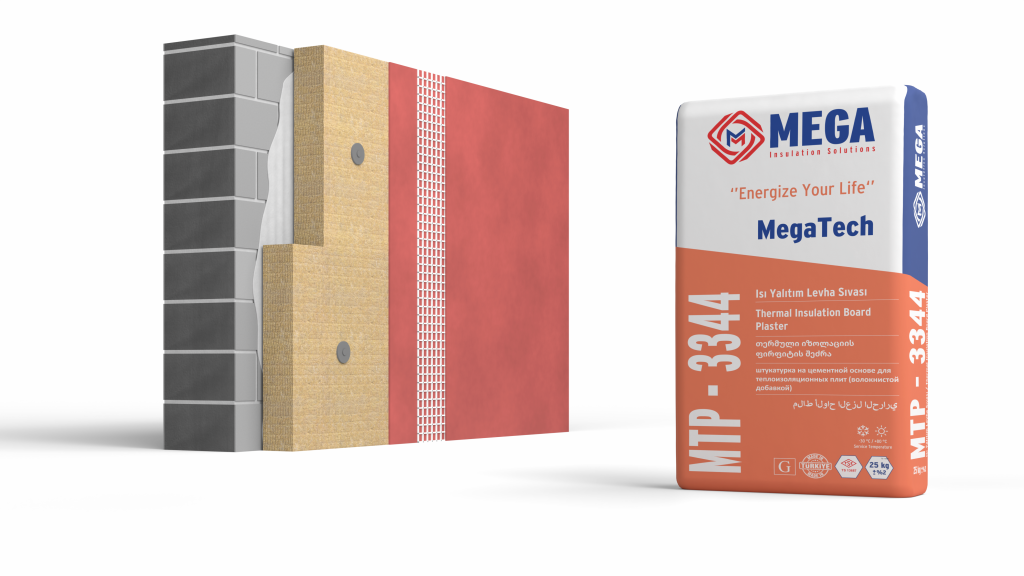
From the wall outwards, an ETICS system consists of adhesive, a thermal insulation board, anchors, a base coat reinforced with mesh and a finishing top coat. The layers are assessed as a system: Article 27 of the Turkish Regulation on the Fire Protection of Buildings requires a thermal insulation system made of these components to be certified by an accredited laboratory.
| Layer | Function | Mega product |
|---|---|---|
| Adhesive | Bonds the board to the wall | Thermal Insulation Board Adhesive MTA-3333; 3–5 kg per m² |
| Thermal insulation board | Reduces heat transfer through the wall | Stone Wool ETICS Board, EPSW white and EPSG grey ETICS boards, rough grooved XPS |
| Anchor | Fixes the board mechanically | Anchor suited to the system data sheet; installed at least 24 hours after bonding (MTA-3333 data sheet) |
| Base coat and reinforcing mesh | Strengthens the board surface and limits cracking | Thermal Insulation Board Plaster MTP-3344; 160 g/m² alkali-resistant mesh, 10 cm overlap |
| Top coat | Forms a water-repellent surface and defines the look of the facade | Decorative Mineral Plaster MTD-3355; 2 mm, painted once dry |
Values are from Mega technical data sheets. Mega Insulation Solutions (Mega Yalıtım) is a Turkish insulation materials manufacturer headquartered in Kavacık, Istanbul, with its factory in Elazığ; it offers products for the board, adhesive, base coat and top coat layers of ETICS under the Mega brand.
Thermal insulation board
This is the layer that determines the thermal performance of the system. Stone wool, EPS (expanded polystyrene, often called “strafor” in Turkey) and XPS (extruded polystyrene) boards are used in ETICS. A board’s insulating performance is determined by its thermal conductivity (λD, W/mK) and its thickness together.
Adhesive and anchors
The boards are bonded to the wall with a powder adhesive mixed with water and then fixed mechanically with anchors. Mega’s thermal insulation board adhesive MTA-3333 is used with stone wool, EPS and XPS boards; according to its data sheet, anchoring is done at least 24 hours after bonding.
Reinforcing mesh and base coat
An alkali-resistant mesh is embedded in the render applied over the boards. Mega’s thermal insulation board plaster MTP-3344 is cement-based and fibre-reinforced; its data sheet describes applying 160 g/m² alkali-resistant mesh with a 10 cm overlap at a total thickness of about 4 mm. The fibres in the render and the mesh help limit cracks that stresses from temperature differences can cause.
Top coat
The top coat defines the texture and colour of the facade. Mega’s decorative mineral plaster MTD-3355 is cement-based, polymer-modified and water-repellent; it is applied 2 mm thick, must not be left unpainted as the final finish and is painted once dry. You can find how each component is selected and the complete list in the ETICS materials guide.
In what order are the layers applied to the wall?
Once the surface is prepared, the boards are bonded, anchored when the adhesive has hardened, then the mesh-reinforced base coat and finally the decorative top coat are applied. According to the Mega adhesive data sheet, the wait is at least 24 hours before anchoring and 2 days before rendering over the boards. A step-by-step description, from surface preparation to corner details, is given in the how to install ETICS guide.
Application note from MegaUsta: If the wall is even, spread the adhesive over the entire back of the board with a notched steel trowel; if it is uneven, apply it in dabs. Use up the mix you have prepared within 2 hours at most; do not remix and reuse mortar that has crusted in the bucket or passed its pot life. We have collected the problems most often seen on site in the ETICS installation mistakes article.
Which insulation boards are used in ETICS?
Stone wool, white or grey EPS and XPS boards are used in ETICS; the choice depends on the building height, fire and acoustic requirements, and the zone where the board will be applied. The table below compares the three materials using one type of each from the Mega technical data sheets.
| Property | Stone wool (MEGA SW F150) | Grey EPS (EPS 30P-G) | XPS (MEGA XPS T1500) |
|---|---|---|---|
| Material | Mineral wool (MW) | Carbon (graphite) enhanced expanded polystyrene | Extruded polystyrene |
| Thermal conductivity λD (W/mK) | ≤0.037 | 0.035 | 0.035 |
| Reaction to fire class (TS EN 13501-1) | A1 | E | E |
| Board size (mm) | 1200 x 600 | 500 x 1000 | 600 x 1200 |
| Thickness range (mm) | 40–120 | 10–100 | 20–80 |
| Product standard | TS EN 13162 | TS EN 13163 | TS EN 13164 |
| Mega product | Stone Wool ETICS Board | EPSG Grey ETICS Board | XPS Rough Grooved |
Values are taken from Mega technical data sheets; the lower the λD, the greater the insulating power of a board of the same thickness. EPS and XPS are class E combustible materials under TS EN 13501-1, while stone wool boards are class A1 according to the data sheet. For a detailed comparison of the materials, see the stone wool vs EPS guide.
Building height has a direct effect on material choice. Under Article 27 of the Turkish Regulation on the Fire Protection of Buildings, external facades must be made of materials classed as “zor yanıcı” (low combustibility) in buildings taller than 28.50 m, and of at least “zor alevlenici” (flame-retardant) materials in other buildings. In buildings lower than 28.50 m whose facade consists of flame-retardant materials or systems, the first 1.5 m above ground level is clad with non-combustible material. If the building height exceeds 6.50 m, fire barriers of non-combustible material at least 15 cm wide on the sides and at least 30 cm wide above windows and similar openings are installed. In the regulation’s classification, class A1 materials belong to the non-combustible group. The decision for each project rests with the responsible engineer.
ETICS with stone wool
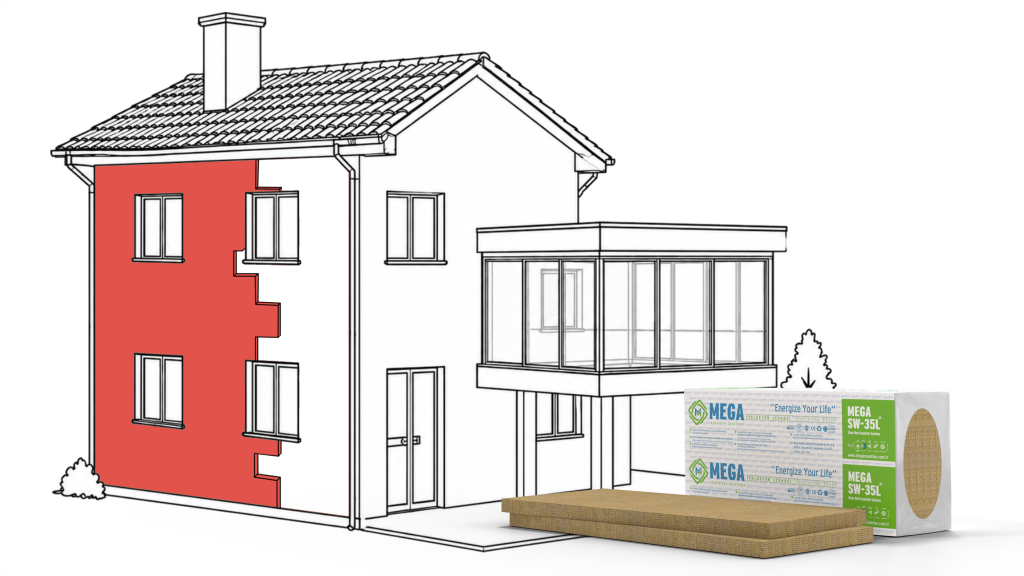
According to Mega technical data sheets, stone wool is a mineral wool board with reaction to fire class A1 and a water vapour diffusion resistance factor of μ = 1. In the stone wool ETICS board range, the MEGA SW F150 (150 kg/m³) and MEGA SW F120 (120 kg/m³) types have a λD of ≤0.037 W/mK. The product page states that the board is used in rendered external wall insulation systems for thermal and acoustic insulation and fire safety. Other stone wool boards for applications such as flat roofs, partition walls and curtain walls are listed on the category page.
ETICS with white and grey EPS
EPS boards are lightweight, which is why they are frequently chosen for ETICS. According to Mega technical data sheets, the λD values of the white EPS ETICS board (EPSW) types range from 0.034 to 0.042 W/mK, while those of the carbon-enhanced grey EPS ETICS board (EPSG) types range from 0.031 to 0.036 W/mK. Both products measure 500 x 1000 mm and have reaction to fire class E. All types are listed on the EPS boards page.
When is XPS used in ETICS?
With its closed-cell structure and low water absorption, XPS stands out in zones exposed to moisture. According to the Mega product page, rough grooved XPS is used for external and internal ETICS and for column and beam insulation, while smooth-surface XPS is used for facades that do not require render and under siding. The MEGA XPS technical data sheets give long-term water absorption as ≤0.7%. Like EPS, XPS is a class E combustible material.
What are the benefits of ETICS?
ETICS reduces heat loss through external walls in winter and heat gain in summer, and lowers the risk of condensation and mould by keeping the inner surface of the wall warmer. Because the insulation layer also covers columns, beams and slab edges from the outside, the number of thermal bridge points falls.
The reduction in energy use varies from building to building; the climate zone, wall section, windows, roof and heating system determine the result together. For this reason it would be wrong to quote a single savings percentage; the expected effect is established by the calculation in the thermal insulation design. The items that affect the budget are covered separately in the ETICS cost article.
Comfort in winter and summer
In winter, the inner surface of an uninsulated external wall is noticeably colder than the room air and creates a feeling of chill near the wall; ETICS brings this surface closer to room temperature. In summer, less heat passes inwards from walls warmed by the sun, and the need for cooling drops.
Lower risk of condensation and mould
Moisture in indoor air can condense when it meets a cold wall surface; this moisture encourages mould, especially in corners and behind wardrobes. Because ETICS raises the temperature of the inner surface, the risk of condensation decreases. For other causes of mould and the role of ventilation, see the what causes mould on walls article.
How do temperature and moisture affect application?
For the mortars to harden properly, application takes place within a certain temperature range and in dry weather. According to Mega technical data sheets, the ambient temperature for the board adhesive, board plaster and decorative plaster must be between +5 °C and +35 °C. No application is made on frozen or thawing surfaces or on surfaces at risk of frost within 24 hours; work is also not carried out in direct sun, in strong wind or on hot surfaces. The adhesive data sheet also rules out application in rain and requires the work to be protected from getting wet until it has fully dried.
Which season is more suitable, together with the precautions to take on hot or rainy days, is explained in the when to apply ETICS article.
How is the board thickness determined?
The board thickness for ETICS is not given as a single figure; it is determined with the TS 825 calculation method, taking into account the building’s climate zone, the wall section and the λD value of the chosen board. The Turkish Regulation on Energy Performance in Buildings requires the thermal insulation design prepared with this method at the building permit stage.
Thickness and λD work together: thermal resistance (RD) is found by dividing the thickness by the λD value. For example, the MEGA XPS T1500 technical data sheet gives an RD of 0.55 m²K/W for 20 mm and 2.25 m²K/W for 80 mm. You can find more detail in the ETICS thickness article.
Frequently Asked Questions
Is mantolama the same as external wall insulation?
Not exactly; mantolama is one of the methods of external wall insulation. In mantolama the board is bonded to the wall, anchored and covered with mesh-reinforced render, so the insulation becomes part of the rendered facade itself. In ventilated curtain wall and under-siding applications, the insulation stays behind a cladding. We compare the options in the types of external wall insulation article.
Does mantolama stop a building from breathing?
Not with a correctly chosen system; what is commonly called “breathing” is the ability of water vapour to pass out through the wall. According to Mega technical data sheets, the water vapour diffusion resistance factor of stone wool boards is μ = 1, and that of the board plaster MTP-3344 is at most 15. The Regulation on Energy Performance in Buildings also requires condensation to be checked in the thermal insulation design according to TS 825; the board type should be chosen together with that calculation.
Are anchors mandatory in ETICS?
In an ETICS system, anchors are a basic component that fixes the board mechanically in addition to the adhesive. The Turkish Regulation on the Fire Protection of Buildings also lists anchors among the parts of a thermal insulation system. According to the Mega board adhesive data sheet, anchors are installed at least 24 hours after bonding. The anchor type, length and number per square metre depend on the board type and the technical data sheet of the system being installed.
Does mantolama change the appearance of a building?
Yes, the colour and texture of the facade are redefined by the top coat, and the wall becomes thicker by the depth of the board and render layers. Mega’s top coat options include decorative mineral plaster MTD-3355 and the line-textured MTD-3355L; MTD-3355 is painted once dry. Because the wall gets thicker, window sills, reveals and other facade details should be planned before installation.
Which is better, internal or external insulation?
Where it can be installed, external insulation is generally more advantageous, because the insulation covers columns, beams and slab edges continuously from the outside and keeps the wall mass on the warm side. In buildings whose facade cannot be altered, or when a solution is needed for a single flat, internal wall insulation can be applied. In that case some floor area is lost inside.
Sources
- Regulation on the Fire Protection of Buildings, Article 27 (Official Gazette 19.12.2007/26735)
- Regulation on Energy Performance in Buildings, Article 10 (Official Gazette 05.12.2008/27075, consolidated text)
- EN 13499: ETICS based on EPS, standard record
- EN 13500: ETICS based on mineral wool, standard record
- Mega technical data sheet: MEGA SW F150 ETICS Board
- Mega technical data sheet: EPS 30P-G and EPS 30U-G
- Mega technical data sheet: MEGA XPS T1500
- Mega technical data sheet: MTA-3333 Thermal Insulation Board Adhesive
- Mega technical data sheet: MTP-3344 Thermal Insulation Board Plaster
- Mega technical data sheet: MTD-3355 Decorative Mineral Plaster
- Mega Yalıtım certificates and documents
For the board type and system components suited to your project, you can contact the Mega Yalıtım technical team and browse MegaTech products on the construction chemicals page.