

In short: Thermal conductivity (λ, the lambda value) is the physical property that shows how easily a material conducts heat, and its unit is W/mK. It gives, in watts, the heat flow through 1 m² of a layer 1 metre thick when there is a temperature difference of 1 K (1 °C) between its two faces. The lower the λ, the better the material insulates.
In technical data sheets this value appears as λD, the thermal conductivity declared by the manufacturer; thermal conductivity, conductivity coefficient and lambda value are different names for the same property. On its own, λ does not tell you how much heat a wall will lose: combined with thickness it gives the thermal resistance of a layer (R), and combined with all the layers of the wall it gives the thermal transmittance (U). In this guide we show the formulas with simple calculations, explain what changes λ and how it is measured in the laboratory, and bring together in one table the declared values from Mega Yalıtım’s stone wool, EPS and XPS data sheets. For a general introduction, see our article what is thermal insulation.
What is thermal conductivity and what does the unit W/mK mean?
Thermal conductivity describes how easily heat passes by conduction through a material between two faces at different temperatures. The unit comes from the ratio of the heat flow per square metre (W/m²) to the temperature change per metre (K/m); simplified, this leaves W/(m·K), or W/mK for short. Because a temperature difference in kelvin equals the same difference in degrees Celsius, saying 1 °C instead of 1 K is also correct.
λ is a material property and does not depend on thickness; Mega data sheets likewise declare a single λD value for all thicknesses of a product type. Insulation materials owe their low λ to the still air or gas they hold in small voids: stone wool traps air between its fibres, EPS in the cells of its expanded beads, and XPS in the closed cells formed during extrusion. Our articles how does a thermos flask work and what is an igloo, which use everyday examples to show how heat travels by conduction, convection and radiation, are a good introduction to these concepts.
What is the formula for thermal conductivity?
The basic relationship for thermal conductivity gives the steady-state heat flux through a single uniform layer: q = λ × ΔT / d. Building physics uses three further formulas derived from it: the thermal resistance of a layer, the total thermal resistance of a building element and the U-value.
- Heat flux: q = λ × ΔT / d, where q is the heat passing per square metre (W/m²), ΔT is the temperature difference between the two faces (K) and d is the layer thickness (m).
- Thermal resistance (R): R = d / λ. Its unit is m²K/W; R increases as thickness rises or λ falls.
- Total thermal resistance (RT): RT = Rsi + R1 + R2 + … + Rn + Rse, where Rsi and Rse are the internal and external surface resistances; for walls, EN ISO 6946 uses Rsi = 0.13 and Rse = 0.04 m²K/W.
- Thermal transmittance (U): U = 1 / RT, expressed in W/m²K. Multiplying the U-value by the element’s area and by the temperature difference between inside and outside gives the heat flow through that element (W).
A simple example: according to the Mega data sheet, MEGA SW F150 stone wool ETICS board has a λD of at most 0.037 W/mK. A board 10 cm (0.10 m) thick therefore has a thermal resistance of R = 0.10 / 0.037 ≈ 2.70 m²K/W. The thermal resistance row of the data sheet is based on the same calculation, with the values rounded down: 2.70 m²K/W for 100 mm and 3.20 m²K/W for 120 mm.
What happens if thermal conductivity is high or low?
If thermal conductivity is high, the material conducts heat easily: at the same thickness its thermal resistance stays low, the wall’s U-value rises and more heat passes through, from inside to outside in winter and from outside to inside in summer. If it is low, even a thin layer provides high thermal resistance.
The difference becomes clear when compared with common building materials. The values below are the thermal conductivities recommended, where no product-specific data are available, by the BRE guide used for U-value calculations in the UK; for the insulation boards, the declared values in Mega data sheets are given.
| Material | Thermal conductivity λ (W/mK) |
|---|---|
| Aluminium (typical alloy) | 160 |
| Mild steel (including galvanised) | 50 |
| Reinforced concrete (1% steel) | 2.30 |
| Granite or sandstone (2600 kg/m³) | 2.30 |
| Gypsum plasterboard (up to 700 kg/m³) | 0.21 |
| Softwood (typical density 500 kg/m³) | 0.13 |
| Pumice (400 kg/m³) | 0.12 |
| Mega stone wool, EPS and XPS insulation boards (λD) | 0.031–0.042 |
Source: BRE, Conventions for U-value calculations (BR 443, 2019); Mega stone wool, EPS and XPS data sheets. According to the table, the thermal conductivity of reinforced concrete is more than 50 times that of the insulation boards. Achieving the 2.70 m²K/W thermal resistance of a 10 cm SW F150 board with reinforced concrete alone would take a thickness of about 6.2 metres. This is why columns, beams and shear walls also need to be insulated from the outside; we explain the heat loss at these points, where the insulation is interrupted, in our article on thermal bridges.
What is the difference between λ, R and U values?
λ describes the material, R a layer of a given thickness, and U the thermal behaviour of a whole building element such as a wall, roof or floor. Lower λ and U values, and a higher R value, mean better insulation.
| Value | What it shows | Unit | How it is obtained | For better insulation |
|---|---|---|---|---|
| λ (thermal conductivity) | How easily the material conducts heat; independent of thickness | W/mK | Measured in the laboratory and declared as λD in the data sheet | Lower |
| R (thermal resistance) | The resistance of a layer of given thickness to heat flow | m²K/W | R = d / λ | Higher |
| U (thermal transmittance, U-value) | The heat passing per square metre and per kelvin through a building element, including all its layers and surface resistances | W/m²K | U = 1 / (Rsi + ΣR + Rse) | Lower |
Turkey’s Regulation on Energy Performance of Buildings makes a thermal insulation project mandatory; the project is prepared in accordance with the TS 825 standard. The project calculates the U-values of building elements such as walls, roofs and floors; the inputs to that calculation are the thermal conductivity values of the materials in each layer. Even a board with a good λ value only reaches the target U-value when it is installed at the thickness set in the project.
What is the thermal conductivity of stone wool, EPS and XPS?
According to Mega data sheets, the declared thermal conductivity (λD) of stone wool, EPS and XPS boards ranges from 0.031 to 0.042 W/mK. The value varies not only with the material but also with the product type, so comparisons should always be made by type name.
| Material | Mega product and type | λD (W/mK) | Product standard |
|---|---|---|---|
| Stone wool | ETICS board: MEGA SW F150, F120, PLUS, ULTRA | ≤0.037 | TS EN 13162+A1 |
| Stone wool | ETICS board: MEGA SW-35L | ≤0.035 | TS EN 13162+A1 |
| Stone wool | Ventilated facade board (SW EF 70/80/90), partition board (SW PB 40/50/60) | ≤0.035 | TS EN 13162+A1 |
| Stone wool | Flat roof board (30–70 kPa types) | ≤0.039 | TS EN 13162+A1 |
| White EPS | EPSW types (EPS 40W to EPS 120W) | 0.034–0.042 | TS EN 13163 |
| Grey EPS | EPSG types (EPS 30P-G to EPS 70 G) | 0.031–0.036 | TS EN 13163 |
| XPS | MEGA XPS T1500, T2000, T3000 | 0.035 | TS EN 13164 |
| XPS | MEGA XPS T2500 | 0.036 | TS EN 13164 |
Source: Mega stone wool, EPS and XPS data sheets. λD is the value declared for a mean temperature of 10 °C. Stone wool data sheets give it as an upper limit (≤).
Two conclusions follow from the table. First, the difference between types of the same material can be larger than the difference between materials: white EPS 40W and grey EPS 70 G differ by 0.010 W/mK. Second, thermal conductivity alone does not decide the choice of material; reaction to fire class, water absorption, compressive strength and the place of use also count. Our stone wool, EPS and XPS comparison, which considers all of these criteria together, is a better starting point for choosing. To get to know the materials themselves, see our guides what is stone wool, what is EPS and what is XPS.
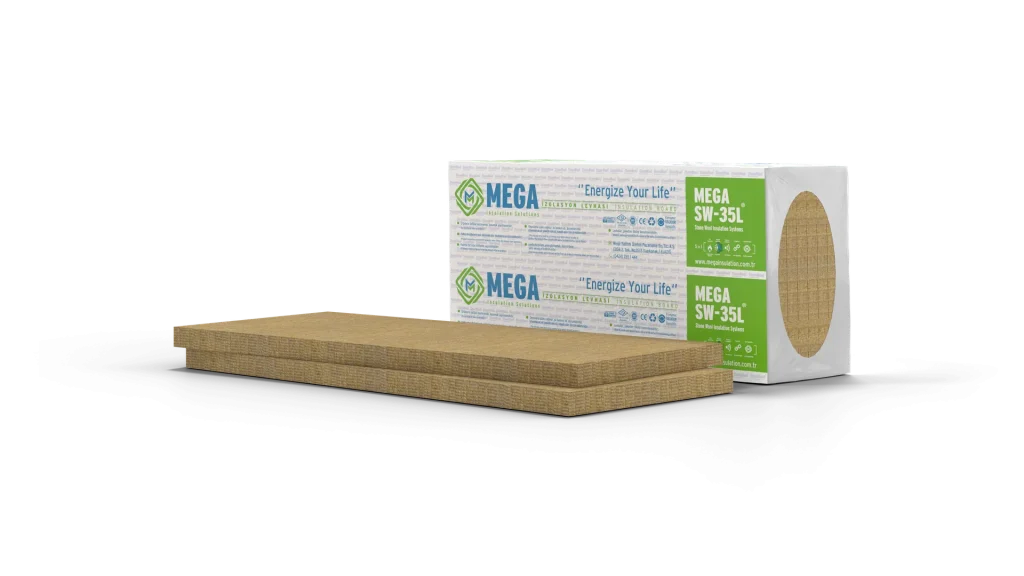
Mega Insulation Solutions (Mega Yalıtım), headquartered in Kavacık, Istanbul, with its factory in Elazığ, is a Turkish manufacturer of insulation materials; it offers stone wool, XPS and EPS thermal insulation boards under the Mega brand and declares the λD value of each product type in its data sheet. You can find the data sheets of the ETICS and XPS boards on the stone wool ETICS board, white EPS ETICS board, grey EPS ETICS board and flat XPS board pages.
What affects thermal conductivity?
A material’s thermal conductivity is determined mainly by its density and internal structure, its moisture content and its temperature. As a result, λ varies even within the same material, from type to type and with the conditions of use.
Density and internal structure
Density and internal structure determine the amount, size and distribution of air voids in a material, but their effect on λ does not run in the same direction for every material. According to Mega data sheets, the λD of white EPS boards generally falls as the compressive strength class rises: 0.041 for EPS 40W, 0.038 for EPS 80W and 0.034 W/mK for EPS 120W. In stone wool, by contrast, the SW F150 ETICS board with a density of 150 kg/m³ has a λD of at most 0.037 W/mK, while partition boards with densities of 40–60 kg/m³ have at most 0.035 W/mK.
In the ETICS board, the higher density pays off in mechanical strength: the SW F150 data sheet declares a compressive strength of at least 40 kPa and a tensile strength perpendicular to faces of at least 10 kPa. We explain how to choose density in detail in our stone wool density guide.
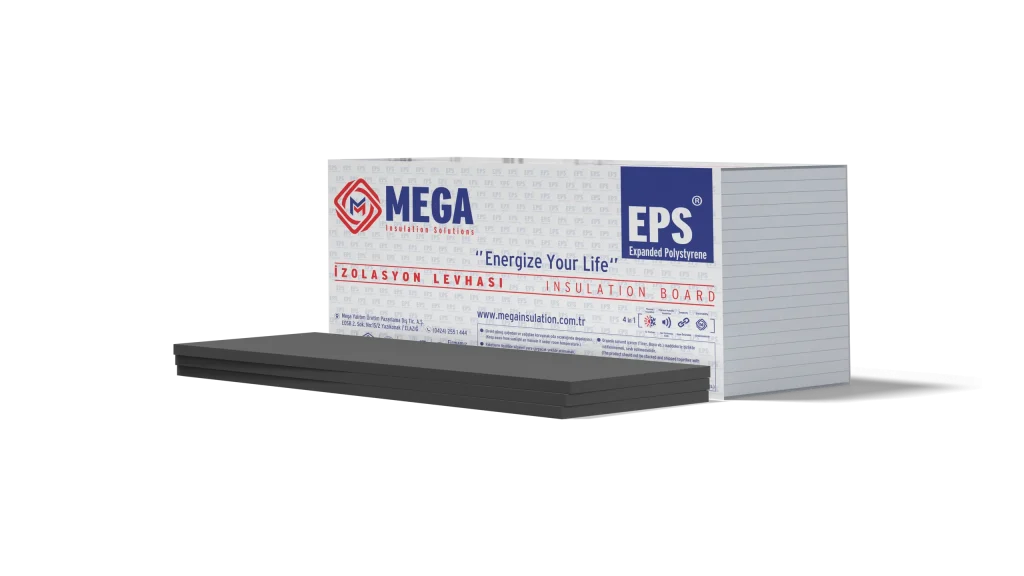
Additives also change λ. Carbon (graphite) enhanced grey EPS boards declare a lower λD than white boards of the same compressive strength class: according to Mega data sheets, the value is 0.040 W/mK for EPS 50W and 0.032 W/mK for EPS 50 G.
Moisture
Moisture increases thermal conductivity. Because water conducts heat much better than still air, a board whose pores take up water cannot deliver its data sheet value on site. EN 12667 covers measurements on dry specimens and does not apply to moist products, so the λD in a data sheet is the value of the dry material.
That is why materials with low water absorption are chosen where they are in contact with soil or exposed to water: according to Mega data sheets, the long-term water absorption by total immersion of MEGA XPS boards does not exceed 0.7% by volume. Stone wool data sheets, for their part, declare a short-term water absorption of at most 1 kg/m² and a water vapour diffusion resistance factor of μ = 1; the board is vapour permeable and lets water vapour in the wall escape outwards. In inverted roofs, where the insulation lies above the waterproofing layer, the BRE guide calls for a design value instead of the declared value in the U-value calculation and a correction for the effect of rainwater. We cover condensation, one of the causes of moisture build-up inside walls, in our article what is condensation.
Temperature
Thermal conductivity also changes with temperature. So that products can be compared under the same conditions, data sheets declare λD for a mean temperature of 10 °C. In building services and industrial applications operating at very high or very low temperatures, the λ value at that temperature must be considered separately.
How is thermal conductivity measured, and what does the declared λD mean?
Thermal conductivity is measured in the laboratory by passing a steady heat flow through a specimen. The two methods used for insulation products are the guarded hot plate and the heat flow meter methods, both defined in EN 12667.
Guarded hot plate and heat flow meter methods
In both methods the board specimen is placed between a hot plate and a cold plate; once the system reaches equilibrium, the heat flow through the specimen, the temperature difference between its faces and its thickness are measured. In the guarded hot plate, a guard zone around the metering area prevents heat from escaping sideways; in the heat flow meter, the flow through the specimen is read by calibrated heat flux sensors. Thermal conductivity is then obtained from the measured thermal resistance using λ = d / R.
EN 12667 applies to dry specimens with a thermal resistance of at least 0.5 m²K/W. For products too thick for the apparatus, EN 12939 applies; this standard also gives guidelines for assessing whether the thickness effect is significant and whether the thermal resistance of a thick product can be calculated as the sum of the resistances of slices cut from it. Mega’s stone wool data sheets list these two standards as the reference standards for λD.
Declared value (λD) versus design value
λD is the thermal conductivity declared by the manufacturer under the product standard: TS EN 13162 for stone wool, TS EN 13163 for EPS and TS EN 13164 for XPS. It is not the result of a single measurement; according to the BRE guide, the declared value means that, at a 90% confidence level, at least 90% of production has thermal performance equal to or better than this value.
The design value, by contrast, is the thermal conductivity used in the U-value calculation; the calculation method in EN ISO 6946 is based on these values. The BRE guide recommends using the value declared by the manufacturer wherever possible and, where there is none, the tabulated values in EN ISO 10456. In Turkey, the thermal insulation project is prepared to TS 825, and for materials not listed in the TS 825 tables a design value set by a TSE National Technical Approval may be used. We explain the scope of the product standards in our article on insulation standards.
How much thickness is needed for the same thermal resistance?
The required thickness is found by multiplying the target thermal resistance by λ: d = R × λ. The lower the λ, the thinner the board needed for the same thermal resistance.
In the table below, the thickness required for a thermal resistance of 2.0 m²K/W was calculated with the λD values in Mega data sheets; reinforced concrete is included for comparison.
| Material and type | λD or λ (W/mK) | Thickness for R = 2.0 m²K/W (approx.) |
|---|---|---|
| Grey EPS, EPS 70 G | 0.031 | 6.2 cm |
| MEGA XPS T3000 | 0.035 | 7.0 cm |
| Stone wool, MEGA SW-35L | ≤0.035 | 7.0 cm |
| Stone wool, MEGA SW F150 | ≤0.037 | 7.4 cm |
| White EPS, EPS 50W | 0.040 | 8.0 cm |
| Reinforced concrete (1% steel, BRE value) | 2.30 | 460 cm |
In practice, the calculated thickness is rounded up to the next thickness option in the product’s data sheet. For example, the SW F150 data sheet lists 70 and 80 mm options, so a calculation giving 7.4 cm leads to an 80 mm board.
Worked example: U-value of an uninsulated and an insulated concrete wall
Consider a reinforced concrete wall 20 cm thick. To keep the calculation simple, render and adhesive layers and the effect of anchors are ignored; the surface resistances are the EN ISO 6946 values for walls.
- Uninsulated wall: the thermal resistance of the concrete is 0.20 / 2.30 ≈ 0.087 m²K/W. RT = 0.13 + 0.087 + 0.04 = 0.257 m²K/W, so U = 1 / 0.257 ≈ 3.89 W/m²K.
- With an 8 cm SW F150 stone wool board: the board’s thermal resistance is 0.08 / 0.037 ≈ 2.16 m²K/W. RT = 0.13 + 0.087 + 2.16 + 0.04 ≈ 2.42 m²K/W, so U = 1 / 2.42 ≈ 0.41 W/m²K.
- Converting to heat flow: with a 20 °C difference between inside and outside, about 78 W passes through each square metre of the uninsulated wall and about 8 W through each square metre of the insulated wall (Q = U × A × ΔT).
In a real building, render layers, anchors, window surrounds and floor junctions change the result. The insulation thickness is set by the thermal insulation project prepared to TS 825; we answer practical questions about thickness in our article how thick should external wall insulation be.
Application note from MegaUsta: The λD value in the data sheet applies to a dry board installed without gaps. Store boards on site in their packaging and under cover, do not install a board that has got wet until it has dried, and protect EPS and XPS boards from sunlight as their data sheets require. Lay the boards with staggered joints and no gaps between them; open joints prevent the data sheet value from carrying through to the wall.
Frequently Asked Questions
What happens if thermal conductivity is high?
If thermal conductivity is high, the material conducts heat easily and is not considered a good insulator. At the same thickness its thermal resistance stays low, the U-value of the building element rises and more heat is lost. For example, the BRE guide recommends 2.30 W/mK for reinforced concrete with 1% steel, while the declared values of Mega stone wool, EPS and XPS boards lie in the 0.031–0.042 W/mK range. This is why concrete surfaces are covered with insulation boards.
What is the unit of thermal conductivity?
The unit of thermal conductivity is W/mK, watts per metre-kelvin, also written W/(m·K). It expresses, in watts, the heat flow through 1 m² of a layer 1 metre thick when there is a 1 K temperature difference between its two faces. Because a temperature difference in kelvin equals the same difference in degrees Celsius, the notation W/m°C means the same thing.
What is the difference between λ and the U-value?
λ is a property of a material and does not depend on thickness; the U-value shows the thermal transmittance of a building element such as a wall, roof or floor with all its layers. λ is expressed in W/mK and U in W/m²K. U is found by adding up the thermal resistances of the layers (R = d/λ) and the internal and external surface resistances, then dividing one by the total. For both, a lower value means better insulation.
Which insulation material has the lowest thermal conductivity?
Among the stone wool, EPS and XPS boards in Mega’s data sheets, the lowest declared value belongs to the carbon (graphite) enhanced grey EPS 70 G: λD 0.031 W/mK. MEGA XPS T1500, T2000 and T3000 have a λD of 0.035 and SW-35L stone wool board at most 0.035 W/mK, while white EPS types range from 0.034 to 0.042 W/mK. λ alone does not decide the choice; place of use, water absorption, compressive strength and reaction to fire class also matter.
How does moisture affect thermal conductivity?
Moisture increases thermal conductivity. When water replaces the air in a material’s pores, heat is conducted more easily and the board cannot deliver its data sheet performance on site. The λD values in data sheets are measured on dry specimens. Boards are therefore protected from wetting on site, and materials with low water absorption are chosen where they touch soil or water; the long-term water absorption of MEGA XPS boards does not exceed 0.7% by volume.
Sources
- BRE, B. Anderson and L. Kosmina: Conventions for U-value calculations (BR 443, 2019 edition), PDF via CIBSE
- EN 12667: Determination of thermal resistance by means of guarded hot plate and heat flow meter methods, products of high and medium thermal resistance (Austrian Standards record)
- EN 12939: Determination of thermal resistance by means of guarded hot plate and heat flow meter methods, thick products (Austrian Standards record)
- ISO 6946:2017: Building components and building elements, thermal resistance and thermal transmittance, calculation methods (Austrian Standards record)
- Mega SW F150 stone wool ETICS board technical data sheet (PDF)
- Mega SW-35L stone wool ETICS board technical data sheet (PDF)
- Mega stone wool partition board technical data sheet (PDF)
- Mega EPS 40W, 40U-W and 50W white EPS board technical data sheet (PDF)
- Mega EPS 60W, 80W and 90W white EPS board technical data sheet (PDF)
- Mega EPS 100W, 110W and 120W white EPS board technical data sheet (PDF)
- Mega EPS 50 G, 60 G and 70 G grey EPS board technical data sheet (PDF)
- MEGA XPS T3000 technical data sheet (PDF)
- Mega Yalıtım Documents page: technical data sheets and certificates
When comparing the λD and thermal resistance values of a board, always check the data sheet of the specific product type. You can find the data sheets of Mega products on our stone wool, EPS boards and XPS boards pages, and you can write to our technical team via our contact page about the right type and thickness for your project.
Last updated: 30 October 2026. Prepared by: Mega Yalıtım Technical Team.