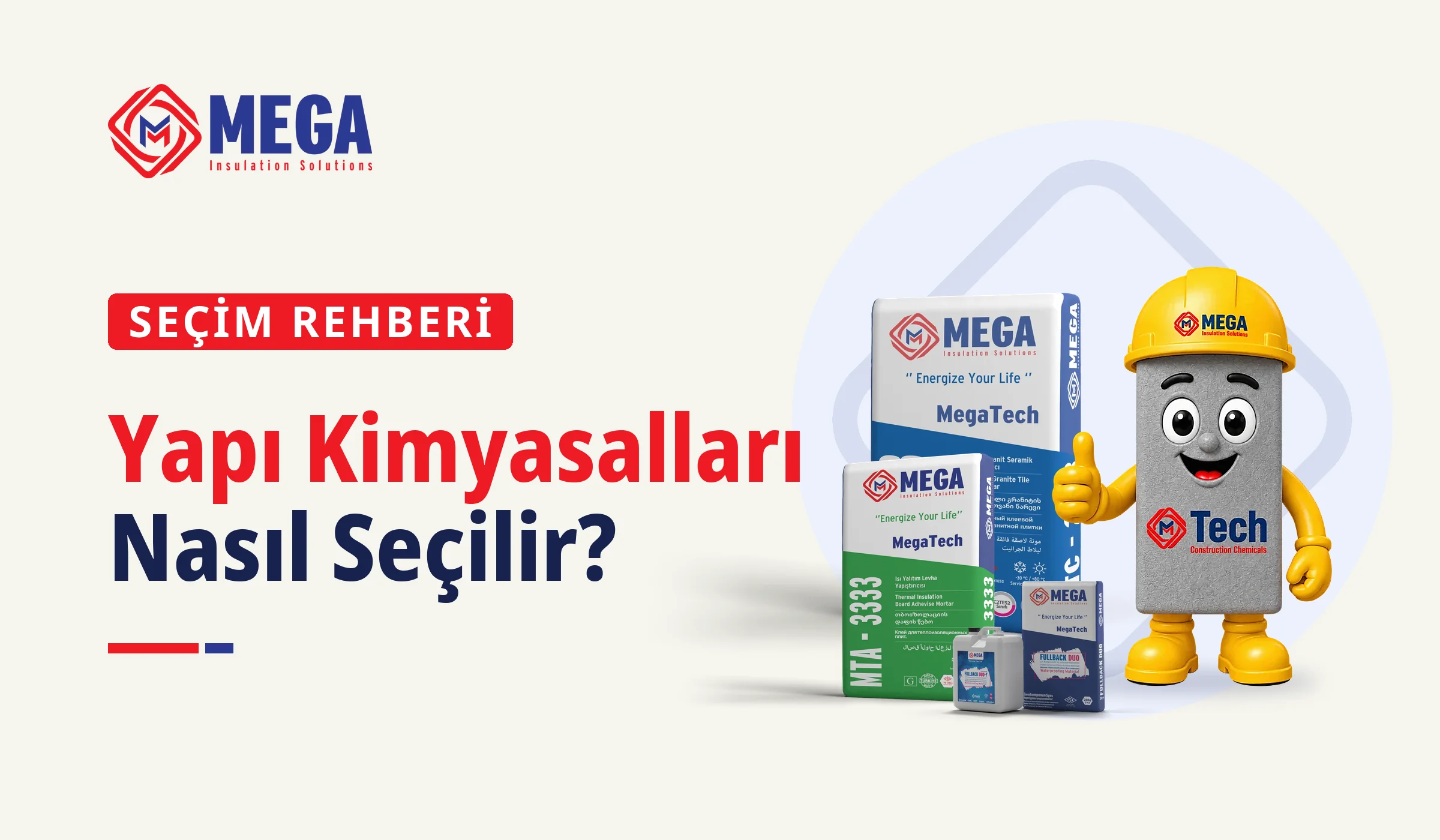
In short: To choose construction chemicals, first define the type of work and the surface, then check the standard and class code of the product group, and finally compare the temperature, time and consumption values in the data sheet with site conditions. The decision rests on the application area and limits in the data sheet, not on the product’s name.
This guide covers the order to follow to reach the right product, which standard to check for each product group, how to read class codes and data sheets, and how to calculate bags. For definitions of the product groups, see our guide to what construction chemicals are; the full range is in the MegaTech construction chemicals category.
In what order do you decide when choosing a construction chemical?
The choice moves from the work to the surface, from the surface to the conditions, and from there to the standard and data sheet. These seven steps show the difference between two products with similar names:
- Define the work: Bonding, plastering, waterproofing or surface preparation. Each job belongs to a separate product group.
- Identify the surface: Concrete, plaster, screed, aerated concrete, exposed concrete or an old covering. Look for your surface in the product’s application list.
- Write down the environment: Indoors or outdoors, wet or dry, horizontal or vertical, any sudden temperature changes? For tiles, the tile size and water absorption also go on this list.
- Check the standard and class: Look at the product group’s standard and the class code on the bag.
- Compare the data sheet limits with the site: The application temperature, working life and coat thickness must suit site conditions.
- Consider the layers below and above: A product does not work alone; it works with the surface beneath it and the layer that goes on top.
- Calculate the quantity: Multiply the area by the data sheet consumption and divide by the package weight.
Mega Insulation Solutions (Mega Yalıtım) offers its construction chemicals under the name MegaTech and its waterproofing products under the name Fullback. The example values below come from these products’ data sheets and product pages.
Which standard applies to which construction chemical?
The standard depends on the product group: TS EN 12004-1 for tile adhesive, TS EN 998-1 for plastering mortar, TS EN 14891 for liquid waterproofing beneath tiles, TS 13566 for insulation board adhesive and TS 13687 for board plaster. A standard defines the properties a product must meet; on its own it does not show that the product suits your surface.
| Product group | Standard | Subject of the standard | Mega products |
|---|---|---|---|
| Ceramic and wall tile adhesive | TS EN 12004-1 | Ceramic tile adhesives and their classification | MTC-2221, MTC-2222, MTC-2232, MTC-2233 |
| Plastering mortar | TS EN 998-1 | Factory-made internal and external plastering mortars with inorganic binders | MTP-7111, MTP-7133 |
| Insulation board adhesive | TS 13566 | Insulation board adhesives | MTA-3333 |
| Insulation board plaster | TS 13687 | Cement-based plaster for insulation boards | MTP-3344 |
| Decorative mineral plaster | TS 7847 | External cladding materials for masonry and concrete | MTD-3355 |
| Liquid waterproofing beneath tiles | TS EN 14891 | Liquid water-impermeable products used beneath tiling bonded with adhesives | Fullback Duo |
Source: scopes of EN 12004-1, EN 998-1 and EN 14891 (SIS, BSI); standard definitions in TSE certificates. The table shows the standard related to the product group, not the certification status of individual products. Published documents are on the Documents page.
Groups outside the table have their own standards too: EN 13888-1 for grouts, EN 998-2 for masonry mortar, EN 13813 for screeds, EN 1504-3 for concrete repair mortars and EN 1504-2 for concrete surface protection systems. ETICS is treated as a system: EPS systems fall under TS EN 13499 and stone wool systems under TS EN 13500. We cover the board standards in our article on insulation standards.
How do you read the class codes on a product?
Class codes briefly state which properties a product declares: tile adhesives use the letters C, T, E and S, and plastering mortars use the codes GP, CS and W. The table below summarises the most common codes.
| Code | Standard | What does it mean? |
|---|---|---|
| C1 / C2 | TS EN 12004-1 | Normal-setting / improved cementitious adhesive |
| T | TS EN 12004-1 | Reduced slip; limits tiles sliding down a vertical surface |
| E | TS EN 12004-1 | Extended open time |
| S1 / S2 | TS EN 12004-1 | Deformable / highly deformable |
| GP | TS EN 998-1 | General-purpose plastering mortar |
| CS I–IV | TS EN 998-1 | Compressive strength category |
| W0–W2 | TS EN 998-1 | Capillary water absorption category |
| CM / DM | TS EN 14891 | Cementitious / dispersion-based liquid waterproofing product |
Source: class descriptions in TSE certificates; scope of EN 14891 (BSI); MPA guide to BS EN 998-1 and 998-2.
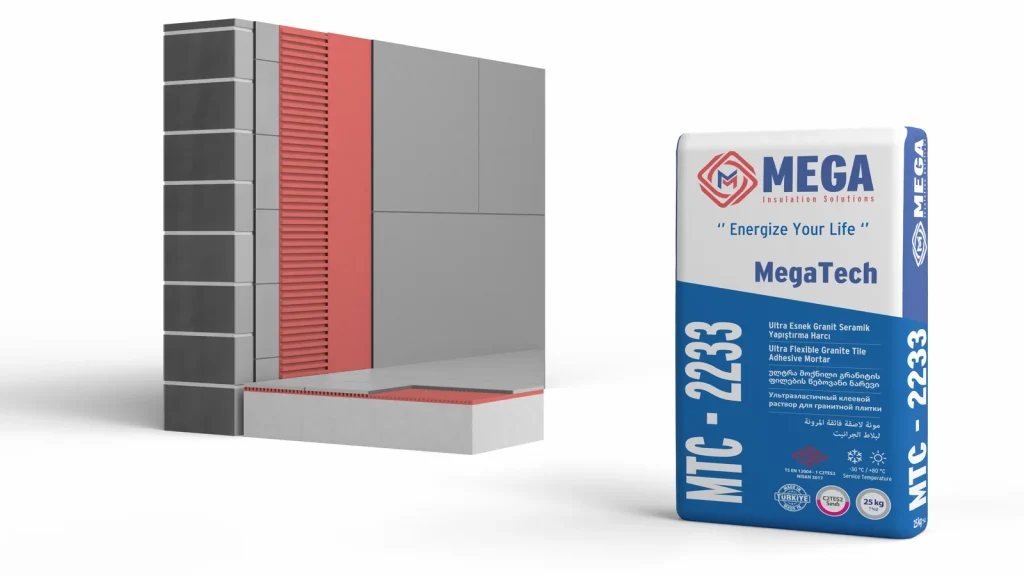
For example, MTC-2233, coded C2TE S2, is an improved (C2), reduced-slip (T), extended-open-time (E) and highly deformable (S2) cementitious adhesive. You can find the details of tile adhesive classes in our article on C1TE, C2TE, S1 and S2.
Which product do you look for by surface and environment?
The product to look for is set by the surface and environment of the job; what separates products in the same group is often the limit in the data sheet. The table below matches each condition with MegaTech and Fullback products and the main limit in the data sheet or on the product page.
| Surface and environment | Property to look for | Product | Limit to watch |
|---|---|---|---|
| Small and medium tiles indoors and outdoors, tile over tile | C1TE | MTC-2221 | Defined for small and medium tiles |
| Wet areas, terraces, surfaces with sudden temperature changes | C1TE S1 | MTC-2222 | Outdoors it is defined for horizontal application only |
| Tiles with water absorption below 3%, porcelain tiles, marble; pools, facades; gypsum plaster, gypsum board, aerated concrete and exposed concrete surfaces | C2TE | MTC-2232 | For large tiles the data sheet limit is below 60×60 cm |
| Underfloor heating, cold stores, pool glass mosaic, over old tiles | C2TE S2 | MTC-2233 | Defined for small and medium tiles; temperature resistance -30 / +60 °C |
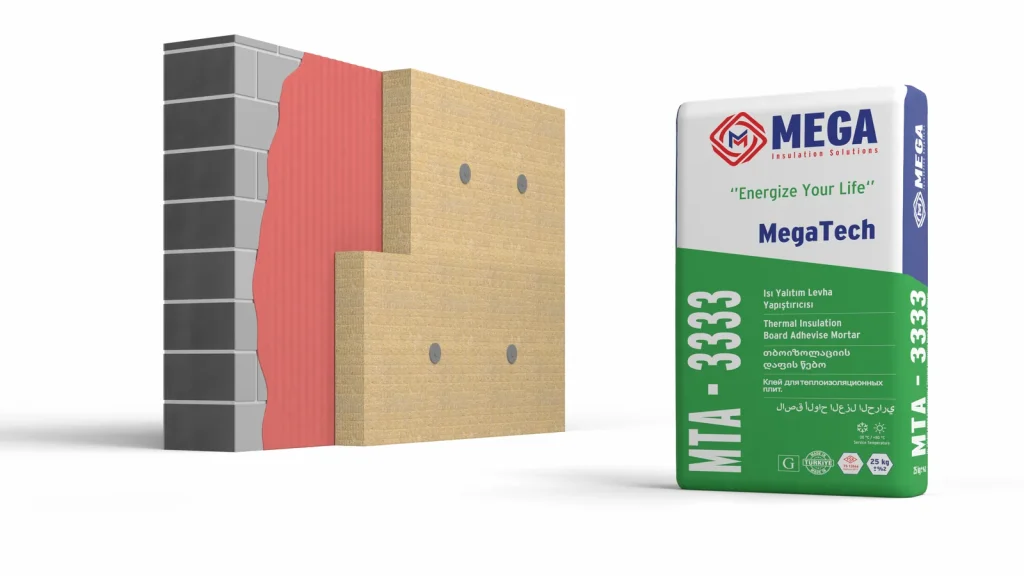
| Bonding stone wool, EPS and XPS boards in ETICS | Board adhesive | MTA-3333 | Dowels after at least 24 hours, board plaster after 2 days |
| Plastering over insulation boards | Fibre-reinforced board plaster | MTP-3344 | 160 g/m² alkali-resistant mesh, 10 cm overlap, about 4 mm |
| Decorative coating on external walls and ETICS plaster | Cement-based mineral plaster | MTD-3355 | Applied at 2 mm; painted once dry, not left bare; not used on horizontal surfaces exposed to rain |
| Brick, aerated concrete, concrete, exposed concrete, pumice block and briquette walls and ceilings, indoors and outdoors; more practical on large surfaces where a machine can be set up | Machine plaster | MTP-7133 | 5–25 mm per coat; mix used within 1 hour at most |
| The same surfaces; more practical on small areas and plaster repairs | Hand plaster | MTP-7111 | 5–25 mm per coat; mix used within 1 hour at most |
| Smooth exposed concrete before plastering | Primer | Exposed Concrete Primer | Defined for indoor use; application temperature +5 / +30 °C |
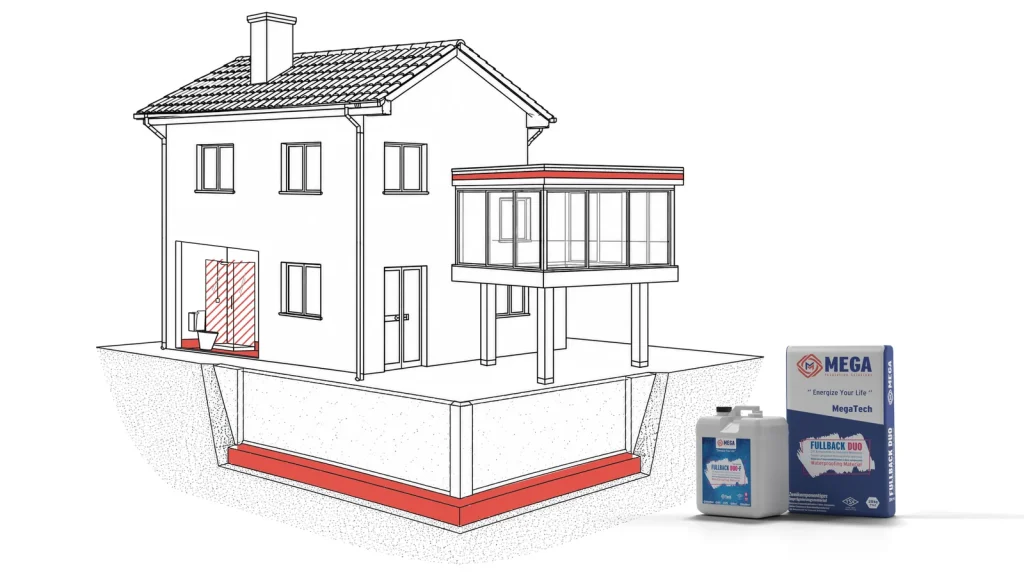
| Wet areas, pools, water tanks, small terraces and balconies, foundations and basement walls | Two-component waterproofing | Fullback Duo | Fully elastic 20+10 kg, semi-elastic 20+5 kg; Duo UV for UV resistance |
| Sloped roofs and terraces, facades; cracks, eaves and chimney bases | One-component acrylic waterproofing | Fullback Acrylic | 20 kg pail; Acrylic UV for UV resistance |
Source: MegaTech technical data sheets and Mega product pages. The MTP-7133 and MTP-7111 data sheets list the same application areas; the split by area size is a matter of ease of application.
Limits change the choice. For example, MTC-2222 is a flexible adhesive, but its product page defines only horizontal application outdoors; tiling on a facade falls within the application area of MTC-2232. We compare waterproofing types in our article on what waterproofing is.
Which values do you check in a data sheet?
In a data sheet, check the application area, application temperature, water ratio, working life, waiting time, consumption and storage conditions, in that order. These values vary by product, so read them from each product’s own data sheet.
| Value to check in the data sheet | What does it determine? | Example values |
|---|---|---|
| Application temperature | The weather in which the work can be done | MTC-2221, MTA-3333, MTP-7133 and MTD-3355: +5 / +35 °C; not applied to frozen surfaces or surfaces at risk of frost within 24 hours, in direct sun or in strong wind. Exposed Concrete Primer: +5 / +30 °C |
| Water ratio | How much water goes into one bag | MTC-2221: 6–6.5 L per 25 kg. MTA-3333: 5.5–6 L per 25 kg. MTP-3344: 6–7 L per 25 kg. MTP-7133: 5.4–6.6 L per 30 kg |
| Working life | How soon the mixed mortar must be used up | MTC-2221: 5 hours. MTA-3333: up to 2 hours. MTP-7133: up to 1 hour |
| Open working time | How soon the tile or board must be placed on spread mortar | MTC-2221: tiles within 20 minutes; the time can shorten in high heat, low humidity and wind. MTA-3333: up to 10–15 minutes |
| Waiting time | When to move on to the next job | MTC-2221: grout after 24 hours on walls, 48 hours on floors. MTA-3333: dowels after at least 24 hours, plaster after 2 days |
| Consumption | How many bags are needed | MTA-3333: 3–5 kg/m². MTP-3344: 3.5–5.5 kg/m². MTD-3355: 2.2–2.5 kg/m². MTP-7133: 15 kg/m² (the data sheet states no thickness) |
| Storage | How long and how the product is kept | MegaTech powder products: 12 months; up to 8 bags stacked, 6 for hand and machine plaster (MTP-7111, MTP-7133) |
Source: MegaTech MTC-2221, MTA-3333, MTP-3344, MTP-7133 and MTD-3355 technical data sheets; Exposed Concrete Primer product declaration.
For MegaTech powder products, you can reach the data sheet through the “Technical Data Sheet” link on the product page. The MTC-2221 data sheet also warns about a surface film: if a film forms on the mortar, it is combed again.
Application note from MegaUsta: Before mixing, check the working life in the data sheet and prepare only as much mortar as you can use in that time. According to the MTA-3333 data sheet, expired mortar is thrown away. According to the MTC-2221 data sheet, it must not be thinned with water or dry mortar and reused.
How many bags of construction chemical do you need?
The number of bags is found by multiplying the area by the data sheet consumption and dividing by the package weight: area (m²) × consumption (kg/m²) ÷ bag (kg). The table below shows this calculation for a 100 m² ETICS facade.
| Product | Data sheet consumption | For 100 m² | 25 kg bags |
|---|---|---|---|
| MTA-3333 board adhesive | 3–5 kg/m² | 300–500 kg | 12–20 bags |
| MTP-3344 board plaster | 3.5–5.5 kg/m² | 350–550 kg | 14–22 bags |
| MTD-3355 decorative mineral plaster | 2.2–2.5 kg/m² | 220–250 kg | 9–10 bags |
Source: MegaTech technical data sheets; quantities are calculated from data sheet consumption and bag counts are rounded up.
This table is not a final take-off but a calculation from data sheet values. No waste has been added because the data sheets give no value for a waste allowance. Tile adhesive consumption varies with tile size and trowel size, so see our article on tile adhesive consumption, and for wall plaster see our guide to ready-mix plaster mortar.
How do you check compatibility between products used together?
Compatibility is checked by seeing whether each product’s data sheet defines the surface below and the next layer. Four common cases are as follows:
- ETICS: According to the MTA-3333 data sheet, dowels go on after at least 24 hours and board plaster after 2 days. The MTP-3344 data sheet calls for 160 g/m² alkali-resistant mesh. You can find all the system’s layers in our article on ETICS materials.
- Wet areas: The order is waterproofing, adhesive and grout. The steps are in our guide to bathroom waterproofing.
- Exposed concrete: According to the MTP-7133 data sheet, the smooth surface is roughened with exposed concrete primer 1 day before plastering. The primer’s product page gives indoor use as its application area. We explain the details in our article on exposed concrete primer.
- Old coverings: The MTC-2221 data sheet lists tile over tile as an application area. We look at the soundness of old coverings in our article on tile over tile.
What do you check before buying?
Before buying, check the product code, production date, packaging and storage area. This check ensures that the correctly chosen product is also used on site under the conditions in its data sheet.
- Code and class: The product code on the bag must match the code in the data sheet you read.
- Production date: According to the data sheets for MegaTech powder products, the shelf life is 12 months from production under proper storage; the work should finish within this period.
- Packaging: A torn or wet bag does not meet the storage conditions in the data sheet.
- Storage area: According to the data sheets for MegaTech powder products, bags are kept in a dry, enclosed area away from direct sunlight and off the floor; no more than 8 bags are stacked, 6 for hand and machine plaster (MTP-7111, MTP-7133).
- Quantity: Calculate by package size; MTA-3333, MTP-3344, MTD-3355 and tile adhesives come in 25 kg bags, and MTP-7111 and MTP-7133 plasters in 30 kg bags.
Frequently Asked Questions
How are construction chemicals chosen?
Construction chemicals are chosen according to the type of work, the surface and the site conditions. First decide whether you need bonding, plastering, waterproofing or a primer; then check the standard and class code of the product group. Finally, compare the data sheet’s application area, application temperature, working life and consumption with site conditions. If your surface is not listed in the data sheet, the product is not chosen for that surface.
Which standards apply to construction chemicals?
The standard depends on the product group. TS EN 12004-1 applies to tile adhesives, TS EN 998-1 to plastering mortars, TS EN 14891 to liquid waterproofing products beneath tiles, TS 13566 to insulation board adhesive and TS 13687 to board plaster. EN 13888-1 is the reference for grouts, EN 13813 for screeds and EN 1504-3 for concrete repair. A standard alone does not show that a product suits your surface.
What should you check in a construction chemical’s data sheet?
First look for your surface and environment in the application list. Then check the application temperature, water ratio, working life of the mix, waiting time before the next layer, consumption and storage conditions. For example, the data sheet for Mega MTA-3333 board adhesive gives 5.5–6 litres of water per 25 kg, a working life of up to 2 hours and consumption of 3–5 kg/m².
How do you calculate the quantity of a construction chemical?
Multiply the area by the data sheet consumption and divide the resulting weight by the package weight. For example, Mega MTA-3333 board adhesive has a consumption of 3–5 kg/m²; a 100 m² facade takes 300–500 kg, or 12–20 bags of 25 kg. This calculation is based on the data sheet value. No waste has been added to the result because the data sheets give no value for a waste allowance.
Which products do MegaTech construction chemicals cover?
MegaTech is Mega’s construction chemicals product family. The range includes MTA-3333 insulation board adhesive and MTP-3344 board plaster; four tile adhesives from C1TE to C2TE S2; MTP-7111 hand plaster and MTP-7133 machine plaster; MTD-3355 decorative mineral plasters and exposed concrete primer. Fullback waterproofing products are listed in the same category.
Should you check the production date when buying a construction chemical?
Yes. According to the data sheets for MegaTech powder products, the shelf life is 12 months from the production date under proper storage. The work should therefore finish within this period. According to the same data sheets, bags are kept in a dry, enclosed area away from direct sunlight and off the floor, and stacked no more than 8 high, or 6 for hand and machine plaster (MTP-7111, MTP-7133). A torn or wet bag does not meet these conditions.
Sources
- MegaTech MTC-2221 technical data sheet (TDS)
- MegaTech MTC-2222 technical data sheet (TDS)
- MegaTech MTC-2232 technical data sheet (TDS)
- MegaTech MTC-2233 technical data sheet (TDS)
- MegaTech MTA-3333 technical data sheet (TDS)
- MegaTech MTP-3344 technical data sheet (TDS)
- MegaTech MTP-7111 technical data sheet (TDS)
- MegaTech MTP-7133 technical data sheet (TDS)
- MegaTech MTD-3355 technical data sheet (TDS)
- SS-EN 12004-1:2017, ceramic tile adhesives, scope (SIS)
- SS-EN 13888-1:2022, ceramic tile grouts, scope (SIS)
- SS-EN 998-1:2016, rendering and plastering mortars, scope (SIS)
- SS-EN 998-2:2016, masonry mortars, scope (SIS)
- BS EN 14891:2017, liquid waterproofing products beneath tiling (BSI)
- BS EN 13813:2002, screed materials (BSI)
- BS EN 1504-2:2004, concrete surface protection systems (BSI)
- BS EN 1504-3:2005, concrete repair mortars (BSI)
- A guide to BS EN 998-1 and BS EN 998-2 (MPA Mortar)
You can browse Mega’s products in the Construction Chemicals category and reach our technical team about your project through our contact page.