
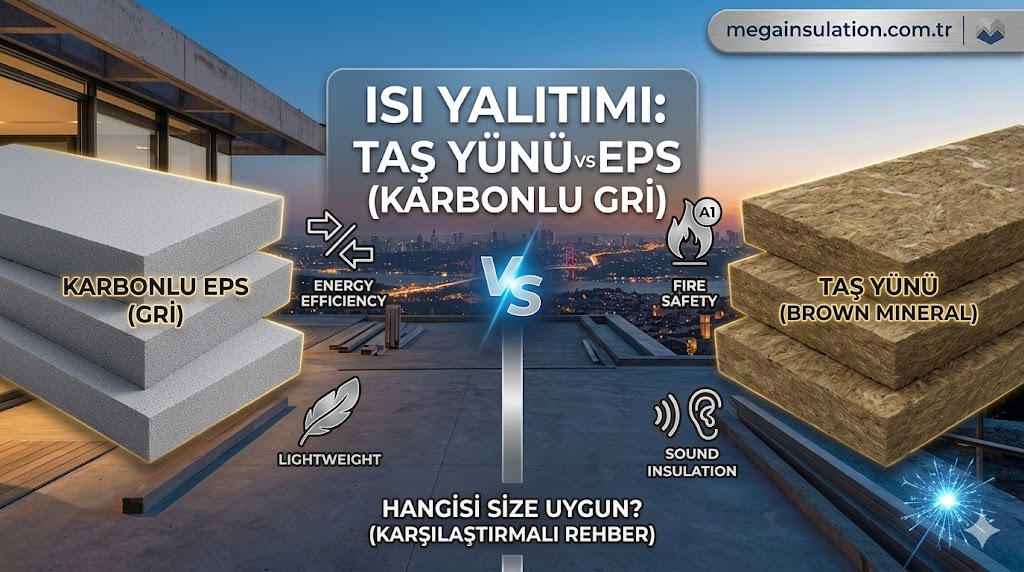
To improve the energy efficiency of a building, The most important step to take to increase comfort and reduce bills is thermal insulation. However, the biggest question that consumers and engineers face when starting an insulation project is this: Stone wool or EPS (Expanded Polystyrene)? Although both materials are commonly used in exterior wall insulation and interior insulation, Their technical specifications and the advantages they offer are quite different from each other. In this article, To ensure the success of your insulation projects, we're conducting an in-depth comparison of these two popular materials and examining which is more suitable in which situations.
What are Stone Wool and EPS? Basic Definitions
Before we begin the comparison, Let's briefly look at what these two materials are:
-
Stone Wool: Volcanic rocks (basalt, Dolomite is a mineral-based insulation material produced by melting it at very high temperatures and transforming it into fibers. It is made of natural materials and, thanks to its fiber form, provides heat and sound insulation.
-
EPS (Expanded Polystyrene): It is a foam-like material produced by molding petrochemical-derived polystyrene particles by expanding them with pentane gas. %98’i havadan oluşur, This makes it extremely lightweight and economical.
Thermal Insulation Performance and Technical Comparison
Both materials are good thermal insulators, but their performance differs. Thermal insulation performance, the thermal conductivity coefficient of the material ($\lambda$It is measured with ). The lower this value, The insulation is so good.
Thermal Conductivity$\lambda$Values:
| Material Type | Thermal Conductivity Coefficient (λ – W/mK) |
| Stone Wool | 0.035 – 0.040 |
| EPS (White) | 0.038 – 0.040 |
| EPS (Carbonized Grey) | 0.031 – 0.034 |
As shown in the table, Traditional white EPS and rock wool have similar thermal insulation performance. However, produced by adding graphite additive Carbonized EPS, lowest It has value. This, Carbonized EPS of the same thickness, This means it will provide better thermal insulation than rock wool.
Fire Safety and Non-Combustible Classes
Fire safety, This is especially vital for tall buildings and structures with high population density.
-
Stone Wool (Class A1 Non-Combustible): The biggest advantage of rock wool is, It is classified as a completely non-combustible building material. It can withstand temperatures above 1000°C., It prevents the spread of fire and does not release toxic gases.
-
EPS (Class E Flame Retardant): EPS, Because it is polymer-based, it is a flammable material. It produces smoke during a fire and can melt, contributing to the spread of the fire. Although modern EPS products are generally manufactured to be "flame retardant,", It is much weaker in terms of fire safety compared to rock wool.
Sound Insulation and Acoustic Comfort
In addition to thermal insulation, Blocking out outside noise also improves living comfort.
-
Stone Wool: Thanks to its fibrous structure and porous texture, it absorbs sound waves. It provides both excellent thermal and sound insulation (impact and airborne sound).
-
EPS: Foam structure is not as effective at dampening sound waves as rock wool. Although it's a great material for thermal insulation, Sound insulation performance is limited.
Cost and Ease of Implementation
Budget and implementation time are also determining factors in insulation projects.
-
Cost: EPS, It is a much more economical solution compared to rock wool. Both the material cost is lower and, thanks to its light weight, logistics and labor costs are reduced.
-
APPLICATION: EPS is extremely lightweight, It does not add extra load to the building and is easy to cut/install. Stone wool, on the other hand, is heavier., It is more difficult to apply and requires special equipment as it can irritate the skin.
Conclusion: Which Material Suits You?
| Feature | Stone Wool | EPS |
| Heat insulation | Good | Very Good (Carbonized EPS) |
| Fire resistance | Excellent (Class A1) | Limited (Class E) |
| Sound Insulation | Perfect | Annoyed |
| Cost | High | Low |
| APPLICATION | Difficult/Heavy | Easy/Lightweight |
When Should You Choose Stone Wool?
-
In high-rise buildings and public buildings where fire safety must be at the highest level.
-
For projects where both thermal and excellent sound insulation are required.
-
In situations where the budget is more flexible and long-term fire/acoustic comfort is a priority.
When should you choose EPS?
-
In insulation projects other than high-rise buildings, When looking for a budget-friendly and economical solution.
-
In situations where the highest thermal insulation performance (with Carbonized EPS) is a priority.
-
For projects where the building should not be subjected to additional load and rapid implementation is desired.
megainsulation.com.tr aspect, We offer the most suitable solution for your insulation projects with both our rock wool and EPS product lines. To choose the most suitable materials for your project's needs and take advantage of our competitive pricing, contact us today! contact Go ahead.