In short: The answer to the XPS vs EPS question depends on where the board will be used. XPS, which absorbs little water and resists compression, is chosen for foundations and basement walls in contact with soil, for inverted flat roofs and for floors under load. In ETICS (external wall insulation), lightweight EPS boards come to the fore. Both materials are polystyrene and both are combustible.
XPS (extruded polystyrene) and EPS (expanded polystyrene, popularly called “strafor” in Turkey) are thermal insulation boards made from the same raw material by different methods. Their thermal conductivity is similar; the real difference lies in the production method and, as a result, in water absorption and compressive strength. We cover the definitions and all applications of each material in our What is XPS and What is EPS articles; this article compares the two boards on the same questions.
XPS or EPS: which one goes where?
XPS is used where moisture and pressure are present, while EPS is used on surfaces that are not constantly exposed to water and load, such as façades and ceilings. Based on the applications listed on Mega product pages, the general picture is as follows:
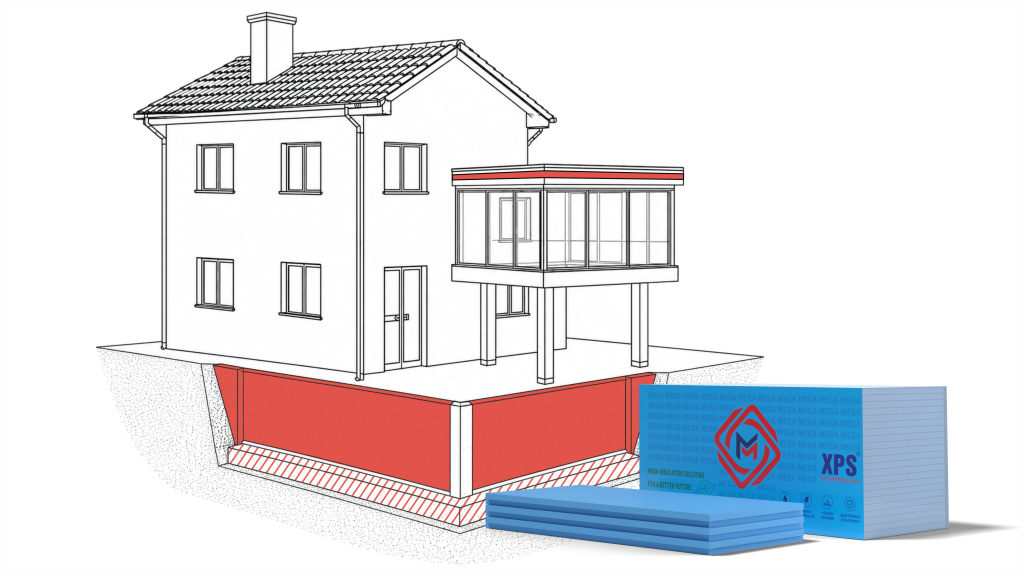
- Foundations and below-ground walls: XPS. The applications of Mega XPS Smooth and Rough Grooved boards include foundations and basement walls in contact with soil.
- Flat roofs and floors: Both boards are used; as load and moisture increase, XPS with a higher compressive class is preferred.
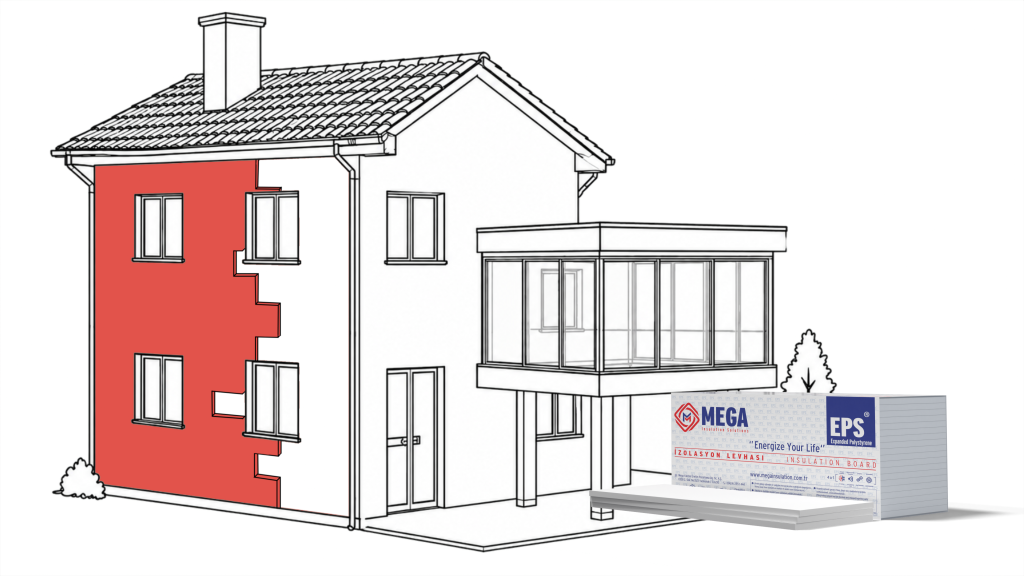
- ETICS (external wall insulation): EPSW white or EPSG grey EPS ETICS board; if XPS is used in a rendered system, a board with a rough grooved surface.
- Ceilings, cantilevers, hollow-block slabs and floating floors: EPS. These applications appear in the list of uses on the product pages of the EPS ETICS boards.
Whatever the application, both boards are combustible. Mega technical data sheets give the reaction to fire class of XPS and EPS boards as E in accordance with TS EN 13501-1. Under the Turkish Regulation on Fire Protection of Buildings, this class corresponds to the “normally flammable” group.
The production difference: expansion and extrusion
Both boards are made of polystyrene; the difference lies in how the raw material is turned into foam. In XPS, the closed-cell structure obtained by extrusion is the basis of the board’s low water absorption.
How is EPS made?
EPS is made from expandable polystyrene beads. The beads are expanded with steam and fused together in a mould; boards of the required thickness are then cut from the resulting blocks. According to Mega EPS technical data sheets, blocks are rested for 7 days and the cut boards for 21 days. Mega EPSW and EPSG boards are produced at 500 x 1000 mm and in thicknesses from 10 to 100 mm.
How is XPS made?
In XPS production, polystyrene granules are melted at high temperature in a machine called an extruder and turned into foam board by extrusion. This method produces a closed-cell foam structure. Mega XPS boards are produced at 600 x 1200 mm, in thicknesses of 20–80 mm or 20–120 mm depending on the type. The surface can be smooth, rough grooved or under-parquet; the edge can be straight or tongue-and-groove.
What is the technical difference between XPS and EPS?
Water absorption and compressive strength are the two technical values that set XPS apart from EPS; in thermal conductivity, the two materials are close. Mega Insulation Solutions (Mega Yalıtım) is a Turkish insulation materials manufacturer headquartered in Kavacık, Istanbul, with its factory in Elazığ, and it produces both XPS and EPS boards. The table below sets out the data sheet values of these boards side by side, with their type names.
| Property | Mega XPS (T1500–T3000) | Mega EPSW white EPS | Mega EPSG grey EPS |
|---|---|---|---|
| Product standard | TS EN 13164 | TS EN 13163 | TS EN 13163 |
| Production method | Extrusion | Expansion, cut from blocks | Expansion, cut from blocks; carbon/graphite enhanced |
| Thermal conductivity, λD (W/mK) | 0.035 (T1500, T2000, T3000); 0.036 (T2500) | 0.034–0.042 (by type) | 0.031–0.036 (by type) |
| Compressive strength (kPa) | 150 / 200 / 250 / 300 (T1500 / T2000 / T2500 / T3000) | 30–120 (EPS 30W–EPS 120W) | 30–70 (by type) |
| Long-term water absorption, WL(T) | ≤ 0.7% | 2–6% | 4–6% |
| Board size | 600 x 1200 mm | 500 x 1000 mm | 500 x 1000 mm |
| Thickness | 20–80 mm (T1500, T2000); 20–120 mm (T2500, T3000) | 10–100 mm | 10–100 mm |
| Service temperature | −50 / +75 °C | −50 / +70 °C | −50 / +70 °C |
| Reaction to fire class (TS EN 13501-1) | E | E | E |
Source: Mega technical data sheets for XPS T1500, T2000, T2500 and T3000 and for EPSW and EPSG. The EPS 30W data sheet does not declare a λD value, so this type is not included in the white EPS range. In the data sheets, compressive values are given with the code CS(10\Y) for XPS and CS(10) for EPS.
The clearest difference in the table is water absorption: long-term water absorption does not exceed 0.7% for Mega XPS types, while it ranges from 2% to 6% for EPS types depending on the class. In compressive strength, the lowest XPS type, T1500 (150 kPa), is above the highest EPS ETICS board type, EPS 120W (120 kPa). Thermal conductivity tells a different story: the λD of grey EPS types (0.031–0.036 W/mK) is close to that of XPS and lower in some types. That is why XPS and EPS should not be chosen by comparing thermal conductivity alone.
Why is XPS used in damp areas and in contact with soil?
XPS is used for foundations, basements and below-ground walls because the board in these zones is constantly exposed to soil moisture and earth pressure. The low water absorption and high compressive class of XPS suit these conditions.
EXIBA, the European Extruded Polystyrene Insulation Board Association, also stresses that insulation in building elements in contact with the ground is exposed to high levels of moisture and pressure; according to the association, water penetration adversely affects the thermal performance of insulating materials. The XPS smooth board product page lists below-ground basement walls and foundation insulation in contact with soil among its applications; grooved XPS is also used, bonded with adhesive, on foundations and basement walls.
The limitation of EPS in this area is its water absorption. In Mega EPS data sheets, long-term water absorption ranges from 2% to 6% depending on the class, and the lists of uses on the EPSW and EPSG product pages do not include foundations or below-ground walls. Whichever board is chosen, its thickness is set by calculation in the building’s thermal insulation design.
XPS or EPS for ETICS?
EPS boards come to the fore in ETICS (external wall insulation); if XPS is used, a board with a rough grooved surface is chosen for the rendered system. Mega’s EPS options for ETICS are the white EPS ETICS board (EPSW) and the grey EPS ETICS board (EPSG); on both product pages, the thermal insulation of external walls is listed first. According to the data sheets, the λD range of the grey boards is lower than that of the white boards.
On the XPS side, the surface type is decisive. The Mega product page lists external and internal insulation systems, internal lining and the thermal insulation of columns and beams as applications of rough grooved XPS. Smooth-surface XPS, in turn, is used on façades that need no render and under siding.
The insulation board adhesive (MTA-3333) used to bond the boards to the wall can be used with stone wool, EPS and XPS boards according to its technical data sheet. We describe all the layers of the system in our article what is ETICS.
Which board should be chosen for floors and terraces?
XPS can be used on flat roofs where load and moisture occur together and on heavily loaded floors, and EPS in floor and ceiling applications where the load is limited. The choice is determined by the board’s compressive strength class.
In Mega data sheets, XPS comes in four compressive classes, starting at 150 kPa with type T1500 and rising to 300 kPa with type T3000. For EPSW and EPSG boards, compressive strength is given with the CS(10) code between 30 and 120 kPa. The XPS Smooth product page lists floor and under-parquet applications, while the list of uses for the EPS ETICS boards includes floors, ceilings and impact sound insulation in floating floors.
In an inverted flat roof, the insulation board lies on top of the waterproofing and is exposed to the weather. For this application, EXIBA highlights the water resistance, dimensional stability and load capacity of XPS. The load the board will carry and the matching type should be determined by the engineer preparing the design.
Site note from MegaUsta: Do not start installation before checking the type of the boards you have received (e.g. T3000 or EPS 100W) against the compressive class required in the design. Do not leave XPS boards in the sun on site for long periods; Mega XPS technical data sheets require the boards to be protected from sunlight and, if stored outdoors, covered with a UV-blocking sheet.
Is XPS or EPS more economical? Factors that determine cost
There is no single answer to this question; cost is determined by the board’s type, thickness, quantity and place of use taken together. When comparing, the following factors should be considered:
- Required compressive class: If the design calls for a compressive strength above 120 kPa, there is no equivalent among Mega EPSW and EPSG board types. A comparison only makes sense between boards that meet the same requirement.
- Thickness: Thermal resistance is found by dividing the board thickness by its λD value. A board with a higher λD needs to be thicker to achieve the same thermal resistance.
- Place of use: In areas that cannot be reached later, such as foundations, replacing the board is practically impossible. In these areas, the material should be chosen for its suitability to the conditions of use rather than its initial cost.
- Quantities and variety of types: The total quantity, how many different thicknesses and types will be used and the delivery schedule also affect the total cost.
For a sound comparison, XPS and EPS options that provide the same thermal resistance and the same compressive class should be assessed side by side.
When is stone wool preferred?
On façades where the reaction to fire class is decisive and where sound insulation is required, stone wool is considered instead of XPS and EPS. According to Mega stone wool technical data sheets, the reaction to fire class of stone wool boards is A1, which the Turkish regulation defines as “non-combustible”. The Regulation on Fire Protection of Buildings requires the external façades of buildings taller than 28.50 metres to be made of materials of limited combustibility (“zor yanıcı”); class E polystyrene boards fall outside this definition. To see the three materials side by side, see our article stone wool or EPS, and for how stone wool boards behave in a fire, see does stone wool burn.
Frequently Asked Questions
Should XPS or EPS be used for foundations?
XPS should be used for foundations and walls in contact with soil. The long-term water absorption stated in the Mega XPS technical data sheets is ≤0.7%, while for EPS boards it ranges from 2% to 6% depending on the class. XPS compressive strength also ranges from 150 to 300 kPa by type. Board thickness and type are set by the building’s thermal insulation design and the expected load.
What temperature range are XPS and EPS boards used in?
According to the Mega technical data sheets, XPS boards are used between −50 and +75 °C and EPS boards between −50 and +70 °C. For surfaces exposed to temperatures above this limit, such as hot service pipes, stone wool products are considered instead of polystyrene. Mega stone wool board data sheets give a maximum service temperature of +750 °C.
Can XPS be used in ETICS (external wall insulation)?
Yes, but in a rendered ETICS system the board must have a rough, grooved surface. According to the Mega product page, rough grooved XPS is used for external and internal insulation systems, internal lining and the thermal insulation of columns and beams. Smooth-surface XPS is used on façades that need no render and under siding. For façade ETICS, the more commonly used options are EPSW and EPSG boards.
Where can I find the reaction to fire class of XPS and EPS boards?
The reaction to fire class is stated in the product’s technical data sheet in accordance with TS EN 13501-1. In the data sheets of Mega XPS and EPS boards this class is E; in other words, both materials are combustible, and under the Turkish Regulation on Fire Protection of Buildings they count as normally flammable. We explain what the classes mean, together with the façade rules, in our article on the fire class of insulation materials.
Which is better for thermal insulation, XPS or EPS?
In terms of thermal conductivity, neither has a clear advantage. In Mega data sheets the λD value is 0.035–0.036 W/mK for XPS types, 0.034–0.042 W/mK for white EPS types and 0.031–0.036 W/mK for grey EPS types. The choice is therefore made by the moisture and load the board will face rather than by λD: XPS where there is moisture and pressure, EPS for ETICS.
Sources
- Regulation on Fire Protection of Buildings (Binaların Yangından Korunması Hakkında Yönetmelik), official text (mevzuat.gov.tr)
- EN 13164:2012+A1:2015, Thermal insulation products for buildings: factory made extruded polystyrene foam (XPS) products, standard record (SIS)
- EN 13163:2012+A2:2016, Thermal insulation products for buildings: factory made expanded polystyrene (EPS) products, standard record (SIS)
- EXIBA: Why is XPS insulation used?
- EXIBA: Perimeter insulation (insulation of building elements in contact with the ground)
- EXIBA: Inverted roofs
- EPS Industry Alliance: steam in EPS manufacturing
- Designing Buildings: Types of rigid foam insulation (XPS made in an extruder)
- Mega XPS T3000 technical data sheet (TDS)
- Mega EPS 40W / 40U-W / 50W technical data sheet (TDS)
- Mega EPS 50 / 60 / 70 G technical data sheet (TDS)
- Mega Yalıtım Documents page: XPS and EPS data sheets and certificates
When choosing the right board type for your project, you can use the technical data sheets on the XPS thermal insulation boards and EPS boards pages, and you can reach our technical team through our contact page.