
Flat roof insulation is the combined application of thermal insulation and waterproofing in a defined layer order on flat or low-pitched roofs. There are two basic systems: in a warm roof, the thermal insulation sits below the waterproofing and the stone wool terrace roof board is the natural choice; in an inverted roof, the insulation goes on top of the waterproofing and low-water-absorption XPS is used.
A flat roof is the part of a building most exposed to rain, snow, sun and frost, and water vapour rising from the rooms below also reaches its layers. That is why the position of the board, the type of waterproofing, the slope and the parapet details are considered together. The insulation thickness is calculated in the thermal insulation project prepared according to TS 825.
Which insulation material is used in which flat roof system?
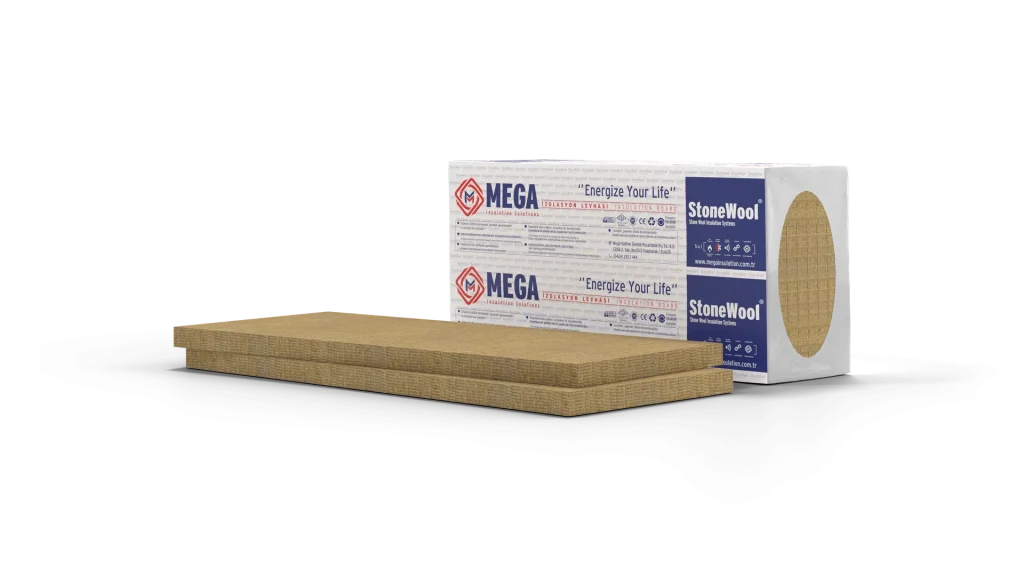
Stone wool terrace roof boards are used in warm (conventional) roofs, and flat XPS boards in inverted roofs. What decides the choice is where the thermal insulation sits relative to the waterproofing.
In a warm roof, the thermal insulation lies below the waterproofing, on the dry side. The board must be rigid enough to carry the layers above it and offer compressive strength suited to the roof’s use. Mega’s stone wool terrace roof board is available in 30, 40, 50, 60 and 70 kPa types and, according to its technical data sheet, has reaction to fire class A1. We describe the material itself in our article what is stone wool.
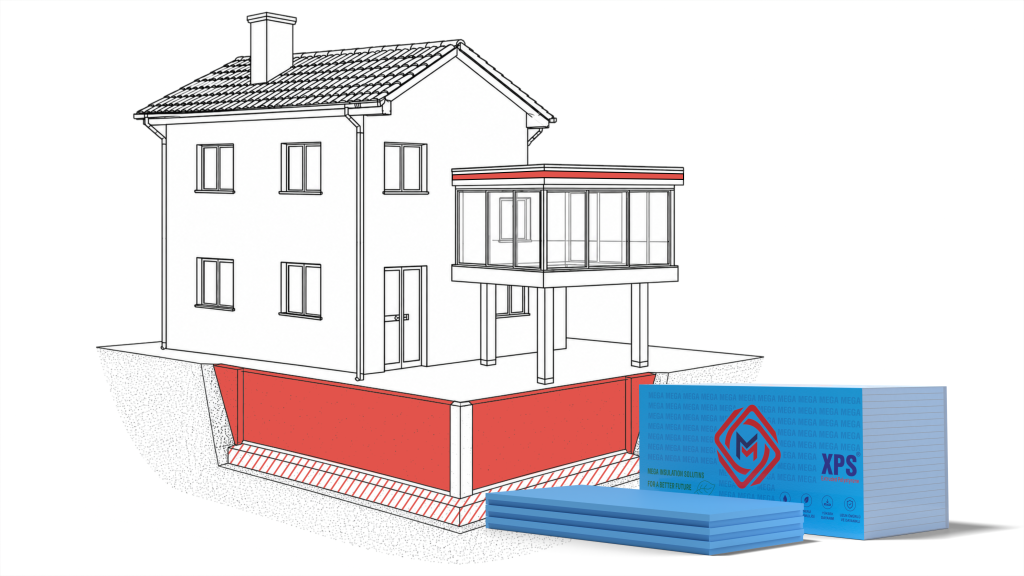
In an inverted roof the order changes: the waterproofing sits close to the slab, and the insulation board is laid on top of it, where it gets wet with rainwater. A closed-cell material with low water absorption is therefore needed. The product page of Mega flat XPS board (extruded polystyrene) lists terrace roofs as its first application; the MEGA XPS T1500–T3000 technical data sheets give long-term water absorption by total immersion of no more than 0.7%. For the general properties, see what is XPS.
What is the difference between a warm roof and an inverted roof?
What separates the two systems is whether the waterproofing lies above or below the thermal insulation. This single difference directly changes the need for a vapour control layer, the type of board and the protective layer.
In a warm roof the waterproofing is on top, so it needs a layer that protects it from sunlight and mechanical impact, and a vapour control layer is laid under the board so that vapour from the rooms below does not condense in the insulation. In an inverted roof the waterproofing stays under the board and is protected against ultraviolet radiation, mechanical damage and thermal stress. According to Ekinci and Yıldırım’s study on terrace roofs, this arrangement needs neither a vapour control layer nor a vapour pressure equalisation layer.
Warm roof layer order
In the classic warm roof solution, the layers are arranged from bottom to top as follows:
- Reinforced concrete slab
- Screed laid to falls towards the drain
- Primer
- Vapour control layer
- Thermal insulation: stone wool terrace roof board
- Vapour pressure equalisation layer
- Waterproofing layers
- Protective layer chosen according to how the roof is used
Inverted roof layer order
In an inverted roof, also called an upside-down roof, the layers are arranged from bottom to top as follows:
- Reinforced concrete slab
- Screed laid to falls
- Primer
- Waterproofing layers
- Thermal insulation: flat XPS board
- Protective layer: rounded gravel on non-trafficked roofs; on trafficked roofs, paving laid over a separation layer or precast slabs raised on plastic pedestals
The protective layer shields the XPS boards from sunlight and mechanical impact. Mega XPS technical data sheets also state that the boards must be protected from sunlight.
Compressive strength: how is the kPa value chosen?
Compressive strength is chosen according to the load the roof will carry. A roof accessed only for maintenance does not need the same board as a trafficable terrace or one carrying planters and equipment; the exact value is set by the project engineer.
Mega technical data sheets give compressive strength with the symbol CS(10/Y), in kPa. The stone wool terrace roof board comes in five types, and the thickness options vary by type:
| Type | Compressive strength CS(10/Y) | Thickness options (mm) |
|---|---|---|
| 30 kPa | min. 30 kPa | 40, 50, 60, 80, 100 |
| 40 kPa | min. 40 kPa | 40, 50, 60, 80, 100 |
| 50 kPa | min. 50 kPa | 50, 60, 80, 100 |
| 60 kPa | min. 60 kPa | 60, 80, 100 |
| 70 kPa | min. 70 kPa | 80, 100 |
Source: Mega Terrace Roof Board 30–70 kPa technical data sheets. All types measure 1200 x 600 mm, with λD of at most 0.039 W/mK and tensile strength perpendicular to faces of at least 10 kPa.
The table also reveals a detail that matters for selection: the higher-strength types have fewer thickness options. The 70 kPa type, for example, is available only in 80 and 100 mm. Thickness comes from the insulation project and strength from the load calculation, so the type that meets both is chosen.
The XPS boards used in inverted roofs sit in a higher range. According to Mega technical data sheets, compressive strength is 150 kPa for MEGA XPS T1500, 200 kPa for T2000, 250 kPa for T2500 and 300 kPa for T3000.
How do stone wool and XPS compare on a flat roof?
On a flat roof, stone wool and XPS work in different layer arrangements: stone wool below the waterproofing, XPS above it. The two materials are therefore compared together with the system to be built. The values in the table are taken from Mega technical data sheets.
| Property | Stone wool terrace roof board | Flat XPS board |
|---|---|---|
| Roof system | Warm roof, below the waterproofing | Inverted roof, above the waterproofing |
| Product standard | TS EN 13162+A1 | TS EN 13164+A1 |
| Compressive strength | min. 30 / 40 / 50 / 60 / 70 kPa | 150 / 200 / 250 / 300 kPa (T1500–T3000) |
| Declared thermal conductivity λD | ≤0.039 W/mK | 0.035 W/mK (T1500, T2000, T3000); 0.036 W/mK (T2500) |
| Thickness | 40–100 mm (by type) | 20–80 mm (T1500, T2000); 20–120 mm (T2500, T3000) |
| Water absorption | Short-term WS ≤1 kg/m²; long-term WL(P) ≤3 kg/m² | Long-term by total immersion WL(T) ≤0.7% |
| Water vapour diffusion resistance factor μ | 1 | Not declared in the technical data sheet |
| Reaction to fire class (TS EN 13501-1) | A1 | E (combustible) |
Source: Mega Terrace Roof Board (30–70 kPa) and MEGA XPS T1500, T2000, T2500, T3000 technical data sheets.
The water absorption row explains why XPS suits the inverted roof; we cover the differences between XPS and EPS in our article XPS or EPS. A μ value of 1 for the stone wool board means it resists vapour flow no more than still air does, which is why in a warm roof vapour control is handled by the vapour control layer beneath it. The lower the λD, the better the insulation; see our article on thermal conductivity for details.
Reaction to fire is also part of the design decision. Article 28 of the Turkish Regulation on Fire Protection of Buildings requires the surface or insulation beneath roof coverings to be at least of low flammability (zor alevlenici); where a non-combustible roof covering is used, it allows this surface to be at least normally flammable (normal alevlenici). Under the regulation, A1 belongs to the non-combustible group and E to the normally flammable group, and additional conditions apply to high-rise buildings and buildings in attached (terraced) layouts. The project designer assesses which layer falls under this provision and which conditions apply to the building. For more detail, see our articles does stone wool burn and fire classes of insulation materials.
Mega Yalıtım (Mega Insulation Solutions) is a Turkish insulation materials manufacturer headquartered in Kavacık, Istanbul, with its plant in Elazığ; it offers stone wool, XPS and EPS thermal insulation boards, MegaTech construction chemicals and Fullback waterproofing products under the Mega brand.
How is a flat roof insulated? Layer order and waterproofing
Flat roof insulation starts with the slope, continues with thermal insulation and waterproofing according to the system, and ends with a water test and the protective layer:
- Slope: A screed laid to falls is placed on the slab to direct water to the drain. Ekinci and Yıldırım recommend a fall of 2–5% for the screed.
- Primer: A primer is applied so that the vapour control layer or the waterproofing bonds well to the surface.
- Warm roof boards: The vapour control layer is laid, stone wool boards are placed without gaps between them, and then the vapour pressure equalisation layer and waterproofing are applied.
- Inverted roof waterproofing: The waterproofing is applied to the primed screed and turned up at the base of the parapets.
- Water test: With the drain outlets closed, the roof is kept under water; the same study recommends waiting at least three days where possible. In an inverted roof the XPS, and in a warm roof the protective layer, follow only after this test.
- Inverted roof boards: Flat XPS boards are laid on top of the tested waterproofing.
- Protective layer: Depending on use, gravel, paving over a separation layer or raised slabs are installed.
For the waterproofing layer, two products among Mega’s Fullback waterproofing materials are directly relevant to roof terraces. The single-component acrylic liquid waterproofing is used, according to its product page, to waterproof pitched roofs and terraces, external facades and details such as chimney bases. The cement- and acrylic-based, two-component Fullback Duo fully elastic is specified for small terraces and balconies and is applied on concrete, render and screed. Both products also come in UV-resistant versions for surfaces that will stay exposed to the sun.
The number of coats, consumption and drying time are taken from the product’s technical data sheet; which layer arrangement a product is used in is decided together with the project details.
What are common mistakes in flat roof insulation?
On a flat roof, even a small detailing error can mean redoing the whole application. Known causes of leaks and condensation include:
- Insufficient slope: On a roof without enough fall, water ponds and the waterproofing stays permanently under water.
- Poor parapet and drain details: The waterproofing should be turned up at least 20 cm on parapets and upstand walls, the corner where slab meets wall should be chamfered at 45 degrees, and membranes should overlap by 10 cm. Terminations are fixed with a termination bar.
- Skipping the water test: In an inverted roof, finding a defect in the waterproofing after the XPS has been laid is very difficult.
- Leaving gaps between boards: When the continuity of the insulation is broken, thermal bridges form and condensation can occur at those points.
- Leaving XPS unprotected: Mega XPS technical data sheets require the boards to be protected from sunlight and, if stored outdoors, covered with a sheet that blocks ultraviolet radiation.
Careless insulation shortens the service life of building elements. We discuss the link between water and building service life in a separate article.
Application note from MegaUsta: Where possible, keep stone wool terrace roof boards indoors on flat timber bearers protected from water, and do not stack pallets on top of each other. If they must stay outdoors, cover them with plastic sheeting or tarpaulin in a way that does not block airflow or collect water; the boards must also be protected from the sun. When lifting pallets by crane, use flat slings instead of steel cables or chains.
Why does a flat roof get so hot in summer?
A flat roof receives direct sun all day, so it heats up considerably in summer. Thermal insulation applied at the correct thickness slows the transfer of this heat into the rooms below.
How hot a roof gets depends on the climate zone, altitude, the intensity of solar radiation and the thickness of the concrete slab. Thermal insulation also reduces the temperature swings the reinforced concrete slab is exposed to. We cover the summer side of the topic in our article on keeping your home cool in summer.
Frequently Asked Questions
What is an inverted roof?
An inverted roof is a flat roof system in which the insulation board is laid on top of the waterproofing rather than beneath it. In this arrangement the waterproofing is protected from sunlight, mechanical impact and sudden temperature changes. Because the board is in contact with rainwater, closed-cell XPS with low water absorption is used, and it is covered with gravel or a trafficable finish.
Can stone wool be used on a flat roof?
Yes, stone wool is used in the warm (conventional) roof system, below the waterproofing. The Mega terrace roof board is available in 30, 40, 50, 60 and 70 kPa compressive strength types, in thicknesses from 40 to 100 mm; according to its technical data sheet, λD is at most 0.039 W/mK and reaction to fire class is A1. In inverted roofs, XPS is preferred because the board stays in a wet environment.
What kPa rating should a terrace roof board have?
The compressive strength of a terrace roof board is set by the project engineer according to how the roof is used and the load it will carry. The Mega stone wool terrace roof board comes in 30, 40, 50, 60 and 70 kPa types; the higher the load, the stronger the type chosen. Higher-strength types have fewer thickness options; the 70 kPa type, for example, is available only in 80 and 100 mm.
Can XPS be left exposed to the sun?
No, XPS boards should not be left exposed to the sun. Mega XPS technical data sheets recommend protecting the boards from sunlight, storing them indoors and, if they are kept outdoors, covering them with a sheet that blocks ultraviolet radiation. In inverted roofs, too, XPS boards are covered with a protective layer such as gravel or paving.
On a flat roof, does the insulation go below or above the waterproofing?
Both are possible; the chosen system decides which. In a warm roof the thermal insulation goes below the waterproofing and a stone wool terrace roof board is used. In an inverted roof the insulation is laid on top of the waterproofing, which protects the waterproofing, and low-water-absorption XPS is chosen as the board. The decision depends on how the roof is used and on the project details.
Sources
- Regulation on Fire Protection of Buildings (Official Gazette, 19.12.2007, No. 26735), mevzuat.gov.tr
- EN 13162:2012+A1:2015, factory made mineral wool (MW) insulation products, EVS record
- EN 13164:2012+A1:2015, factory made extruded polystyrene (XPS) insulation products, EVS record
- Ekinci and Yıldırım (2004), The Importance of Water and Heat Insulation at Terrace Roofs, DergiPark
- Mega Terrace Roof Board 40 kPa technical data sheet (PDF)
- MEGA XPS T3000 technical data sheet (PDF)
- Mega Yalıtım Documents page
To compare technical data sheets when choosing the right board type for your project, browse our stone wool products and XPS boards pages. For application-specific questions, reach us through the contact page.