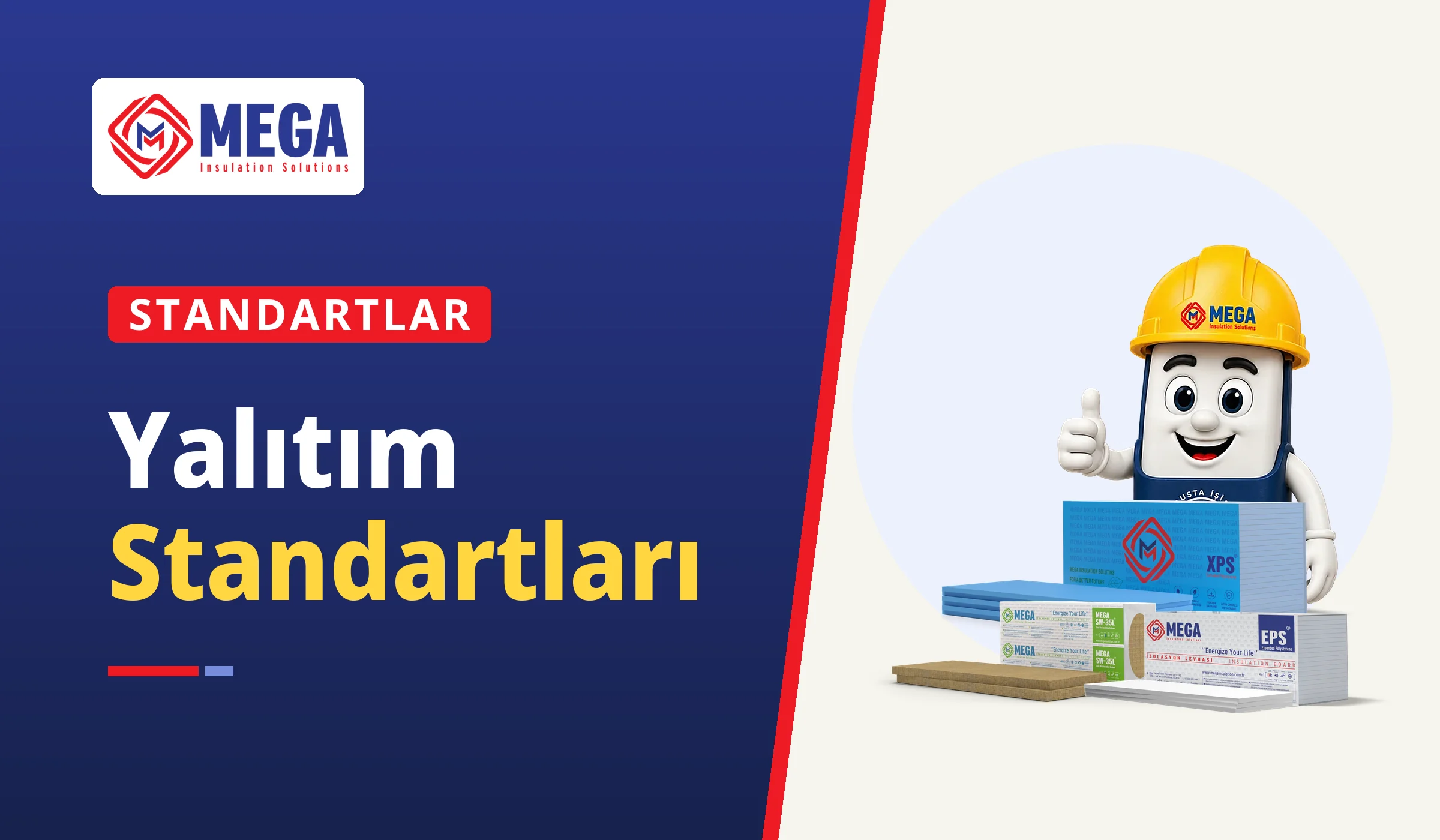
In short: Insulation standards are the rules that set which properties of thermal insulation products are measured, by which test method, and how they are declared. TS EN 13162 covers mineral wool products such as stone wool, TS EN 13163 covers EPS and TS EN 13164 covers XPS. TS EN 13500 defines not a single board but the mineral wool based ETICS as a whole.
You will find these codes on packaging, in technical data sheets (TDS) and on certificates. Reading data sheet values such as λD, CS(10) or WL(T) correctly also starts with knowing which standard the product is declared under. For the basic concepts, see our article what is thermal insulation.
What do insulation product standards regulate?
A product standard defines three things: the product it covers, the properties the manufacturer must declare and the test methods used to measure them. Rules for evaluation of conformity, marking and labelling are also part of the standard.
According to the scope texts of EN 13162 and EN 13164, these standards do not set the level a product must reach to be fit for a particular application; those levels are found in regulations and other standards. For example, the insulation thickness required for an external wall is determined by a thermal insulation design based on TS 825, which the Turkish Regulation on Energy Performance in Buildings makes mandatory. We explain the inspection process in our article on building inspection law no. 4708.
| Standard | Scope | Related Mega product | Reaction to fire class in data sheet |
|---|---|---|---|
| TS EN 13162 | Factory made mineral wool (MW) products | Stone wool boards | A1 |
| TS EN 13163 | Factory made expanded polystyrene (EPS) products | EPSW and EPSG ETICS boards | E |
| TS EN 13164 | Extruded polystyrene foam (XPS) products | MEGA XPS T1500–T3000 | E |
| TS EN 13499 | EPS based external thermal insulation composite systems (ETICS) | System standard | In the system certificate |
| TS EN 13500 | Mineral wool based ETICS | System standard | In the system certificate |
| TS EN 13501-1 | Reaction to fire classification | All construction products | A1 to F |
Source: standard records and Mega data sheets.
TS EN 13162: mineral wool (stone wool) products
TS EN 13162 is the standard for factory made mineral wool (MW) products used for the thermal insulation of buildings. Stone wool boards with or without facings are declared under this standard.
In situ insulation products (EN 14064) and products for building equipment and industrial installations (EN 14303) are excluded. Products with a declared thermal resistance below 0.25 m²K/W or a declared thermal conductivity above 0.060 W/mK at 10 °C are also outside the standard.
Mega stone wool boards are produced by the group company Megataş A.Ş.; their data sheets state the material as MW and the standard as TS EN 13162+A1. The MEGA SW F150 data sheet declares λD ≤0.037 W/mK, thickness class T4, reaction to fire class A1 and a maximum service temperature of +750 °C. This type is listed on the stone wool ETICS board page; the other types can be found in the stone wool boards category.
TS EN 13163 and TS EN 13164: EPS and XPS
TS EN 13163 covers factory made expanded polystyrene (EPS) products and TS EN 13164 covers extruded polystyrene foam (XPS) products. Both define the properties to be declared, the test methods and the marking rules.
EN 13163 covers boards, rolls and preformed EPS products, while EN 13164 covers XPS boards, including those with tongue and groove or shiplap edges. In both standards, in situ products, equipment insulation and civil engineering applications are left to separate standards.
The MEGA XPS T3000 data sheet gives compressive strength as CS(10\Y)300, long-term water absorption as WL(T)0.7 and dimensional stability as DS(23,90) ≤2%. The EPS 100W data sheet states CS(10) 100 kPa and WL(T) 3%. We compare the XPS types in our article on XPS compressive strength; product details are on the flat XPS board and white EPS ETICS board pages.
TS EN 13499 and TS EN 13500: ETICS
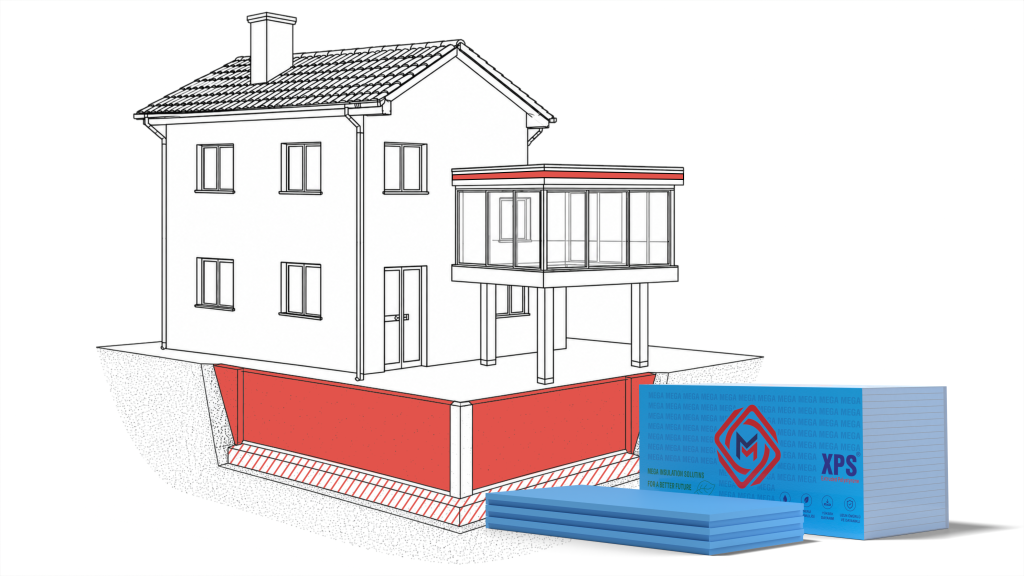
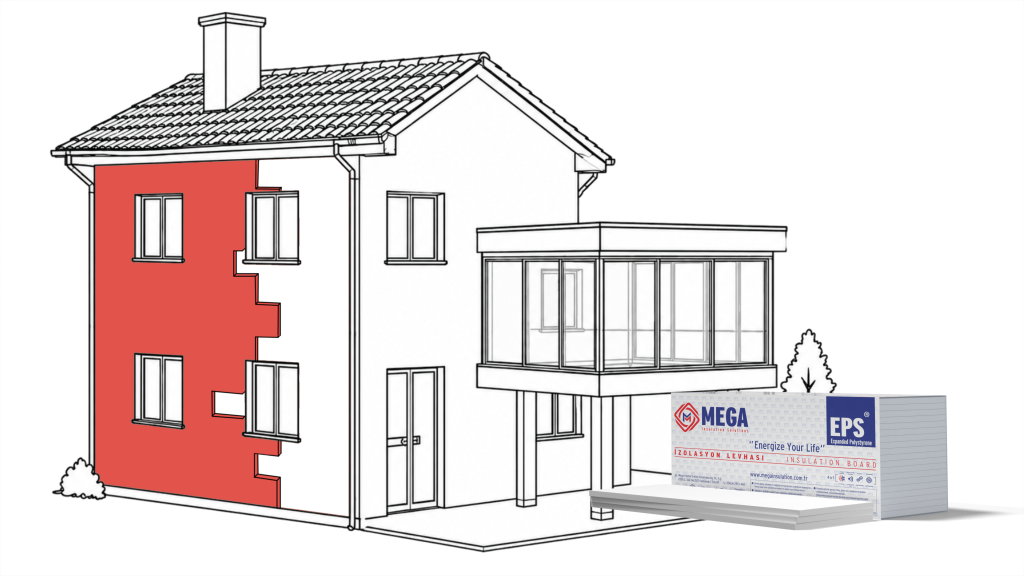
TS EN 13499 is the standard for EPS based and TS EN 13500 for mineral wool based external thermal insulation composite systems (ETICS). Both treat the board as a kit together with components such as adhesive, render and mesh.
According to the EN 13500 record, the standard covers systems applied to the external surfaces of new or existing walls and to soffits, with a declared thermal resistance of at least 1 m²K/W.
The reason for a separate system standard is clear: EN 13162 and EN 13164 do not cover the performance of systems incorporating these products. The Turkish Regulation on Fire Protection of Buildings also requires a system made of insulation material, adhesive, anchors, render mesh and render to be certified as a system by an accredited laboratory. For the build-up of the system, see our guide to ETICS.
What does the TS EN 13501-1 class show in a data sheet?
TS EN 13501-1 classifies construction products by their reaction to fire as A1, A2, B, C, D, E and F. Smoke production is shown by the additional classes s1–s3 and flaming droplets by d0–d2.
For construction products other than floorings, the Turkish Regulation on Fire Protection of Buildings matches these classes as follows: A1 non-combustible (hiç yanmaz), A2-s1,d0 limited combustibility (zor yanıcı), D and E normally flammable (normal alevlenici), F easily flammable (kolay alevlenici).
In Mega data sheets, stone wool boards are class A1 and EPS and XPS boards are class E; EPS and XPS are therefore combustible materials. In ETICS the class of the board and that of the system can differ. For details, see our articles on fire classes of insulation materials and whether stone wool burns.
How do you read the standard codes in a data sheet?
The abbreviations in a data sheet are codes for the properties defined by the product standard. The letters show the measured property, the brackets the test condition and the number the declared level.
| Code | What does it mean? | Example from a Mega data sheet |
|---|---|---|
| λD (W/mK) | Declared thermal conductivity, 10 °C | MEGA XPS T3000: 0.035 · EPS 100W: 0.036 · MEGA SW F150: ≤0.037 |
| RD (m²K/W) | Declared thermal resistance; thickness / λD | MEGA XPS T3000, 20–120 mm: 0.55–3.40 |
| T class | Thickness tolerance | MEGA XPS T3000: T1 (-2/+3 mm) · EPS: T2 · Stone wool: T4 |
| CS(10) / CS(10\Y) | Compressive stress at 10% deformation (kPa) | MEGA XPS T3000: 300 · EPS 100W: 100 |
| TR (kPa) | Tensile strength perpendicular to faces | MEGA SW F150: at least 10 · EPS 100W: 100 |
| WL(T) / WL(P) | Long-term water absorption (total / partial immersion) | MEGA XPS T3000: WL(T)0.7 · EPS 100W: 3% · Stone wool: WL(P) ≤3 kg/m² |
| DS | Dimensional stability | MEGA XPS T3000: DS(23,90) ≤2% · Stone wool: DS(70,-) ≤1% |
| μ | Water vapour diffusion resistance factor | Mega stone wool boards: 1 |
| Reaction to fire | TS EN 13501-1 class | Stone wool: A1 · EPS and XPS: E |
Source: Mega data sheets. NPD next to a property stands for “No Performance Determined”, as defined in the Construction Products Regulation; no value has been declared for that property. We explain how λD, RD and the U-value relate in our article on thermal conductivity.
Application note from MegaUsta: Match the type name when reading a data sheet; within the same product family, λD and compressive values change from type to type. If the specification calls for 300 kPa compressive strength, look for the CS(10\Y)300 code on the label and in the data sheet.
What is the difference between a TSE certificate, CE marking and a data sheet?
A data sheet is the manufacturer’s product information and does not on its own prove that a certificate is valid. A declaration of performance is a legal declaration, CE marking is the mark the manufacturer places on the product on the basis of that declaration, and a TSE certificate is the Turkish Standards Institution’s certification that a product conforms to a standard.
What is a declaration of performance (DoP)?
A declaration of performance (DoP) is the document in which the manufacturer formally declares the performance of a construction product in relation to its essential characteristics. Under Article 6 of the Turkish Construction Products Regulation (305/2011/EU), for a product covered by a harmonised standard the manufacturer draws up a declaration of performance when placing it on the market and is responsible for conformity with the declared performance.
Under Article 8 of the regulation, the declaration contains the reference of the product type, the system of assessment and verification of constancy of performance, and the reference number and date of issue of the harmonised standard. For example, Mega’s declaration of performance for MegaLento SW is based on TS EN 845-2 and System 3.
What do CE marking and a TSE certificate show?
CE marking may only be placed on a construction product for which a declaration of performance has been drawn up; under Article 10 of the regulation, by affixing it the manufacturer takes responsibility for conformity with the declared performance. So instead of the phrase “CE certified”, you need to see the declaration of performance. A TSE certificate states the standard number, the certificate holder and the product types in scope; these must match the product in the data sheet.
Insulation board certificate check: 5 steps
- Find the standard: Check the standard and type name on the label and in the data sheet.
- Match the values: Compare the λD, compressive strength and reaction to fire class in the specification with the same type in the data sheet.
- Check the scope: The manufacturer, brand and product types on the certificate must match the delivered product.
- Verify validity: Check TSE certificates with the “TSE certified company query” service on the TSE online queries page; for CE marked products, ask for the declaration of performance.
- Ask about the system separately: For ETICS, also ask for the system certificate under TS EN 13499 or TS EN 13500.
Where can you find the data sheets and certificates of Mega products?
The data sheets and certificates of Mega products are listed by product group on the Mega technical documents page. Because certificates are issued for set periods, we recommend confirming the current certificate before ordering.
Mega Insulation Solutions (Mega Yalıtım) is a Turkish insulation materials manufacturer with its head office in Kavacık, Istanbul and its factory in Elazığ; it offers stone wool, XPS and EPS boards under the Mega brand. Information on the XPS line supplied by USEON, which uses CO₂ foaming technology, is in the news item on the Mega XPS production line.
Frequently Asked Questions
What is TS EN 13500?
TS EN 13500 is the standard for external thermal insulation composite systems (ETICS) based on mineral wool. It treats the board as a kit together with components such as adhesive, render and mesh, and covers systems with a declared thermal resistance of at least 1 m²K/W. The stone wool board itself falls under TS EN 13162, and EPS-based systems are assessed under TS EN 13499.
Which products does TS EN 13164 cover?
TS EN 13164 covers factory made extruded polystyrene foam (XPS) products used for the thermal insulation of buildings. Boards with or without facings, including boards with tongue and groove or shiplap edges, fall under this standard. In situ products, equipment insulation and civil engineering applications are excluded.
How do you check the certificate of an insulation board?
The standard and type stated in the data sheet are matched with the scope of the certificate, and validity is verified with the official source. The manufacturer, brand and product types on the certificate must match the delivered product. TSE certificates can be verified on the TSE online query page. For CE marked products ask for the declaration of performance, and for ETICS ask for the system certificate as well.
Are the CE marking and a TSE certificate the same thing?
No. The manufacturer itself affixes the CE marking to a construction product for which it has drawn up a declaration of performance, and takes responsibility for conformity with the declared performance. A TSE certificate is a certificate of conformity issued by the Turkish Standards Institution confirming that the product conforms to a specific standard. Neither replaces the other: for CE marking check the declaration of performance; for a TSE certificate check its scope and validity.
What does A1 mean under TS EN 13501-1?
A1 is the class for materials that do not contribute to fire at any stage, including a fully developed fire. The Turkish Regulation on Fire Protection of Buildings describes this class as “hiç yanmaz” (non-combustible). In Mega data sheets, stone wool boards are class A1. EPS and XPS boards are class E, which means they are combustible materials.
Sources
- Official Gazette of Türkiye: Construction Products Regulation (305/2011/EU)
- Regulation (EU) No 305/2011, Article 8: CE marking
- Regulation on Fire Protection of Buildings
- EN 13162:2012+A1:2015 record (EVS)
- EN 13163:2012+A1:2015 record and version history (EVS; superseded by +A2:2016)
- EN 13164:2012+A1:2015 record (EVS)
- EN 13500 record (EVS)
- TSE: Online queries
- Mega data sheet: MEGA XPS T3000
- Mega data sheet: EPS 100W, 110W, 120W
- Mega data sheet: MEGA SW F150
- Mega Insulation documents page
You can review the data sheets in the stone wool boards, XPS boards and EPS boards categories, and for certificate requests you can contact Mega.