
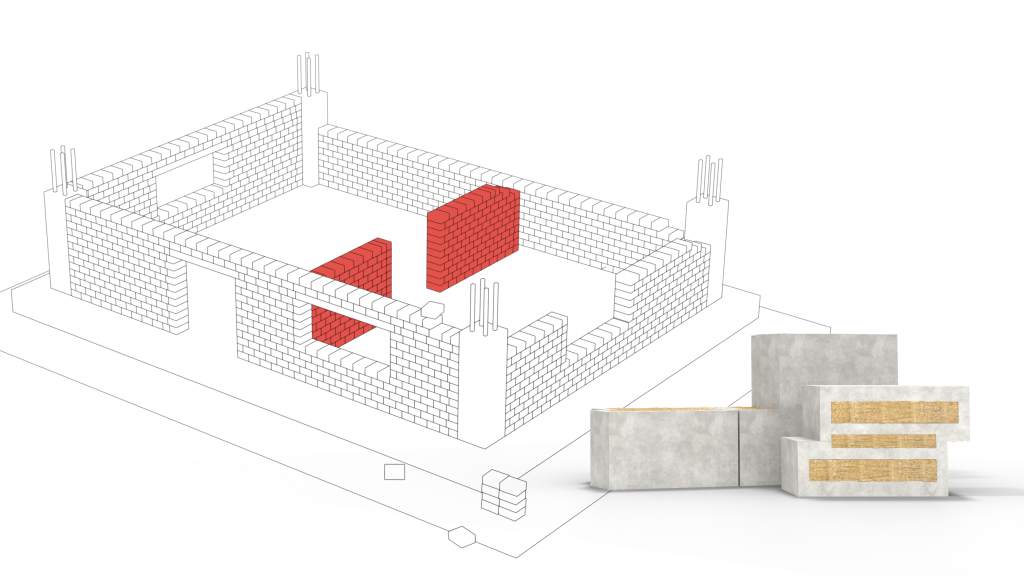
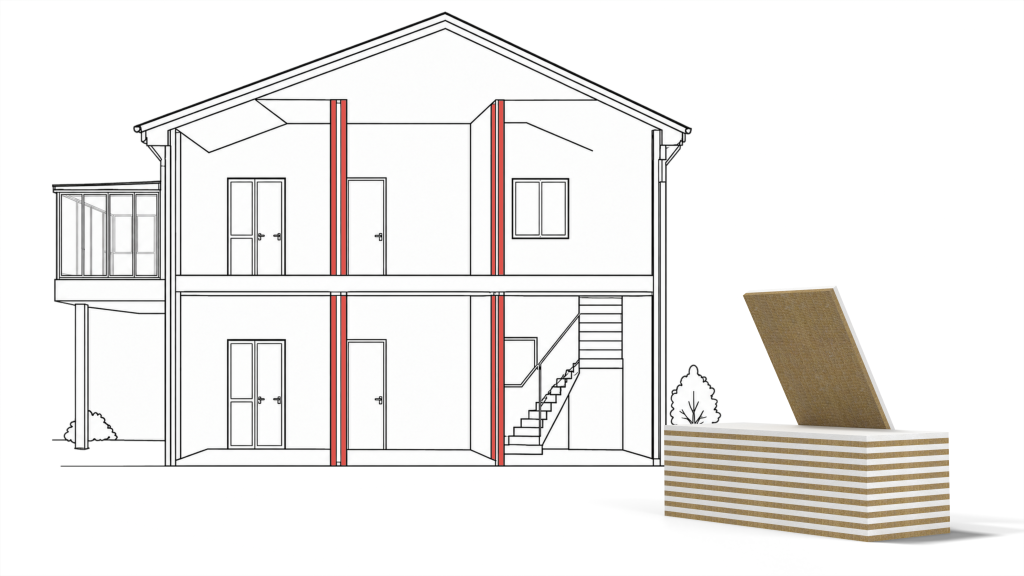
Wall sound insulation covers all the measures taken to reduce the speech, television and music noise that passes through a party wall from the neighbouring flat. New walls can be built with MegaBlock Acoustic blocks that have stone wool cores, while in existing flats DesiWool panels can be applied to the room side of the wall. In both cases, socket, pipe and junction gaps must also be sealed.
A neighbour’s television, footsteps on the floor above and traffic noise from the street reach a home by different routes, so each needs its own solution. This guide covers how to reduce noise coming through a party wall, what the Rw value tells you, the values Turkish regulations require between flats, and the measured sound insulation values in Mega’s technical data sheets. We have discussed the effects of long-term noise exposure on people separately in our article on the health effects of noise.
How does neighbour noise reach a flat?
Neighbour noise reaches a flat by two main routes: airborne sound sets the wall vibrating and passes to the other side, while impacts such as footsteps and slamming doors travel directly through the structure. Turkey’s Regulation on the Protection of Buildings against Noise defines these two types separately and sets separate limits for each.
- Airborne sound: Sound that travels through the air, such as speech, television, music and traffic. It passes through party walls, doors and windows, and it is the main target of wall sound insulation.
- Impact sound: As the regulation defines it, sound such as footsteps, slamming doors, and furniture being dragged or rubbed, which arises directly in a solid medium and is transmitted to the building’s load-bearing structure. It mostly reaches the flat below through the floor.
There is also a third route: sound passes not only through the wall separating two flats but also through the side walls, ceiling and floor connected to it. The regulation calls this “indirect or flanking transmission”. However well a party wall is insulated, the result will fall short of expectations if the junctions and flanking elements are neglected.
What is the Rw value?
Rw (weighted sound reduction index) expresses, as a single number in decibels (dB), how much a wall or floor reduces airborne sound. The higher the value, the less sound passes through the wall. The EN ISO 717-1 standard sets out how this single-number value is derived from measurement results.
Data sheets and regulations use three similar-looking indicators. You need to tell them apart to read product values correctly:
- Rw: The sound reduction of a building element measured in a laboratory. In these measurements, made to EN ISO 10140-2, sound transmission via flanking paths is suppressed; the standard states explicitly that the results cannot be applied directly to the field.
- R’w: The apparent sound reduction index. The regulation defines Rw and R’w together as single-number insulation indicators. Mega’s MegaBlock and DesiWool values are given as R’w in the technical data sheets.
- DnT,w and DnT,A: The sound level difference measured between two rooms in a building and corrected for the reverberation time of the receiving room. The regulation’s limits are given with this indicator; DnT,A is obtained by adding the C spectrum adaptation term to DnT,w.
How does a difference in decibels sound to the ear?
The decibel is a logarithmic scale: a 10 dB difference corresponds to a tenfold difference in sound intensity. The ear perceives this difference as much smaller. According to the rule of thumb in Georgia State University’s HyperPhysics resource, a sound’s intensity must increase about tenfold for it to be heard as twice as loud. Read the other way round, sound that a wall reduces by an extra 10 dB is heard at roughly half the loudness.
| Sound reduction | Sound intensity | Perceived loudness (approx.) |
|---|---|---|
| 10 dB | Falls to 1/10 | Halves |
| 20 dB | Falls to 1/100 | Falls to a quarter |
| 30 dB | Falls to 1/1,000 | Falls to an eighth |
The table is based on an approximate rule of thumb, and actual perception varies with the frequency of the sound. Even so, it explains why a few decibels that look small make a clear difference to the ear.
How much sound insulation does the regulation require between flats?
The Regulation on the Protection of Buildings against Noise divides buildings into acoustic performance classes from A to F and requires at least class C in new buildings. In buildings undergoing major renovation, at least class D is required for the building elements affected. The limits for residential buildings are given in the tables of the regulation’s Annex 3:
| Acoustic performance class | Minimum airborne sound insulation between flats (DnT,A, dB) | Maximum impact sound level from the floor above (L’nT,w, dB) |
|---|---|---|
| A | 62 | 46 |
| B | 58 | 50 |
| C (minimum for new buildings) | 52 | 54 |
| D | 48 | 58 |
| E | 44 | 62 |
| F | 40 | 66 |
Source: Regulation Annex 3, Tables 3.4 and 3.5, rows for independent units and common areas in residential buildings. For airborne sound, performance improves as the value rises; for impact sound, it improves as the value falls.
These values are measured in the building, between two rooms, and cannot be compared one-to-one with the R’w value in a data sheet. Under the regulation, a building permit is not issued for a project that does not meet its noise protection requirements, and an occupancy permit is withheld from a building found deficient in execution until the deficiencies are corrected. That is why the wall type should be selected on the basis of an acoustic design or an architectural acoustics report.
How is wall sound insulation built into a new building?
In a new building, wall sound insulation is provided as the wall is built: masonry walls use sound insulation blocks with stone wool layers, while lightweight partitions use stone wool boards placed between the studs. Mega’s MegaBlock Acoustic is a wall block developed for sound insulation, with one or more stone wool layers inside the block body; once the wall is built, the insulation layer is already in place inside it. Mega’s product page describes it as a patented wall system designed to provide sound insulation with as thin a wall as possible and to reduce application errors by combining different materials in a layered structure.
The product page lists party walls, kitchens and bathrooms, bedrooms, hotel rooms, plant rooms, studios and shafts exposed to high noise levels among its main uses. The sound insulation values in the data sheets rise as the block width increases:
| Series | Block size (mm) | Stone wool layer | Plastered wall R’w (dB) | Test reference in the sheet header |
|---|---|---|---|---|
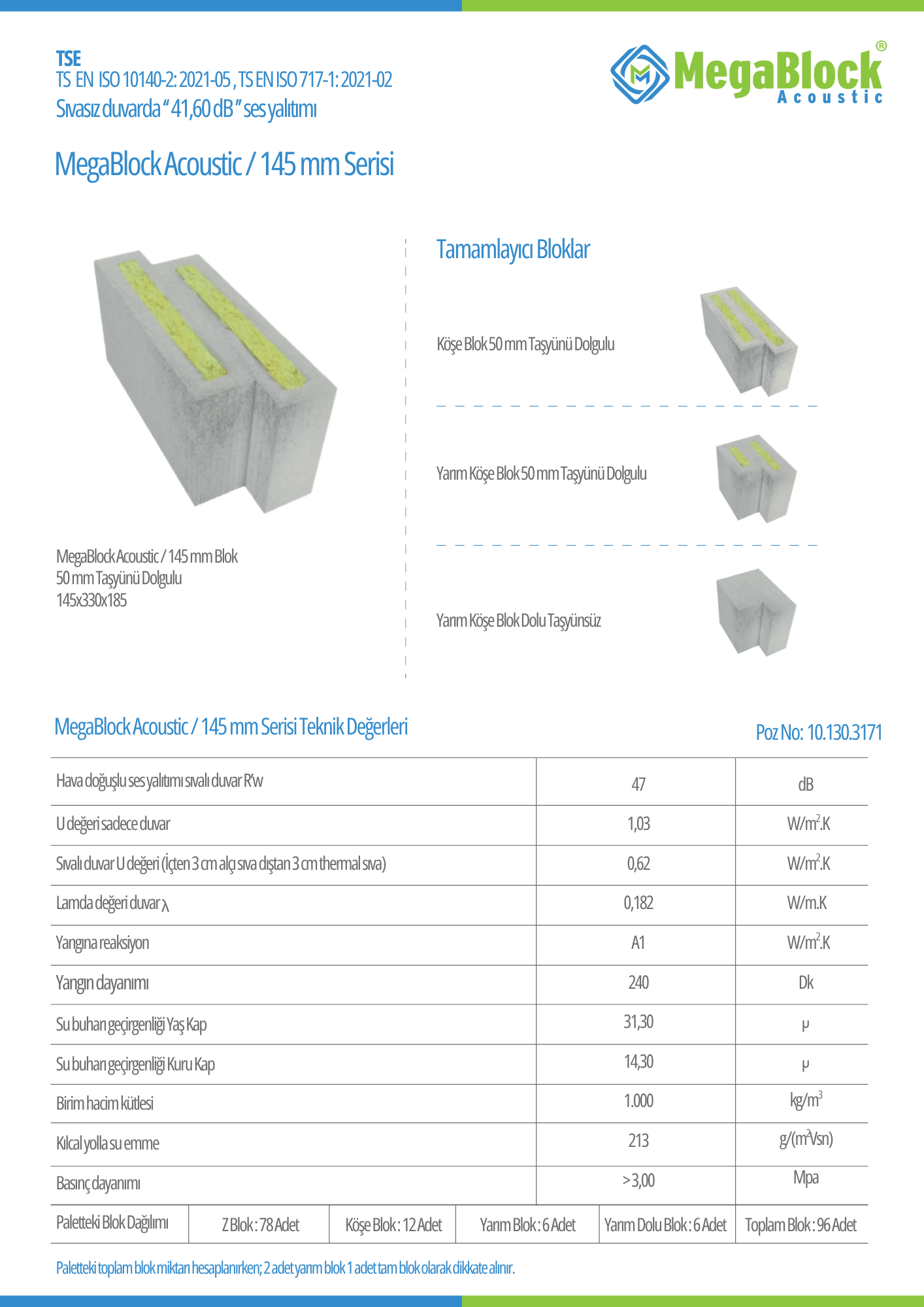
| MegaBlock Acoustic 145/50SW | 145 x 330 x 185 | 50 mm | 47 | TSE, 41.60 dB on an unplastered wall |
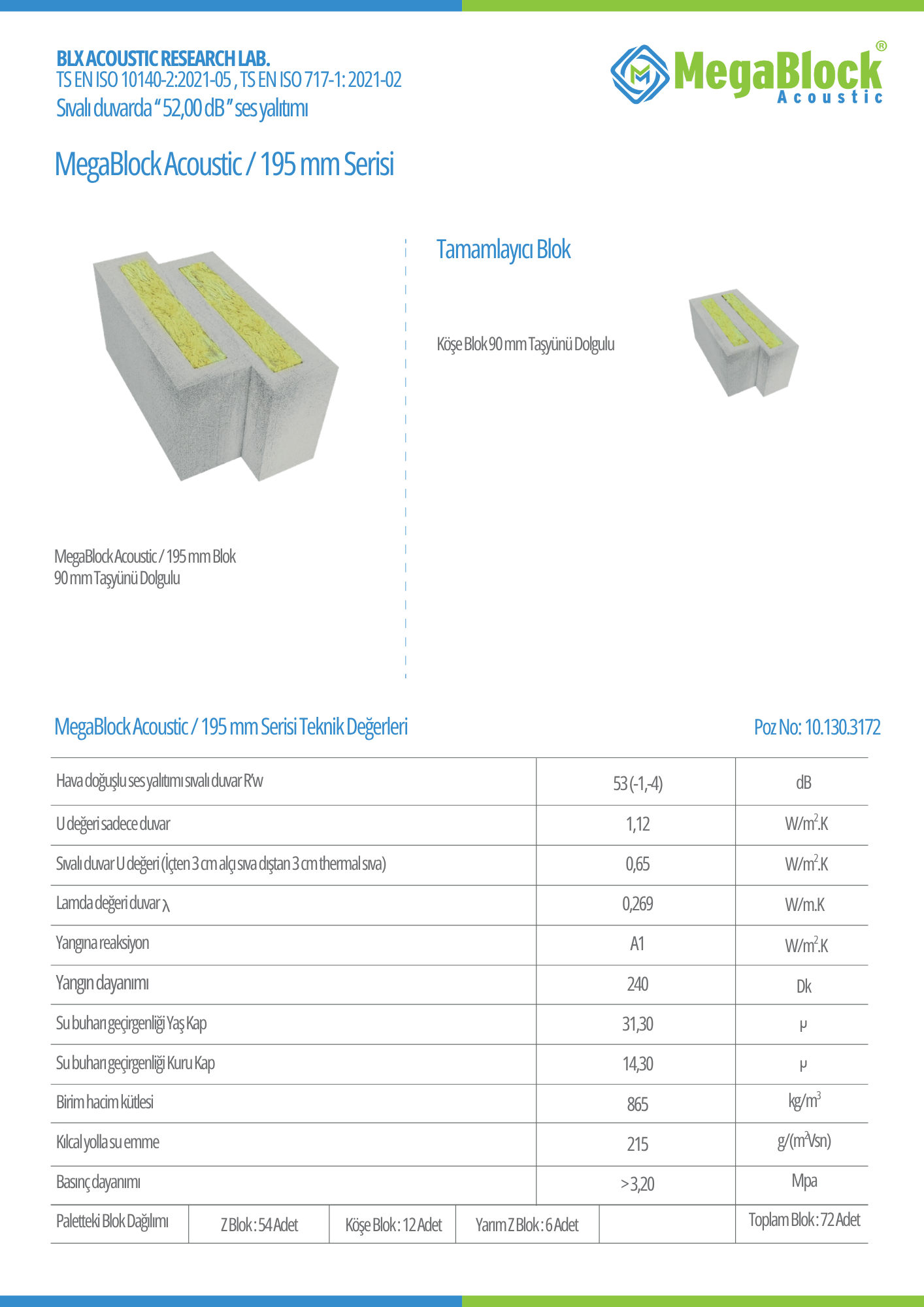
| MegaBlock Acoustic 195/90SW | 195 x 330 x 185 | 45 + 45 = 90 mm | 52 | BLX Acoustic Research Lab, 52.00 dB on a plastered wall |
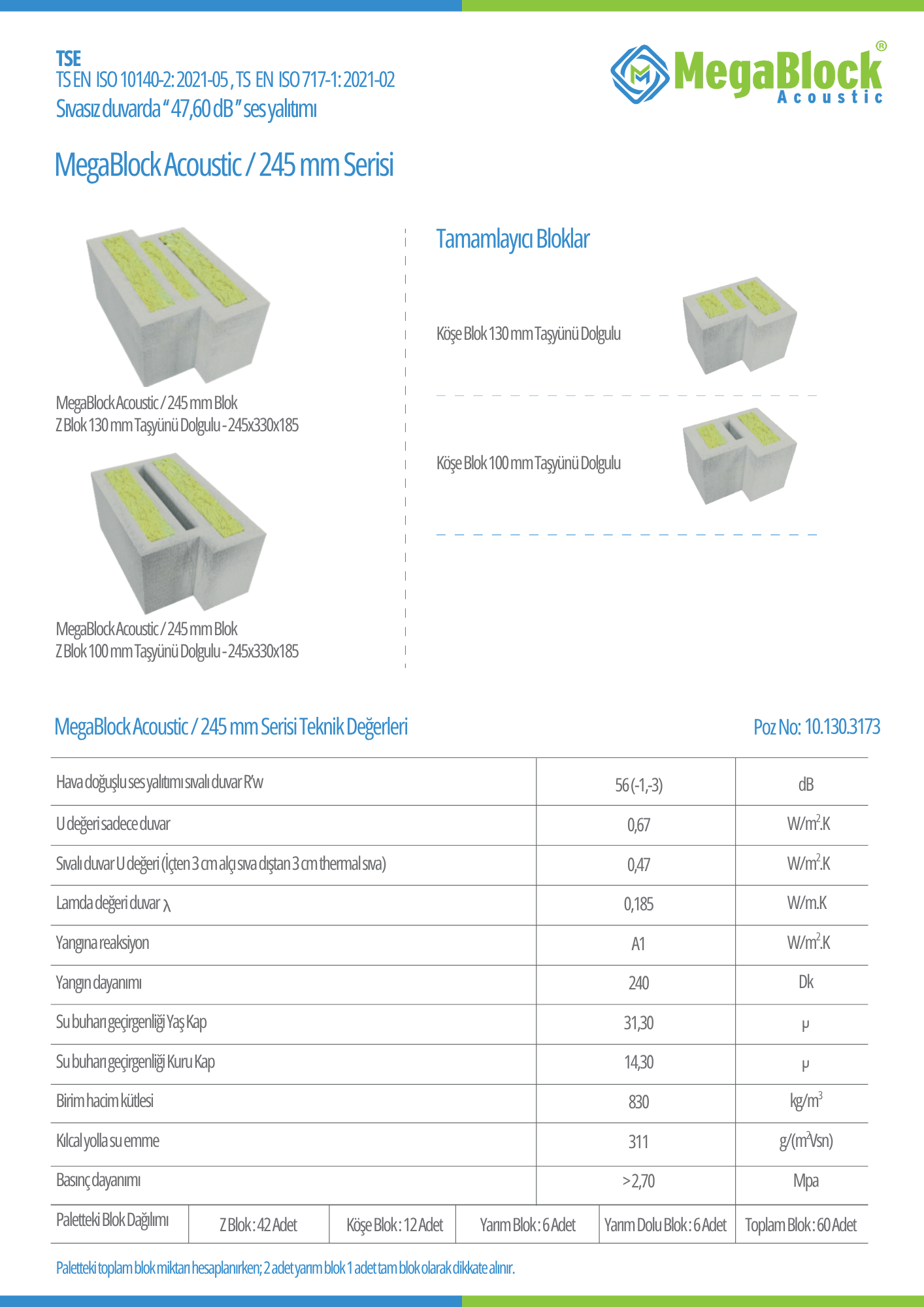
| MegaBlock Acoustic 245 series (245/100SW, 245/130SW) | 245 x 330 x 185 | 50 + 50 = 100 mm or 50 + 30 + 50 = 130 mm | 56 (-1;-3) | TSE, 47.60 dB on an unplastered wall |
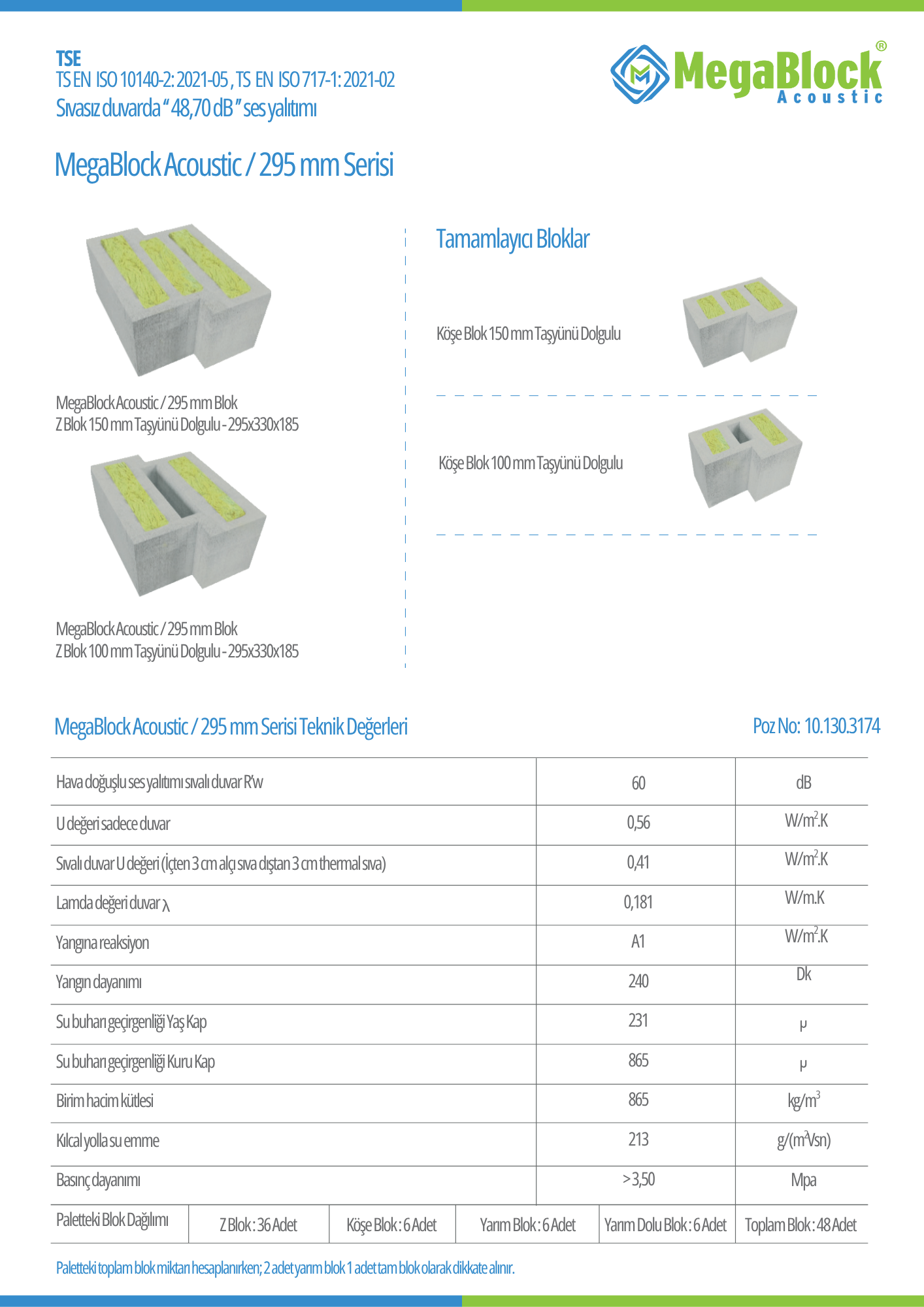
| MegaBlock Acoustic 295 series (295/100SW, 295/150SW) | 295 x 330 x 185 | 50 + 50 = 100 mm or 50 + 50 + 50 = 150 mm | 60 | TSE, 48.70 dB on an unplastered wall |
Source: block and stone wool dimensions from Mega’s product page; sound values from the MegaBlock Acoustic technical data sheets. The figures in brackets are the C and Ctr spectrum adaptation terms. According to the sheets, all series have reaction to fire class A1 and a bulk density between 830 and 1,000 kg/m³.
Do not confuse plastered and unplastered values when reading them. In the same 145 mm series, the TSE test measured 41.60 dB for the unplastered wall, while the data sheet table gives 47 dB for the plastered wall. When comparing two products or two series, always set values measured under the same conditions side by side. The product page also carries a data sheet for a thinner series, 95/35SW (plastered wall R’w 40 dB); however, this series does not appear in the block size table on the product page.
According to the product page, the block is easy to cut and is laid together with corner and solid blocks, with a lintel over door and window openings. These complementary elements make installation faster and more uniform. You can find the general structure of the block system and how it differs from the Thermal series in our guide What is MegaBlock, and all MegaBlock Acoustic data sheets on our sound insulation block page.
What should be used for a plasterboard partition?
If a lightweight partition is to be built inside a flat, sound insulation is provided by stone wool boards placed between the studs. Mega’s partition board is used for sound and thermal insulation in lightweight partition systems; according to the data sheet, the MEGA SW PB 40/50/60 types are produced at densities of 40, 50 and 60 kg/m³ and thicknesses of 40–120 mm, with a λD of no more than 0.035 W/mK. We explain how to choose thickness and density, how to place the boards and how to detail the junctions step by step in our guide to stone wool sound insulation.
How is wall sound insulation added in an existing flat?
The practical way to add sound insulation in an existing flat without demolishing the party wall is to apply a panel of stone wool and gypsum board to the room side of the wall. Mega’s DesiWool panel is used for this: one face is gypsum board and the other is stone wool. The stone wool face provides the insulation, while the gypsum board face becomes the room’s new wall surface.
According to the product page, DesiWool is used for sound and thermal insulation on party walls between adjoining flats, interior partition walls, the inner faces of external walls, and walls adjoining stair and lift shafts. According to the data sheet, the panels measure 2700 x 1200 mm and are produced in six thicknesses between 15 and 80 mm.
The sound values come from tests carried out with DesiWool W15 at Ticem İleri Yapı Teknolojileri, a laboratory accredited under ISO/IEC 17025. The tests were performed to EN ISO 10140-2 and rated to EN ISO 717-1:
| Application | R’w | What to keep in mind |
|---|---|---|
| One-sided (on one face of the box profile in the report) | 29 dB | Value of the test sample |
| Two-sided (on both faces of the box profile) | 42 dB | Value of the test sample |
These figures belong to the test sample and should not be read as an addition to your existing wall’s value. Mega sources contain no measurement of the increase on an existing wall; if you need that figure, ask for a report tested with the wall. The result at home depends on the wall’s own construction, the junctions with side walls and floors, and socket and service openings. You can find the installation steps and the moisture issues to watch with internal insulation in our guide to interior wall insulation (DesiWool), and the product’s data sheet and test reports on the DesiWool page.
DesiWool is a sound insulation panel; it is not a sound absorber designed to reduce echo in a room. Sound insulation reduces the sound passing through the wall, whereas sound-absorbing surfaces reduce reflections inside the room. We describe the extreme case of sound absorption, the anechoic chamber, in a separate article; the difference between the two concepts is clearer there.
What can be done in the floor against impact sound?
Impact sounds such as footsteps, dragged furniture and slamming doors travel through the floor and the load-bearing structure, so wall insulation does not solve them; a floating floor is needed, with an insulation board laid under the screed. The regulation sets the impact sound limit for the floor of the room where the sound originates, that is, the floor of the flat above.
According to the product page, Mega’s floating floor board is a stone wool board used for thermal, sound and vibration insulation under floor finishes, under screeds between two concrete layers and beneath foundations carrying vibrating equipment. According to the data sheet, the MEGA SW FF100/110/120 types have a density of 100–120 kg/m³, a thickness of 30 mm and a compressive strength of 25 kPa. We cover the layer sequence, edge details and installation steps in our guide What is a floating floor.
Which solution suits which noise source?
For a quiet flat, first identify where the sound is coming from, then choose the right solution for that surface. The table below summarises the solutions in this article by noise source:
| Noise source | Where the sound passes | In new construction | In an existing flat |
|---|---|---|---|
| Speech, television, music from next door | Party wall | Wall built with MegaBlock Acoustic | DesiWool panel on the room side of the wall |
| Sound passing from room to room inside the flat | Interior partition | MegaBlock Acoustic or stone wool partition board between studs | DesiWool panel |
| Noise from stair and lift shafts | Wall adjoining the shaft | MegaBlock Acoustic | DesiWool panel |
| Footsteps and dragged furniture from above | Floor (impact sound) | Stone wool floating floor board under the screed | Floating floor when the floor above is renewed |
| Socket, pipe and cable penetrations | Holes and gaps in the wall | Sealing the penetrations | Sealing the penetrations |
All the products in the table are offered under the Mega brand. Mega Insulation Solutions (Mega Yalıtım) is a Turkish manufacturer of insulation materials with its head office in Kavacık, Istanbul, and its plant in Elazığ; its range includes stone wool, XPS and EPS thermal insulation boards as well as MegaBlock, DesiWool and MegaTech construction chemicals. For uses of stone wool boards beyond sound insulation, see our article on stone wool applications.
What are the common mistakes in wall sound insulation?
Even with a good product, the result depends on the details of the installation. Avoid these mistakes:
- Leaving socket and service openings open: Socket boxes and pipe and cable penetrations make holes in the wall. If these gaps are not sealed, sound bypasses the insulated body of the wall.
- Forgetting flanking paths: Side walls, ceilings and floors connected to the party wall also carry sound. The joints where the wall meets the ceiling and floor must not be left open.
- Mistaking the laboratory value for the result in the building: Flanking paths are suppressed in the laboratory. The result in the building depends on junction details and flanking elements.
- Confusing plastered and unplastered values: When comparing products, set values measured under the same conditions side by side.
- Confusing sound insulation with sound absorption: Sound-absorbing finishes are meant to reduce reflections inside the room. For noise from the neighbours, the wall’s sound insulation must be improved.
- Choosing products without documented values: Prefer products whose sound values are declared in a technical data sheet or test report, and check the conditions under which the value was measured.
Installation note from MegaUsta: In a sound-insulated wall, do not place the sockets of two flats back to back at the same position; offset the boxes and fill the gap around each box with mortar. Seal around pipe and cable penetrations, and do not leave open the joints where the wall meets the ceiling and floor. Where blocks have been cut to fit, check before plastering that the joints are fully filled.
Frequently Asked Questions
How do you stop neighbour noise coming through a wall?
Neighbour noise is reduced by improving the sound insulation of the party wall and sealing the gaps in it. If the wall is still to be built, MegaBlock Acoustic blocks with stone wool cores can be used; on an existing wall, a panel made of stone wool and gypsum board, such as DesiWool, is fixed to the room side. Socket, pipe and cable penetrations must be sealed, and the joints where the wall meets the ceiling and floor must not be left open. Footfall noise from the flat above is dealt with in the floor.
What should the Rw value be?
The regulation does not set an Rw limit for a single wall; it limits the DnT,A value measured on site between dwellings. New homes must reach at least class C, which requires at least 52 dB between independent units; for class A the figure is 62 dB. Because flanking paths are suppressed in the laboratory, a wall’s Rw is not the same as the result in the building. The wall type should therefore be chosen by acoustic calculation, leaving a margin.
How much sound insulation does a MegaBlock wall provide?
According to Mega’s technical data sheets, a plastered wall built with MegaBlock Acoustic has an R’w of 47 to 60 dB depending on the series: 47 dB for the 145 mm series, 53 dB for 195 mm, 56 dB for 245 mm and 60 dB for 295 mm. In the TSE tests cited in the sheet headers, the unplastered wall measured 41.60 dB in the 145 mm series and 48.70 dB in the 295 mm series. The result in the building depends on the junction details.
Can sound insulation be added to an existing flat?
Yes, sound insulation can be added to an existing flat without demolishing the wall. A DesiWool panel, with gypsum board on one face and stone wool on the other, is applied to the room side of the party wall. The DesiWool W15 reports give R’w 29 dB for one-sided application on a box profile and R’w 42 dB for two-sided application; these values are not a gain added to the existing wall. For the increase on an existing wall, ask for a report tested with the wall.
Which materials are used for wall sound insulation?
The material depends on the type of wall. For new masonry walls, sound insulation blocks with stone wool cores (MegaBlock Acoustic) are used; in lightweight partitions such as plasterboard walls, stone wool partition boards are placed between the studs; and on existing walls, composite panels of stone wool and gypsum board (DesiWool) are applied. Footfall noise from above, however, comes through the floor rather than the wall, so it is reduced by laying a floating floor board under the screed.
Sources
- Noise Protection of Buildings Regulation (Binaların Gürültüye Karşı Korunması Hakkında Yönetmelik), Official Gazette, 31 May 2017, No. 30082 (Articles 4, 5, 10 and 11)
- Annexes to the same regulation: Annex 3, Tables 3.4 and 3.5 (Official Gazette, PDF)
- EN ISO 717-1:2020 Acoustics: rating of sound insulation in buildings and of building elements, Part 1: airborne sound insulation (SIS standard record)
- EN ISO 10140-2:2021 Acoustics: laboratory measurement of sound insulation of building elements, Part 2: airborne sound insulation (SIS standard record)
- Georgia State University, HyperPhysics: “Rule of Thumb” for Loudness
- Mega technical data sheet: MegaBlock Acoustic 145/50SW
- Mega technical data sheet: MegaBlock Acoustic 195/90SW
- Mega technical data sheet: MegaBlock Acoustic 245 series
- Mega technical data sheet: MegaBlock Acoustic 295 series
- Mega technical data sheet: DesiWool Panel
- DesiWool W15 sound test report, one-sided application
- DesiWool W15 sound test report, two-sided application
- Mega technical data sheet: Floating Floor Board (MEGA SW FF100/110/120)
- Mega technical data sheet: Partition Board (MEGA SW PB 40/50/60)
- Mega Insulation certificates and technical documents
If you are choosing a wall type for a new project, you can review the series and data sheets on the MegaBlock wall systems page, and send questions about the right solution for your existing flat to our technical team through the contact page.
Prepared by: Mega Insulation Technical Team. Technical values are taken from Mega technical data sheets, test reports and product pages; limit values are taken from the regulation text published in the Official Gazette.