

There is no single figure for ETICS insulation thickness that suits every building. The right thickness is calculated in the thermal insulation design from the external wall U-value limit given in TS 825 for the building’s region, the wall’s own layers and the thermal conductivity (λD) of the chosen board. According to Mega data sheets, stone wool ETICS boards are made in 40–120 mm and EPS boards in 10–100 mm.
This article works through the thickness calculation step by step. Using worked examples, we show how many millimetres of stone wool, white and grey EPS and XPS are needed for the same thermal resistance, how the benefit changes as thickness grows, how the rule is set in Europe and what to check on buildings being renovated. You can read about the system itself in our what is ETICS article and about the installation steps in the how ETICS is installed guide.
What determines ETICS insulation thickness?
Three factors determine the thickness: the building’s climate region, the existing make-up of the wall and the λD value of the insulation board. The thermal insulation design required by Turkey’s Energy Performance of Buildings Regulation brings the three together using the calculation method in TS 825. For the calculated thickness to deliver on the wall, the insulation must also be applied without interruption.
- Climate region: TS 825 divides Turkey into regions by heating degree-days and defines, for each region, the thermal transmittance (U-value) that building elements, including external walls, must meet. The limit is stricter in colder regions, which means thicker insulation.
- Wall make-up: Brick, pumice block, aerated concrete and reinforced concrete walls each have a different thickness and thermal conductivity. The higher the wall’s own thermal resistance, the smaller the share left to the insulation board.
- The board’s λD value: λD is the declared thermal conductivity at 10 °C (W/mK). The lower the value, the thinner the board needed for the same thermal resistance. For more on the concept, see our thermal conductivity article.
- Continuity: If the insulation is interrupted at columns, beams, slab edges or around windows, heat escapes through those points. Whether the layer is continuous matters as much as its thickness; we explain this in our thermal bridge article.
The text of the regulation published in the Official Gazette requires the thermal insulation design to be prepared using the calculation method specified in TS 825. We cover the scope of the standard, its regions and the edition in force in our TS 825 article.
How is insulation thickness calculated?
Insulation thickness is worked out backwards from the target U-value. First the total thermal resistance the wall must reach is found, the resistance of the existing wall layers is subtracted, and the remainder is converted into thickness by multiplying it by the board’s λD value.
The calculation of thermal resistance and thermal transmittance for building elements is defined in EN ISO 6946. In simplified form, the steps are as follows:
- The external wall U-value limit for the building’s region is taken from TS 825 (W/m²K).
- The total thermal resistance the wall must reach is found: R total = 1 / U.
- The thermal resistances of the existing wall layers (thickness / thermal conductivity for each layer) and the internal and external surface resistances are added up.
- The share left to the insulation is calculated: R insulation = R total − (wall layers + surface resistances).
- The thickness is found: d = R insulation × λD (d in metres). The result is rounded up to the next board thickness.
This calculation is carried out by the authorised mechanical engineer preparing the thermal insulation design, for all building elements together. The standard also provides a correction term for metal fasteners that penetrate the insulation, so installation details such as anchors are reflected in the result.
How thick should each board be for the same thermal resistance?
To reach the same thermal resistance, a board with a lower λD value can be thinner. For 2.50 m²K/W, for example, 80 mm of grey EPS 50 (G) is enough, while white EPS 80W needs 95 mm; stone wool and XPS fall between the two.
The table below is a worked example that assumes the insulation layer must provide 1.50 and 2.50 m²K/W. These are not recommended limits for any region or building; they were chosen only to show the difference between materials. The thicknesses were found with the formula d = R × λD.
| Board (Mega type) | λD (W/mK) | Thickness for R = 1.50 m²K/W | Thickness for R = 2.50 m²K/W | Thickness range in data sheet |
|---|---|---|---|---|
| Stone wool ETICS board, MEGA SW F150 | ≤0.037 | 55.5 mm | 92.5 mm | 40–120 mm |
| Stone wool ETICS board, MEGA SW-35L | ≤0.035 | 52.5 mm | 87.5 mm | 50–120 mm |
| White EPS, EPS 80W | 0.038 | 57.0 mm | 95.0 mm | 10–100 mm |
| Grey EPS, EPS 50 (G) | 0.032 | 48.0 mm | 80.0 mm | 10–100 mm |
| XPS, MEGA XPS T3000 | 0.035 | 52.5 mm | 87.5 mm | 20–120 mm |
Source: Mega data sheets (MEGA SW F150, MEGA SW-35L, EPS 60W/80W/90W, EPS 50/60/70 (G), MEGA XPS T3000). In practice, the calculated thickness is rounded up to the next board thickness.
The table makes one point clear: a λD difference that looks small turns into centimetres as thickness grows. At the 2.50 m²K/W target there is a 15 mm gap between the boards with the lowest and the highest λD. That gap helps when you need to save space on the facade, keep window reveals shallow or stay within a thickness limit under the eaves. We compare white and grey EPS in detail in grey EPS or white EPS and stone wool with EPS in stone wool or EPS.
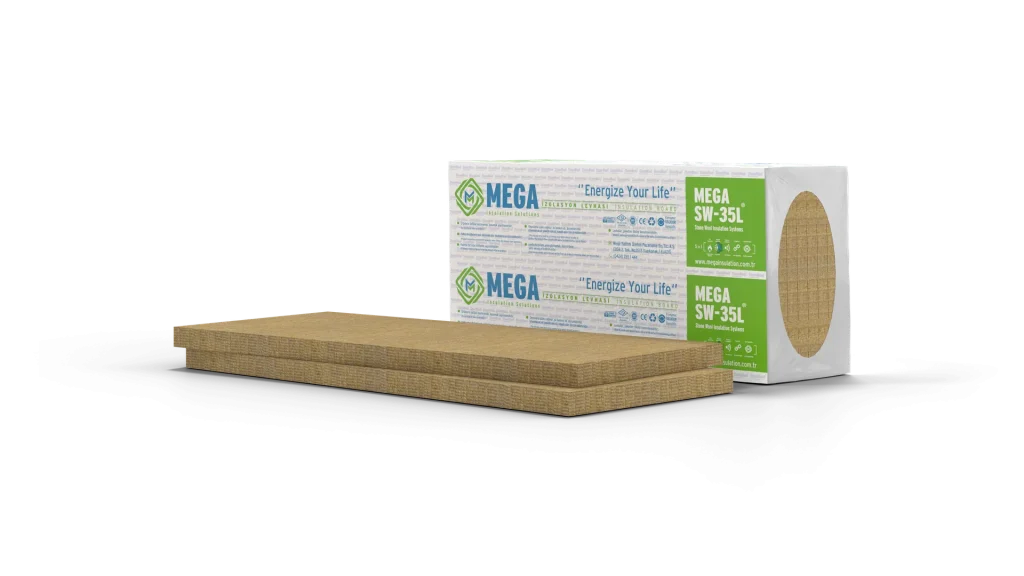
Thickness is not the only selection criterion. When the board type is chosen, fire rules based on building height, moisture conditions on the facade and acoustic expectations are also taken into account. Mega Insulation Solutions (Mega Yalıtım) is a Turkish manufacturer of insulation materials that offers stone wool, XPS and EPS thermal insulation boards under the Mega brand; the values in the table were taken from the data sheets of these products.
- Stone wool: According to the Mega data sheet, the stone wool ETICS board has an A1 reaction-to-fire class and a water vapour diffusion resistance factor of μ = 1.
- EPS: The white EPS ETICS board and the carbon/graphite-enhanced grey EPS ETICS board are lightweight boards. According to their data sheets, their reaction-to-fire class is E, which means they are combustible.
- XPS: With long-term water absorption of ≤0.7% according to its data sheet, XPS stands out in damp areas such as foundations, below-ground retaining walls and flat roofs. According to the product pages, the flat XPS board is used on facades that need no render and on below-ground retaining walls, while grooved XPS is used in ETICS. XPS is also class E.
You can find the facade options compared side by side in our types of ETICS article.
How does the benefit change as thickness increases?
Heat loss falls as thickness increases, but each extra centimetre brings less than the one before. This is because heat transfer does not fall linearly with thickness; it falls in inverse proportion to it.
The table below calculates the thermal resistance and thermal transmittance of the insulation layer alone for MEGA SW F150 (λD 0.037 W/mK). Once the wall’s own layers are added, the actual U-value is lower still; the table only shows the trend.
| Board thickness | Thermal resistance R = d / λD (m²K/W) | Layer thermal transmittance 1 / R (W/m²K) | Reduction vs. previous row (W/m²K) |
|---|---|---|---|
| 40 mm | 1.08 | 0.93 | — |
| 60 mm | 1.62 | 0.62 | 0.31 |
| 80 mm | 2.16 | 0.46 | 0.15 |
| 100 mm | 2.70 | 0.37 | 0.09 |
| 120 mm | 3.24 | 0.31 | 0.06 |
Going from 4 cm to 6 cm lowers the layer’s thermal transmittance by about 0.31 W/m²K, whereas going from 10 cm to 12 cm lowers it by only 0.06 W/m²K. This does not make thick insulation unnecessary; in cold regions thick boards are needed anyway to meet the limit. But once the thickness that meets the limit has been reached, closing thermal bridges and getting the details right shape the result as much as adding centimetres.
The installation side also has to be considered when thickness is chosen. As the board gets thicker, anchors get longer and window reveals deeper; sills, parapets and eaves junctions have to be redesigned to the new facade line.
How is insulation thickness set in Europe?
There is no single thickness that applies across Europe; each country sets the rule in its own legislation, and usually does so through the U-value of the building element rather than in centimetres. In Germany, for example, when insulation is applied to the external wall of an existing residential building or its external render is renewed, the wall’s U-value must, as a rule, not exceed 0.24 W/m²K.
A rough reading converts this value into thickness: for 0.24 W/m²K, the wall’s total thermal resistance must be at least about 4.2 m²K/W. If the resistance of the wall and its surfaces were ignored entirely, this would correspond to about 14.6 cm of a board with a λD value of 0.035 W/mK; the wall’s own resistance reduces the required thickness somewhat. Where thickness is limited for technical reasons, German regulations also accept installing the greatest thickness possible under the technical rules; in that case the material’s design thermal conductivity must not exceed 0.035 W/mK (0.045 W/mK for blown-in insulation and insulation made from renewable raw materials).
At EU level, the revised Energy Performance of Buildings Directive (EU) 2024/1275 entered into force on 28 May 2024, and 29 May 2026 was set as the deadline for member states to transpose it into national law. The directive makes zero-emission buildings the standard for new buildings and aims for a fully decarbonised building stock by 2050.
The logic is the same in Turkey: TS 825 sets U-value limits by region, and thickness follows by calculation from that limit and the wall’s make-up. That is why single-figure comparisons such as “so many centimetres in Europe, so many here” are misleading. A fair comparison is made on the target U-values for the same climate and the same wall.
How is ETICS thickness chosen for a building being renovated?
On an existing building, thickness is determined with the same calculation once the actual layers of the wall have been established on site. The text of the Energy Performance of Buildings Regulation published in the Official Gazette requires that, in major repairs and alterations to existing buildings, the parts being worked on are shown to meet the thermal transmittance coefficients in TS 825.
- Know the wall: If there are no drawings, the wall material, its thickness, the render layers and any existing insulation are checked on site. The calculation is based on the section actually found, not on assumptions.
- Assess the old insulation: If the facade already has a thin insulation layer, no new layer is added on top until its soundness and bond to the substrate have been checked. We list the preliminary checks in our ETICS on older buildings guide.
- If space is tight, choose a board with a lower λD: Where thickness is limited by window reveals, eaves, a neighbouring building or the entrance door, a grey EPS such as EPS 70 (G) (λD 0.031 W/mK) or MEGA SW-35L (λD ≤0.035 W/mK) provides the same thermal resistance with a thinner layer than boards with a higher λD.
- Redesign the details: When thickness increases, window sills, parapet and eaves junctions, rainwater downpipes and the fixings of air-conditioning outdoor units are adjusted to the new facade line.
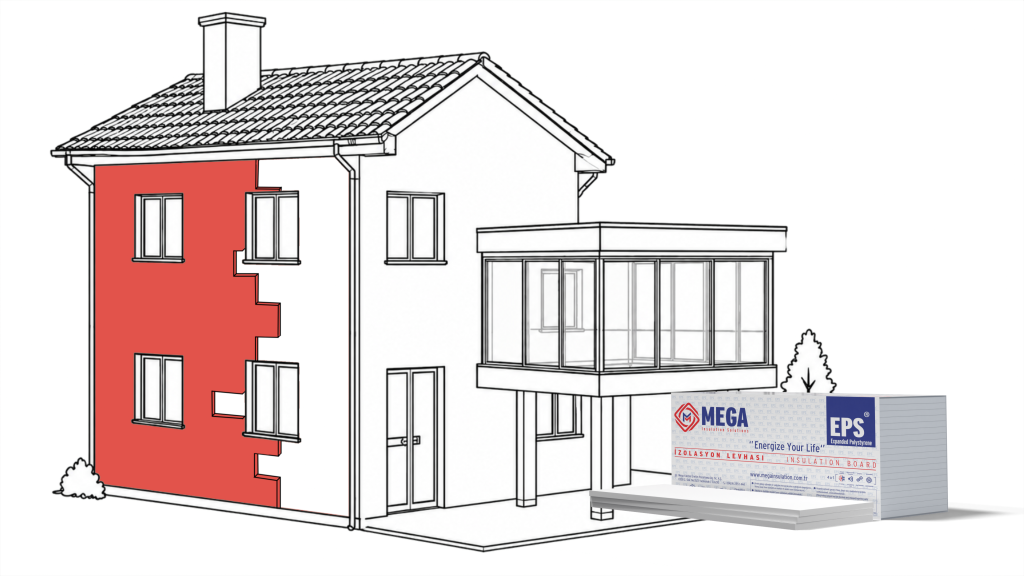
If you want to plan the insulation together with roof, window and building services work, our building renovation article is a good place to start.
Application note from MegaUsta: When you change the board thickness, select the anchor length again. The anchor must pass through the board, the adhesive layer and any old render and penetrate far enough into the load-bearing wall. Have the window sills measured only after the new thickness is final.
Frequently Asked Questions
How thick should ETICS insulation be?
ETICS insulation thickness is calculated in the thermal insulation design from the external wall U-value limit given in TS 825 for the building’s region, the make-up of the wall and the board’s λD value; there is no single correct figure. According to Mega data sheets, stone wool ETICS boards are made in 40–120 mm and EPS ETICS boards in 10–100 mm. The calculated value is rounded up to the next board thickness.
Is 5 cm of ETICS insulation enough?
That depends on the building’s region and the make-up of the wall; only the calculation in the thermal insulation design can show whether 5 cm is enough. As a guide, a thickness of 50 mm provides about 1.35 m²K/W with the MEGA SW F150 stone wool board and about 1.56 m²K/W with the grey EPS 50 (G) board. If this resistance does not achieve the U-value the wall must reach, a thicker board is needed.
How is insulation thickness calculated under TS 825?
First, the total thermal resistance the wall must reach (1/U) is derived from the U-value limit given in TS 825 for the building’s region. The resistance of the wall layers and surfaces is subtracted, and the remainder is converted into thickness by multiplying it by the board’s λD value: d = R × λD. The result is rounded up to the next board thickness. The calculation is carried out for all building elements in the thermal insulation design.
Is thicker insulation always better?
Heat loss falls as thickness increases, but each extra centimetre brings less. For MEGA SW F150, going from 4 cm to 6 cm lowers the thermal transmittance of the insulation layer by about 0.31 W/m²K, while going from 10 cm to 12 cm lowers it by 0.06 W/m²K. Once the thickness that meets the limit has been reached, closing thermal bridges and getting the details right also determine the result.
Is ETICS insulation thicker in Europe?
There is no single thickness that applies across Europe; each country sets the rule in its own legislation, mostly through the U-value. In Germany, for example, when insulation is applied to the external wall of an existing home, the U-value must, as a rule, not exceed 0.24 W/m²K. Ignoring the wall’s own resistance, this corresponds to about 14.6 cm of a board with a λD of 0.035 W/mK; the actual thickness is lower, depending on the wall.
Sources
- Official Gazette of Turkey, 5 December 2008, No. 27075: Energy Performance of Buildings Regulation
- EN ISO 6946:2017 Building components and building elements: Thermal resistance and thermal transmittance, calculation methods (standard listing, EVS)
- German buildings energy act, Annex 7: Maximum U-values of external building elements in existing buildings (gesetze-im-internet.de)
- European Commission: Energy Performance of Buildings Directive
- Mega data sheet: MEGA SW F150 ETICS Board
- Mega data sheet: MEGA SW-35L stone wool board
- Mega data sheet: EPS 60W, 80W and 90W white ETICS boards
- Mega data sheet: EPS 50, 60 and 70 (G) grey ETICS boards
- Mega data sheet: MEGA XPS T3000
- Mega Insulation certificates and technical documents
When deciding which board to use at what thickness on your project, you can refer to the data sheets on the stone wool boards, EPS boards and XPS boards pages and send your questions to our technical team via the contact page.
Prepared by: Mega Insulation Technical Team. Technical values are taken from Mega data sheets and regulatory information from official texts; the worked examples are intended only to illustrate the method.