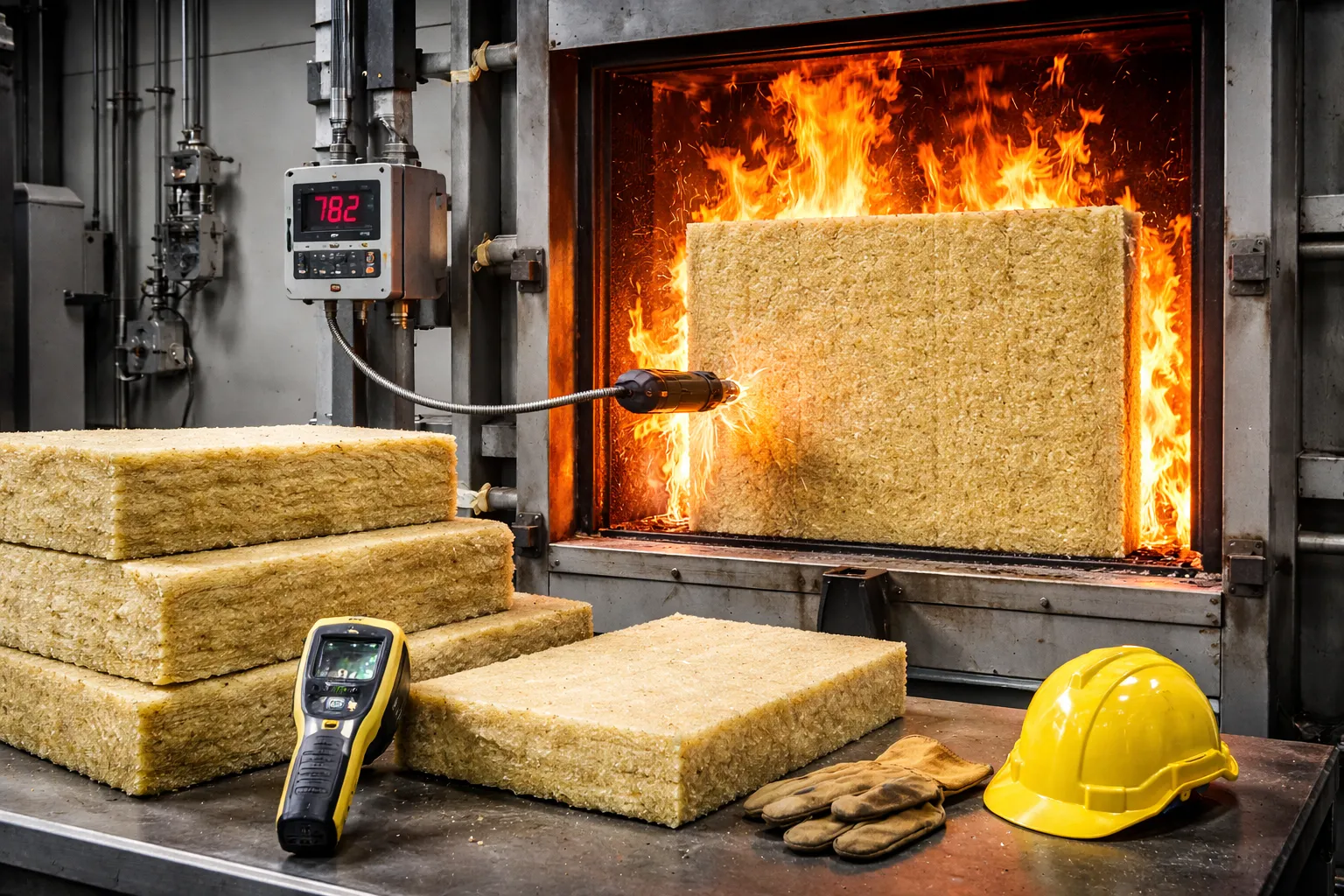
In short: The fire class of an insulation material shows how the product reacts to fire and is given as a class from A1 to F under TS EN 13501-1. According to Mega technical data sheets, stone wool boards are class A1, the non-combustible class. EPS and XPS are combustible polymer foams; their class in the data sheets is E, which the Turkish regulation places in the normally flammable group.
The class is stated in the product’s technical data sheet. On an external wall, however, the class of the board alone is not enough; the system built with adhesive, anchors, mesh and render and the facade rules of the Turkish Regulation on Fire Protection of Buildings also have to be checked. The classes in this article are taken from the technical data sheets of Mega Yalıtım, which supplies stone wool, XPS and EPS thermal insulation boards under the Mega brand.
What is a reaction to fire class?
A reaction to fire class shows how much a building material contributes to combustion and how far it spreads flame. The classes A1, A2, B, C, D, E and F of TS EN 13501-1 are matched to Turkish flammability terms in the Annex 2 tables of the Regulation on Fire Protection of Buildings.
| Class (TS EN 13501-1) | Summary of the regulation’s definition | Term used in the regulation |
|---|---|---|
| A1 | Does not contribute to combustion at any stage of a fire, including a fully developed fire. | Non-combustible |
| A2 | Meets the class B criteria and does not contribute significantly to fire load or fire growth in a fully developed fire. | A2-s1,d0: limited combustibility; with other smoke and droplet ratings: hardly flammable |
| B | Meets stricter requirements in addition to the class C criteria. | Hardly flammable |
| C | Meets stricter requirements in addition to the class D criteria; lateral flame spread under thermal attack by a single burning item remains limited. | Hardly flammable |
| D | Meets the class E criteria and resists a small flame attack for a long period. | Normally flammable |
| E | Resists a small flame attack for a short period without significant flame spread. | Normally flammable |
| F | Fire performance has not been determined. | Easily flammable |
The additional ratings describe smoke and droplets. s1, s2 and s3 refer to smoke production: s3 has no limit, while s1 meets the strictest criterion. d0, d1 and d2 refer to flaming droplets: with d0 no flaming droplets or particles occur, while d2 has no limit. A2-s1,d0, for example, is the class the regulation calls limited combustibility.
For the scope of the standards in more detail, see our guide to TS EN 13501-1 and insulation standards.
What is a class A1 non-combustible material?
A class A1 non-combustible material does not contribute to combustion at any stage of a fire, including a fully developed fire, and the regulation refers to it as non-combustible. Stone wool belongs to this group: the technical data sheets of Mega stone wool boards, a mineral wool (MW) insulation material covered by TS EN 13162, declare their reaction to fire class as A1.
The same data sheets give a maximum service temperature of +750 °C for the stone wool boards. Class A1 describes the board itself; even when the board in an ETICS is A1, the class of the system is stated separately in the system certificate. The fire safety of the building depends on facade details, fire barriers and other passive measures together.
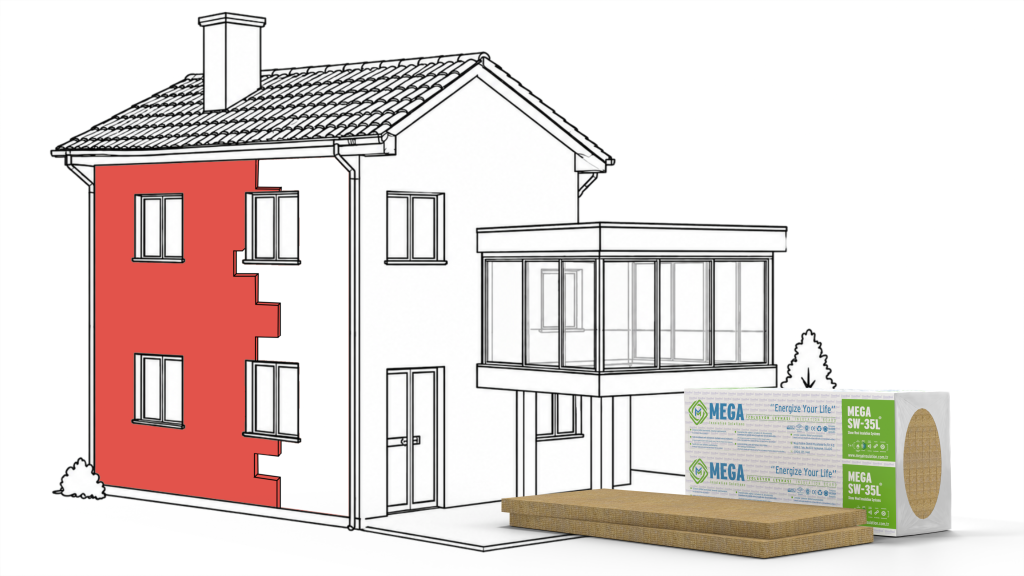
Besides the facade boards, the Mega stone wool range includes the partition wall board for lightweight partition systems and the stone wool industrial board for industrial plants, process equipment and steel structures. MegaBlock BC, used on columns, beams and other elements prone to thermal bridging, is also stone wool based. We explain the material itself in what is stone wool and its applications in stone wool applications.
For its behaviour at high temperatures, see our guide does stone wool burn; the answer to does stone wool melt is in the same article.
Do EPS and XPS burn?
Yes. EPS (expanded polystyrene, known in Turkey as “strafor”) and XPS (extruded polystyrene) are combustible polymer foams. In Mega technical data sheets, the reaction to fire class of both materials is E under TS EN 13501-1, which the regulation classifies as normally flammable.
The regulation defines class E as materials that resist a small flame attack for a short period without significant flame spread. EPS and XPS should therefore not be described as non-combustible, flame-proof or fire-resistant materials.
This does not mean the two materials cannot be used on facades. The regulation requires the system made of insulation material, adhesive, anchors, render mesh and render to be certified as a system by an accredited laboratory; the class of the system is stated in that certificate. The height limits and fire barrier rules of Article 27 also apply.
Mega product pages list the main uses of XPS as terrace roofs, foundations in contact with soil and below-grade basement walls, while EPS is mainly used in ETICS. You can find the properties of both materials in our articles what is EPS and what is XPS.
The table below shows the classes declared in Mega technical data sheets for the three material groups.
| Product | Mega types | Reaction to fire class (TS EN 13501-1) | Term used in the regulation |
|---|---|---|---|
| Stone wool ETICS board | MEGA SW F150, F120, PLUS, ULTRA, SW-35L | A1 | Non-combustible |
| Stone wool ventilated facade board | MEGA SW EF 70/80/90 | A1 | Non-combustible |
| Stone wool partition wall board | MEGA SW PB 40/50/60 | A1 | Non-combustible |
| XPS board (smooth and rough grooved) | MEGA XPS T1500, T2000, T2500, T3000 | E | Normally flammable |
| EPS ETICS board | EPSW white and EPSG grey boards | E | Normally flammable |
Source: Mega stone wool, XPS and EPS technical data sheets. All data sheets and certificates are available on the Mega Yalıtım Documents page.
For differences in thermal conductivity, water absorption and applications, see our comparison of stone wool, EPS and XPS.
What do Turkish facade fire regulations require?
Under Article 27 of the Regulation on Fire Protection of Buildings, external walls of buildings taller than 28.50 m must be made of materials of limited combustibility, and those of other buildings of at least hardly flammable materials. Limited combustibility corresponds to A2-s1,d0 under TS EN 13501-1; class A1 materials also meet this requirement.
Article 27 was redrafted by Council of Ministers Decision No. 2015/7401 of 16 March 2015 (Official Gazette, 9 July 2015, issue 29411). The main rules concerning facade insulation are:
- System certificate: A thermal insulation system built with insulation material, adhesive, anchors, render mesh, render and similar components must be certified by an accredited laboratory under the relevant standards (27/2-a).
- Ground-level strip: In buildings lower than 28.50 m whose facade consists of hardly flammable materials or systems, the first 1.5 m above ground level must be clad with non-combustible material (27/2-b).
- Barriers around openings: In those buildings taller than 6.50 m, fire barriers of non-combustible material at least 15 cm wide on the sides and at least 30 cm wide above windows and similar openings are required (27/2-b).
- Between floors: Unprotected openings such as windows on two floors must be separated vertically by a fire-resistant facade element at least 100 cm high, or the facade must be protected by an automatic sprinkler system (27/1).
- Adjoining buildings: Where adjoining buildings differ in height, the facade of the taller building’s storey at the roof level of the lower building must be clad with non-combustible material or a non-combustible system (27/2-c).
- Curtain walls: Facade and insulation materials used in curtain walls with open joints or ventilated cavities must be at least of limited combustibility (27/3-b).
Two height values in the regulation are often confused. The definition of a high-rise building covers buildings with a building height above 21.50 m or a structure height above 30.50 m (Article 4). The threshold that decides the facade material, however, is 28.50 m. Article 27 contains no rule based on storey counts such as “5 storeys” or “10 storeys”; the thresholds are given in metres.
The regulation also sets additional requirements depending on the occupancy class and location of the building. For example, the fourth paragraph added to the article in 2021 requires all external walls of buildings erected in the areas defined in paragraph 5 of Article 21, which relate to large industrial and energy facilities within or adjacent to forest land, to be made of non-combustible material (27/4). The final choice of materials and details is therefore made for each project by the designer and the responsible engineer. For the main types of facade systems, see our article on types of external wall insulation.
How do you choose insulation by building type?
The choice starts with identifying the minimum class the regulation requires for the building height and facade system, and is completed with the thermal insulation design and site details. The table below translates the provisions of Article 27 into material choices.
| Situation | Regulatory requirement | Material approach |
|---|---|---|
| Building height above 28.50 m, rendered facade (ETICS) | Facade of limited combustibility (A2-s1,d0); A1 also meets this requirement (27/1) | An ETICS whose system certificate shows this class. Class E EPS and XPS boards do not meet this requirement. The stone wool ETICS board is class A1, but the class of the system has to be checked in the system certificate. |
| Buildings up to 28.50 m high, rendered facade | Facade of at least hardly flammable material (27/1); in buildings lower than 28.50 m, a ground-level strip and, above 6.50 m, barriers around openings of non-combustible material (27/2-b) | An EPS, XPS or stone wool based system whose certificate shows at least the hardly flammable class. The ground-level strip and the barriers require non-combustible (A1) material; Mega stone wool boards are A1 according to their data sheets. |
| Curtain wall with open joints or ventilated cavity | Facade and insulation materials of at least limited combustibility (27/3-b) | Class E EPS and XPS boards do not meet this requirement. The ventilated facade board is class A1 according to the Mega data sheet. |
The class of the insulation material is only one part of a building’s passive fire protection. Escape routes, fire compartments and elements such as the fire door are governed by the same regulation.
Frequently Asked Questions
Is EPS (strafor) combustible?
Yes, EPS (expanded polystyrene, “strafor”) is a combustible material. The technical data sheets of Mega EPS boards give its reaction to fire class as E under TS EN 13501-1, and the Regulation on Fire Protection of Buildings places this class in the normally flammable group. On facades, EPS is used as part of an ETICS certified by an accredited laboratory, in line with the height and fire barrier rules of Article 27 of the regulation.
Does XPS burn, and what is its fire class?
Yes, XPS burns. The technical data sheets of Mega XPS T1500, T2000, T2500 and T3000 boards give its fire class as E under TS EN 13501-1, which the regulation calls normally flammable. Its closed-cell structure and low water absorption (long-term water absorption of at most 0.7% according to the data sheet) make XPS a common choice for foundations and terrace roofs, but these properties do not change its flammability class.
What is the difference between class A1 and class A2?
A class A1 material does not contribute to combustion at any stage of a fire, including a fully developed fire, and the regulation calls it non-combustible. A2 is a material that does not contribute significantly to fire load or fire growth; A2-s1,d0 counts as limited combustibility, while other smoke and droplet ratings place it in the hardly flammable group. Mega stone wool boards are class A1 according to their data sheets.
What is a fire barrier in external wall insulation?
A fire barrier is a strip of non-combustible material formed along the sides and top of windows and similar openings in facade insulation. Under Article 27 of the regulation, in buildings lower than 28.50 m but taller than 6.50 m whose facade consists of hardly flammable materials or systems, this strip must be at least 15 cm wide on the sides of the openings and at least 30 cm wide above them.
Sources
- Regulation on Fire Protection of Buildings (Official Gazette 19.12.2007, issue 26735), Article 4, Article 27 and Annex 2, mevzuat.gov.tr
- Regulation Amending the Regulation on Fire Protection of Buildings, Decision 2015/7401 (Official Gazette 09.07.2015, issue 29411)
- Mega stone wool ETICS board MEGA SW F150 technical data sheet
- Mega stone wool ventilated facade board technical data sheet
- MEGA XPS T3000 technical data sheet
- MEGA EPS 40W / 40U-W / 50W technical data sheet
- Mega Yalıtım Documents page: technical data sheets and certificates
The data sheets and reaction to fire classes of Mega stone wool boards are available in our stone wool product group, and you can send questions about the right system for your project to our technical team via our contact page.