In short: Insulation materials are products used to limit the passage of heat, water, sound or fire through a building element, and they fall into four groups by function: thermal insulation, waterproofing, sound insulation and fire protection materials. Each group has its own legislation and product standards. The right material is chosen by the function of the insulation, the building element and the values in the data sheet.
This guide covers the types of insulation material, which is used on which building element, the properties to check in the data sheet and the order of selection. For details on individual materials, see our guides what is thermal insulation and what is waterproofing.
What are insulation materials?
By function, insulation materials fall into four main groups: thermal insulation, waterproofing, sound insulation and fire protection materials; materials for insulating pipes and ducts are named as a separate group. In everyday Turkish the same products are also called “izolasyon malzemeleri”. One material can contribute to more than one function, but each function has its own criteria and legislation.
| Type of insulation | What does it limit? | Main material groups | Basis |
|---|---|---|---|
| Thermal insulation | Heat transfer between two environments at different temperatures | Mineral wools (stone wool, glass wool), EPS, XPS, polyurethane, phenolic foam, cellular glass and other boards | Regulation on the Energy Performance of Buildings, TS 825 |
| Waterproofing | Water and moisture entering the building element | Liquid-applied materials, waterproofing sheets, structural (watertight concrete) waterproofing | Regulation on Waterproofing in Buildings |
| Sound insulation | Airborne and impact sound passing into the neighbouring space | Glass wool, stone wool and other sound-absorbing infills; floating floor layers | Regulation on the Protection of Buildings against Noise |
| Fire protection | The spread of fire on the facade, on the roof and inside the building | Materials the regulation counts as non-combustible (A1) and low-combustible (A2-s1,d0), fire barriers | Regulation on Fire Protection of Buildings |
| Pipe and duct insulation | Heat loss, heat gain and condensation in pipes, ducts and equipment | Glass wool, stone wool, rubber foam, polyethylene foam | Regulation on the Energy Performance of Buildings, Article 11 |
Source: İZODER general information pages (thermal, water, sound, fire, and pipe and duct insulation) and the regulations named in the table.
Mega Insulation Solutions (Mega Yalıtım) offers, under the Mega brand, stone wool, EPS (expanded polystyrene) and XPS (extruded polystyrene) thermal insulation boards, stone wool-based sound insulation products and Fullback waterproofing materials from these groups. The sections below cover each group together with the values in Mega data sheets.
Which materials are used for thermal insulation?
Thermal insulation uses mineral wools and foam boards with low thermal conductivity. Every thermal insulation material made for buildings has its own product standard; according to İZODER’s list, the standards are as follows:
| Material | Abbreviation | Product standard | In the Mega range |
|---|---|---|---|
| Stone wool and glass wool (mineral wool) | MW | TS EN 13162 | Stone wool boards |
| Expanded polystyrene | EPS | TS EN 13163 | EPSW white and EPSG grey boards |
| Extruded polystyrene | XPS | TS EN 13164 | XPS flat and rough grooved boards |
| Polyurethane foam | PUR | TS EN 13165 | None |
| Phenolic foam | PF | TS EN 13166 | None |
| Cellular glass | CG | TS EN 13167 | None |
| Wood wool boards | WW | TS EN 13168 | None |
| Expanded perlite | EPB | TS EN 13169 | None |
| Expanded cork | ICB | TS EN 13170 | None |
| Wood fibre boards | WF | TS EN 13171 | None |
| Sprayed polyurethane foam | PUR/PIR | TS EN 14315-1 | None |
| Polyethylene foam | PEF | TS EN 16069 | None |
Source: İZODER, “Thermal insulation: general information”, Table 3 (thermal insulation in buildings column); Mega product pages.
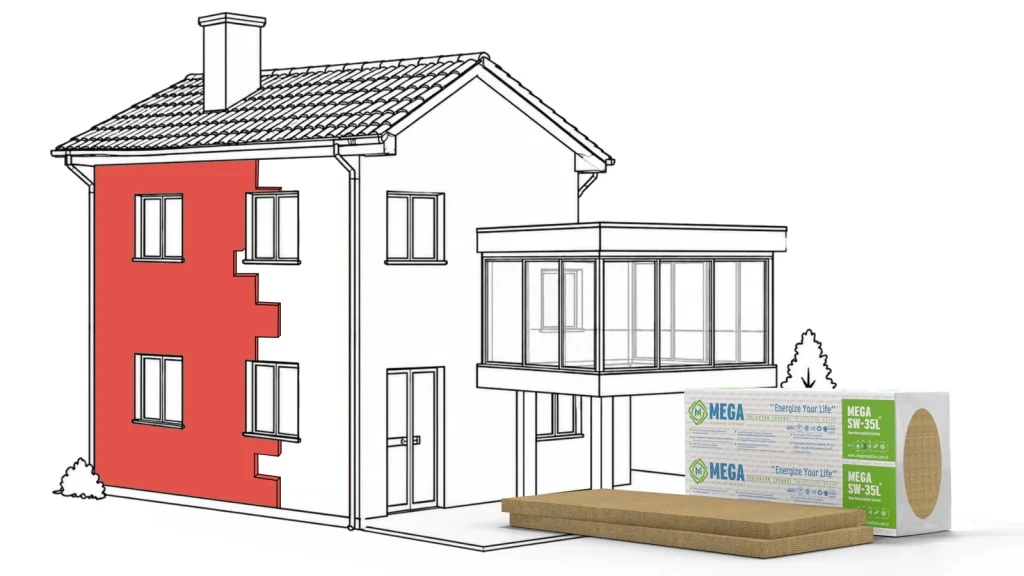
In Mega data sheets, the declared values of the three materials differ clearly. The MEGA SW F150 stone wool ETICS board has a thermal conductivity (λD) of at most 0.037 W/mK and a reaction-to-fire class of A1. The MEGA XPS T3000 board has a λD of 0.035 W/mK, a compressive strength of at least 300 kPa and a long-term water absorption by total immersion of at most 0.7%. White EPS 50W has a λD of 0.040 W/mK and the carbon-reinforced grey EPS 70 board 0.031 W/mK; EPS and XPS boards have a reaction-to-fire class of E.
These values also explain where each material stands out: XPS is preferred in damp, load-bearing locations, EPS in ETICS, and stone wool where fire and sound requirements apply. You can find a side-by-side comparison of the three in our section on thermal insulation materials and the meaning of the λ value in our post on thermal conductivity.
Which materials are used for waterproofing?
Waterproofing uses three methods and the materials that go with them: materials applied to the surface as a liquid, ready-made waterproofing sheets, and structural waterproofing in which the concrete itself is designed to be watertight. The Regulation on Waterproofing in Buildings defines these methods and lists the standards the materials must meet in Annex 1.
- Liquid-applied materials: Based on cement, acrylic dispersion, bitumen or reaction resin; applied by trowel, roller or brush, or sprayed.
- Waterproofing sheets: Ready-made sheets based on bitumen or on plastic and rubber; on site they are usually called membranes.
- Structural waterproofing: The concrete is designed to be watertight and the joints are protected separately. Under the regulation, this method cannot be used alone if the reinforced concrete element is thinner than 18 cm.
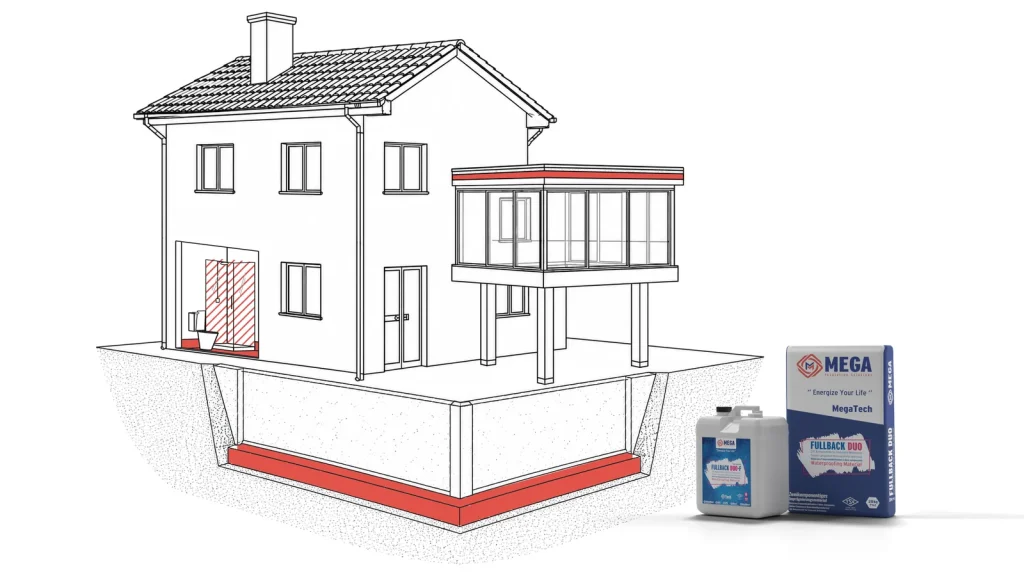
Mega’s Fullback family belongs to the liquid-applied group: the cement and acrylic-based, two-component Fullback Duo products and the acrylic-based, one-component Fullback Acrylic products. According to the product pages, Fullback Duo is used in wet areas, on balconies, on small terraces and on foundation, basement and retaining walls; Fullback Acrylic is used on pitched roofs and terraces, on external walls and on details such as eaves and chimney bases. The Fullback family has no sheet-type product; because the regulation takes sheet-type material as the basis on horizontal surfaces exposed to pressurised water, the choice for foundations in that condition is made in the design. The methods are detailed in our post on types of waterproofing.
Which materials are used for sound insulation?
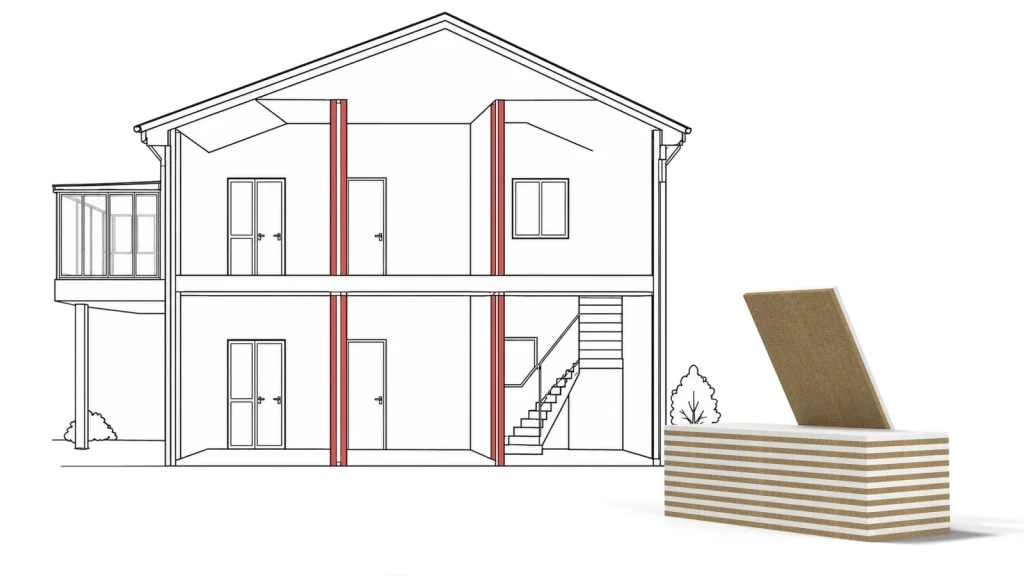
In sound insulation the material is chosen by the type of sound: infilled wall systems are used against airborne sounds such as speech and music, and resilient layers that separate the screed from the slab against impact sounds such as footsteps. For wall, floor and roof applications İZODER lists materials such as glass wool, stone wool, flexible polyurethane-based foams and melamine foam; EPS appears on this list only as a special class T product with improved dynamic stiffness.
| Application | Main type of sound | Type of material | Mega product |
|---|---|---|---|
| Lightweight partition wall | Airborne | Stone wool board | Partition Board (MEGA SW PB 40/50/60) |
| Inner face of an existing wall, party wall | Airborne | Stone wool and gypsum board composite panel | DesiWool |
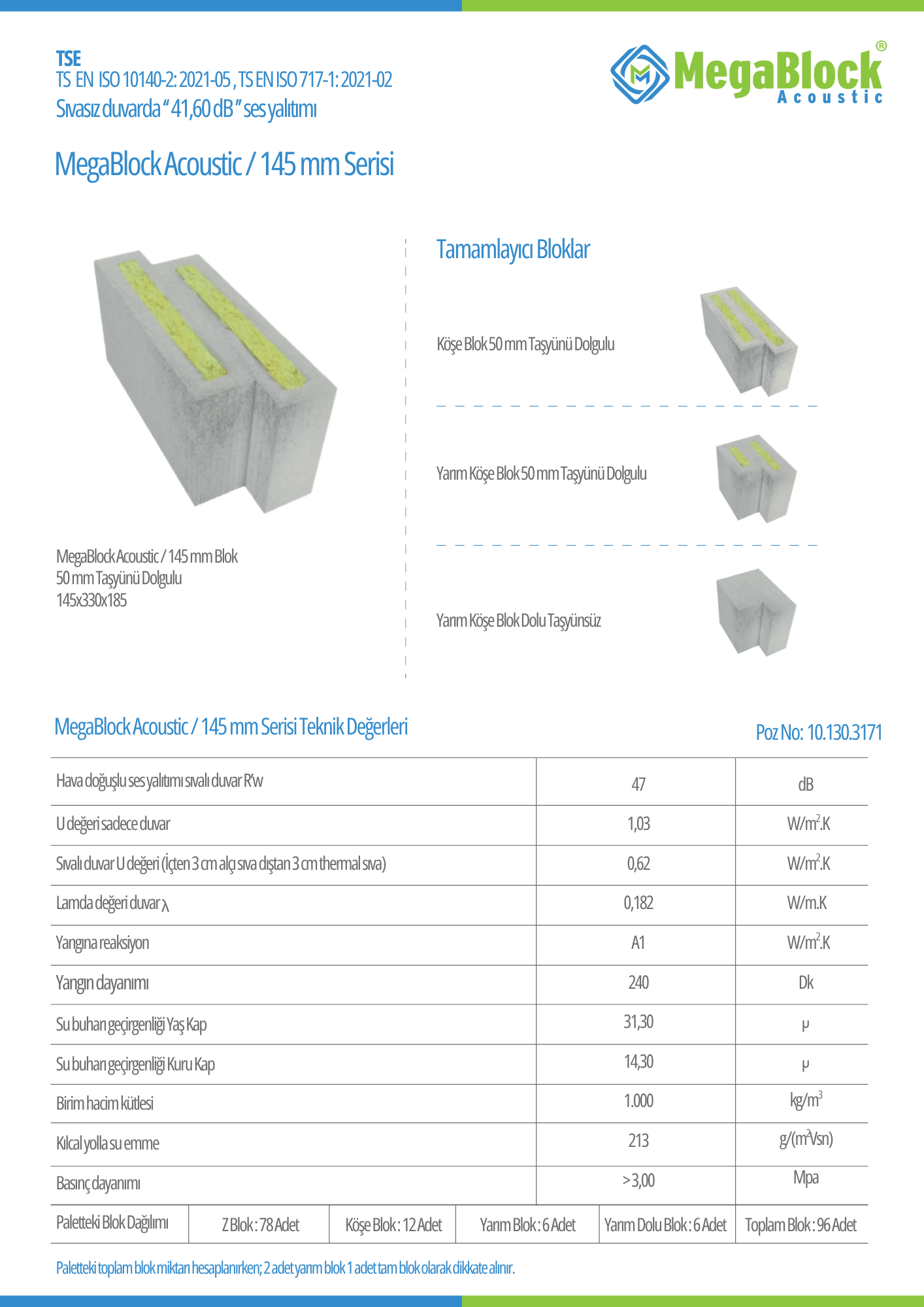
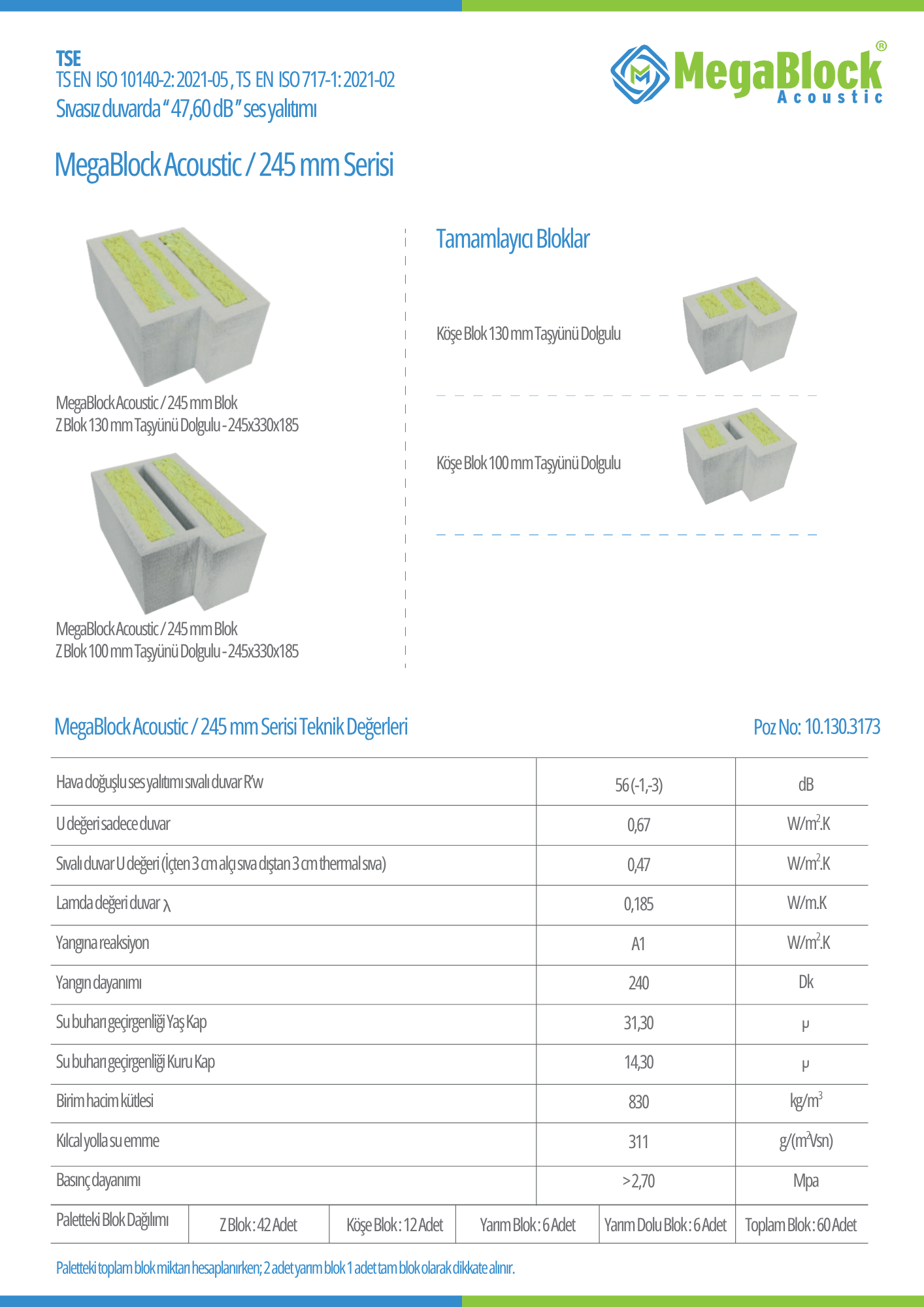
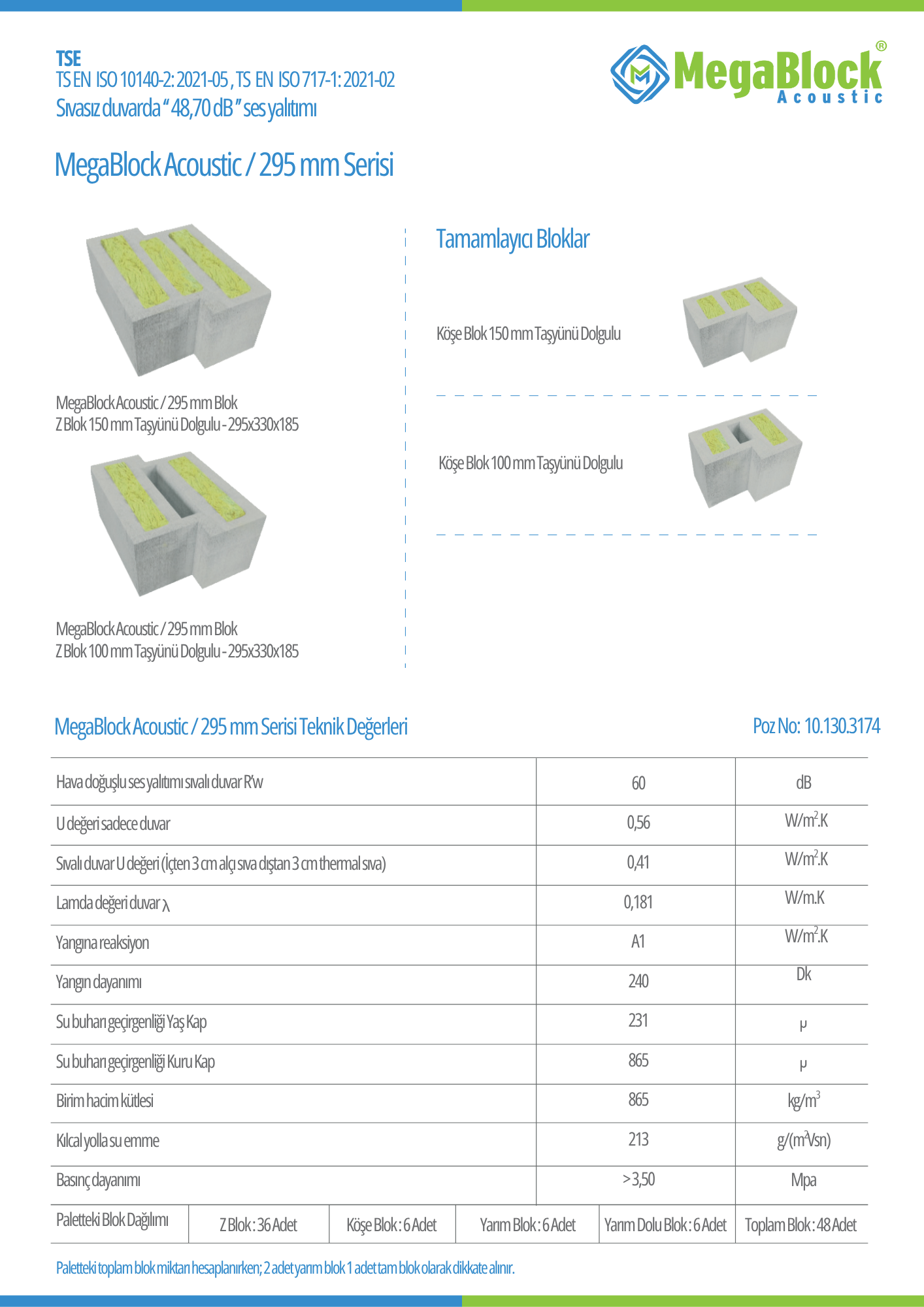
| Newly built wall | Airborne | Block with stone wool layers | MegaBlock Acoustic |
| Floor, under the screed | Impact | Stone wool board | Floating Floor Board (MEGA SW FF100/110/120) |
Source: Mega product pages and data sheets.
The Mega values given together with their test conditions are: R’w 29 dB on one side and 42 dB on both sides for the DesiWool W15 panel in the laboratory (Ticem test reports); and, for an unplastered wall built with MegaBlock Acoustic, 41.60 dB for 145/50SW, 47.60 dB for the 245 series and 48.70 dB for the 295 series (data sheets). These values were not measured under equivalent conditions and are not to be read as a gain added to the value of an existing wall. We explained selection by application in our post on sound insulation materials.
How are materials classified for fire protection?
For fire protection, materials are distinguished by their reaction-to-fire class, which shows how far they contribute to combustion: A1, A2, B, C, D, E and F under TS EN 13501-1. The Regulation on Fire Protection of Buildings treats class A1 as non-combustible, class A2-s1,d0 as low-combustible and class E as normally flammable.
In Mega data sheets, stone wool boards are class A1 and EPS and XPS boards are class E. The regulation ties these classes to conditions by building element:
- External walls: The facade must be of low-combustible material in buildings with a building height above 28.50 m, and of at least flame-retardant material in other buildings (Article 27).
- Roof: The surface or insulation under the roof covering must be of at least flame-retardant material; if the covering is non-combustible, the surface the covering is applied on may be of at least normally flammable material (Article 28).
- Interior surfaces: Thermal and sound insulation applied on the inside of walls must be of at least normally flammable material; in high-rise buildings and in venues with a capacity above 100 people such as cinemas, theatres, conference halls and wedding halls, of at least flame-retardant material (Article 29).
In ETICS, the class of the board alone is not enough: the regulation requires the system made up of board, adhesive, anchors, reinforcing mesh and render to be certified as a system by an accredited laboratory. You can find what the classes mean and the facade rules in our post on the fire class of insulation materials, and how stone wool behaves at high temperature in does stone wool burn.
Which materials are used for pipe and duct insulation?
Pipe and duct insulation uses materials made to fit the shape of pipes, valves, ducts and equipment: in this group İZODER lists glass wool, stone wool, rubber foam and polyethylene foam. The aim is to prevent heat loss on hot lines, and heat gain and condensation on cold lines. These products also have standards separate from building boards; for example, mineral wools used on pipes and ducts come under TS EN 14303.
Mega’s stone wool technical products belong to this group: the HVAC board, faced with aluminium foil on one side, for air-conditioning and ventilation ducts, and pipe sections for industrial and building services pipes. We covered applications in industrial plants in our post what is industrial insulation.
Which insulation material is used on which building element?
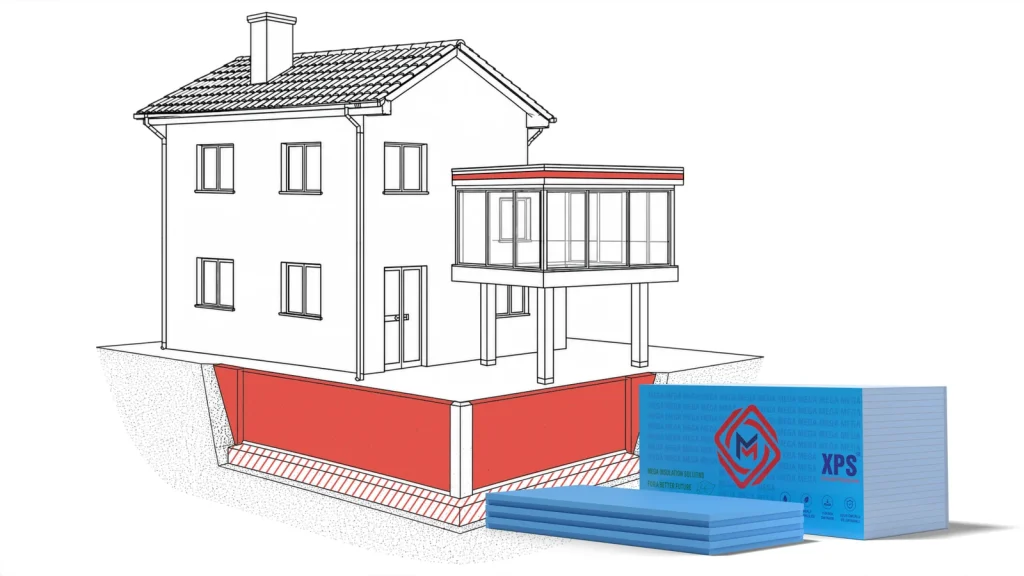
The material is chosen by the effect the building element is exposed to: water and load below ground, reaction-to-fire class on the facade, impact sound on the floor. The table below summarises the building elements, the main insulation function and the corresponding product on Mega product pages.
| Building element | Main function | Type of material | Mega product | Value in the data sheet or on the product page |
|---|---|---|---|---|
| Foundation and basement wall | Water, heat | Waterproofing with XPS board over it | Fullback Duo (not planned as the main waterproofing on horizontal surfaces exposed to pressurised water; the regulation takes sheet-type material as the basis); XPS flat board | MEGA XPS T1500–T3000: compressive strength at least 150–300 kPa, long-term water absorption at most 0.7% |
| External wall, rendered system (ETICS) | Heat, fire | Stone wool, EPS or XPS board | ETICS Board; EPSW and EPSG boards; XPS rough grooved board | MEGA SW F150: λD at most 0.037 W/mK, A1. EPS and XPS boards: E. Where building height exceeds 28.50 m, the facade must be low-combustible (Article 27). |
| Ventilated facade | Heat, fire | Stone wool board | Ventilated Facade Board (MEGA SW EF 70/80/90) | A1; λD at most 0.035 W/mK |
| Inner face of the external wall, party wall | Sound, heat | Stone wool and gypsum board composite panel | DesiWool | W15, panel fixed to a box-profile frame in the laboratory: R’w 29 dB (one side), 42 dB (both sides); not a gain to add to an existing wall |
| Lightweight partition wall | Sound, fire | Stone wool board | Partition Board (MEGA SW PB 40/50/60) | A1; λD at most 0.035 W/mK |
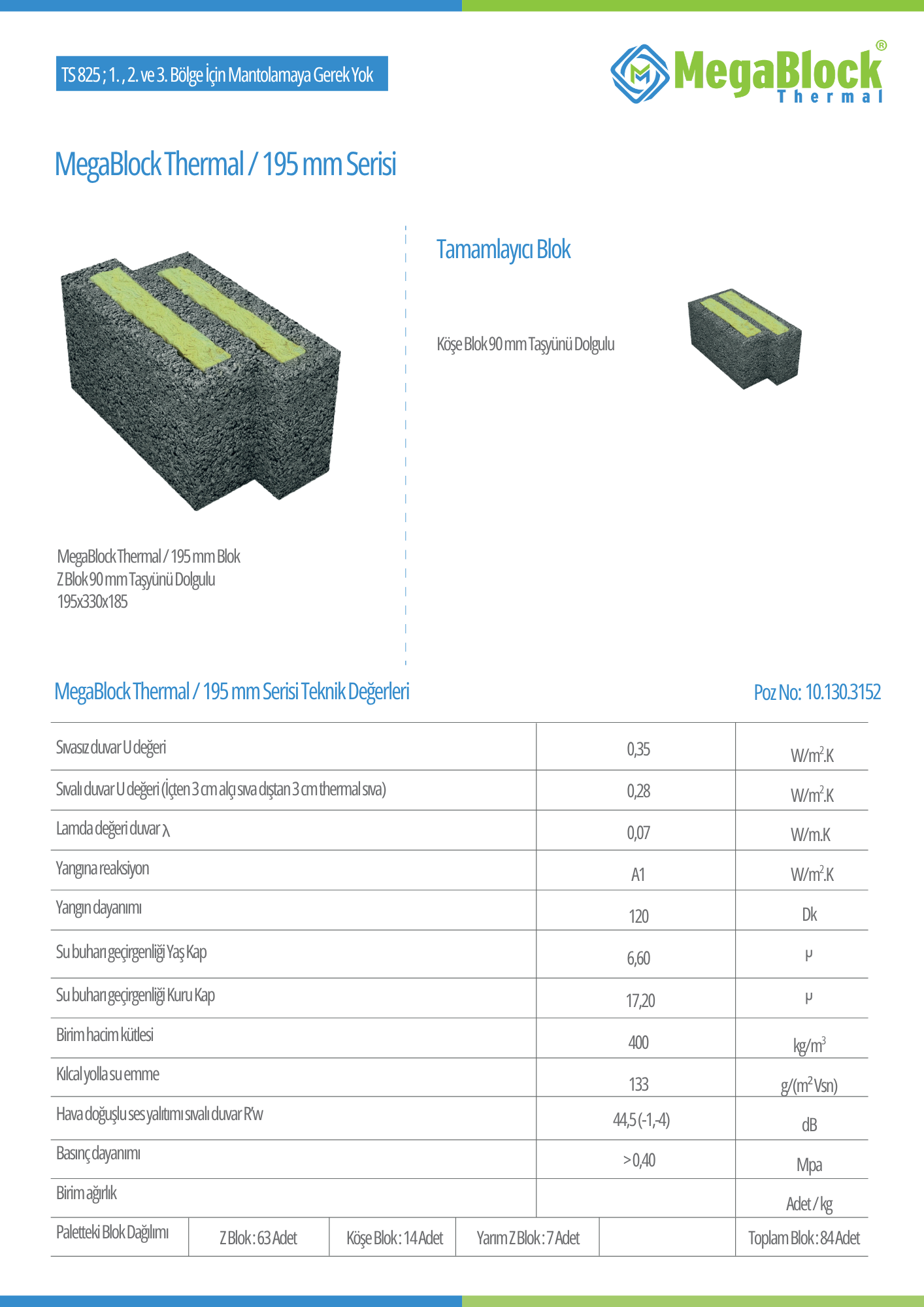
| Newly built wall | Heat or sound | Block with stone wool layers | MegaBlock Thermal; MegaBlock Acoustic | Thermal 195/90SW: U 0.35 W/m²K (unplastered). Acoustic 145/50SW: 41.60 dB (unplastered) |
| Column and beam faces | Preventing thermal bridges | Stone wool slab or XPS board | MegaBlock BC; XPS rough grooved board | BC: 150 kg/m³ stone wool, faced with acrylic render |
| Intermediate floor, under the screed | Impact sound, heat | Stone wool board | Floating Floor Board (MEGA SW FF100/110/120) | 100–120 kg/m³; A1; λD at most 0.036 W/mK |
| Terrace roof | Heat, water | Stone wool (warm roof) or XPS (inverted roof) and waterproofing | Terrace Roof Board; XPS flat board | Terrace Roof Board: compressive strength at least 30–70 kPa by type, λD at most 0.039 W/mK |
| Wet area (except industrial kitchens and laundries) and balcony | Water | Cement-based, two-component liquid-applied material | Fullback Duo | 20 kg powder + 10 kg liquid; 20 kg powder + 5 kg liquid in the semi-elastic type |
| Pipes and ducts | Heat, sound, fire | Stone wool pipe section and foil-faced board | Pipe section; HVAC board | The product page gives no numerical value |
Source: Mega product pages and data sheets; DesiWool W15 test reports (Ticem). The table is general guidance; thickness and layer order are determined in the design.
You can find the order in which these materials are applied on site in our post on the sequence of insulation in structural works, and all the insulation work in a building together with the legislation in our guide to construction insulation.
How are the properties of insulation materials read in the data sheet?
The properties of insulation materials are read from the declared values in the data sheet; which value is decisive depends on the function of the insulation.
| Property | Notation and unit | Where it is decisive | How to read it |
|---|---|---|---|
| Thermal conductivity | λD, W/mK | Thermal insulation | The lower it is, the higher the thermal resistance at the same thickness |
| Thermal resistance | R = d/λ, m²K/W | Thermal insulation | Thickness divided by the λ value; the higher it is, the better the insulation |
| Reaction-to-fire class | A1–F (TS EN 13501-1) | Facade, roof, interior surfaces | A1 is the non-combustible class, E the normally flammable class |
| Water absorption | % or kg/m² | Below ground and terraces | The lower it is, the less water the board takes up in wet conditions |
| Water vapour diffusion resistance factor | μ | Condensation control | The lower it is, the more easily the material lets vapour through |
| Compressive strength | kPa | Floors, terraces and foundations | The higher it is, the less the board is crushed under load |
| Sound reduction index | Rw or R’w, dB | Airborne sound in walls | The higher it is, the less sound the wall lets through |
| Impact sound level | L’nT,w, dB | Impact sound in floors | Measured in the finished building, not stated in the data sheet; the lower it is, the less sound reaches the floor below |
Because values vary from type to type within the same product family, the data sheet is read by the type name on the packaging. Thickness is part of the calculation too: a thermal resistance of 2.0 m²K/W needs 70 mm of MEGA XPS T3000 board with a λD of 0.035 W/mK, and 80 mm of EPS 50W board with a λD of 0.040 W/mK. We covered how the thickness a building needs is calculated in our post on insulation thickness.
How do you choose an insulation material?
An insulation material is chosen in this order: function first, then building element, legal requirement and data sheet values. If the decision starts from a product name, the application area in the data sheet and the place of use may not match.
- Define the function: Is it heat loss, water, noise or fire safety? Each function has its own criteria; a thermal insulation board does not replace waterproofing.
- Define the building element and what it is exposed to: Contact with soil, load, sun, moisture and temperature conditions narrow down the material group.
- Check the legal requirement: The reaction-to-fire class tied to building height on the facade, whether the water is pressurised in waterproofing, at least acoustic performance class C in new buildings and the U values in the thermal insulation project all limit the choice.
- Compare data sheet values by type name: In Mega XPS boards, compressive strength is at least 150 kPa in type T1500 and at least 300 kPa in type T3000.
- Think of the system as a whole: In ETICS the board, adhesive, anchors, mesh and render, and in waterproofing the main material and the complementary products at joints and penetrations, must be compatible with each other. The Regulation on Waterproofing in Buildings also takes as its basis the use of materials that do not impair each other’s performance.
- Leave the thickness to the design: In thermal insulation, thickness is determined in the thermal insulation project by the TS 825 calculation; in waterproofing, thickness and consumption are determined in the design details.
- Check the documents: The product standard, data sheet and declaration of performance must match the type name on the packaging.
Application note from MegaUsta: Insulation material is protected from water, sun and impact on site until the day it is applied. Store stone wool boards on timber battens and covered, stack XPS boards flat and protect them from the sun, and keep powder construction chemicals in a dry, enclosed area off the floor.
Which standards and documents are required for insulation materials?
For insulation materials, the product standard, the data sheet and the conformity documents are required together. The Regulation on the Energy Performance of Buildings requires building and insulation materials to carry a conformity mark and a declaration or certificate of conformity.
- Product standard: TS EN 13162 for stone wool, TS EN 13163 for EPS, TS EN 13164 for XPS.
- Data sheet: Values such as λD, reaction-to-fire class and compressive strength are read by type name.
- System certificate: In ETICS, the reaction-to-fire class of the system is given in the system certificate, not in the board’s data sheet.
- Test report: For sound values, the report states the test condition, such as laboratory or field, plastered or unplastered.
We explained what the standard codes mean in our guide to insulation standards. The data sheets and documents for Mega products are on the Documents page, and the board types on the stone wool, EPS and XPS category pages.
Frequently Asked Questions
What are insulation materials?
Insulation materials are products used for thermal insulation, waterproofing, sound insulation and fire protection. Thermal insulation uses boards such as stone wool, glass wool, EPS and XPS; waterproofing uses liquid-applied materials and waterproofing sheets; sound insulation uses mineral wools and floating floor layers. For fire safety, the decisive property is the material’s reaction-to-fire class. There are also separate insulation materials for pipes and ducts.
Which insulation material is the best?
No single insulation material is best everywhere; the right material depends on the function and the building element. According to Mega data sheets, stone wool boards are class A1 and stand out where fire and sound requirements apply. MEGA XPS boards have a long-term water absorption by total immersion of at most 0.7%; these boards are preferred below ground and on terraces. EPS boards are used in ETICS.
Are “yalıtım” and “izolasyon” the same thing?
Yes. In Turkish, “izolasyon” is the everyday word for “yalıtım” (insulation); the two terms describe the same products. Legislation and standards use the term “yalıtım”: the Regulation on Waterproofing in Buildings and TS 825 Thermal Insulation Requirements for Buildings are examples. When choosing a product, what matters is not the word but the material’s function and the values in its data sheet.
Does a thermal insulation material also provide sound insulation?
Not every thermal insulation material provides sound insulation. Mega’s EPS and XPS boards are offered for thermal insulation and their data sheets give no dB value. Stone wool-based products do have measured values: R’w 29 dB for the DesiWool W15 panel on one side in the laboratory, and 41.60 dB for an unplastered wall built with MegaBlock Acoustic 145/50SW. In a project with a sound target, choose a product that has a test report.
Which materials are used for wall insulation?
On external walls, rendered systems (ETICS) use stone wool, EPS or XPS boards; ventilated facades use stone wool boards. On the inner face of walls and on party walls, composite panels such as DesiWool, made of stone wool and gypsum board, are preferred, and stone wool partition boards in lightweight partition walls. If the insulation is to be built into the wall itself, MegaBlock blocks with stone wool layers are used.
How is the thickness of an insulation material determined?
For thermal insulation, thickness is calculated in the thermal insulation project prepared to TS 825; the project shows the U values of the building elements and the building’s annual heating energy demand. The thermal resistance of a layer is its thickness divided by its λ value. For example, a thermal resistance of 2.0 m²K/W needs 70 mm of a board with a λD of 0.035 W/mK, and 80 mm of a board with 0.040 W/mK.
Sources
- Regulation on the Energy Performance of Buildings, current text, Articles 9, 10 and 11 (Legislation Information System, in Turkish)
- Regulation on Waterproofing in Buildings, Official Gazette, 27.10.2017, no. 30223 (in Turkish)
- Regulation on the Protection of Buildings against Noise, Official Gazette, 31.05.2017, no. 30082 (in Turkish)
- Regulation on Fire Protection of Buildings, Articles 27, 28, 29 and Annex 2 (Legislation Information System, in Turkish)
- İZODER: Thermal insulation, general information (Table 3: standards the materials are subject to; in Turkish)
- İZODER: Waterproofing, general information (in Turkish)
- İZODER: Sound insulation, general information (in Turkish)
- İZODER: Fire insulation, general information (in Turkish)
- İZODER: Pipe and duct insulation, general information (in Turkish)
- Mega data sheet: MEGA SW F150 ETICS Board (PDF)
- Mega data sheet: Ventilated Facade Board (PDF)
- Mega data sheet: Partition Board (PDF)
- Mega data sheet: Floating Floor Board (PDF)
- Mega data sheet: Terrace Roof Board 30 kPa (PDF)
- Mega data sheet: Terrace Roof Board 70 kPa (PDF)
- Mega data sheet: MEGA XPS T1500 (PDF)
- Mega data sheet: MEGA XPS T3000 (PDF)
- Mega data sheet: EPS 40W / 40U-W / 50W (PDF)
- Mega data sheet: EPS 50 / 60 / 70 carbon-reinforced (PDF)
- Ticem test report: DesiWool W15, one side (PDF)
- Ticem test report: DesiWool W15, both sides (PDF)
- Mega data sheet: MegaBlock Acoustic 145/50SW (image)
- Mega data sheet: MegaBlock Acoustic 245 series (image)
- Mega data sheet: MegaBlock Acoustic 295 series (image)
- Mega data sheet: MegaBlock Thermal 195/90SW (image)
You can browse all product groups on our insulation products page and reach us about your project through our contact page.