
Stone wool is a thermal insulation material made by melting volcanic rock such as basalt, turning the melt into fine fibres and bonding those fibres into boards or mats. Standards refer to it as mineral wool (MW). It is used for thermal and acoustic insulation in buildings, especially where fire safety matters; according to their technical data sheets, Mega stone wool boards are classified A1 for reaction to fire.
Together with glass wool, stone wool is one of the two main branches of the mineral wool family. Because it is produced as boards, mats and pipe sections, it is used in many places, from facades and roofs to partition walls and industrial pipework. The technical values in this article are taken from the technical data sheets of Mega stone wool boards. If you are new to the basics of thermal insulation, start with our article what is thermal insulation.
What does stone wool mean, and what is it made from?
Stone wool takes its name from its raw material: rock is melted and turned into fibres that look like wool. According to the reference document on glass and mineral wool production published by the European Commission’s Joint Research Centre (JRC), the main raw material is an alumino-silicate rock, usually basalt. This rock is melted together with limestone or dolomite and sometimes with blast furnace slag.
In international literature it is known as “stone wool” or “rock wool”. The product standard TS EN 13162 covers factory-made mineral wool products, with or without facings, used for the thermal insulation of buildings; these products are manufactured as mats, boards or slabs.
The main difference between stone wool and glass wool lies in the raw materials. According to the same EU document, glass wool is made from glass raw materials such as sand, soda ash, dolomite and limestone, together with glass cullet. The document notes that stone wool is usually favoured for high-temperature and fire-protection applications, while glass wool is often chosen where light weight is critical. For a detailed comparison of the two materials, see our article glass wool or stone wool.
How is stone wool made?
Stone wool is made by melting rock, turning the melt into fibres and bonding the fibres into boards. The JRC reference document describes conventional production in the following steps:
- Preparing the raw materials: Basalt and limestone or dolomite are prepared in large lumps. Production waste can be ground, bonded into briquettes with cement and fed back into the furnace.
- Melting: Rock, briquettes and coke are charged in layers into a vertical furnace called a cupola. The hottest zone of the furnace reaches approximately 2000 °C; the molten rock collects at the bottom and flows out along a short trough.
- Fiberising: The melt falls onto rapidly rotating wheels and is thrown off as a fine spray. Air blown from behind the wheels attenuates the droplets into fibres.
- Binder application: An aqueous phenolic resin solution is sprayed onto the fibres as they form. The fibres collect on a conveyor as a mat, which is layered to reach the required weight per unit area.
- Curing: The mat passes through an oven at approximately 250 °C. Here the product thickness is set, the product is dried and the binder is cured.
- Cutting and packaging: The air-cooled product is cut to size and packaged. The data sheets of Mega stone wool boards give a board size of 1200 x 600 mm and PE film packaging.
According to the same document, flame furnaces or electric arc furnaces can also be used instead of a cupola; fiberising and the subsequent steps remain the same.
What are the properties of stone wool?
The main properties that define stone wool are thermal conductivity, reaction to fire, water vapour permeability, water absorption and dimensional stability. The table below shows the declared values shared by the technical data sheets of Mega stone wool boards, together with the relevant standards.
| Property | Declared value | Standard |
|---|---|---|
| Material | Stone wool (MW) | TS EN 13162 |
| Board size | 1200 x 600 mm | TS EN 822 |
| Declared thermal conductivity, λD (10 °C) | Max. 0.035–0.039 W/mK depending on board type | TS EN 12939 / TS EN 12667 |
| Reaction to fire class | A1 | TS EN 13501-1 |
| Water vapour diffusion resistance factor, μ | 1 | TS EN 12086 |
| Short-term water absorption, WS | ≤1 kg/m² | TS EN 1609 |
| Long-term water absorption, WL(P) | ≤3 kg/m² | TS EN 12087 |
| Dimensional stability, DS(70,-) | Max. 1% | TS EN 1604 |
| Thickness class | T4 | TS EN 823 |
| Maximum service temperature | +750 °C | No standard stated in the data sheet |
Source: technical data sheets of Mega stone wool ETICS, ventilated facade, partition, floating floor and flat roof boards. Density and compressive strength vary by board type, so they are given separately in the product table below.
How does stone wool insulate against heat?
Stone wool insulates by holding still air between its fibres; this structure slows the passage of heat through the material. The performance of an insulation material is expressed by its thermal conductivity (λ): the lower the value, the less heat passes through the same thickness.
In Mega stone wool data sheets, the λD value is at most 0.035 to 0.039 W/mK depending on the board type. The insulating effect of a board at a given thickness is expressed by its thermal resistance (RD), obtained by dividing the thickness by λD. According to the MEGA SW F150 data sheet, a 50 mm board has a thermal resistance of 1.35 m²K/W and a 100 mm board 2.70 m²K/W. The thickness required for a wall or roof is calculated in the thermal insulation design prepared to TS 825.
What does it do for sound insulation?
Thanks to its fibrous, porous structure, stone wool contributes to sound insulation in lightweight partition walls and floors. Mega data sheets state that the stone wool products are used for thermal and sound insulation and fire safety in buildings and industrial facilities, and the JRC document also notes that mineral wool has good acoustic properties. Even so, the acoustic performance of a wall or floor depends on all of its layers and junction details, not on the board alone. We cover the subject in detail in our article stone wool sound insulation.
How does stone wool behave in a fire?
According to their technical data sheets, Mega stone wool boards are classified A1, the highest reaction-to-fire class under TS EN 13501-1. The same data sheets declare a maximum service temperature of +750 °C; this value is not a melting point but the service limit stated in the data sheet.
The Turkish Regulation on Fire Protection of Buildings states that A1 materials do not contribute to fire at any stage, including a fully developed fire, and calls this class “non-combustible”. For comparison, Mega EPS and XPS boards are Class E according to their data sheets; the regulation places this class in the “normally flammable” group.
An A1 board on a facade does not make the whole system A1. The regulation requires the external thermal insulation system, consisting of insulation board, adhesive, anchors, mesh and render, to be certified as a system by an accredited laboratory. For details, see our articles does stone wool burn and fire classes of insulation materials.
Which products make up Mega Insulation’s stone wool range?
Mega Insulation’s stone wool range includes ETICS, ventilated facade, partition, floating floor, flat roof and industrial boards, plus technical products consisting of HVAC duct boards and preformed pipe sections. Mega Insulation Solutions (Mega Yalıtım) is a Turkish manufacturer of insulation materials with its head office in Kavacık, Istanbul, and its plant in Elazığ, exporting to more than 20 countries. According to the note in the data sheets, its stone wool boards are produced at the facilities of the group company Megataş A.Ş. in accordance with TS EN 13162+A1 and offered under the Mega brand. Stone wool is also used as a composite layer in DesiWool panels together with gypsum board, and in MegaBlock wall blocks together with pumice and cement.
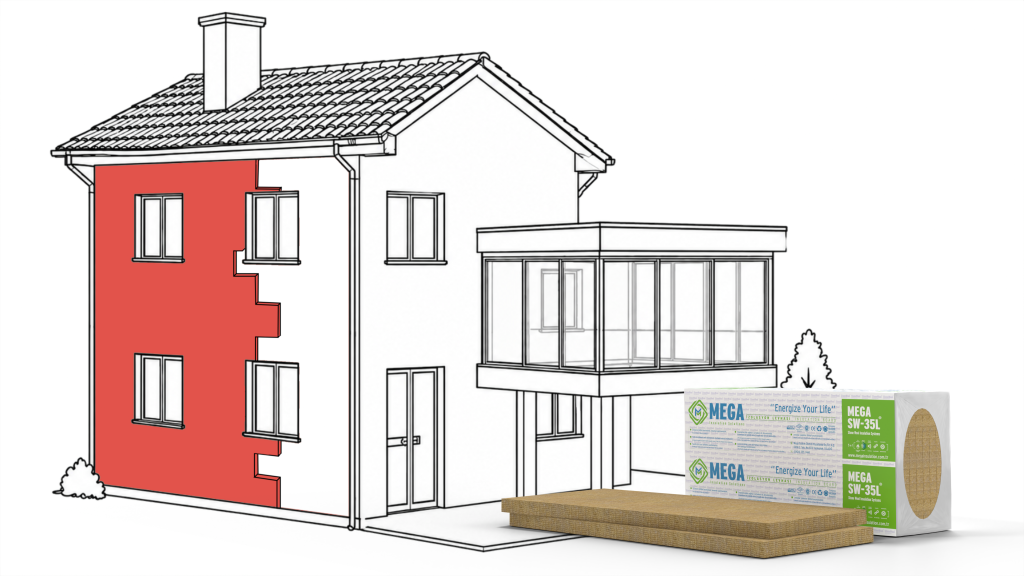
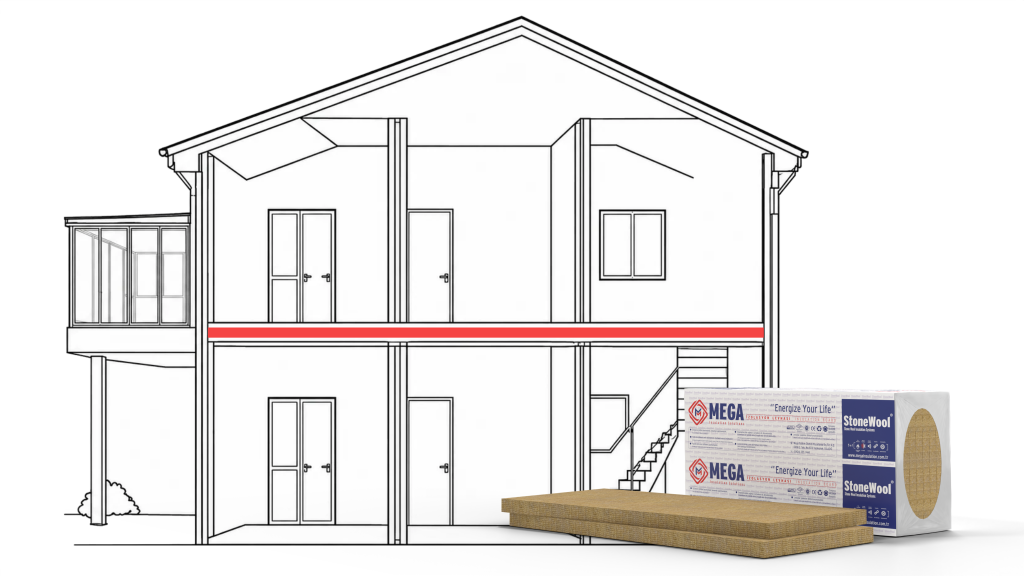
Stone wool is found in many parts of a building, from the facade to the roof: in rendered ETICS and ventilated facades on the outside, in lightweight partition walls inside, under the screed in floors, and in flat and pitched roofs. In industry it insulates pipes, ducts and process equipment. A full list of applications is in our article stone wool applications, and facade options are covered in types of external wall insulation.
| Product | Mega type | Density (kg/m³) | Thickness (mm) | λD (W/mK) | Compressive strength, CS(10/Y) | Application |
|---|---|---|---|---|---|---|
| Stone wool ETICS board | MEGA SW F150 / SW F120 | 150 / 120 | 40–120 | ≤0.037 | F150: min. 40–55 kPa; F120: min. 30 kPa | Rendered external thermal insulation systems (ETICS) |
| Ventilated facade board | MEGA SW EF 70/80/90 | 70–90 | 40–120 | ≤0.035 | Not declared (NPD) | Fixed to the facade wall or between supporting profiles |
| Partition wall board | MEGA SW PB 40/50/60 | 40–60 | 40–120 | ≤0.035 | Not declared (NPD) | Lightweight partition wall systems |
| Floating floor board | MEGA SW FF100/110/120 | 100–120 | 30 | ≤0.036 | 25 kPa | Under screed and between two concrete slabs; thermal, sound and vibration insulation |
| Flat roof board | 30, 40, 50, 60 and 70 kPa types | Not given in the data sheet | 40–100 | ≤0.039 | Min. 30–70 kPa | Flat roofs, pitched metal and timber roofs |
Source: Mega technical data sheets of the respective products. Density and thickness are given according to the types and options in each data sheet.
Read side by side, the data sheets show that density varies with the application. The partition board used in lightweight partitions has a density of 40–60 kg/m³, while the MEGA SW F150 and F120 ETICS boards, which carry render, have densities of 150 and 120 kg/m³; both types declare a tensile strength perpendicular to faces of at least 10 kPa. We explain which density suits which application in our guide to stone wool density.
For industrial applications, the stone wool industrial board (MEGA SW 70 and SW 110; with glass tissue facing, aluminium foil or unfaced) is used in industrial facilities, process equipment, steel structures and prefabricated panels. For HVAC ducts and industrial and building service pipes, the Stone Wool Technical Products range includes an HVAC duct board with aluminium foil on one face and preformed pipe sections. Up-to-date data sheets for these two groups should be requested from Mega Insulation.
For details of roof and floor applications, see our articles flat roof insulation and what is a floating floor.
What are the advantages and limitations of stone wool?
According to Mega data sheets, the main advantages of stone wool boards are their A1 reaction-to-fire class, low thermal conductivity and vapour permeability. Their limitations are the weight that comes with the higher density of ETICS types, the need to protect them from liquid water, and the fact that not every type is designed to carry loads.
Advantages
- Reaction to fire: All Mega stone wool boards with a technical data sheet are Class A1 under TS EN 13501-1.
- Thermal insulation: The λD value is at most 0.035–0.039 W/mK depending on the board type.
- Vapour permeability: The water vapour diffusion resistance factor is μ = 1, so the board resists the passage of water vapour no more than still air does. We explain how this relates to condensation in our article breathable walls and condensation.
- Dimensional stability: In the dimensional stability test at 70 °C, the change is at most 1%.
- High temperatures: The maximum service temperature in the data sheets is +750 °C; according to the data sheet notes, stone wool products are also used in industrial facilities and process equipment.
Limitations
- Weight: The MEGA SW F150 and F120 ETICS boards have densities of 150 and 120 kg/m³; a 1200 x 600 mm MEGA SW F150 board 100 mm thick weighs about 11 kg. The adhesive and anchor layout should be planned for this weight.
- Liquid water: The board absorbs little water, but it is not waterproof. It should be protected from rain on site; for foundations and basement walls in contact with soil or permanent moisture, XPS boards are usually preferred.
- Compression: No compressive strength is declared for partition and ventilated facade boards, and their data sheets state that these types are not to be used in applications requiring compressive creep resistance. For flat roofs and under-screed applications that carry loads, types with a declared compressive strength are selected.
- Dust during installation: Cutting and fitting release dust and fibres, so personal protective equipment should be worn.
If you want to compare it with foam-based boards, our article stone wool or EPS compares the two materials in terms of thermal, moisture and fire behaviour.
Application note from MegaUsta: Store stone wool boards on site in their PE film packaging, raised off the ground and covered; do not install a board that has been rained on, whether on a wall or under a screed, before it has dried. For ETICS, use the board adhesive as its data sheet describes: comb it onto the back of the board with a notched trowel if the substrate is even, or apply it in dabs if it is not. Do not start mechanical anchoring until at least 24 hours later.
Frequently Asked Questions
Is stone wool a thermal insulator?
Yes, stone wool is a thermal insulation material; the still air trapped between its fibres slows the passage of heat. Mega stone wool data sheets declare a thermal conductivity (λD, 10 °C) of at most 0.035 to 0.039 W/mK, depending on the type. The effect in a building depends on thickness: according to the MEGA SW F150 data sheet, a 100 mm board has a thermal resistance of 2.70 m²K/W.
Does stone wool absorb water?
Stone wool absorbs little water, but it is not a waterproof material. Mega stone wool data sheets declare short-term water absorption of at most 1 kg/m² (TS EN 1609) and long-term water absorption by partial immersion of at most 3 kg/m² (TS EN 12087). Boards should therefore be protected from rain on site; for foundations and basement walls in contact with soil or permanent moisture, XPS boards are usually preferred.
Is stone wool harmful to health, and what precautions apply during installation?
In Volume 81 of its Monographs, published in 2002, the International Agency for Research on Cancer (IARC) placed stone wool in Group 3, not classifiable as to its carcinogenicity to humans. Cutting and installation still release dust and fibres. Installers should therefore wear gloves, long-sleeved work clothing, safety glasses and a dust mask, ventilate the cutting area and collect offcuts with a vacuum cleaner instead of sweeping.
What are the dimensions of stone wool boards?
The technical data sheets of Mega stone wool boards give a board size of 1200 x 600 mm, while thickness varies with the application. ETICS, ventilated facade and partition boards are declared in 40–120 mm, flat roof boards in 40–100 mm depending on the type, and the floating floor board in 30 mm. The thickness required for a wall or roof is determined by the calculation in the thermal insulation design.
Which standard is stone wool manufactured to?
Stone wool boards used in buildings are manufactured and specified under TS EN 13162, the standard for factory-made mineral wool (MW) products. According to the note in Mega’s stone wool data sheets, the boards are produced at the facilities of the group company Megataş A.Ş. in accordance with TS EN 13162+A1. Reaction to fire is classified under TS EN 13501-1; product certificates are available on Mega Insulation’s Documents page.
Sources
- Regulation on Fire Protection of Buildings (Türkiye), Annex 2: Combustibility classes of materials (mevzuat.gov.tr)
- European Commission Joint Research Centre (JRC), Best Available Techniques (BAT) Reference Document for the Manufacture of Glass, 2013, Section 2.9: Mineral wool
- IARC Monographs Volume 81 (2002), Man-made Vitreous Fibres: summary and evaluation (IPCS INCHEM)
- EN 13162:2012+A1:2015, Thermal insulation products for buildings: Factory made mineral wool (MW) products, standard record (EVS)
- Mega Insulation, ETICS Board 150 (MEGA SW F150) technical data sheet (PDF)
- Mega Insulation, MEGA SW F120 ETICS board technical data sheet (PDF)
- Mega Insulation, Ventilated Facade Board technical data sheet (PDF)
- Mega Insulation, Partition Board technical data sheet (PDF)
- Mega Insulation, Floating Floor Board technical data sheet (PDF)
- Mega Insulation, Flat Roof Board 30 kPa technical data sheet (PDF)
- Mega Insulation documents (Documents page)
Choosing the right stone wool board means weighing the application, the required thickness and the compressive strength against the data sheets. You can browse the full range on the stone wool boards page and send questions about your project to Mega Insulation via the contact page.