
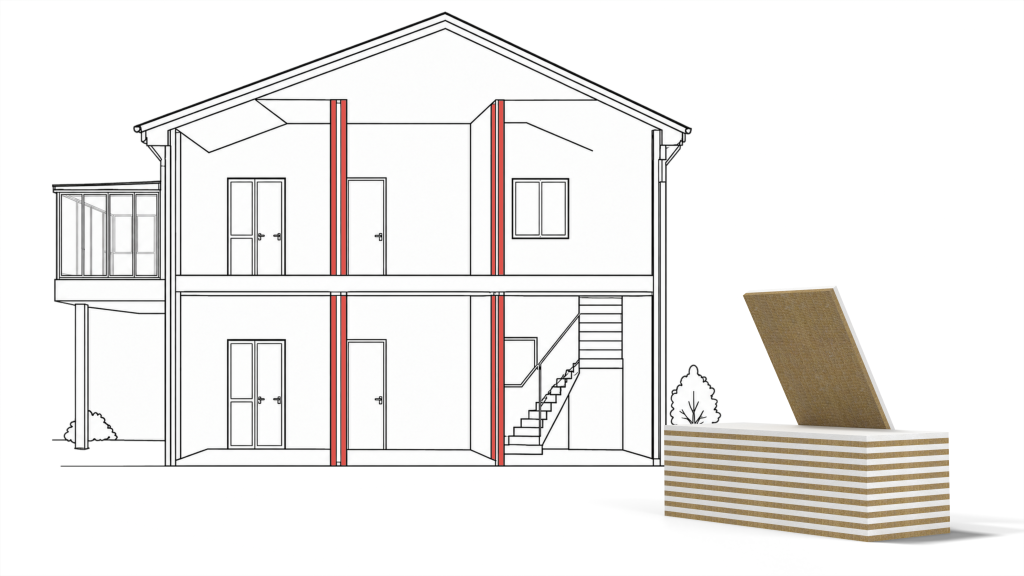
Stone wool does provide sound insulation, but as part of a wall system rather than on its own. Its fibrous, porous structure damps the air vibration in the cavity between the two linings of a plasterboard partition and reduces the sound passing into the next room. Three things determine the result: the board filling the cavity completely, the lining layers and junction details that leave no sound bridges.
This guide explains how stone wool works in partition wall sound insulation, the installation steps and the detailing mistakes that are made most often. For readers looking for dB values, the test report and data sheet values of two stone wool based Mega products are given in a separate table. If you are new to the material, the article what is stone wool is a good place to start.
Mega Insulation Solutions (Mega Yalıtım) is a Turkish manufacturer of insulation materials with its head office in Kavacık, Istanbul and its plant in Elazığ. For sound insulation it offers the stone wool partition board, the gypsum-faced DesiWool panel and the MegaBlock Acoustic wall block under the Mega brand.
How does stone wool reduce sound?
Stone wool reduces sound by damping it in the cavity inside the partition. Sound striking one face of the wall makes that face vibrate, and the vibration travels through the air in the cavity to the opposite face. The fibrous material filling the cavity absorbs the energy of this air vibration and weakens the sound that reaches the other face.
The sound insulation information page of İZODER describes two approaches. Single-leaf walls resist sound through their mass; this is called the mass law, and insulation increases as the wall gets heavier. A solution relying on mass alone, however, is often neither economical nor practical because of load, thickness and sound bridge issues. The alternative is the double-leaf lightweight partition, with thin linings fixed to both faces and a sound-absorbing material between them. In acoustics this arrangement is known as a mass-spring-mass system: the plasterboards form the masses and the air between them forms the spring, while the stone wool damps the sound energy in the cavity.
That is why stone wool should not be seen as a sound stopper on its own. The same board will not deliver the expected result in a wall whose two faces are rigidly connected or whose edges are left open. If you want to know why noise deserves attention, see the article on the effects of noise on human health.
What is the difference between airborne sound and impact sound?
Airborne sound reaches the wall by travelling through the air, whereas impact sound is generated directly in the structure, usually in the floor. A stone wool partition is built against the first type.
- Airborne sound: The Turkish Regulation on the Protection of Buildings against Noise defines it as sound that spreads through the air from the vibration of a source in the air. Speech, television and music fall into this group.
- Impact sound: According to the regulation, it arises directly in a solid medium, for example a floor, and is transmitted through the building elements. Footsteps, slamming doors and furniture being dragged are typical examples.
Footsteps from the floor above cannot be solved with a partition wall. İZODER states that impact sound can only be prevented with a double-layer floor, which means a floating floor with a resilient layer between the screed and the structural slab. For this application Mega offers the floating floor board; according to its data sheet the board is 30 mm thick with a density of 100–120 kg/m³.
How is stone wool installed in a plasterboard partition, step by step?
Stone wool between plasterboards is fitted after the frame is erected and one face is boarded. The whole installation takes six steps: the frame is erected, one face is boarded, the cavity is filled with stone wool, services are prepared, the second face is boarded and the junctions are sealed. Stud spacing, screw pattern and the number of board layers follow the installation details of the plasterboard system used.
- Erect the frame: Horizontal tracks are fixed to the floor and ceiling and studs are placed between them. Placing a resilient separating tape where the profiles touch the floor, ceiling and side walls reduces direct transmission of vibration into the structure.
- Board the first face: Plasterboards are screwed to the studs. If two layers of board are used, the joints of the second layer are staggered so that they do not line up with those of the first.
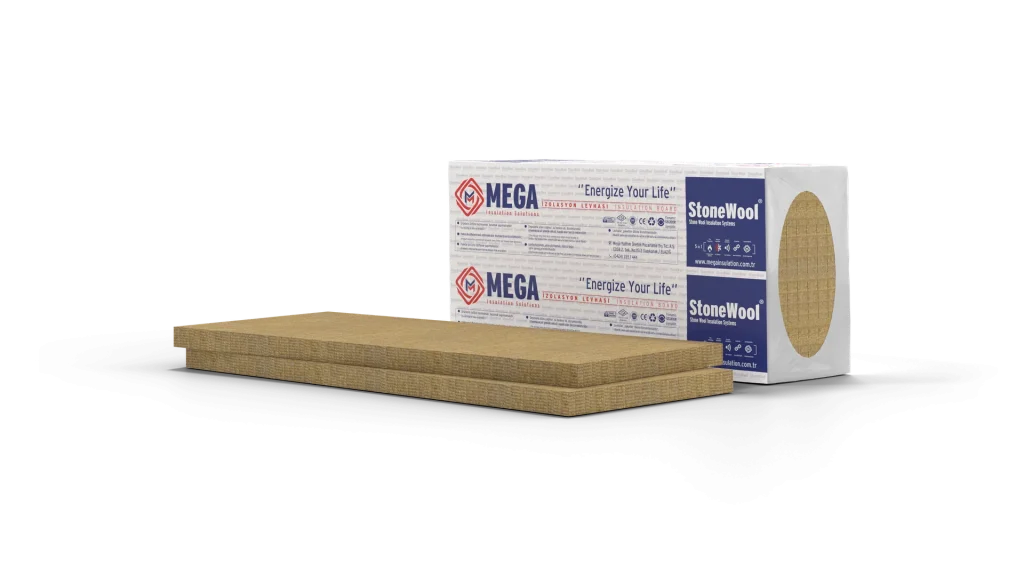
- Fill the cavity: Stone wool boards are fitted tightly between the studs so that no voids remain. Mega partition board measures 1200 x 600 mm; it is measured and cut to the stud spacing, and no gaps are left at board joints or along the profiles.
- Prepare the services: Electrical back boxes and pipe penetrations are installed before the second face is closed. Stone wool is cut around these points but the space behind them is not left empty.
- Board the second face: The boards on the opposite face are positioned so that their joints do not line up with the joints on the first face.
- Seal the junctions: The perimeter joints where the boards meet the floor, ceiling and side walls are filled with a flexible, airtight sealant, followed by joint tape and jointing compound.
Installation note from MegaUsta: Do not compress the board to make it fit the cavity; choose a thickness that suits the stud depth. The partition board data sheet notes that it is not used in applications requiring compressive creep resistance, so it is not designed for locations under sustained compressive load. On site, store the packs indoors where possible, on a flat surface protected from water.
How do you choose stone wool thickness and density for a partition wall?
Thickness is chosen according to the stud width and the target sound insulation value; the board should fill the cavity without being compressed. According to its technical data sheet, Mega’s partition board is produced in thicknesses from 40 to 120 mm.
For density, the data sheet defines three types: MEGA SW PB 40, 50 and 60, that is 40, 50 and 60 kg/m³. You can find the effect of density on the thermal and mechanical values of stone wool boards in detail in the stone wool density guide.
How many dB of sound insulation do DesiWool and MegaBlock Acoustic provide?
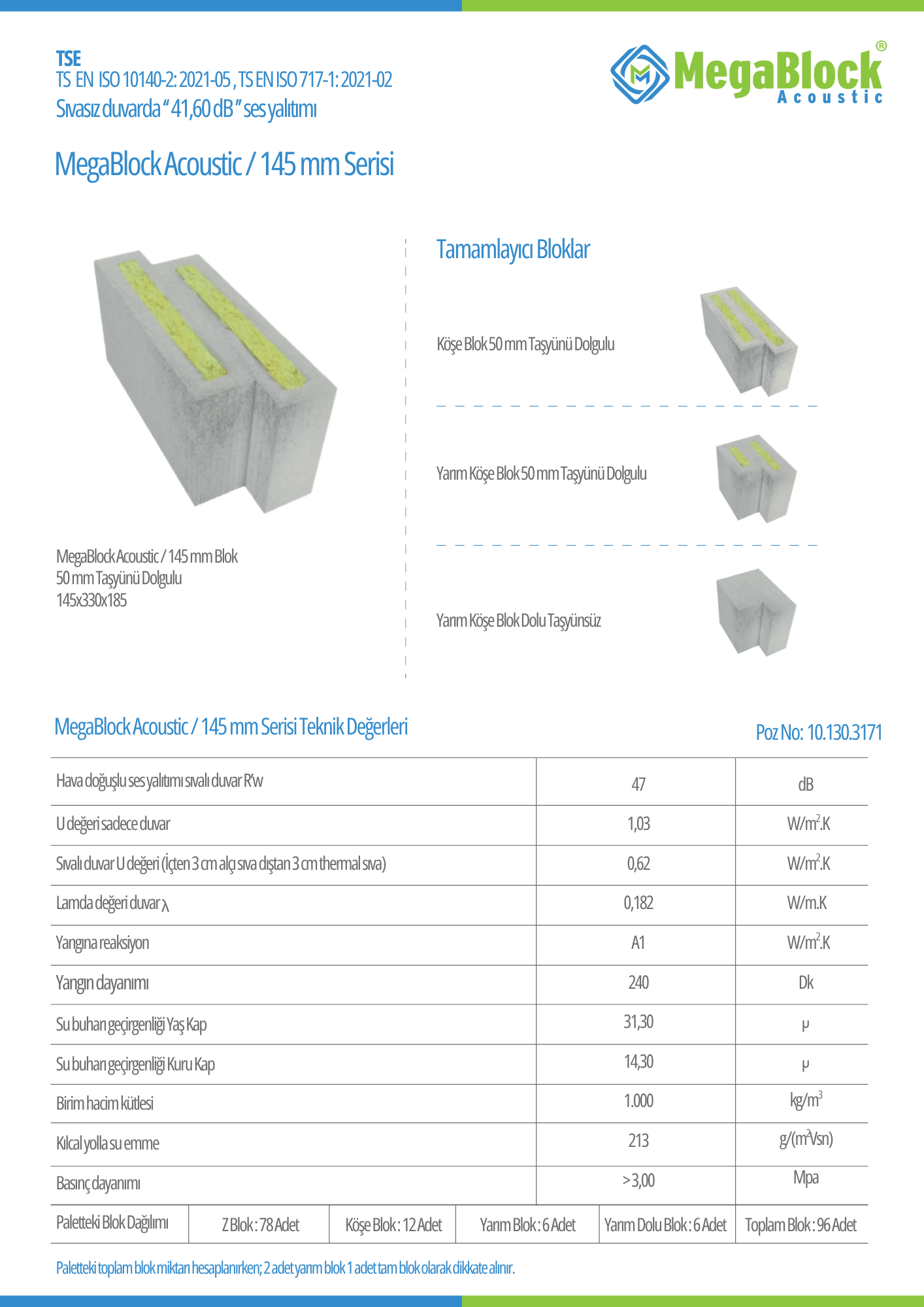
Documented dB values are available for two stone wool based Mega products: accredited laboratory test reports for DesiWool W15 and the technical data sheet for MegaBlock Acoustic. Both give airborne sound insulation as R’w in decibels; the higher the value, the better the insulation.
| Product | Construction | R’w (dB) | Condition | Source |
|---|---|---|---|---|
| DesiWool W15 | Applied on one side | 29 | Laboratory, EN ISO 10140-2 and EN ISO 717-1 | Accredited laboratory test report |
| DesiWool W15 | Applied on both sides | 42 | Laboratory, EN ISO 10140-2 and EN ISO 717-1 | Accredited laboratory test report |
| MegaBlock Acoustic 145 mm (50 mm stone wool) | Plastered wall | 47 | Given in the data sheet as the plastered wall value | Mega technical data sheet |
| MegaBlock Acoustic 145 mm (50 mm stone wool) | Unplastered wall | 41.6 | TS EN ISO 10140-2 and TS EN ISO 717-1 test | Mega technical data sheet (citing a TSE test) |
Source: DesiWool W15 one-sided and two-sided test reports, MegaBlock Acoustic 145/50SW technical data sheet. The values in the table show that the result changes markedly when the same product is applied to both faces or when the wall is plastered. When comparing dB values, look at the construction in which the value was measured, not at the product name. The value of a plasterboard partition is likewise read from the report of the system tested with its board layers, studs and stone wool infill together.
DesiWool is a composite panel with gypsum board on one face and stone wool on the other, produced in thicknesses from 15 to 80 mm according to its data sheet. For where it is used, see the article on interior wall insulation; for technical details, see the DesiWool page.
MegaBlock Acoustic, on the other hand, is a stone wool filled wall block; according to the data sheet, the 145 mm block contains 50 mm of stone wool. In the same data sheet series, values of 56 and 60 dB are given for plastered walls built with 245 and 295 mm blocks. The block family is introduced in the article what is MegaBlock, and the data sheets are on the sound insulation block page.
How can sound bridges be prevented?
A sound bridge is a point where sound bypasses the insulation layer and passes to the other side through a rigid connection or an opening. The regulation requires flanking transmission at junctions to be added to the calculation of sound insulation in the building, so the junction details matter as much as the wall itself.
- Sockets and back boxes: Do not place sockets on the two faces of the wall back to back in the same stud bay; offset them into different bays. Keep stone wool behind the back box and seal around the box with sealant.
- Pipe and duct penetrations: The hole in the board is cut slightly larger than the pipe and the annular gap is filled with flexible sealant. The pipe is not clamped rigidly to the stud or the board.
- Stud connections: Screwing both faces to the same stud carries vibration from one face to the other. Where higher insulation is targeted, the faces are mounted on separate rows of studs or on resilient profiles.
- Floor and ceiling junction: If the wall stops below a suspended ceiling, sound travels around it through the ceiling void. The partition is taken up to the structural slab and the perimeter joint is sealed with sealant.
- Doors: In a wall with a door, the weak point is usually the door. The regulation allows the value achieved together with the door in a building element containing a door to be up to 10 dB below the limit value.
We cover the solutions that can be applied to an existing party wall separately in the article on wall sound insulation.
How do you read R’w, C and Ctr in a test report?
Rw and R’w are weighted sound reduction indices that express the airborne sound insulation of a building element as a single number, in decibels (dB). The higher the value, the less sound passes through the wall.
These single numbers are calculated according to EN ISO 717-1. The standard gives the rules for converting frequency-band measurements made in the laboratory to EN ISO 10140-2, or in buildings to ISO 16283-1, into a single value. A laboratory value describes the element tested; in a building, sound also travels via the flanking walls, floor and ceiling. The regulation therefore requires building performance to be calculated by adding flanking transmission to laboratory values. For this reason the result on site may fall below the laboratory value.
The brackets next to the value contain the spectrum adaptation terms C and Ctr. EN ISO 717-1 uses these terms to account for different noise types, such as sources inside a building and traffic outside. For example, the reported value for DesiWool W15 applied on both sides is R’w (C;Ctr) = 42 (-3;-9) dB; adding Ctr brings it down to 33 dB. In Türkiye, the Regulation on the Protection of Buildings against Noise requires at least acoustic performance class C in new buildings; the limit values for each class are given in the annexes of the regulation.
Frequently Asked Questions
Does stone wool provide sound insulation?
Yes. Stone wool works as the sound-absorbing layer in the cavity between the two linings of a lightweight partition and reduces the airborne sound passing to the other side. The result depends on the lining layers, on filling the cavity completely and on avoiding sound bridges. As a measured example, DesiWool W15 achieved R’w 29 dB applied on one side and 42 dB applied on both sides in an accredited laboratory test.
How many cm of stone wool goes between plasterboard?
Stone wool thickness is chosen to suit the stud width; the board should fill the cavity without being compressed and without leaving gaps. Where higher sound insulation is targeted, a wider stud and a matching thickness are used. According to its technical data sheet, Mega’s partition board is produced from 40 to 120 mm; types and thicknesses are listed on the partition board page.
Stone wool or EPS for sound insulation?
Stone wool is the material used as the sound-absorbing layer in a partition cavity. İZODER lists EPS among sound insulation materials only as board with improved dynamic stiffness. Mega’s EPS ETICS board data sheets declare no sound insulation value, and the product pages mention EPS for sound only in floating floors against impact sound. Details are in the article on EPS applications.
How do you stop sound leaking through sockets and pipe penetrations in a plasterboard wall?
Sockets on the two faces of the wall are not placed back to back in the same stud bay but offset into different bays. Stone wool is kept behind the back box and the gap around the box is sealed with sealant. At pipe penetrations the hole is cut slightly larger than the pipe, the annular gap is filled with flexible sealant and the pipe is not fixed rigidly to the board. Options for an existing party wall are covered in the article on wall sound insulation.
Sources
- Regulation on the Protection of Buildings against Noise (Official Gazette of Türkiye, 31.05.2017, No. 30082)
- İZODER (Turkish insulation association): Sound insulation, general information
- EN ISO 717-1:2020 rating of airborne sound insulation, standard record (SIS)
- Mega: Partition board (MEGA SW PB) technical data sheet (PDF)
- Mega: DesiWool technical data sheet (PDF)
- Mega: DesiWool W15 one-sided application sound test report (PDF)
- Mega: DesiWool W15 two-sided application sound test report (PDF)
- Mega: MegaBlock Acoustic 145/50SW technical data sheet
- Mega Insulation documents page
If you want to compare data sheets side by side when choosing products for a partition or party wall, see the stone wool boards page, and for project-specific questions you can reach the Mega technical team via the contact page.