

What causes mould on walls? The underlying cause is a surface that stays damp for a long time. When warm, humid indoor air meets a cold wall surface it condenses; water leaking through the roof or facade, plumbing leaks and rising damp from the ground can also wet the wall. Airborne mould spores multiply on a surface that stays damp. The lasting fix is first to remove the source of moisture and, where condensation is the cause, to keep the inner face of the wall warm with insulation.
In most homes, mould on walls starts in the same places: around windows, in the corner where an external wall meets the ceiling, and behind a wardrobe or sofa. In this guide we explain what causes mould, why corner mould appears mostly at cold spots, what a “breathable wall” and vapour permeability mean, how external and internal insulation affect mould, and which measures you can take at home.
What causes mould on walls?
The decisive condition for mould on a wall is that the surface stays damp for a long time. According to the mould guide of the US Environmental Protection Agency (EPA), mould spores are too small to see, float constantly through indoor and outdoor air, and may begin growing when they land on a wet surface. The guide stresses that no type of mould will grow without water or moisture.
Where the moisture comes from varies from home to home. Because the remedy depends on the source, the first step is to understand which situation you are dealing with:
| Moisture source | Where does mould appear? | Telltale sign | Direction of the fix |
|---|---|---|---|
| Surface condensation | Inner faces of external walls, corners, around windows, behind wardrobes and sofas | Gets worse in cold weather; windows also mist up and collect droplets | Lowering indoor humidity, ventilating, warming the inner face of the wall with insulation |
| Water leaking in from outside | Ceilings below roofs and terraces, cracked facades, balcony junctions | Becomes visible after rainy days; the stain usually spreads from one point | Repairing the waterproofing of the roof, facade or balcony |
| Plumbing leak | Bathroom and kitchen walls, pipe penetrations | Independent of the season; the same area stays wet | Repairing the leak, drying the wall |
| Rising damp from the ground | Lower part of walls on ground and basement floors | Damp appears as a band along the bottom of the wall | Ground and basement wall insulation, drainage |
The UK Government guidance on damp and mould in the home uses similar categories: moisture generated inside the home that cools and condenses on colder parts of the building, water entering through defects in walls, roofs, windows or floors, rising damp and plumbing leaks. This article focuses mainly on condensation mould. If there is a leak or rising damp, that problem must be fixed first; insulation alone does not solve it. As the EPA points out, mould gradually damages the material it grows on; we cover the effect of moisture on the structure separately in our article on building lifespan.
How does mould affect health?
According to official health guidance, damp and mould primarily affect the airways and lungs; the eyes and skin can also be affected. The World Health Organization (WHO) guidelines on indoor dampness and mould summarise the most important health effects associated with damp, mouldy buildings as increased respiratory symptoms, allergies and asthma, together with disturbance of the immune system.
According to the EPA guide, inhaling or touching mould or mould spores may cause hay fever-type allergic symptoms in sensitive people, such as sneezing, runny nose, red eyes and skin rash. In people with asthma who are allergic to mould, it can trigger asthma attacks. Mould can irritate the eyes, skin, nose, throat and lungs of everyone, whether or not they are allergic.
The UK Government guidance lists groups at greater risk: children and young people whose organs are still developing, older people, pregnant women, people with weakened immune systems and people with pre-existing health conditions.
These sources describe mould as a factor that can worsen allergy and asthma symptoms; not every allergy is caused by mould, and a doctor assesses the cause of any symptoms. On the building side, the task is the measure WHO identifies as the most important means of avoiding health effects: preventing or minimising persistent dampness and microbial growth on interior surfaces and in building structures. The health information in this article is general in nature and is not a substitute for medical advice.
How does mould start on a cold wall surface?
Mould starts when water vapour in room air meets a cold wall: the humidity of the air next to the surface rises, and if the surface is cold enough, the vapour turns into water. According to the EPA, condensation on windows, walls or pipes can also be a sign of high indoor humidity.
The wall does not need to be soaking wet for mould to start. EN ISO 13788, the standard on the moisture behaviour of building elements, defines a method for calculating the internal surface temperature below which mould growth is likely for a given indoor air temperature and relative humidity. A cold surface that stays at high humidity for a long time can be enough for mould, even if no droplets are visible.
You can think of the process as a simple chain:
- Moisture enters the indoor air: Cooking, showering, washing dishes and drying clothes add water vapour to indoor air.
- The external wall gets cold: In winter, the inner face of an uninsulated or poorly insulated external wall stays colder than the room air.
- Moisture builds up on the surface: The relative humidity of the air in front of the cold surface rises. If the surface temperature drops below the dew point, vapour turns into water on the surface.
- Mould multiplies: If the surface stays damp for days, mould spores from the air start to grow there.
- The chain is broken: Lowering indoor humidity and warming the inner face of the wall with insulation cut the chain at both ends.
We explain in detail how the dew point is found and which humidity level to aim for at home in our article what is condensation.
What causes corner mould?
Corner mould appears at the coldest points of a wall. Corners where external walls meet, the faces of reinforced concrete columns and beams, the area around windows and the line where a floor slab reaches the facade lose more heat than their surroundings. These cold spots are called thermal bridges. Because the inner surface stays colder there, condensation and mould also start there first.
The UK Government guidance notes that condensation forms on window frames, in corners and on low parts of walls behind sofas or wardrobes, and adds that gaps in insulation can create cold spots. The EPA likewise lists wall surfaces behind furniture, where condensation forms, among the places where hidden mould may occur. Because little air circulates behind furniture, the surface stays both colder and damper.
The lasting fix for a thermal bridge is continuous insulation. The national thermal insulation worker qualification of Türkiye’s Vocational Qualifications Authority (MYK) also requires insulation to continue over columns and beams to prevent thermal bridges, and boards at window and door edges to be fitted in one piece, cut to an L shape, so that no joint is formed.
Application note from MegaUsta: Do not push wardrobes, bookcases and sofas right up against an external wall; leave a gap behind them for air to circulate. After cleaning mould from a corner, watch the same spot for a few weeks. If the stain comes back, the problem is not the cleaning but the fact that the spot stays cold, and it needs to be dealt with by insulation.
What does a breathable wall mean and what does vapour permeability (μ) show?
A breathable wall is not a wall that lets air in; it is a wall whose layers let water vapour pass slowly and in a controlled way. In such a wall, moisture that gets into the structure is not trapped and can dry out over time. Data sheets express this behaviour as the water vapour diffusion resistance factor (μ): the lower the μ value, the more easily the material lets water vapour through.
Standards also show why vapour permeability matters. Besides surface condensation, EN ISO 13788 covers methods for assessing the risk of interstitial condensation caused by water vapour diffusion inside a building element and for calculating how long water trapped between two layers of high vapour resistance takes to dry out. In a wall whose layers let vapour through, moisture that gets in keeps a path to dry out.
According to Mega data sheets, the μ values of some products used in facade and wall layers are as follows:
| Product | Role in the wall | Water vapour diffusion resistance factor (μ) | Source |
|---|---|---|---|
| Stone wool ETICS board (MEGA SW F150, F120, PLUS, ULTRA, SW-35L) | External wall insulation layer | 1 | Mega stone wool data sheets (TS EN 13162+A1) |
| MTP-3344 insulation board render | Mesh-reinforced base coat | Max. 15 (EN 1015-19) | MTP-3344 data sheet |
| MegaBlock Thermal insulating block (145, 195, 245 and 295 mm series) | Masonry unit | Wet cup 6.60 / dry cup 17.20 | MegaBlock Thermal data sheet |
The μ = 1 declared for stone wool boards is the lowest value in this table; the board offers very little resistance to the passage of water vapour. One distinction is worth keeping in mind: what reduces condensation by warming the inner face of the wall is the insulation itself, and this effect does not depend on the type of board. Vapour permeability determines how easily moisture that has entered the wall can dry out.
Does mould decrease if external wall insulation is done correctly?
Yes; correctly installed external wall insulation reduces the risk of condensation mould. External insulation wraps the wall, including the faces of columns and beams, in a continuous shell. Internal surfaces therefore stay warmer, and cold spots at corners and beam faces shrink. If there are leaks, plumbing faults or persistently high indoor humidity, external insulation alone does not solve them.
The EPA recommends covering cold surfaces with insulation and raising the air temperature to prevent condensation. The UK Government guidance also notes that homes that are not sufficiently insulated and heated are more prone to moisture and condensation building up on the inside of external walls and windows. The same guidance contains an important warning: some energy efficiency improvements may reduce overall ventilation, and if ventilation is not addressed, the risk of damp and mould can increase. Ventilation should therefore be planned together with insulation.
For external insulation to work against mould, the installation needs to meet these conditions:
- Continuity: No gaps are left between boards and the boards are laid in a staggered pattern; columns, beams and slab edges are insulated too. An exposed beam face becomes a new cold spot in the middle of an insulated wall.
- Window surrounds: At window and door edges, boards are cut to an L shape and fitted in one piece so that no joint is formed.
- Vapour-open layers: The stone wool ETICS board with a μ value of 1 and the MTP-3344 insulation board render with a μ value of max. 15 form a system that does not block the path of vapour. As a finish, the line-pattern mineral render, which the product page describes as a “breathable” coating applied over the insulation system render, can be used.
- Suitable weather: According to their data sheets, MegaTech adhesives and renders are applied between +5 and +35 °C; work is not carried out on frozen surfaces, in direct sunlight or in strong wind. You can find the right period in our article when to apply external wall insulation.
- Moisture source first: Cracks, leaks or rising damp in the facade are fixed before insulation. For surface checks and preparation on existing buildings, see our guide to insulating old buildings.
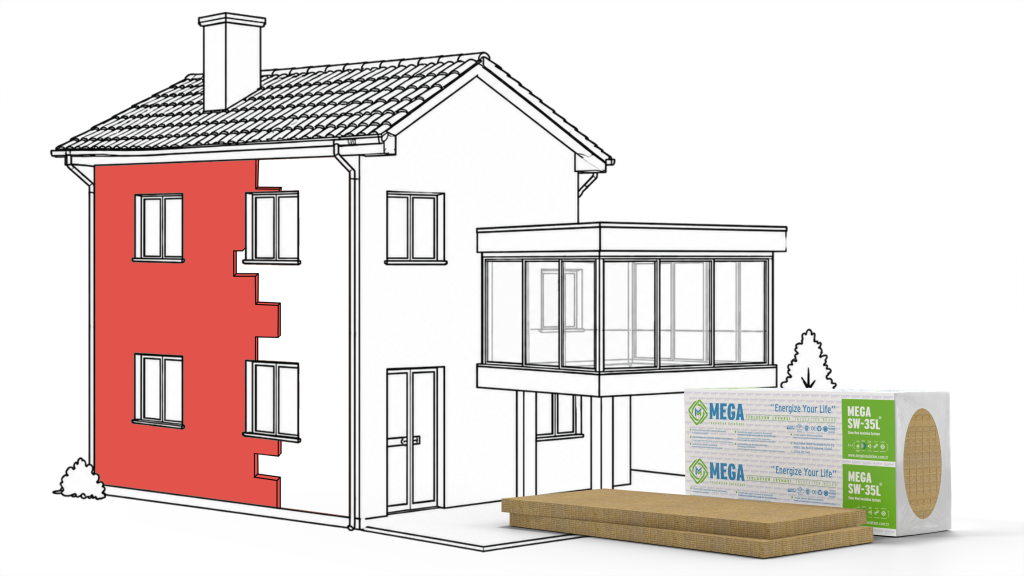
We compare external wall systems built with stone wool, EPS and XPS boards in our article on types of external wall insulation. According to Mega data sheets, the reaction to fire class of stone wool boards is A1 under TS EN 13501-1; you can read about the material’s structure and other properties in what is stone wool. Mega Insulation (Mega Yalıtım) is a Turkish manufacturer of insulation materials with its head office in Kavacık, Istanbul, and its factory in Elazığ; it offers stone wool, XPS and EPS thermal insulation boards, MegaTech construction chemicals and the DesiWool panel under the Mega brand. On the facade, the board, the base coat render and the decorative finish can all be chosen from this product family.
What should you watch for with internal insulation when external insulation is not possible?
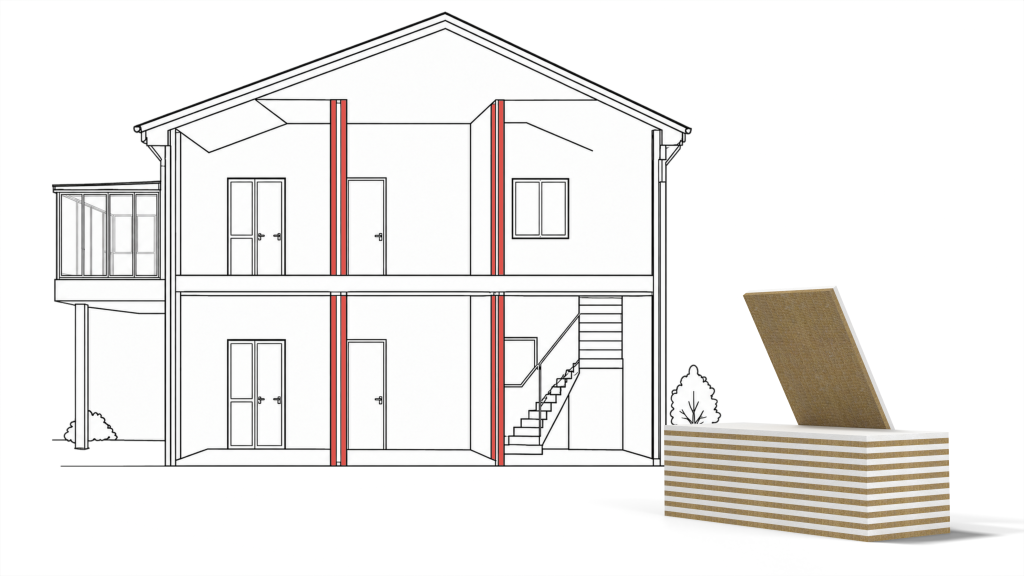
If the residents of an apartment building cannot agree or the facade cannot be altered, an external wall can also be insulated from the inside. Correctly installed internal wall insulation warms the room-side surface of the wall and reduces the risk of condensation mould. Because the wall itself stays on the cold side of the insulation with this method, the details need more care:
- Damp and mould on the wall are dealt with before the panels are fitted.
- No air gap is left between panel and wall, and the joints are sealed.
- According to the MYK national thermal insulation worker qualification, insulation on internal walls is continued for at least 50 cm onto the ceiling and floor surfaces meeting the wall to avoid thermal bridges.
- Whether to use a vapour barrier is decided according to the wall build-up, with a condensation calculation. By the MYK definition, a vapour barrier is a material with high resistance to water vapour, such as polyethylene film, aluminium foil or kraft paper.
Mega’s DesiWool panel is a composite panel with plasterboard on one face and stone wool on the other. According to the product page, it is used for sound and thermal insulation on the inner faces of external walls and on partition and party walls; according to its data sheet, its λD is at most 0.035 W/mK. According to the product page, its composite structure allows the stone wool and plasterboard to be installed in a single application and shortens installation time.
How can mould be prevented? 6 steps you can take at home
The way to prevent mould is to control moisture; the EPA guide sums this up as “the key to mold control is moisture control”. The steps below deal with ventilation, indoor humidity and insulation together:
- Find the source of moisture: Look at where the stain is and when it grows. If there is a leak or plumbing fault, repair it first. According to the EPA, if you clean up the mould but do not fix the water problem, the mould will most likely come back.
- Dry wet areas quickly: The EPA states that if wet materials and areas are dried within 24–48 hours of a leak, in most cases mould will not grow.
- Lower indoor humidity: Run the bathroom fan or open the window when showering, use the cooker hood when cooking, and vent moisture-producing appliances such as clothes dryers to the outside where possible. The EPA recommends keeping indoor relative humidity below 60% if possible.
- Keep the air moving: Ventilate by opening doors and windows when practical, and leave room for air to circulate behind furniture standing against external walls.
- Clean the mould, do not paint over it: The EPA advises against painting or caulking mouldy surfaces and warns never to mix chlorine bleach with cleaning products that contain ammonia. If the mouldy area exceeds about 1 m² (10 ft²) or there is significant water damage, the guide refers readers to a more comprehensive cleanup guide; in that case it is sensible to get professional help.
- Insulate the cold wall: If condensation keeps forming on the same wall, the lasting fix is to warm its inner face. External wall insulation is considered at building level and internal insulation for a single flat; heating the home adequately also raises surface temperatures. If you are planning a major upgrade, putting insulation at the start of the building renovation plan makes the work easier.
Frequently Asked Questions
What causes mould on walls?
Mould on walls forms when a surface stays damp for a long time. In heated homes, one of the main causes is warm, humid indoor air condensing on a cold external wall. Water leaking through the roof or facade, plumbing leaks and rising damp from the ground can also wet the wall. Because mould spores are always present in the air, they multiply on surfaces that stay damp. A lasting fix starts with finding the source of the moisture.
Does external wall insulation prevent mould?
External wall insulation reduces the risk of condensation mould, but it does not prevent every kind of mould. A correctly installed system covers the external wall, columns and beams without gaps, so internal surfaces stay warmer and the cold spots in corners shrink. If there are leaks, plumbing faults or persistently high indoor humidity, mould can still form. Moisture sources should therefore be fixed before insulating, and regular ventilation should continue afterwards.
What does a breathable wall mean?
A breathable wall is one that lets water vapour, not air, pass slowly and in a controlled way through its layers. In such a wall, moisture that gets into the structure is not trapped and can dry out over time. Data sheets express this property as the water vapour diffusion resistance factor (μ); the lower the value, the more easily vapour passes. According to Mega data sheets, stone wool boards have a μ value of 1. A breathable wall does not replace ventilation.
Can internal insulation solve mould in a home where external insulation is not possible?
If installed correctly, it helps. Internal insulation warms the room-side surface of the wall and reduces the risk of condensation mould. Before the panels go on, however, any damp and mould on the wall must be dealt with, no gaps should be left between panel and wall, and the insulation should also continue at the ceiling and floor junctions. Whether a vapour barrier is needed depends on the wall build-up. Our internal wall insulation guide covers the details.
Does stone wool go mouldy?
Stone wool is an inorganic material made of mineral fibres; it is not one of the organic materials, such as leaves and wood, that mould breaks down in nature. Even so, no building material should be treated as mould-proof under every condition: if dust, dirt and long-lasting moisture build up on its surface, mould can grow on that deposit. That is why stone wool boards are stored protected from water on site and applied to a dry, sound surface.
Does painting over a mouldy wall solve the problem?
No. Paint may hide the stain for a while, but unless the source of the moisture is removed, the mould comes back. The EPA advises against painting or caulking mouldy surfaces, recommends cleaning up the mould and drying the surface first, and notes that paint applied over mould is likely to peel. The UK Government guidance also stresses that simply removing surface mould does not stop damp and mould from reappearing. Painting comes last.
Sources
- World Health Organization (WHO), WHO guidelines for indoor air quality: dampness and mould (2009)
- US Environmental Protection Agency (EPA), A Brief Guide to Mold, Moisture and Your Home
- UK Government (OHID, DHSC, MHCLG, UKHSA), Understanding and addressing the health risks of damp and mould in the home
- EN ISO 13788:2012 Hygrothermal performance of building components and building elements: internal surface temperature to avoid critical surface humidity and interstitial condensation, calculation methods (EVS standard record)
- Vocational Qualifications Authority of Türkiye (MYK), 12UY0057-3 Thermal Insulation Worker (Level 3) National Qualification
- Mega technical data sheet: MEGA SW F150 ETICS Board
- Mega technical data sheet: MEGATECH MTP-3344 Insulation Board Render
- Mega technical data sheet: DesiWool
- Mega Insulation certificates and technical documents
You can review stone wool external insulation solutions for cold walls that lead to mould, together with their data sheets, on the stone wool boards page, and send questions about your building to us via the contact page.