

Stone wool density shows how many kilograms one cubic metre of board weighs and is expressed in kg/m³. In Mega stone wool data sheets, partition boards are declared at 40–60, ventilated facade boards at 70–90, the floating floor board at 100–120 and ETICS boards at 120 and 150 kg/m³. In these sheets, thermal insulation does not improve as density rises; compressive and tensile strength values are declared for the higher-density boards.
On site, stone wool is often referred to by a density figure such as “the 150 one”, but that figure alone does not tell you which job a board is suitable for. This guide sets out the values from Mega stone wool data sheets side by side, by application. If you are new to the material, start with the article what is stone wool.
Mega Insulation Solutions (Mega Yalıtım), headquartered in Kavacık, Istanbul, with its plant in Elazığ, offers stone wool, XPS and EPS thermal insulation boards under the Mega brand. According to the note on the data sheets, Mega stone wool boards are manufactured at the facilities of group company Megataş A.Ş. in accordance with TS EN 13162+A1.
What does stone wool density tell you?
Density is the ratio of a board’s mass to its volume, and its unit is kg/m³. For thermal insulating products, apparent density is determined with the method in TS EN 1602 (EN 1602), by dividing the mass of a specimen by its volume.
Mega stone wool data sheets declare density according to this standard. For the MEGA SW F120 and F150 ETICS boards the tolerance is ±10%, meaning the measured density of a board declared at 150 kg/m³ may deviate from the declared value by up to 10 percent. When people on site say “150 density stone wool”, they mean a board with a declared density of 150 kg/m³.
Density on its own is not a quality grade but a selection criterion that shows which job a board was made for. A 40 kg/m³ board placed inside a partition wall and a 150 kg/m³ board bonded and rendered on a facade are designed for different tasks.
Does insulation improve as density increases?
According to Mega data sheets, no, not directly. The declared thermal conductivity of the 40–60 kg/m³ MEGA SW PB partition board is λD ≤0.035 W/mK, while that of the 150 kg/m³ MEGA SW F150 ETICS board is λD ≤0.037 W/mK. Going by the declared values, the lighter board’s thermal conductivity is no higher than the heavier board’s.
λD is a board’s declared thermal conductivity at 10 °C and is measured according to TS EN 12939/12667; the lower the value, the better the insulation. You can find more detail on the concept in the article on thermal conductivity.
What determines thermal insulation is the thermal resistance produced by λD and thickness together (RD = thickness / λD); for 100 mm MEGA SW F150 this calculation gives about 2.7 m²K/W. The values that differ with density in the data sheets are compressive strength and tensile strength perpendicular to faces: they are not declared for the partition and ventilated facade boards, but they are for the floating floor and ETICS boards. That is why density matters where the board carries load.
Which stone wool density is used for which application?
In Mega data sheets, density is stepped by application: 40–60 for lightweight partitions, 70–90 for ventilated facades, 100–120 for floating floors, and 120 and 150 kg/m³ for ETICS. For some types the data sheet gives no density; these boards are defined by their compressive strength.
| Product and type | Application | Density (kg/m³) | λD (W/mK) | Thickness (mm) | Compressive strength (kPa) | Tensile strength perpendicular to faces, TR (kPa) |
|---|---|---|---|---|---|---|
| ETICS board MEGA SW F150 | Rendered external wall insulation (ETICS) | 150 (±10%) | ≤0.037 | 40–120 | min. 40 / 45 / 55 | min. 10 |
| ETICS board MEGA SW F120 | Rendered external wall insulation (ETICS) | 120 (±10%) | ≤0.037 | 40–120 | min. 30 | min. 10 |
| MEGA SW PLUS | Rendered external wall insulation (ETICS) | Not declared | ≤0.037 | 40–120 | min. 25 | min. 7.5 |
| MEGA SW ULTRA | Rendered external wall insulation (ETICS) | Not declared | ≤0.037 | 40–120 | min. 30 / 35 / 40 | min. 7.5 |
| MEGA SW-35L | Rendered external wall insulation (ETICS) | Not declared | ≤0.035 | 50–120 | min. 25 | min. 7.5 |
| Floating floor board MEGA SW FF100/110/120 | Under screed, slabs between storeys | 100–120 | ≤0.036 | 30 | 25 | No performance determined (NPD) |
| Ventilated facade board MEGA SW EF 70/80/90 | Ventilated (curtain) facade | 70 / 80 / 90 | ≤0.035 | 40–120 | No performance determined (NPD) | No performance determined (NPD) |
| Partition board MEGA SW PB 40/50/60 | Lightweight partition wall | 40 / 50 / 60 | ≤0.035 | 40–120 | No performance determined (NPD) | No performance determined (NPD) |
| Flat roof board 30, 40, 50, 60 and 70 kPa | Flat and pitched roofs | Not declared | ≤0.039 | 40–100 (by type) | min. 30–70 (by type) | min. 10 |
Source: Mega stone wool technical data sheets (TS EN 13162+A1). “Not declared” and NPD mean that the data sheet gives no value for that property.
All boards in the table measure 1200 x 600 mm and, according to the data sheets, have reaction to fire class A1 (TS EN 13501-1). This class, listed as “non-combustible” in the Turkish fire regulation, does not change with density. For details, see does stone wool burn; for where each board goes in a building, see stone wool applications.
Why are 120–150 kg/m³ boards used for ETICS?
Because in ETICS the stone wool board is the layer that receives the mesh and render. That is why ETICS board data sheets include compressive and tensile values that partition and ventilated facade boards do not have; Mega’s two ETICS boards with a declared density are MEGA SW F120 (120 kg/m³) and MEGA SW F150 (150 kg/m³).
Tensile strength perpendicular to faces (TR) is the strength a board shows when pulled at right angles to its faces, and it is determined according to TS EN 1607. Both data sheets share λD ≤0.037 W/mK and a TR of at least 10 kPa. The difference is compressive strength: at least 30 kPa for F120, while the F150 data sheet gives three values of at least 40, 45 and 55 kPa.
F150 is supplied unfaced, and F120 both faced and unfaced. Where higher compressive strength is wanted at the same thermal performance, F150 is the stronger candidate; the final decision rests with the project specification and the system being applied. The group also includes MEGA SW PLUS, ULTRA and SW-35L, whose density is not given in the data sheets; these types have a tensile strength of at least 7.5 kPa.
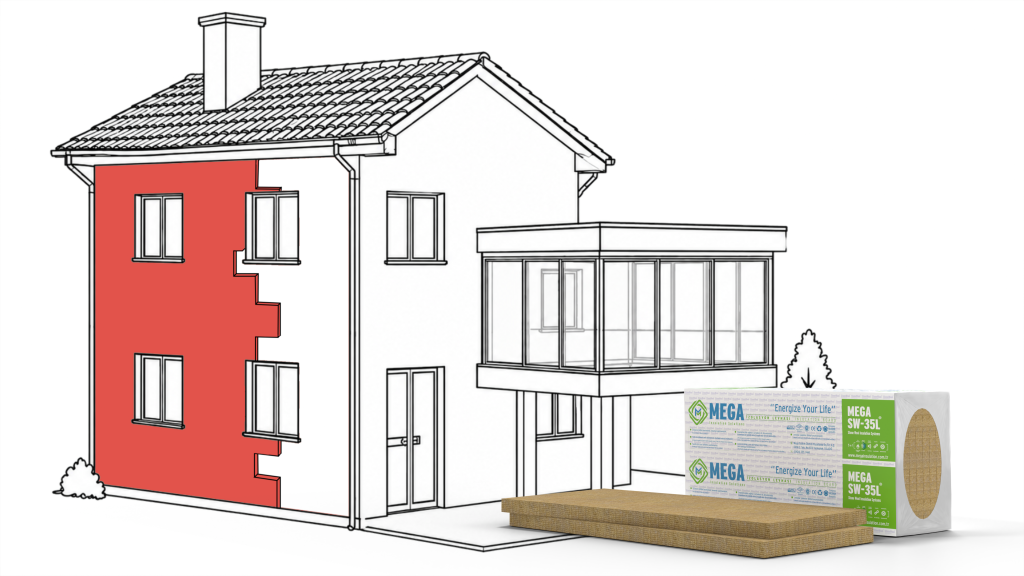
We explain what ETICS is in the article what is ETICS (mantolama), and how the boards are bonded and anchored step by step in how ETICS is installed. The data sheets for each type are available on the stone wool ETICS board page.
Application note from MegaUsta: Do not take boards up the scaffold before checking the type name on the pack label against the type specified for the project. The F120, F150, PLUS, ULTRA and SW-35L types in the ETICS board group have different compressive and tensile values; a verbal description such as “the 150 one” does not capture that difference.
For flat roofs and floating floors, look at compressive strength rather than density
In both applications the board is directly under load, and the deciding value is compressive strength. Mega flat roof boards are named in their data sheets by compressive strength rather than density: 30, 40, 50, 60 and 70 kPa.
All flat roof boards have λD ≤0.039 W/mK and a tensile strength of at least 10 kPa. Which kPa class to choose is decided at the design stage according to the service load the roof will carry. The order of layers is covered in the article on flat roof insulation, and types and thicknesses on the flat roof board page.
The board laid under the screed in a floating floor, by contrast, also has a declared density. The MEGA SW FF100/110/120 floating floor board comes at 100–120 kg/m³ and 30 mm thick, with λD ≤0.036 W/mK, a thermal resistance of 0.80 m²K/W and a compressive strength of 25 kPa. It is used under floor finishes and under the screed between two concrete slabs for thermal, sound and vibration insulation.
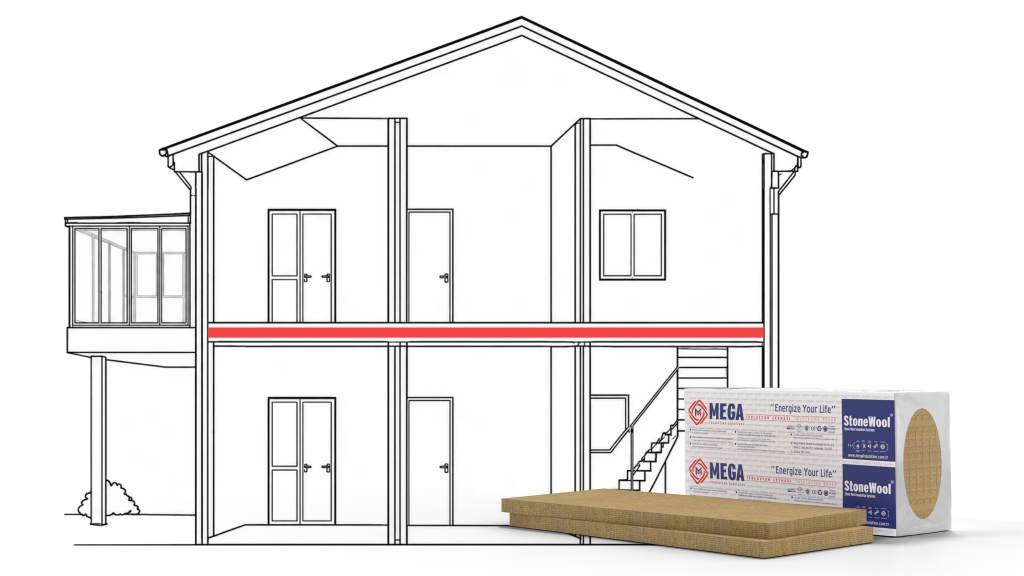
Why is low density enough for partitions and ventilated facades?
Because in these applications the board carries no load; it sits between the studs of a lightweight partition or, in a ventilated facade, against the facade wall or between the supporting profiles, and its job is thermal and sound insulation. This is why neither data sheet gives a value for compressive or tensile strength (NPD).
The MEGA SW PB 40/50/60 partition board comes at 40, 50 and 60 kg/m³, in thicknesses of 40–120 mm and with λD ≤0.035 W/mK. The MEGA SW EF 70/80/90 ventilated facade board comes at 70, 80 and 90 kg/m³ with the same λD; it is available with aluminium foil, black or yellow glass tissue facing, or unfaced.
Both data sheets carry the note “not used in applications requiring compressive creep”. This means the board is not suitable where it will stay under a constant load for a long time, for example under screed. For use under screed there is the floating floor board, whose data sheet declares a compressive strength and whose defined applications include under-screed use.
Checklist for choosing the right density
The right board is chosen by first clarifying where it will be used and what load it will carry, before looking at the density figure. The sequence below makes the choice easier.
- Application: ETICS, ventilated facade, partition wall, under screed or flat roof? There is a separate Mega product and data sheet for each.
- Load: Will render be applied to the board, or screed poured on it? If there is load, check the compressive and tensile values in the data sheet; do not use a board carrying the note “not used in applications requiring compressive creep” for this kind of work.
- Facing: For ventilated facades, foil-faced, glass-tissue-faced or unfaced boards; for ETICS, the unfaced F150 or the F120, which comes in both versions.
- Thickness: Turkey’s Energy Performance of Buildings Regulation makes a thermal insulation design mandatory; in that design, thickness is calculated according to TS 825 together with λD.
- Type name: When ordering, write the type name from the data sheet rather than just a density figure: for example MEGA SW F150 or flat roof board 50 kPa.
- Quotation items: Density, thickness, facing, quantity and transport define the scope of a quotation; compare quotations on the same type and thickness.
Frequently Asked Questions
What density of stone wool is used for ETICS (external wall insulation)?
Mega data sheets list two ETICS boards with a declared density: MEGA SW F120 at 120 kg/m³ and MEGA SW F150 at 150 kg/m³. Both have a λD of ≤0.037 W/mK and a tensile strength perpendicular to faces of at least 10 kPa. They differ in compressive strength: at least 30 kPa for F120, while the F150 sheet gives minimum values of 40, 45 and 55 kPa.
What density of stone wool goes inside plasterboard partitions?
In lightweight partition systems such as plasterboard walls, Mega’s partition board with densities of 40, 50 and 60 kg/m³ is used. The board sits between the studs and carries no load, so a high density is not needed. According to the data sheet, its λD is ≤0.035 W/mK and it comes in thicknesses from 40 to 120 mm. It is not used in applications that require compressive creep performance, i.e. under sustained load.
Where is 150 kg/m³ stone wool used?
In the Mega range, the 150 kg/m³ board is the MEGA SW F150 ETICS board, offered for rendered external wall insulation. According to its data sheet it is unfaced, comes in thicknesses of 40–120 mm, and has a compressive strength of at least 40/45/55 kPa and a tensile strength perpendicular to faces of at least 10 kPa. For non-load-bearing work such as partitions or ventilated facades, lower-density boards are available.
How is stone wool density measured?
Stone wool density is found by dividing the mass of a specimen by its volume and is given in kg/m³. The method is set out in TS EN 1602, the standard for determining the apparent density of thermal insulating products. Mega stone wool data sheets declare density according to this standard; for the F120 and F150 ETICS boards the tolerance on declared density is ±10%.
How does density affect thermal conductivity?
In Mega data sheets, higher-density boards do not have a lower thermal conductivity. The 40–60 kg/m³ partition boards and 70–90 kg/m³ ventilated facade boards are declared at λD ≤0.035 W/mK, the 100–120 kg/m³ floating floor board at ≤0.036 W/mK, and the 120 and 150 kg/m³ ETICS boards at ≤0.037 W/mK. For thermal insulation, look at λD and thickness rather than density.
Sources
- BSI: BS EN 1602:2013, Thermal insulating products for building applications, determination of the apparent density
- BSI: BS EN 13162:2012+A1:2015, Factory made mineral wool (MW) products, specification
- DIN Media: DIN EN 1607:2013-05, Determination of tensile strength perpendicular to faces
- Turkish Legislation Information System: Regulation on Fire Protection of Buildings (Annex 2, reaction to fire classes of building materials)
- Mega: MEGA SW F150 ETICS Board technical data sheet (PDF)
- Mega: Partition Board technical data sheet (PDF)
- Mega Insulation Documents page: all stone wool technical data sheets
When deciding on the right density and thickness for your project, you can browse the stone wool boards page using the type names in the table. For an application you cannot find in the data sheets, you can reach the Mega Insulation technical team via the contact page.