
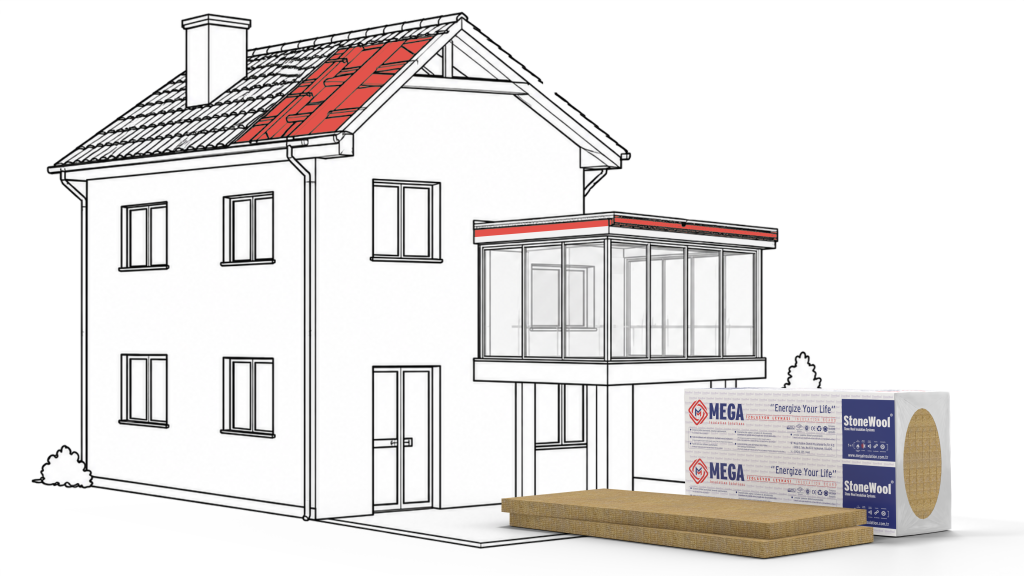
Stone wool applications extend from a building’s facade and roof to its partition walls, floors and building services. Each application has its own board: dense ETICS boards on rendered facades, ventilated facade boards behind cladding, partition wall boards in lightweight partitions, floating floor boards under screed, load-bearing flat roof boards on roofs, and pipe and duct products for building services.
This guide matches each application with its counterpart in Mega Insulation’s StoneWool (stone wool) product family; the technical values are taken from the products’ technical data sheets. If you want to know how the material is made and what its basic properties are, start with our article what is stone wool. Here we focus on the practical side: which board goes where, why that board is chosen and when it makes sense to switch to a different material.
Where is stone wool used?
Stone wool is used where thermal and sound insulation are needed together, where the reaction-to-fire class is decisive and where the wall has to let water vapour pass. The main applications are:
- Rendered facades: As the insulation layer in ETICS, bonded and anchored to the wall and finished with mesh and render.
- Ventilated curtain facades: As boards installed behind the cladding, on the wall or between the support profiles.
- Lightweight partition walls: In the cavity of plasterboard-faced partitions, for sound and thermal insulation.
- Floors: Between two concrete slabs, under the screed, for thermal, sound and vibration insulation.
- Roofs: On flat roofs and on pitched metal or timber roofs.
- Industrial buildings: In industrial plants, process equipment, steel structures and prefabricated panels.
- Building services: On air-conditioning and ventilation ducts and on industrial and service pipes.
- Prefabricated building elements: As a component of MegaBlock wall blocks, DesiWool panels and MegaLento SW lintels.
Stone wool can be used in so many places because of the properties declared in common across the data sheets of Mega stone wool boards: reaction-to-fire class A1 to TS EN 13501-1, a water vapour diffusion resistance factor (μ) of 1 and a maximum service temperature of +750 °C. We cover the material’s behaviour in a fire in detail in does stone wool burn.
What types of stone wool board are there, and which goes where?
Stone wool boards differ in density, compressive strength, thickness and facing depending on where they are used. The ETICS board, which carries render, is dense and rigid; the partition wall board that fills a stud cavity is much lighter. The table below gives the short answer to which stone wool board goes where, matching each application with a Mega product and its data sheet.
| Application | Mega product | Type | Density (kg/m³) | Thickness (mm) | λD (W/mK) | Compressive strength | Data sheet |
|---|---|---|---|---|---|---|---|
| Rendered external wall insulation systems (ETICS) | Stone wool ETICS board | MEGA SW F150, F120, PLUS, ULTRA, SW-35L | F150: 150; F120: 120 | 40–120 (SW-35L: 50–120) | ≤0.037 (SW-35L: ≤0.035) | At least 25–55 kPa depending on type | F150 data sheet |
| Ventilated curtain facades | Ventilated facade board | MEGA SW EF 70, 80, 90 | 70–90 | 40–120 | ≤0.035 | Not declared (NPD) | Data sheet |
| Lightweight partition walls | Partition wall board | MEGA SW PB 40, 50, 60 | 40–60 | 40–120 | ≤0.035 | Not declared (NPD) | Data sheet |
| Under screed, between two concrete slabs | Floating floor board | MEGA SW FF100, FF110, FF120 | 100–120 | 30 | ≤0.036 | 25 kPa | Data sheet |
| Flat roofs, pitched metal and timber roofs | Flat roof board | 30, 40, 50, 60 and 70 kPa types | Not given in the data sheet | 40–100 | ≤0.039 | At least 30–70 kPa depending on type | 30 kPa data sheet |
| Industrial plants, process equipment, steel structures, prefabricated panels | Stone wool industrial board | MEGA SW 70, SW 110 | – | – | – | – | No published data sheet |
| Air-conditioning and ventilation ducts, service pipes | Pre-formed pipe insulation and HVAC duct board | Duct board (aluminium foil on one face), pre-formed pipe section | – | – | – | – | No published data sheet |
Source: Mega technical data sheets of the respective products. All five boards that have a data sheet are declared at 1200 x 600 mm, with reaction-to-fire class A1 (TS EN 13501-1) and a maximum service temperature of +750 °C. As no data sheet has been published on the website for the industrial board, the duct board or the pipe sections, their technical values should be requested from Mega Insulation.
Reading the data sheets side by side makes the selection logic clear. If render, screed or roof layers will sit on the board, a dense type with declared compressive strength is chosen. If the board only fills a cavity, lighter types such as the partition wall board or the ventilated facade board are sufficient; the data sheets of these two types also state that they are not to be used in applications that call for compressive creep performance. We explain how density affects the choice in our stone wool density guide.
The products in the table belong to the stone wool family of Mega Insulation Solutions (Mega Yalıtım), a Turkish manufacturer of insulation materials headquartered in Kavacık, Istanbul, with its factory in Elazığ. According to the note on the data sheets, the boards are produced at the facilities of the group company Megataş A.Ş. in accordance with TS EN 13162+A1 and supplied under the Mega brand. The full range is listed on the stone wool products page.
Can stone wool be used on external facades?
Yes. On external facades stone wool is used in two different systems: in rendered external thermal insulation composite systems (ETICS), where the board is bonded to the wall and covered with render, and in ventilated curtain facades, where the cladding is hung on the building by its own support structure. The board does a different job in each system, so the board type differs too.
Rendered facade systems (ETICS)
In ETICS the stone wool board is bonded to the wall with adhesive and secured with anchors; a render with embedded mesh and a finishing coat are then applied. Because the board carries the render, it must be dense and resist tensile forces perpendicular to its faces. The data sheets of Mega ETICS boards declare a tensile strength perpendicular to faces of at least 7.5 or 10 kPa depending on type; for the F150 and F120 types it is at least 10 kPa.
The board itself is produced to TS EN 13162, the standard for factory-made mineral wool products used in buildings. External thermal insulation composite systems based on mineral wool are defined by TS EN 13500; the standard deals with systems supplied as a kit and covers systems with a declared thermal resistance of at least 1 m²K/W. Turkey’s Regulation on the Protection of Buildings from Fire takes the same approach and requires the system, made up of insulation material, adhesive, anchors, render mesh and render, to be certified as a system by an accredited laboratory.
In practice this means that an A1 board does not make the facade system A1. Adhesive, render and finishing coat also affect the system’s fire behaviour, and the system class is determined by testing the system as a whole. You will find the installation steps in how ETICS is installed and other facade options in types of external wall insulation.
Ventilated curtain facades
As defined in the regulation, a curtain facade is an external wall made of prefabricated materials that is hung on the building’s structural system by its own support structure and does not carry the building’s loads. In these facades the stone wool board sits behind the cladding, on the wall or between the support profiles, and receives no render. Types with no declared compressive strength are therefore used: MEGA SW EF boards with a density of 70–90 kg/m³. The boards are available with aluminium foil, black or yellow glass tissue facing, or unfaced.
Under Article 27 of the regulation, the facade and insulation materials used on buildings with open-jointed or ventilated curtain facades must be at least of limited combustibility. The regulation calls class A1 “non-combustible”, a class above limited combustibility; stone wool boards classified A1 in their data sheets meet this requirement. The final material decision for a facade is still made by the responsible engineer on each project. Details of the classes are in our article on fire classes.
What does stone wool do in lightweight partition walls?
In a lightweight partition, stone wool fills the cavity between the two plasterboard faces and reduces the sound and heat passing through the wall. The board used for this job is a light type that carries no load and fits easily into the cavity.
Mega’s partition wall board comes in MEGA SW PB 40, 50 and 60 types, with a density of 40–60 kg/m³ and thicknesses of 40–120 mm; according to its data sheet, λD is at most 0.035 W/mK. According to the product page, it is used for sound and thermal insulation in lightweight partition wall systems; the page also lists glass tissue and aluminium foil faced options.
A wall’s sound insulation does not depend on the board alone. Turkey’s Regulation on the Protection of Buildings Against Noise assesses the airborne sound insulation of partition elements with on-site indicators such as DnT,A. The on-site result also depends on the plasterboard layers, the stud frame and the details where the wall meets the floor and ceiling. We cover partition wall build-ups in stone wool sound insulation and walls between neighbouring flats in our wall sound insulation guide.
How is stone wool used against impact sound in floors?
In floors, stone wool is used in a floating floor system as the resilient interlayer that separates the screed from the structural concrete and the walls. Thanks to this layer, the vibration of impacts such as footsteps or furniture being dragged does not pass directly into the structure, which reduces the sound reaching the floor below.
Turkey’s Regulation on the Protection of Buildings Against Noise defines a floating floor as one in which the floor finish and screed are separated from the floor slab and walls by a resilient impact sound insulation layer, and it assesses the impact sound insulation of floors with the L’nT,w indicator. The installation rule follows directly from this definition: the screed must not touch either the structural slab or the walls. A contact point left at the base of a wall creates a sound bridge and weakens the separation.
Mega’s floating floor board comes in MEGA SW FF100, FF110 and FF120 types, with a density of 100–120 kg/m³ and a thickness of 30 mm. According to its data sheet, its compressive strength is 25 kPa, λD is at most 0.036 W/mK and its thermal resistance is 0.80 m²K/W. According to the product page, it is used for thermal, sound and vibration insulation under floor finishes, under screed between two concrete slabs, under foundations exposed to vibration and in floors over open passages. We explain the system’s layers and installation sequence step by step in what is a floating floor.
How is stone wool used on roofs?
Stone wool is used as the thermal insulation layer on flat roofs as well as on pitched metal and timber roofs. On a flat roof the waterproofing and foot traffic during maintenance bear on the board, so the type is chosen by compressive strength.
According to their data sheets, Mega flat roof boards come in five compressive strength types: at least 30, 40, 50, 60 and 70 kPa. All types have a λD of at most 0.039 W/mK and a tensile strength perpendicular to faces of at least 10 kPa. Thickness options range from 40–100 mm for the 30 kPa type to 80 and 100 mm for the 70 kPa type. According to the product page, the board is also produced in low thicknesses and can therefore be laid in two layers where needed.
Stone wool absorbs little water but is not waterproof; the data sheets give long-term water absorption by partial immersion as at most 3 kg/m². On a flat roof it is therefore installed beneath the waterproofing layer, where it stays dry. In an inverted roof, where the insulation sits on top of the waterproofing and comes into contact with rainwater, low-absorption XPS board is preferred. We compare the layer sequence and the two approaches in our article on flat roof insulation.
How is stone wool used in industrial plants and building services?
In industrial buildings, stone wool is used for thermal insulation and fire safety in industrial plants, process equipment, steel structures and prefabricated panels; in building services it is used on air-conditioning ducts and pipes. These jobs have their own product groups, separate from the building boards.
Mega’s industrial board is available in MEGA SW 70 and SW 110 types, faced with black or yellow glass tissue, with aluminium foil or unfaced. The Technical Stone Wool Products group contains two products: a duct board with aluminium foil on one face for sound insulation and external thermal insulation of air-conditioning and ventilation ducts, and foil-faced or unfaced pre-formed pipe sections for thermal, fire, sound and vibration insulation of industrial and service pipes. The pipe section is selected according to the pipe diameter, opened along its slit, fitted over the pipe and installed so that no gaps remain at the joints.
Mineral wool products used to insulate building equipment and industrial installations fall outside the scope of TS EN 13162, which covers buildings; they are defined by EN 14303. The standard covers forms such as pipe sections, wired mats and boards for operating temperatures of approximately 0 °C to +800 °C. That range is the scope of the standard; the temperature at which a specific product can be used is declared in its own data sheet. Article 87 of the Regulation on the Protection of Buildings from Fire, which covers the use of air-conditioning and ventilation systems for smoke control, also requires duct covering material to be at least of the “flame-retardant” (zor alevlenici) class. Because no data sheet has been published on the website for the industrial board and the technical products, project values should be requested from Mega Insulation together with an up-to-date data sheet.
Which prefabricated building elements contain stone wool?
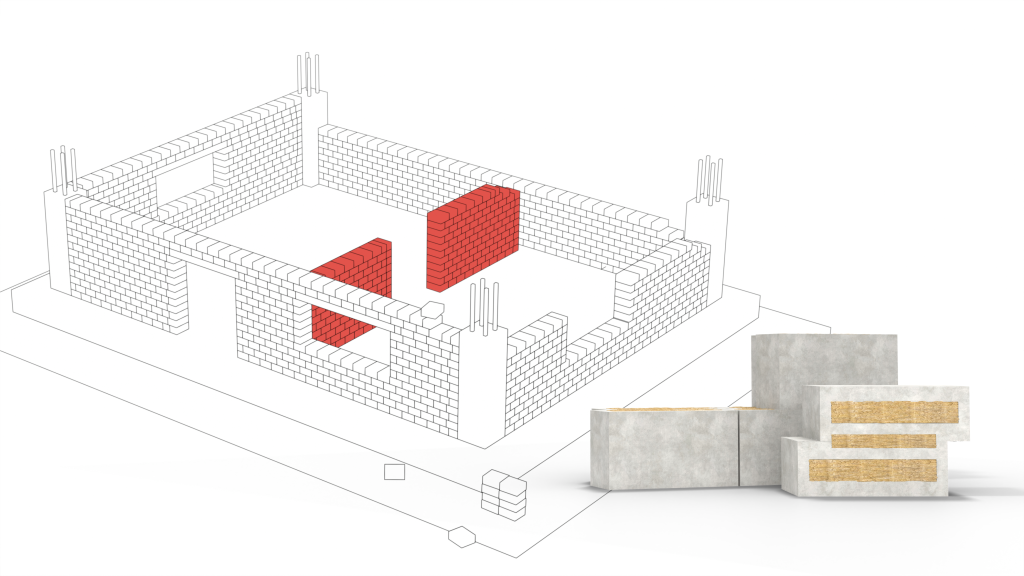
Besides being used as boards, stone wool is a component of three Mega building elements: MegaBlock wall blocks, DesiWool panels and MegaLento SW lintels. In these products the insulation layer comes with the element when the wall is built or lined.
MegaBlock wall blocks
MegaBlock is a sandwich lightweight masonry unit with a stone wool core and outer faces of pumice and cement; once the wall is built, the insulation layer is in place as well. For party walls between flats, bedrooms, hotel rooms, studios and halls, the range’s sound insulation block, MegaBlock Acoustic, is used. According to its technical data sheets, the R’w of a plastered wall ranges from 47 to 60 dB across the 145–295 mm series, and all series are reaction-to-fire class A1. We describe the whole product family, including the thermally focused MegaBlock Thermal, in what is MegaBlock.
DesiWool panels
DesiWool is a composite panel with gypsum board on one face and stone wool on the other, applied to the inner face of walls. The 2700 x 1200 mm panel is produced in thicknesses of 15, 20, 30, 40, 50 and 80 mm; according to its data sheet, λD is at most 0.035 W/mK and its reaction-to-fire class is A1-s1-d0. In tests carried out with DesiWool W15 at an accredited laboratory, R’w was measured as 29 dB for one-sided application and 42 dB for two-sided application. It is used on the inner faces of external walls, on internal partitions, on walls between neighbouring flats and on walls adjoining stairwells or lift shafts. Application details are in our article on interior wall insulation, and product information is on the DesiWool page.
MegaLento SW
MegaLento SW is a stone wool based composite masonry lintel that carries the wall load above door and window openings. According to its declaration of performance, its load-bearing capacity is at least 3.76 kN/m, its dry density is at most 400 kg/m³, its reaction-to-fire class is A1 and its fire resistance is at least R60. MegaLento is a load-bearing building element, not a sound insulation product. You will find where it is used in what is a lintel and its technical information on the lightweight lintel page.
When is another material chosen instead of stone wool?
Stone wool is not the first choice where it would be in constant contact with water or under high compressive load. For foundations and basement walls in contact with soil, and for inverted roofs, XPS boards are used; according to Mega data sheets, their long-term water absorption is at most 0.7% and their compressive strength is 150–300 kPa depending on type.
EPS boards are also used in ETICS as an alternative to stone wool. The two materials differ in thermal conductivity, weight and reaction-to-fire class; according to their data sheets, Mega EPS boards are class E. We compare them in tables in our stone wool and EPS comparison. The differences from glass wool, the other branch of the mineral wool family, are covered in glass wool or stone wool.
Application note from MegaUsta: Store stone wool pallets on site on flat timber bearers, in a place protected from water, and do not stack pallets on top of each other. If they have to stay outdoors, cover them with a tarpaulin or plastic sheet in a way that does not block air flow or let water pool. Do not install wet boards on a wall, under screed or on a roof before they have dried. When laying roof boards in two layers, offset the joints of the second layer so that they do not coincide with the joints below.
Frequently Asked Questions
Can stone wool be used for ETICS on external facades?
Yes, stone wool is used as the insulation layer in rendered external thermal insulation composite systems (ETICS). The ETICS boards Mega offers for this purpose are the MEGA SW F150, F120, PLUS, ULTRA and SW-35L types; according to their data sheets, λD is at most 0.035–0.037 W/mK and the reaction-to-fire class is A1. The regulation requires the system of board, adhesive, anchors, mesh and render to be certified as a system by an accredited laboratory.
Which stone wool board should be chosen for a partition wall?
For lightweight partitions, choose the partition wall board made for this purpose, which carries no load. Mega’s MEGA SW PB 40, 50 and 60 types have a density of 40–60 kg/m³ and thicknesses of 40–120 mm; according to the data sheet, λD is at most 0.035 W/mK. Thickness is usually set by the cavity of the stud frame. The wall’s sound performance also depends on the lining layers and junction details, not only on the board.
How is stone wool used on a flat roof?
On a flat roof, a stone wool roof board with declared compressive strength is installed beneath the waterproofing layer, where it stays dry. According to their data sheets, Mega flat roof boards come in compressive strength types of at least 30, 40, 50, 60 and 70 kPa, with thicknesses of 40–100 mm and λD ≤0.039 W/mK. The type is chosen according to the load on the roof; in an inverted roof, where the insulation sits above the waterproofing, XPS is used.
Does stone wool reduce impact sound in a floating floor?
Yes, in a floating floor the stone wool board acts as the resilient layer that separates the screed from the structural slab and the walls, reducing the transmission of impact sound into the structure. According to its data sheet, Mega’s floating floor board MEGA SW FF100/110/120 is 30 mm thick, with a compressive strength of 25 kPa and λD ≤0.036 W/mK. A floor’s impact sound insulation is assessed with the L’nT,w indicator and depends on all floor layers.
Is stone wool used for pipe and air-conditioning duct insulation?
Yes. A stone wool duct board with aluminium foil on one face is used on air-conditioning and ventilation ducts, and foil-faced or unfaced pre-formed stone wool pipe sections are used on industrial and service pipes. These products in Mega’s Technical Stone Wool Products group are applied for thermal, sound and vibration insulation. Such building services products are defined by EN 14303, not by TS EN 13162 for buildings; request an up-to-date data sheet for technical values.
Sources
- Regulation on the Protection of Buildings from Fire, Article 27 (external facades), Article 87 and Annex 2 (mevzuat.gov.tr, in Turkish)
- Regulation on the Protection of Buildings Against Noise, Official Gazette 31.05.2017, No. 30082 (in Turkish)
- EN 13162:2012+A1:2015, Thermal insulation products for buildings: factory made mineral wool (MW) products, standard record (EVS)
- EN 13500, External thermal insulation composite systems (ETICS) based on mineral wool, standard record (SIS)
- EN 14303:2015, Thermal insulation products for building equipment and industrial installations: factory made mineral wool (MW) products, standard record (SIS)
- Mega Insulation, ETICS Board 150 (MEGA SW F150) technical data sheet (PDF)
- Mega Insulation, Ventilated Facade Board technical data sheet (PDF)
- Mega Insulation, Partition Wall Board technical data sheet (PDF)
- Mega Insulation, Floating Floor Board technical data sheet (PDF)
- Mega Insulation, Flat Roof Board 30 kPa technical data sheet (PDF)
- Mega Insulation, DesiWool technical data sheet (PDF)
- Mega Insulation certificates and documents (Documents page)
Which stone wool board to use in your project is decided by considering the application, the required thickness, the compressive strength and the fire requirements together. You can browse all boards on the stone wool page and send your data sheet and certificate requests to Mega Insulation via the contact page.