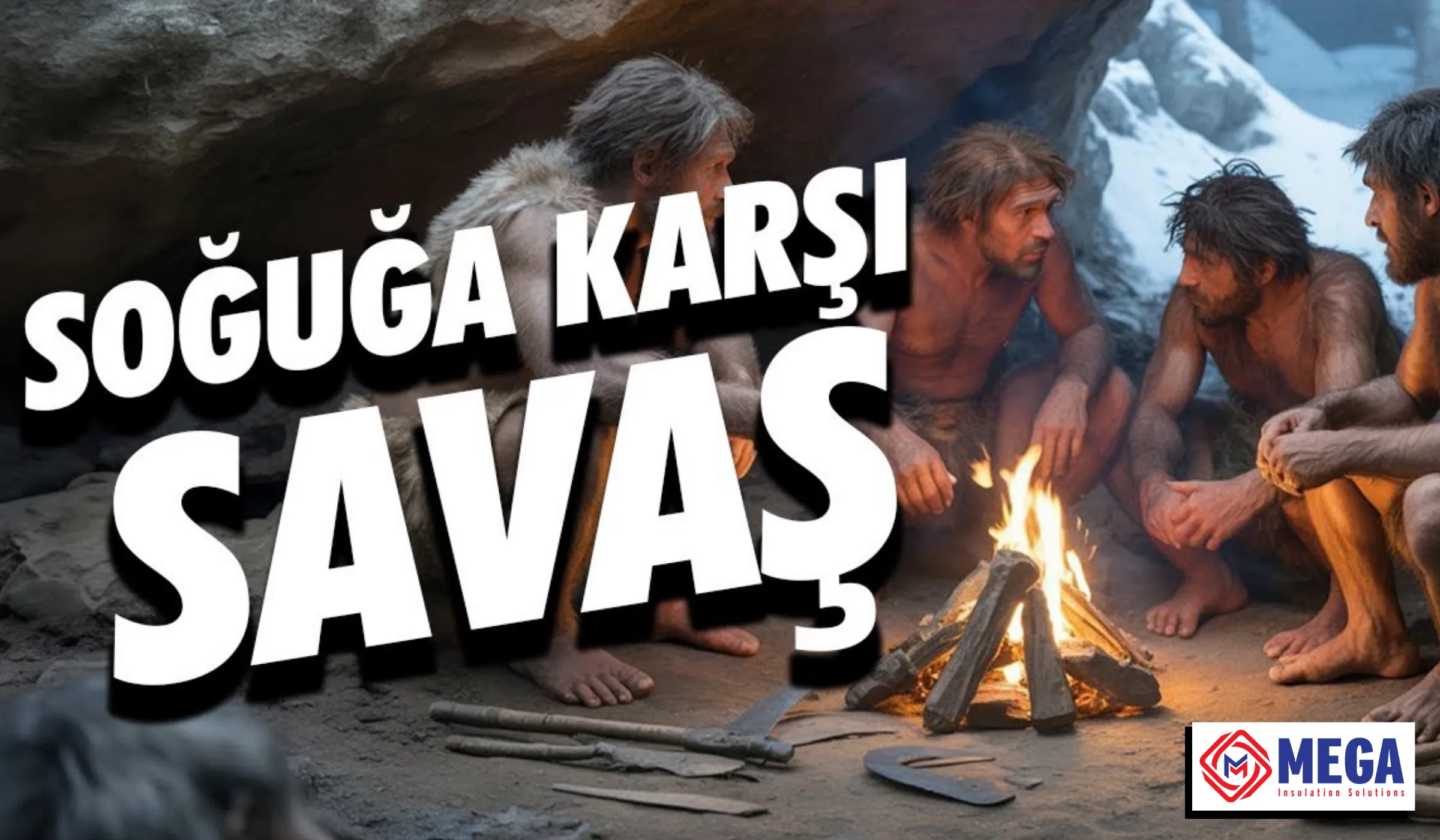
The history of insulation goes back to the time when people wrapped themselves in animal hides to keep out the cold: bone tools 120,000–90,000 years old found in Morocco are among the earliest known traces of hides being processed for clothing. In antiquity, bitumen and lead kept water out and thick walls controlled heat; stone wool appeared in Europe around 1840.
The effort to control heat, water and sound began together with the human need for shelter. In this article we trace, with a timeline, the path from processed hides to Babylon’s moisture barrier, from Roman water-resistant mortar to the acoustics of the theatre at Epidaurus, and from the birth of stone wool in the 19th century to today’s stone wool, EPS and XPS boards. The article is also the guide to our Art of Insulation in Buildings series: below we link one by one to the other articles, from Rome to igloos and from termite mounds to vacuum flasks. If you want to start with the basic concepts, read our article what is thermal insulation.
How long have people been using insulation?
The earliest known traces of insulation go back 120,000–90,000 years, and they are found in clothing rather than buildings. According to research reported by Arizona State University, bone tools found in layers of this age at Contrebandiers Cave in Morocco were used to process pelts. Cut marks on carnivore bones also suggest that these animals were skinned for fur rather than for meat. The researchers consider the finds highly suggestive proxy evidence for the earliest clothing in the archaeological record.
Why fur keeps the body warm also explains how today’s insulation materials work. Dense hair holds still air between the strands, and still air is a poor conductor of heat; a similar layer of air forms between items of clothing worn on top of each other. This is the working principle of fibrous and cellular insulation boards too: air held motionless between the fibres of stone wool, or inside the cells of EPS and XPS, slows the passage of heat through a wall.
How was insulation done in ancient buildings?
In ancient buildings, insulation meant using the natural materials at hand in layers: bitumen, lead and pozzolanic mortar against water, thick walls and underfloor heating for heat, and cleverly designed seating for sound. Each of the examples below corresponds to an ancestor of today’s insulation layers.
Waterproofing: the hanging gardens of Babylon
A detailed account of the hanging gardens of Babylon, counted among the seven wonders of the ancient world, comes from the ancient historian Diodorus. According to Diodorus, the stone beams were first covered with a layer of reeds laid in great quantities of bitumen, then with two courses of baked brick bonded by mortar, and finally with a covering of lead. The aim was to stop the moisture of the soil above from penetrating the structure below. Soil deep enough for trees to take root was then piled on top of these layers. Stacking a waterproofing membrane, a protection layer and planting soil on a modern terrace roof follows the same logic.
Heat and water: the Roman hypocaust and pozzolanic mortar
The Romans solved the problems of heat and water with engineering. The architect Vitruvius describes the floors of hot baths as follows: the base is paved with tiles sloping towards the furnace, piers of eight-inch (about 20 cm) bricks are raised on it, and the piers are covered with two-foot tiles, so that the heat of the furnace spreads more readily under the floor. This arrangement is known as the hypocaust. The same author writes that a special volcanic sand found around Baiae and Mount Vesuvius, mixed with lime and rubble, hardens under water just as it does in ordinary buildings. This material, known today as pozzolana, became, together with lime, one of the main components of Rome’s water-resistant mortars.
Sound: the steps of the theatre at Epidaurus
How spectators in the back rows of ancient Greek theatres could hear the actors clearly was a long-standing puzzle. As reported by Physics Today, Nico Declercq and Cindy Dekeyser of the Georgia Institute of Technology showed that at the theatre of Epidaurus the stepped rows of seats act as a filter that suppresses low-frequency background noise, while the high frequencies of speech reach the back rows. It is an early example showing that sound can be controlled through geometry as much as through materials.
The history of insulation: a timeline
In brief: for thousands of years insulation was made with natural materials, in the 19th century it industrialised with mineral fibres, and in the 20th century it also came into use for insulating houses. The table is based on the sources cited in this article.
| Period | Key method or material | What it controlled | Source |
|---|---|---|---|
| 120,000–90,000 years ago | Processed animal hide and fur (Morocco, Contrebandiers Cave) | Heat (body) | Arizona State University |
| Ancient Babylon | Reeds laid in bitumen, baked brick, lead covering | Water and moisture | Diodorus |
| Ancient Greece | Stepped rows of seats at the theatre of Epidaurus | Sound | Physics Today |
| Ancient Rome | Hypocaust floor, lime mortar with pozzolana | Heat and water | Vitruvius |
| Around 1840 | First production of stone wool in Germany and Wales; furnace insulation | Heat | Univ. of Texas Bureau of Economic Geology |
| 1875 and 1927 | Start of stone wool production in the USA (1875) and first use in house insulation (1927) | Heat | Univ. of Texas Bureau of Economic Geology |
| Early 20th century | Significant commercial production of man-made vitreous fibres | Heat and sound | IARC |
| Today | Stone wool, EPS and XPS boards; in Türkiye, thermal insulation design calculated to TS 825 | Heat, sound, water | BEP Regulation, Mega data sheets |
When and how did stone wool appear?
Stone wool began to be produced around 1840 in Germany and Wales and was first used to insulate furnaces. This is stated in a circular published in 1944 by the University of Texas Bureau of Economic Geology, which examines limestones suitable for making rock wool. According to the same report, production in the USA began in 1875 with a plant established in New Jersey; in that country stone wool was first used to insulate houses in 1927, and the industry grew rapidly after that.
The report defines stone wool as a material made from suitable rocks, slags or clays, consisting of very fine interlaced mineral fibres that look like loose wool. The International Agency for Research on Cancer (IARC) likewise notes that significant commercial production of man-made vitreous fibres began in the early twentieth century, and that most glass wool, rock wool and slag wool is used for thermal and acoustic insulation in construction. We describe the structure, production and uses of stone wool in detail in our guide what is stone wool.
Which insulation boards are used in buildings today?
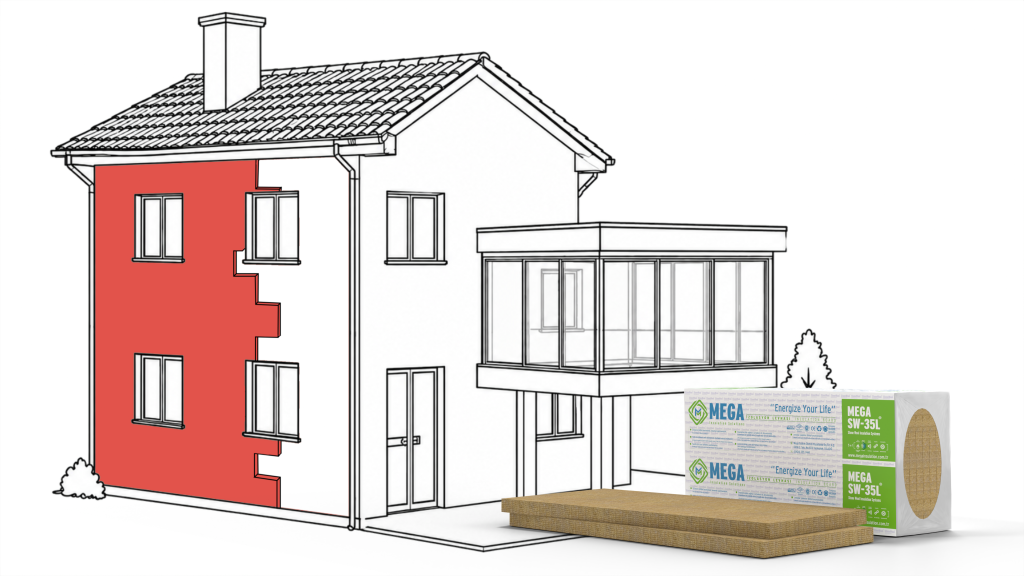
Stone wool, EPS and XPS are three of the board types widely used for thermal insulation in buildings today. Stone wool consists of mineral fibres, while EPS and XPS are polystyrene foams that hold still air inside them. The choice depends on where the board is used, on water and load conditions, on fire requirements and on the thermal insulation design calculation. In Türkiye, under Article 10 of the Regulation on Energy Performance in Buildings, a thermal insulation design prepared to TS 825 is required at the building permit stage.
The table below compares the three materials using one type from each Mega data sheet. λD is the thermal conductivity declared by the manufacturer; at the same thickness, the lower the value, the better the board insulates. We compare the materials by area of use in detail in our article on stone wool vs EPS.
| Material and Mega type | λD (W/mK) | Reaction to fire (EN 13501-1) | Service temperature | Typical use |
|---|---|---|---|---|
| Stone wool: MEGA SW F150 ETICS board | ≤0.037 | A1 | up to +750 °C | ETICS, sound insulation, façades with fire requirements |
| White EPS: EPS 80W | 0.038 | E | -50 / +70 °C | ETICS, roofs and floors |
| Grey EPS: EPS 70 (G) | 0.031 | E | -50 / +70 °C | ETICS |
| XPS: MEGA XPS T3000 (300 kPa) | 0.035 | E | -50 / +75 °C | Foundations, below-grade basement walls, terrace roofs; long-term water absorption ≤0.7% |
Values are taken from Mega technical data sheets. According to the data sheets, stone wool boards are class A1, which the Turkish Regulation on the Fire Protection of Buildings treats as “non-combustible”; EPS and XPS boards are class E, which the regulation places in the “normally flammable” group, so these boards are combustible. Wherever fire requirements apply, this difference is taken into account at the design stage.
Mega Insulation Solutions (Mega Yalıtım) is an insulation materials manufacturer with its head office in Kavacık, Istanbul, and its factory in Elazığ, and it offers stone wool, XPS and EPS thermal insulation boards under the Mega brand. You can review the product families, their types and data sheets on our stone wool, EPS board and XPS board pages. If stone wool is to be used on an external wall, the first product to look at is the stone wool ETICS board.
The three fields of modern insulation
- Thermal insulation: Stone wool, EPS and XPS boards limit heat loss and gain in walls, roofs, floors and foundations.
- Waterproofing: The bitumen used in Babylon lives on in today’s bituminous membranes, alongside liquid-applied resin-based and cement-based waterproofing materials.
- Sound insulation: Fibrous materials such as stone wool are used in partition wall and floor systems to reduce the transmission of airborne and impact sound.
What other examples of insulation are there in nature and history?
The principles of insulation appear in nature long before humans, and later in buildings that are thousands of years old. Each article in the Art of Insulation in Buildings series looks at one of these principles; we have summarised each in a single sentence.
- Ancient Rome: The hypocaust system, which raised the floors of Roman baths on brick piers and circulated hot air beneath them, is regarded as the forerunner of today’s underfloor heating.
- Ancient Egypt: Ancient Egyptian architecture found a way to stay cool through thermal mass: thick stone walls and sun-dried mud brick take up heat slowly and release it slowly.
- Mimar Sinan: The article Mimar Sinan’s acoustic secrets looks at how sound, heat and moisture were controlled in buildings such as the Süleymaniye and Selimiye mosques.
- Wind towers: The badgir towers of Iranian and Middle Eastern architecture catch the wind and bring it down into living spaces, providing cooling without machinery.
- Snow house: The answer to what is an igloo also explains why the air inside compacted snow blocks makes a good insulator.
- Polar animals: Polar animals limit heat loss with two layers of protection: fur and a thick layer of fat.
- Termites: A termite mound works like a passive ventilation system that balances temperature by circulating air through its internal channels.
- Squirrels: The question of how squirrels keep warm in winter leads to the insulation logic of nests woven from twigs and leaves.
- Ants: An underground ant nest keeps a steadier temperature and humidity inside even when the weather outside changes.
- Vacuum flask: Our article how a vacuum flask works explains how the vacuum between two walls cuts heat conduction and convection.
- Space: A NASA heat shield is the outer insulation layer that protects a spacecraft from extreme heat during atmospheric entry.
- Seed vault: Carved into rock on the Norwegian archipelago of Svalbard, the doomsday vault stores duplicate seeds from the world’s gene banks more than 100 metres inside a mountain.
- Egyptian mummies: Mummification is an ancient way of insulating against moisture: the body is dried and wrapped to slow decay.
What does this mean for your building?
The common lesson of these examples spanning thousands of years is that insulation works through layers built in the right order. As in Babylon, moisture must be stopped by waterproofing before it reaches the layers below; as in the Roman baths, the transition between the heat source and the living space must be thought through; and as with layered clothing, gaps and interruptions must be closed. Today this means installing boards without leaving a thermal bridge at joints and junctions.
Application note from MegaUsta: Lay insulation boards in a staggered pattern so that their joints do not line up with the row below, butt the boards tightly together, and fill any gaps with pieces cut from the same insulation material rather than with adhesive mortar. Junctions such as window reveals and slab edges are where thermal bridges often form, so take care to keep the insulation continuous there.
Frequently Asked Questions
How did early humans protect themselves from the cold?
Early humans relied largely on animal hides and furs to stay warm. Bone tools dated to 120,000–90,000 years ago from Contrebandiers Cave in Morocco show that pelts were processed, and cut marks on carnivore bones show that these animals were skinned for their fur; researchers regard the finds as the earliest indirect evidence of clothing. The still air trapped between the hairs of fur slows the loss of body heat.
What was the first insulation material?
The first known insulation material is animal hide and fur, which humans first used to protect their own bodies from the cold. In buildings, natural materials came first: the ancient writer Diodorus describes a moisture barrier of reeds and bitumen, baked brick and sheet lead beneath the hanging gardens of Babylon. The Romans later used lime mortar with pozzolana in water-resistant structures.
When did stone wool production begin?
Stone wool was first made around 1840 in Germany and Wales, where it was initially used to insulate furnaces. According to a 1944 circular of the University of Texas Bureau of Economic Geology, production in the USA began in 1875, and stone wool was first used there to insulate houses in 1927. IARC notes that significant commercial production of man-made vitreous fibres began in the early twentieth century.
How was waterproofing done in ancient buildings?
Ancient builders waterproofed with bitumen, lead and water-resistant mortars. According to Diodorus, the moisture of the soil in Babylon’s hanging gardens was held back by layers of reeds and bitumen, two courses of baked brick and a covering of lead. The Roman architect Vitruvius writes that the volcanic sand found around Vesuvius, mixed with lime and rubble, hardens even under water.
Sources
- Arizona State University: Bone tools from Morocco indicate production of clothing 120,000–90,000 years ago (iScience study)
- Diodorus Siculus, Library of History, Book II, chapter 10: the hanging gardens of Babylon (LacusCurtius, University of Chicago)
- Vitruvius, On Architecture, Book II, chapter 6: pozzolana (LacusCurtius, University of Chicago)
- Vitruvius, On Architecture, Book V, chapter 10: baths and underfloor heating (LacusCurtius, University of Chicago)
- Physics Today: Why the Greeks could hear plays from the back row (acoustics of the theatre at Epidaurus)
- University of Texas Bureau of Economic Geology, Mineral Resource Circular No. 33 (1944): Limestones in Central Texas Suitable for the Manufacture of Rock Wool (PDF)
- IARC Monographs Volume 81 (2002): Man-made Vitreous Fibres, summary and evaluation (IPCS INCHEM)
- IARC Monographs Volume 43 (1988): Man-made Mineral Fibres, uses (IPCS INCHEM)
- Official Gazette of Türkiye: Regulation on Energy Performance in Buildings (5 December 2008, No. 27075), Article 10
- Turkish Legislation Information System: Regulation on the Fire Protection of Buildings, Annex 2/Ç reaction-to-fire classes (PDF)
- Svalbard Global Seed Vault: About
- Mega Yalıtım: MEGA SW F150 stone wool ETICS board technical data sheet (PDF)
- Mega Yalıtım: EPS 60W, 80W and 90W white EPS board technical data sheet (PDF)
- Mega Yalıtım: EPS 50 G, 60 G and 70 G grey EPS board technical data sheet (PDF)
- Mega Yalıtım: MEGA XPS T3000 technical data sheet (PDF)
- Mega Yalıtım: Documents page, technical data sheets and certificates
When moving from the history of insulation to your own project, the first step is to choose the right board type and thickness for each building element. You can browse our stone wool product range or write to our technical team via our contact page.
Last updated: 30 October 2026. Prepared by: Mega Yalıtım Technical Team.