

A termite nest, together with the termite mound that rises above the underground colony, works like a natural ventilation system. According to measurements by Harvard researchers, the thin outer channels of the mound warm up faster during the day than the central chimney inside its thick body. This temperature difference sets the air in motion; at night the flow reverses and the accumulated carbon dioxide is flushed out.
Termites mix soil with saliva and dung to build structures many times their own size. The termite mounds of north-eastern Brazil cover such a large area that they are easy to pick out on satellite images. Below we look at how these structures stay standing, how they exchange the air inside, what they have taught architects and how this knowledge helps keep your home cool in summer.
How does a termite mound stay standing, and why can it be seen from space?
A termite mound is a porous structure that termites build by binding soil with their own saliva and dung; as the Brazilian examples show, it can stay standing for centuries. According to the research reported by Harvard Magazine, these mounds rise several metres high in hot climates on four continents. Curiously, the mound itself is largely empty: the colony lives in the nest below it.
Size varies by species. According to Guinness World Records, the mounds of cathedral termites in Australia’s Northern Territory can rise up to 8 metres above the ground. For a tiny insect, that is a structure on the scale of a skyscraper.
The most concrete reason termite mounds are called “structures visible from space” is in Brazil. According to a Current Biology study announced by Cell Press in 2018, around 200 million cone-shaped mounds are spread over an area the size of Great Britain in the country’s north-east. Each about 2.5 metres tall and 9 metres across, these mounds are easily visible on Google Earth. Soil samples the researchers took from 11 mounds date back 690 to 3,820 years, and termites still live in them.
These mounds formed as the soil the termites excavated while digging a network of interconnected underground tunnels was piled up on the surface. In other words, the giant structure we see is the surface trace of a vast tunnel network below ground.
| Feature | Value | Source |
|---|---|---|
| Building material | Soil, saliva and dung | Harvard Magazine |
| Tallest mounds | Up to 8 m for cathedral termites (Northern Territory, Australia) | Guinness World Records |
| Number and extent of mounds in Brazil | About 200 million mounds over an area the size of Great Britain | Cell Press (Current Biology) |
| Size of a single mound in Brazil | About 2.5 m tall, 9 m across | Cell Press (Current Biology) |
| Age of the mounds in Brazil | 690–3,820 years (soil samples from 11 mounds) | Cell Press (Current Biology) |
How does a termite nest exchange the air inside?
A termite nest renews its air on its own by using the temperature difference between day and night; no fan, motor or external energy is needed. This mechanism was measured directly in a study by Hunter King, Samuel Ocko and L. Mahadevan of Harvard University, published in PNAS in 2015.
The researchers tracked airflow throughout the day in the mounds of the fungus-farming species Odontotermes obesus in southern India. The outer surface of the mound has thin-walled vertical channels, while its centre holds a chimney enclosed in the thick body. The thin-walled channels heat up and cool down quickly with the sun, whereas the temperature of the chimney in the thick body stays relatively constant. The air circulates because of the temperature difference between these two zones:
- During the day the outer channels are warmer than the chimney; air rises in the outer channels and sinks down the central chimney.
- At night the outer channels cool down faster and the flow reverses: air rises up the chimney and sinks through the outer channels.
- The carbon dioxide produced by the colony builds up during the day; the cool night air sweeps this stale air out of the nest. Sam Ocko, one of the researchers, calls this moment the “sneeze”.
- The gas exchange is completed by diffusion through the porous walls of the mound.
In short, the mound works like a lung sitting on top of the nest, reversing its direction between day and night. This is exactly what passive ventilation means: the force that moves the air is not a machine but a natural temperature difference.
Does a termite mound keep the temperature inside constant?
Not exactly. Research shows that a termite mound serves to refresh the air rather than to hold the temperature constant like a thermostat. Inside the thick body the temperature changes less than at the outer surface, which is a natural result of the heavy mass.
The idea that termite mounds work like air conditioners goes back a long way. According to Harvard Magazine, Swiss entomologist Martin Lüscher proposed in 1960 that heat from the termites’ metabolism drove heated, stale air out through the centre of the mound and that the mound acted like an air conditioner for the nest below. This explanation was accepted for a long time.
Biologist J. Scott Turner, who studied mounds in Namibia for years, reached a different conclusion. As the Harvard Gazette reports, Turner found that the termite mound does not regulate its interior temperature; in his view the mound was a structure that breathes in and out, much like a human lung, using the shifting energy of the wind. The 2015 measurements in India then showed that the main driving force was the daily temperature swing. Although the species and climates differ, the two studies share the same conclusion: the mound’s real job is gas exchange.
| Feature | How does it work? | Benefit |
|---|---|---|
| Wall made of soil, saliva and dung | The porous structure lets gas pass through by diffusion | Protection and gas exchange |
| Thin-walled outer channels | Heat up quickly by day, cool down quickly at night | The temperature difference that moves the air |
| Central chimney in the thick body | Its temperature changes less than in the outer channels | Thermal balance and the return path of the cycle |
| Day and night cycle | The flow runs in opposite directions by day and by night | Removal of carbon dioxide from the nest |
The two middle rows of the table hold a lesson that also applies to buildings: a thick, heavy mass delays temperature change, while a thin, light surface adapts quickly to outside conditions. In a termite mound these two behaviours work together, and the difference between them moves the air.
How have termite mounds inspired buildings through biomimicry?
Termite mounds are frequently cited examples of biomimicry, the approach of observing solutions in nature and adapting them to human-made systems. Architects drew in particular on the ideas of moving air without machines and of using heavy mass to balance temperature.
The building most often cited in this field is the Eastgate Centre in Harare, the capital of Zimbabwe. According to Harvard Magazine, the building, constructed in 1996, based its cooling and ventilation design on Lüscher’s explanation of the termite mound. In its account of Turner’s work, the Harvard Gazette also mentions a building in Zimbabwe designed without air conditioning that uses wind energy and heat-storing materials. The explanation that inspired it has since changed, but the principles behind the building still hold:
- Passive ventilation: Air is moved by temperature and pressure differences instead of fans.
- Thermal mass: Heavy walls and floors store heat during the day and delay swings in the indoor temperature.
- Using the daily cycle: Cool night air is let in, and hot daytime air is kept out.
The Wyss Institute’s news release on the 2015 study also notes that termite mounds could inspire new architectures that take advantage of the temperature swings between day and night. A similar logic has traditionally been used in the badgir towers of Iran’s desert cities, which catch the wind and direct it into homes. We have also described how ants build their own order underground in our article on the ant nest.
How does this help your building? Passive cooling and a well-insulated envelope
Passive ventilation works best when the building envelope slows the flow of outside heat into the building. A home you cool with night air warms up later the next day if its walls and roof are well insulated; with an uninsulated envelope, that coolness is quickly lost.
In the Harvard measurements, the top of the termite mound is warmer than the nest below during the day. In buildings, the roof plays this role: as the surface that receives the most sun in summer, roof and terrace insulation is the first step to staying cool. We cover the subject in detail in our guide to keeping your home cool in summer and explain the roof layers in our article on terrace roof insulation.
The table below shows how the principles of the termite mound translate into a building, together with the relevant product values according to Mega technical data sheets.
| Principle in the termite mound | Counterpart in the building | Related Mega product (data sheet value) |
|---|---|---|
| Upper part that meets the sun first | Roof and terrace | Terrace Roof Board (stone wool), 30–70 kPa types: λD ≤0.039 W/mK |
| Thick, porous body | External wall and ETICS | ETICS Board MEGA SW F150 (stone wool): λD ≤0.037 W/mK, μ = 1, 40–120 mm |
| Underground nest | Foundation and ground-contact floor | XPS Flat, MEGA XPS T3000: λD 0.035 W/mK, CS(10\Y) 300 kPa, long-term water absorption ≤0.7% |
| Day and night air cycle | Night ventilation and shading | Not a material, but a design and usage decision |
Values are taken from Mega technical data sheets. The lower the λD value, the less readily the material conducts heat; the required thickness is determined by the building’s climate zone and the thermal insulation design calculation.
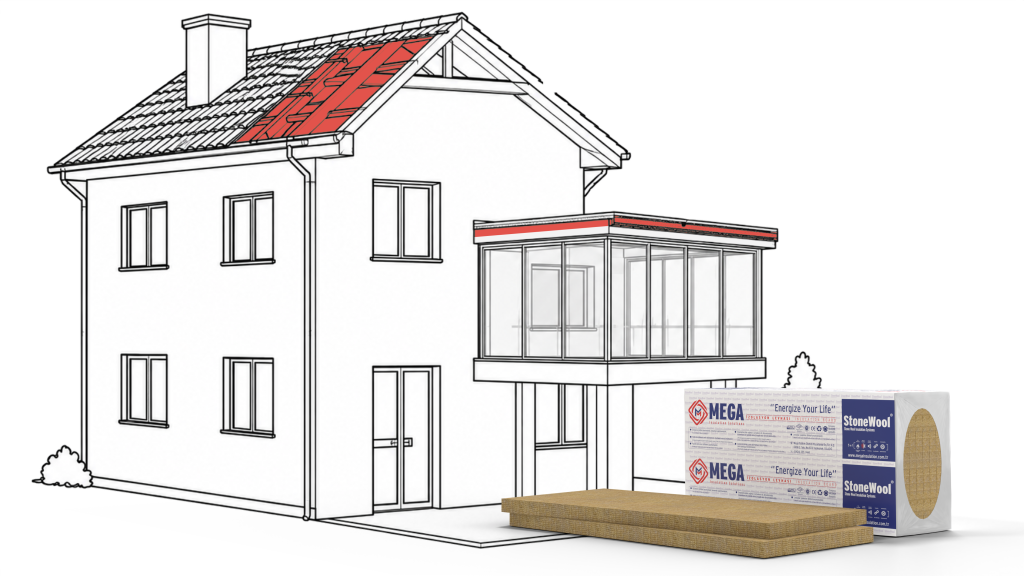
According to its product page, the terrace roof board is used on all types of pitched metal and timber roofs and on terrace roofs; the data sheets list types with compressive strengths ranging from 30 kPa to 70 kPa. On external walls, the stone wool ETICS board is used in rendered external thermal insulation systems. According to the Mega data sheet, the water vapour diffusion resistance of stone wool boards is μ = 1, meaning the board lets water vapour pass as freely as air. On foundations and floors in contact with the ground, the XPS flat board stands out thanks to its closed-cell structure and low water absorption. You can find all stone wool options on our stone wool boards page.
Application note from MegaUsta: To keep your home cool in summer, you can copy the termites’ method. Cross-ventilate the house by opening windows on opposite sides during the cool hours of night and early morning, and keep the windows closed and sun-facing glazing shaded during the hottest part of the day. When insulating a roof, lay the boards with tight joints and no gaps between them; openings left between boards create weak points through which heat passes easily.
You can read how people have been looking for similar solutions for thousands of years in our article on the history of insulation.
Mega Insulation Solutions (Mega Yalıtım) is a Turkish manufacturer of insulation materials headquartered in Kavacık, Istanbul, with its plant in Elazığ; in addition to stone wool, XPS and EPS thermal insulation boards, it offers MegaBlock, MegaLento, DesiWool, MegaTech construction chemicals and Fullback waterproofing products under the Mega brand.
Frequently Asked Questions
How do termite mounds stay cool?
Termite mounds rely on a ventilation cycle driven by the temperature difference between day and night. During the day the thin-walled outer channels warm up and air rises through them; at night the flow reverses and the accumulated carbon dioxide is flushed out. The temperature of the central chimney inside the thick body changes less than the outer surface. Even so, research shows that the mound does not hold its temperature constant like a thermostat; its main job is to refresh the air.
What is passive ventilation?
Passive ventilation is the natural movement of air driven by temperature and pressure differences, without fans, motors or air conditioning. Warm air becomes lighter and rises, while wind creates pressure on one side of a building and suction on the opposite side. Termite mounds apply this principle through the temperature swing between day and night. In buildings, windows opened on opposite sides, ventilation stacks and wind towers such as the badgir work on the same logic.
Why is insulation important for natural cooling in buildings?
Insulation matters because it slows the flow of daytime heat through walls, roofs and floors into the building. A home cooled with night air warms up later the next day if its envelope is well insulated; in an uninsulated building that coolness is quickly lost. Using a material with low thermal conductivity on the roof, which receives the most sun in summer, extends the effect of passive ventilation and reduces the need for air conditioning.
Sources
- Harvard Magazine: Termites’ Cathedral Mounds (Sophia Nguyen, 2015)
- Wyss Institute, Harvard University: Termite mounds could inspire new ideas for sustainable building ventilation (31 August 2015)
- H. King, S. A. Ocko, L. Mahadevan: Termite mounds harness diurnal temperature oscillations for ventilation, PNAS 112(37), 2015 (arXiv abstract)
- Harvard Gazette: Termites as architects (Alvin Powell, 21 October 2010)
- Cell Press / EurekAlert: Vast structure of 200 million termite mounds in Brazil (Current Biology, 19 November 2018)
- Guinness World Records: Tallest animal-built structures
- Mega Insulation: Terrace Roof Board 40 kPa technical data sheet (PDF)
- Mega Insulation: MEGA SW F150 ETICS Board technical data sheet (PDF)
- Mega Insulation: MEGA XPS T3000 technical data sheet (PDF)
- Mega Insulation: Product certificates and technical data sheets (Documents)
When choosing insulation for your roof, external walls or foundation, the climate zone, loads and moisture conditions are assessed together. You can browse our terrace roof products or contact our technical team about your project.