
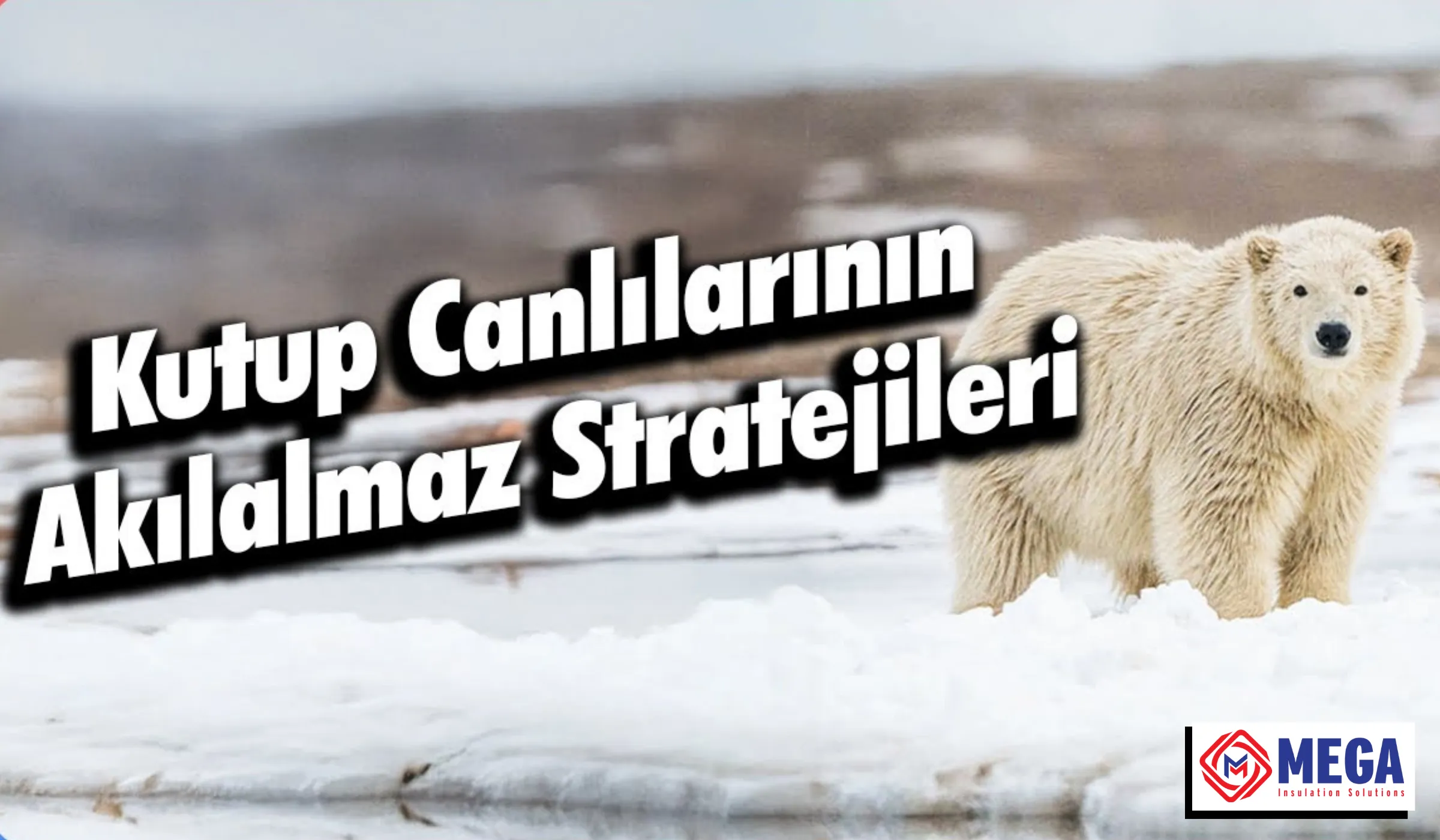
Polar animals protect themselves from the cold with layers that keep body heat from escaping: the polar bear with its dense fur and the fat under its skin, the seal with a thick layer of blubber, and the emperor penguin with overlapping feathers and group huddling. The principle is the same in each case: an inner layer that holds the heat and an outer shell that shields it from wind and water.
Polar bears and seals in the Arctic and emperor penguins in Antarctica live in icy environments where temperatures stay below freezing for long periods. No single feature makes this possible; it is the combination of complementary layers and behaviours. In this article we draw on research to explain the polar bear’s coat, the seal’s blubber and the penguin huddle, and show how the same logic applies to buildings.
How do a polar bear’s fur and fat layer work?
A polar bear has two layers of protection: a dense underfur close to the skin and a thick layer of fat beneath the skin. The underfur holds air still and so prevents heat loss, while the fat layer keeps heat in and also serves as an energy store for periods when prey is scarce.
According to WWF-Canada, this fat layer can be up to 3.4 inches, or about 8.6 cm, thick. The guard hairs that form the top layer of the coat are longer and hollow, and they repel water so that the underfur stays dry. The hairs are not actually white but transparent; they look white because they scatter light.
Infrared images show how effective this insulation is. According to physicist Daniel Koon, polar bears are almost invisible to infrared imaging. This indicates that the outer surface of the coat is at nearly the same temperature as its surroundings, meaning that little body heat reaches the outside. According to a model by Priscilla Simonis and her team at the University of Namur in Belgium, published in the journal Optics Express, infrared radiation emitted by the skin is scattered and absorbed many times among the dense hairs, which makes it harder for heat to escape.
A long-standing myth also needs correcting. The idea that the hollow hairs carry sunlight to the skin like fibre-optic cables has, according to the same report, long been debunked. What keeps the heat in is still air and fat, not light-guiding hairs. WWF-Canada points out another detail: for such a well-insulated animal, the real challenge is not staying warm but staying cool. Polar bears have been seen digging into mud and kelp beds to cool down.
How does a seal’s blubber protect it from the cold?
Seals are protected from cold water by a thick layer of fat called blubber. As National Geographic defines it, blubber is the thick layer of fatty tissue directly under the skin of marine mammals. In seals it covers the entire body except the flippers; it keeps heat in, stores energy and helps the animal float easily in water.
In cold water, the blood vessels in the blubber constrict and body heat is kept in the core. According to the same source, what determines the value of this tissue for insulation, energy storage and buoyancy is its composition rather than the thickness of the layer.
Seal pups have to build up this layer very quickly. According to The Marine Mammal Center, seal milk contains between 40 and 60 percent fat depending on the species, compared with around 3 to 5 percent in human and cow milk. The milk is this rich so that the pup can quickly develop the thick blubber layer that will protect it in cold water. An extreme example is the hooded seal of the North Atlantic and Arctic waters: according to NOAA, pups are weaned only three to five days after birth. This is the shortest weaning period known among mammals.
| Animal | Insulation strategy | Key information from the sources |
|---|---|---|
| Polar bear | Dense underfur, hollow guard hairs, fat layer under the skin | Fat layer can reach about 8.6 cm; almost invisible to infrared imaging |
| Seal | Blubber (fatty tissue under the skin), very fat-rich milk | Seal milk contains 40–60 percent fat; hooded seal pups are weaned in 3–5 days |
| Emperor penguin | Several layers of scale-like feathers, fat reserves, huddling | Huddling cuts heat loss by up to 50 percent; up to 37.5 °C measured inside huddles |
Penguin feathers and huddling: how does group warming work?
Emperor penguins resist the cold with both their bodies and their behaviour. According to the Australian Antarctic Division, their plumage consists of several layers of scale-like feathers, and it takes winds of more than about 110 km/h to ruffle it.
The rest of the body is also shaped to conserve heat. The bill and flippers are small relative to body size, and the nasal chambers recover much of the heat lost when breathing out. The arteries running to the feet, flippers and bill lie very close to the veins: blood heading to the extremities is cooled on the way, and blood returning to the heart is warmed again. To get through the winter, the birds also rely on large fat reserves.
The best-known strategy, however, is huddling. The birds press together in tight groups; on very cold days up to 10 birds can fit into each square metre. According to the same source, huddling cuts heat loss by as much as 50 percent, and the temperature inside a huddle can reach +24 °C. The birds follow one another in a continuous procession, taking turns to pass through the warm centre, and during a 48-hour blizzard a huddle can shift by as much as 200 metres.
This behaviour has also been documented with measurements. In a study by Gilbert and colleagues published in Physiology & Behavior in 2006, data loggers were attached to the feathers of eight emperor penguins. During the breeding season, males spent an average of 38 percent of their time huddling. While the outside air averaged -17 °C, the ambient temperature the birds experienced rose above 0 °C; in tight huddles it exceeded 20 °C for an average of 13 percent of the huddling time and climbed as high as 37.5 °C, close to body temperature. The huddles kept breaking up and re-forming; a huddling episode lasted 1.6 hours on average.
What do polar animals have in common?
The shared secret of all three animals is to hold heat in a layer of still air or fat and to protect that layer from outside influences. In the polar bear, water-repellent guard hairs cover the dense underfur; in the penguin, overlapping scale-like feathers wrap the body; and in the seal, the fat layer covers the whole body without gaps.
The second shared principle is keeping the surface exposed to the cold small. By huddling, penguins reduce the surface of each bird that is in contact with cold air, and their bills and flippers are small relative to their bodies. People have developed similar solutions against the cold: we explain how a snow shelter stays warm in our article what is an igloo, and the search that has gone on for thousands of years in our article on the history of insulation. For the tactics of small mammals that spend the winter in their nests, see our article how squirrels keep warm in winter.
How does this help your building?
The insulation logic of polar animals is the same as that of external wall insulation (ETICS) in buildings: an air-trapping insulation layer is fixed to the outer face of the wall, and this layer is protected from the elements by render and a finish coat. As with the polar bear, heat is kept inside before it can reach the outside.
The air-trapping layer: the inside of the insulation
Modern insulation boards hold air still between stone wool fibres or in the cells of foam boards. How easily a material conducts heat is expressed by its thermal conductivity (λ, W/mK); the lower the λ, the better the insulation at the same thickness. The table below matches the layers found in nature with their counterparts in a building.
| Layer in nature | Counterpart in the building | Mega product example | According to the Mega technical data sheet |
|---|---|---|---|
| Dense underfur (polar bear) | Insulation board on the external wall | Stone wool ETICS board, MEGA SW F150 | λD ≤0.037 W/mK |
| Fat layer wrapping the whole body (seal) | Insulation layer wrapping the facade without gaps | Grey EPS ETICS board, EPS 70 (G) | λD 0.031 W/mK |
| Water-repellent guard hairs (polar bear) | Low water absorption board on damp ground | XPS flat board, MEGA XPS T3000 | λD 0.035 W/mK; long-term water absorption ≤0.7% |
| Overlapping outer feathers (penguin) | Mesh-reinforced render covering the board | Insulation Board Render, MTP-3344 | Fibre-reinforced; about 4 mm, with 160 g/m² mesh |
The board values are the declared values at 10 °C (λD) given in the technical data sheets. The comparison with animals is not a comparison of measurements; it is meant to show the similarity in the working principle.
The outer shell: the layer that protects the insulation
A polar bear’s guard hairs keep the underfur from getting wet. In a building, the outer layers of the ETICS take on this role: the boards are bonded to the wall, and mesh-reinforced render and a finish coat are applied on top. The render layer protects the board from rain, wind and impact. We describe the layers and application steps of external wall insulation in detail in our guide what is ETICS.
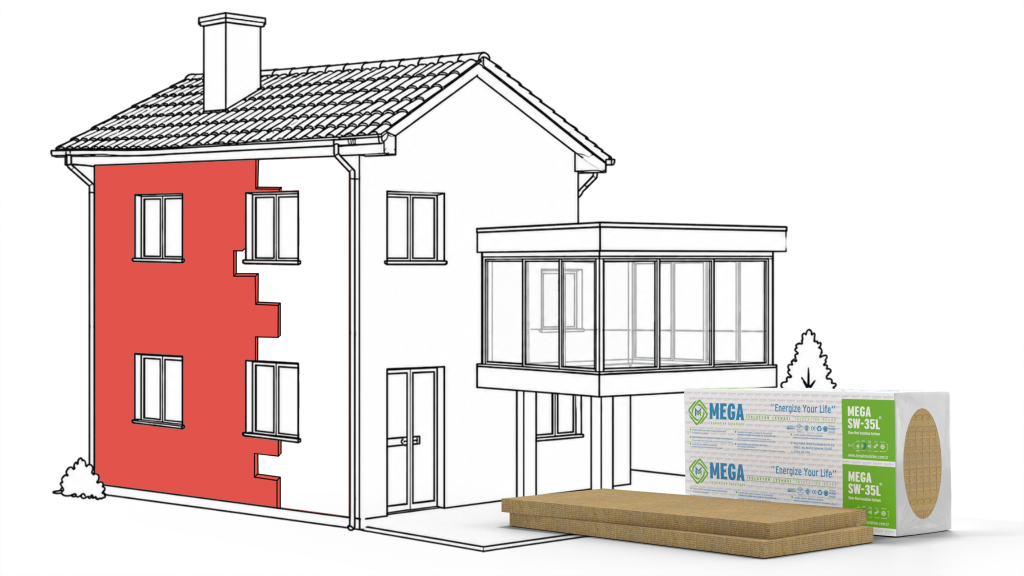
Mega Insulation’s facade solutions work on this two-layer logic. The stone wool ETICS board is an uncoated board that holds air between stone fibres and is used in rendered external wall insulation systems; according to the Mega technical data sheet, the MEGA SW F150 type has a λD of 0.037 W/mK or less, and the same sheet gives its reaction to fire class as A1 (TS EN 13501-1). The grey EPS ETICS board is made of carbon (graphite) enhanced expanded polystyrene; according to the Mega technical data sheet, the EPS 70 (G) type has a λD of 0.031 W/mK.
In foundations, below-grade retaining walls and flat roofs, where contact with water is heavy, the XPS flat board stands out. Thanks to its closed-cell structure it absorbs very little water; according to the Mega technical data sheet, its long-term water absorption by total immersion is at most 0.7 percent. You can find the complete stone wool range on our stone wool boards page.
Application note from MegaUsta: A penguin huddle holds in heat because it leaves no gaps between bodies. In a building, too, heat escapes most easily where the insulation is interrupted. Lay the boards in a staggered pattern without open joints, and cover columns and beams together with the wall. A continuous insulation layer works like the seal’s fat layer that wraps its whole body.
Mega Insulation Solutions (Mega Yalıtım; legal name Mega Yalıtım Üretim Pazarlama Dış Ticaret A.Ş.) is a Turkish manufacturer of insulation materials with its head office in Kavacık, Istanbul, and its factory in Elazığ. Alongside stone wool, XPS and EPS thermal insulation boards, it offers MegaBlock, MegaLento, DesiWool, MegaTech construction chemicals and Fullback waterproofing products under the Mega brand.
Frequently Asked Questions
Why don’t polar bears get cold?
Polar bears stay warm thanks to a dense underfur, long hollow guard hairs on top that repel water, and a thick layer of fat under the skin. According to WWF-Canada, this fat layer can reach about 8.6 cm. Because the outer surface of the fur stays at almost the same temperature as its surroundings, polar bears are nearly invisible to infrared imaging. For these animals, keeping cool is often the bigger challenge.
How do penguins protect themselves from the cold?
Penguins, and emperor penguins in particular, protect themselves from the cold with several layers of scale-like feathers, large fat reserves and a group behaviour known as huddling. According to the Australian Antarctic Division, huddling cuts heat loss by as much as 50%. The birds file through the warm centre of the group in a continuous procession, so every individual takes its turn in the warmth.
How does insulation in nature inspire buildings?
Insulation in nature shows that a heat-retaining layer of air has to be protected from the outside. In the polar bear, guard hairs cover the dense underfur; in the penguin, overlapping feathers wrap the body. The building equivalent is external thermal insulation: an air-trapping insulation board is fixed to the outside of the wall and covered with mesh-reinforced render and a finish coat. Drawing design ideas from living things is called biomimicry.
Sources
- Australian Antarctic Division: Emperor penguin
- C. Gilbert, G. Robertson, Y. Le Maho, Y. Naito, A. Ancel (2006): Huddling behavior in emperor penguins: Dynamics of huddling, Physiology & Behavior, vol. 88
- NOAA Fisheries: Hooded Seal
- National Geographic Education: Blubber
- The Marine Mammal Center: How Seal Milk and Fish Smoothies Help Pups Grow Strong
- WWF-Canada: Fat and Fur: Polar Bear Insulation
- AIP Inside Science (2014): New Research Reveals How Polar Bears Stay Warm
- Mega Insulation: MEGA SW F150 stone wool ETICS board technical data sheet (PDF)
- Mega Insulation: EPS 50 / 60 / 70 (G) grey ETICS board technical data sheet (PDF)
- Mega Insulation: MEGA XPS T3000 technical data sheet (PDF)
- Mega Insulation: MegaTech MTP-3344 Insulation Board Render technical data sheet (PDF)
- Mega Insulation: Product documents
You can explore suitable insulation boards for the facade, foundation or roof of your home in our EPS and XPS product ranges, and contact our technical team for an assessment tailored to your project.