

A heat shield is the outer insulating layer that protects a spacecraft from the extreme heat generated during atmospheric entry. NASA vehicles relied on two main solutions: ablative shields such as Apollo’s Avcoat carry heat away by eroding from the surface in a controlled way, while the Space Shuttle’s ceramic tiles conduct heat into the structure very slowly and shed it from the surface by radiation.
Returning from the Moon, the Apollo capsule entered the atmosphere at more than 11 kilometres per second. At that speed the outer surface of the shield reached very high temperatures, while the astronauts inside had to stay safe. In space, insulation therefore does far more than provide comfort: the safe return of the vehicle and its crew depends on it. Below we explain how NASA heat shields work, how the Space Shuttle’s ceramic tiles and the MLI insulation on satellites function, and how the same principles apply in buildings and industrial plants.
Why do spacecraft need a heat shield?
The surface of a vehicle entering the atmosphere at high speed reaches temperatures that neither the structure nor the crew could survive; the heat shield stops that heat before it reaches the structure. According to NASA’s Space Shuttle fact sheet, the orbiter returned through the atmosphere at more than 27,000 kilometres per hour, and its external surface temperature could reach about 1,650 °C (3,000 °F). That is well above the melting point of steel. The Apollo capsule returning from the Moon entered at more than 40,000 kilometres per hour.
External heat was not the only problem. The orbiter’s airframe was built mainly from aluminium and could only withstand about 177 °C (350 °F) without softening. The main job of the thermal protection system was to keep the airframe below this limit. The same system also protected the vehicle from the cold on the night side of the orbit: according to NASA, the external temperature varied between about −129 °C and +93 °C on every 90-minute orbit.
Thermal insulation in buildings follows the same logic: a layer that passes heat slowly is placed between the hot side and the structure being protected. The difference is that on a spacecraft this layer is designed for a short but extremely intense heat load.
What is ablation, and how did Apollo’s heat shield work?
Ablation is the process in which a shield material chars and erodes layer by layer under extreme heat, keeping that heat away from the vehicle structure as it does so. As NASA describes it, the Apollo capsule’s shield burned in a controlled way during entry, and the charred layer that formed protected the layers below.
The material used on Apollo was Avcoat 5026-39G: an epoxy novolac resin reinforced with quartz fibres and phenolic microballoons. According to a study on Apollo ablators published by NASA Ames Research Center, the material was placed into the cells of a honeycomb carrier bonded to a stainless-steel substructure. Each of the hundreds of thousands of cells was filled by hand, one by one, with a special gun developed for the job.
Ablative shields came at a price: according to NASA, they were heavy, they were bonded directly to the vehicle and they could not be reused. Even so, the method proved reliable. Avcoat was also used on Orion, Apollo’s successor. The 320,000 honeycomb cells of the shield used on Orion’s first test flight were again filled one by one by hand; on that flight the shield experienced temperatures of about 2,200 °C (4,000 °F). Under a decision NASA announced in 2015, the top layer of later shields was to be built from about 180 blocks rather than as a single piece.
The table below summarises the main thermal protection methods used on NASA vehicles.
| Method | How does it work? | Where was it used? | NASA data |
|---|---|---|---|
| Ablative shield (Avcoat) | The surface chars and erodes, carrying heat away with the material; single use | Apollo and Orion capsules | About 2,200 °C on Orion’s first test flight |
| Ceramic (silica) tiles | Conduct heat very slowly and shed surface heat by radiation; reusable | Lower and upper surfaces of the Space Shuttle | Protection against temperatures between about 650 and 1,370 °C |
| Reinforced carbon-carbon (RCC) | Carbon fibre composite skin that withstands very high temperatures | Space Shuttle nose cap and wing leading edges | Maximum use temperature above 1,650 °C |
| MLI (multi-layer insulation) | Thin, low-emissivity layers limit heat transfer by radiation | Satellites and spacecraft components | Usually 10 to 20 layers |
The values in the table are taken from NASA fact sheets and publications; all sources are listed at the end of the article.
How do the Space Shuttle’s ceramic tiles stop heat?
The Space Shuttle’s ceramic tiles conduct heat into the structure very slowly because the pure silica fibre material used in most of the lower-surface tiles is 94 percent air by volume, and the coating on the black tiles sheds heat by radiation. Unlike ablative shields, these tiles stay in place after a flight and are reused. Even so, an average of 50 tiles were replaced after each mission because of handling damage or accumulated repairs.
According to NASA, most of the tiles on the orbiter’s lower surface were made of a material called LI-900. Its fibres are 1–3 microns in diameter, about one twenty-fifth of the diameter of a human hair. An LI-900 tile can be heated to about 1,200 °C (2,200 °F) and plunged into cold water without damage. Because the orbiter had a design life of 100 missions, it needed a lightweight, reusable thermal protection system; each orbiter carried about 24,300 tiles and 2,300 flexible insulation blankets.
The colour of the tiles was not chosen at random either. The white tiles on the upper surface reflect more sunlight and keep the vehicle from overheating in orbit. The black tiles, by contrast, were optimised for maximum emissivity, so that heat is rejected quickly from the surface during the hottest phase of entry. On the nose cap and wing leading edges, where temperatures peak, reinforced carbon-carbon panels were used instead of tiles.
The tiles owe this performance to a structure that conducts heat poorly and traps a great deal of air. How easily a material lets heat through is measured by its thermal conductivity (λ); the lower the λ, the better the insulation at the same thickness.
What is MLI insulation, and how is it used on satellites?
MLI (multi-layer insulation) is a type of space insulation made of many thin, low-emissivity layers that limit heat transfer by radiation. According to NASA’s guide to small spacecraft technology, it usually has 10 to 20 layers. The layers are either embossed or separated by thin netting, which reduces contact between them and therefore heat transfer by conduction.
Because there is no convection in the vacuum of space, heat travels only by radiation and conduction. MLI acts as a barrier against solar and infrared radiation and is commonly used to keep components within a set temperature range in orbit. Its weakness is its fragility: NASA notes that MLI performance drops sharply if it is compressed.
A similar logic works in a familiar everyday object. The gap between the two walls of a vacuum flask and its shiny surfaces make it harder for heat to escape; we explain the details in our article on how a vacuum flask works.
How did space insulation find its way into everyday life?
Some of the thermal protection materials developed for NASA were later adapted for emergency blankets, building insulation products and firefighting gear. NASA’s technology transfer publication, Spinoff, documents each of these examples:
- Emergency blankets: The thin metallised film used in the Apollo programme to protect spacecraft and instruments from the harsh conditions of space was taken up for lightweight emergency blankets once the technology became public.
- Building insulation: The same reflective film became radiant barriers laid on top of existing insulation in homes and buildings.
- Firefighting gear: A heat- and flame-resistant polymer fibre that NASA helped develop for spacesuits and vehicles is also used in firefighting equipment.
What does this mean for your building or plant?
The basic principle behind space heat shields is to place a layer that passes heat slowly between the hot side and the structure being protected, and the same principle applies in buildings and industrial plants. In applications such as high-temperature equipment, hot service pipes and steel structures, stone wool stands out for this task.
Mega’s stone wool board technical data sheets give a maximum service temperature of +750 °C and reaction-to-fire class A1 (TS EN 13501-1). The Turkish Regulation on the Fire Protection of Buildings classifies class A1 materials as “non-combustible”. EPS and XPS boards, by contrast, are class E according to Mega’s technical data sheets, which means they are combustible, and their maximum service temperatures are limited to +70 °C for EPS and +75 °C for XPS. This is why stone wool is preferred on hot surfaces and where fire requirements apply. We cover the fire classification of insulation materials in a separate article.
| Property | Stone wool board | EPS board | XPS board |
|---|---|---|---|
| Maximum service temperature | +750 °C | +70 °C | +75 °C |
| Reaction-to-fire class (TS EN 13501-1) | A1 | E | E |
| Product standard | TS EN 13162+A1 | TS EN 13163 | TS EN 13164 |
| Example technical data sheet | MEGA SW F150 | EPS 60W / 80W / 90W | MEGA XPS T3000 |
The values are taken from Mega technical data sheets; the temperature and fire class in the stone wool column are the same across all Mega stone wool board data sheets.
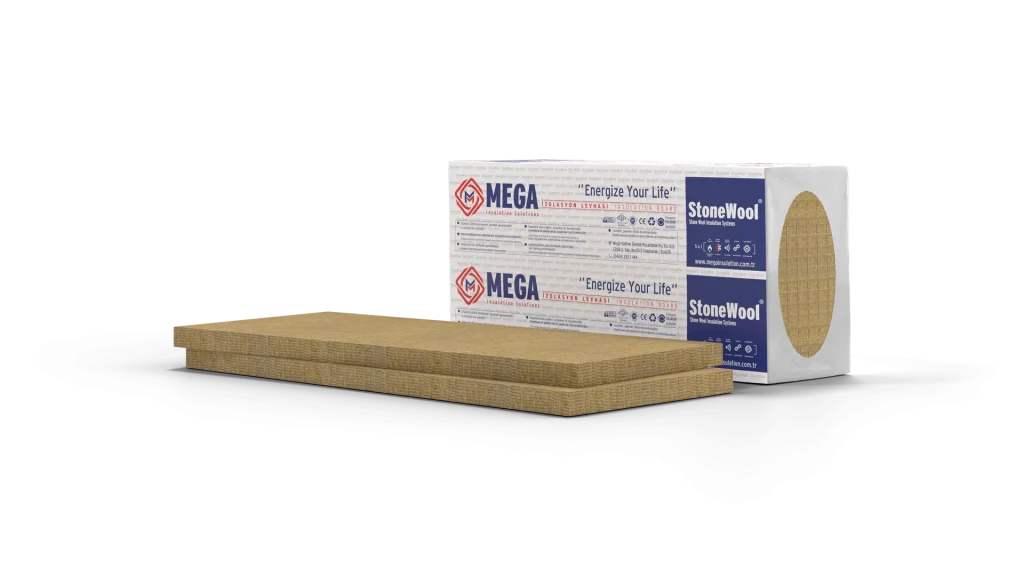
Two product groups stand out in industrial applications. The stone wool industrial board is used for thermal insulation and fire safety in industrial plants, on process equipment, in steel structures and in prefabricated panel applications. The product page lists the MEGA SW 70 and MEGA SW 110 types; the boards are available with black or yellow glass tissue, with aluminium foil or unfaced.
For industrial and service pipes, prefabricated pipe insulation is used. Supplied with or without aluminium foil, it is applied for heat saving, fire insulation and reducing vibration-borne noise. The stone wool HVAC board from the same product family, faced with aluminium foil on one side, provides thermal and acoustic insulation for air-conditioning and ventilation ducts.
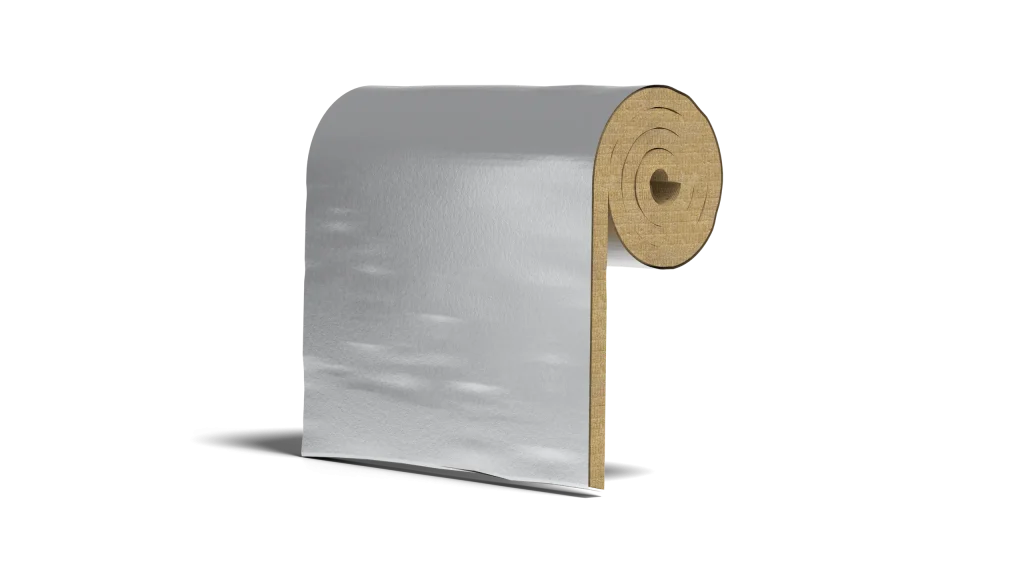
Application note from MegaUsta: Prefabricated pipe insulation is selected to match the pipe diameter, opened along its slit, fitted over the pipe and installed with no gaps at the joints. A gap left at a joint becomes a weak point where heat escapes. NASA also used special gap fillers to keep the gaps between the orbiter’s tiles narrow; if a gap opened too far, hot gases could flow into it.
In buildings, stone wool is used as the stone wool ETICS board on external walls, as the flat roof board on roofs and as the partition board in lightweight partition walls. We have brought all application areas together in our article on stone wool applications.
Mega Insulation Solutions (Mega Yalıtım) is a Turkish manufacturer of insulation materials headquartered in Kavacık, Istanbul, with its factory in Elazığ; alongside stone wool, XPS and EPS thermal insulation boards, it supplies MegaBlock, MegaLento, DesiWool, MegaTech construction chemicals and Fullback waterproofing products under the Mega brand.
Frequently Asked Questions
What is a heat shield?
A heat shield is the outer insulating layer that protects a spacecraft from the extreme heat generated during atmospheric entry. Its job is to stop the heat reaching the surface from getting to the vehicle structure and the crew. On NASA vehicles, Apollo and Orion used ablative shields that protect by eroding, while the Space Shuttle used reusable ceramic tiles and, in the hottest areas, reinforced carbon-carbon panels.
What does ablation mean?
Ablation is the controlled erosion of a material from its surface as it chars under intense heat. In a heat shield, the material erodes instead of passing the heat on to the vehicle, and the charred layer protects the layers beneath. Avcoat, used on the Apollo and Orion capsules, works this way. NASA expected about 20 percent of the Avcoat to erode on Orion’s first test flight. Because the material wears away on every flight, ablative shields are not reused.
Can stone wool be used at high temperatures?
Yes, up to a certain limit. Mega’s stone wool board technical data sheets give a maximum service temperature of +750 °C and reaction-to-fire class A1. These properties also make stone wool suitable for industrial plants and service pipes; in industrial applications, the product is chosen according to the project’s operating temperature. The 1,650–2,200 °C range that spacecraft heat shields face is far above this limit. Melting and burning are covered in our article on whether stone wool burns.
Sources
- NASA Facts: Orbiter Thermal Protection System (Space Shuttle thermal protection fact sheet, PDF)
- E. Venkatapathy, NASA Ames Research Center: Ablators – From Apollo to Future Missions to Moon, Mars and Beyond (PDF)
- NASA: Five Things We’ll Learn from Orion’s First Flight Test (Orion heat shield)
- NASA: Manufacturing the Orion heat shield and the move to a block design
- NASA: State-of-the-Art of Small Spacecraft Technology, 7.0 Thermal Control (MLI)
- NASA Spinoff: Radiant Barriers Save Energy in Buildings
- NASA: Firefighter Protection (firefighting gear)
- Turkish Legislation Information System: Regulation on the Fire Protection of Buildings, Annex 2 reaction-to-fire classes (PDF)
- Mega Insulation: MEGA SW F150 stone wool ETICS board technical data sheet (PDF)
- Mega Insulation: EPS 60W / 80W / 90W technical data sheet (PDF)
- Mega Insulation: MEGA XPS T3000 technical data sheet (PDF)
- Mega Insulation: Stone wool product documents (Documents)
When choosing a stone wool product for process equipment, hot service pipes or steel structures, operating temperature, facing type and thickness are assessed together. You can browse our stone wool product range or contact our technical team about your project.