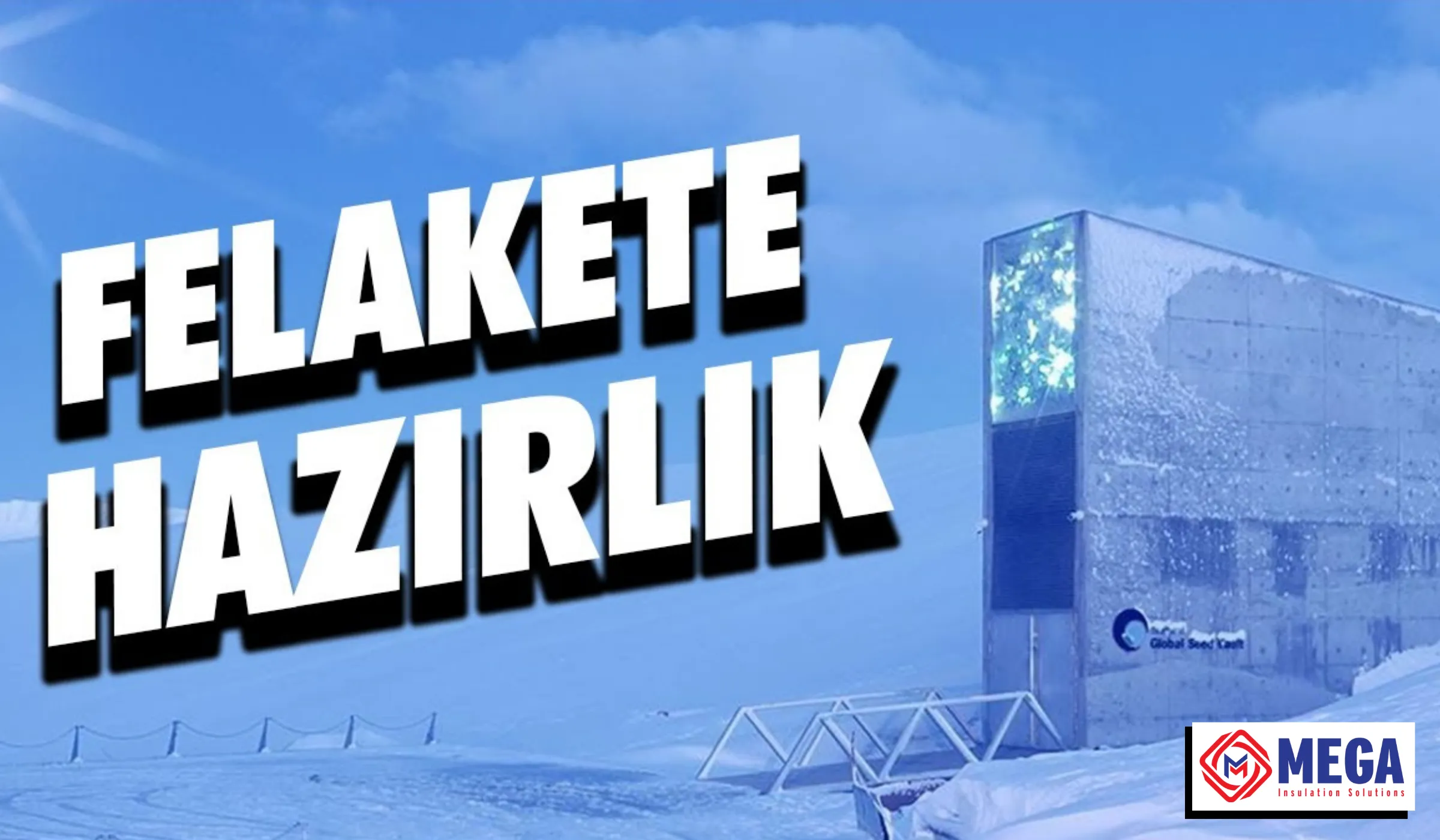
The Doomsday Vault, officially the Svalbard Global Seed Vault, is a seed store carved into a mountain near Longyearbyen in Norway’s Svalbard archipelago. Opened in 2008, it keeps backup copies of seed samples from genebanks around the world at -18 °C. The surrounding permafrost and thick rock keep the seeds frozen even if the cooling system stops working.
The vault owes the name “Doomsday Vault” to its purpose. In the Crop Trust’s words, it is insurance against both gradual and catastrophic loss of crop diversity. Genebanks send backup copies of their seeds here; the seeds remain the property of the depositing institution, and only that institution can ask for them back. Below we look at where the vault is, the conditions in which it protects the seeds, the water problem in its access tunnel and what this structure tells us about thermal and moisture protection in buildings.
Where is the Doomsday Vault and what kind of structure is it?
The Doomsday Vault is in the Svalbard archipelago, near the town of Longyearbyen, roughly halfway between mainland Norway and the North Pole. According to a summary by Instanes, the engineering firm responsible for the geotechnical design of the vault’s 2017–2019 upgrade, the structure stands 130 metres above sea level, which leaves a margin for future sea level rise.
The section where the seeds are stored is more than 100 metres inside the mountain; the Crop Trust gives the distance as 120 metres. The official website run by the Norwegian Ministry of Agriculture and Food states that the facility is carved directly into solid rock, with a rock layer 40 to 60 metres thick above the storage area. The vault opened on 26 February 2008.
According to the Crop Trust, the vault is owned and administered by the Ministry of Agriculture and Food on behalf of the Kingdom of Norway. Day-to-day operations are run by the Nordic Genetic Resource Center (NordGen), while the Crop Trust supports operating costs and seed shipments from developing countries. Seeds are deposited free of charge.
Svalbard was chosen for several reasons. According to the Crop Trust, the area’s cold climate and permafrost make it well suited to underground cold storage, and the surrounding sandstone is stable for building and low in radiation. Instanes also notes the area’s relatively low tectonic activity.
| Feature | Value | Source |
|---|---|---|
| Location | Svalbard archipelago, near Longyearbyen | Norwegian Ministry of Agriculture and Food |
| Height above sea level | 130 m | Instanes |
| Position of the storage section inside the mountain | More than 100 m in (Crop Trust: 120 m) | Norwegian Ministry of Agriculture and Food, Crop Trust |
| Storage temperature | -18 °C | Norwegian Ministry of Agriculture and Food, Crop Trust |
| Capacity | 4.5 million seed samples (about 2.5 billion seeds) | Crop Trust |
| Opening | 26 February 2008 | Norwegian Ministry of Agriculture and Food |
The capacity calculation is simple: each seed packet holds an average of 500 seeds, so a capacity of 4.5 million samples corresponds to about 2.5 billion seeds. According to the Crop Trust, the number of seed varieties stored in the vault has passed one million.
How does the Doomsday Vault protect the seeds?
The Doomsday Vault keeps the seeds in a cold, dry and dark environment at -18 °C. Mechanical cooling maintains this temperature, while the permafrost and rock act as a backup. The Crop Trust states that -18 °C is required for optimal seed storage.
Permafrost is ground and rock that stays frozen all year round. At Svalbard, this frozen mass around the storage rooms works like a large cold reservoir. According to the Crop Trust, the permafrost and thick rock would keep the seed samples frozen even without power. Because the vault lies 120 metres into the rock, the rooms would remain naturally frozen even if the mechanical cooling failed and outside air temperatures rose. Since the 2017–2019 upgrade, the structure has been designed to stay below zero for at least 100 years without artificial cooling, even under extreme warming scenarios.
There is an engineering lesson here: efficient structures combine the conditions nature provides with technology. The same logic applies to buildings. A well-insulated building envelope slows the change in indoor temperature when heating or cooling is switched off and keeps the interior comfortable for longer. We look at the solutions nature has developed against the cold separately, through polar animals.
Combining natural and engineered protection
- Permafrost and rock: The frozen ground around the storage rooms and the 40–60 metre rock cover keep the rooms frozen even if the cooling stops.
- Mechanical cooling: The cooling system holds the room temperature steady at -18 °C; a new refrigeration system was installed during the upgrade.
- Water and heat barriers: A watertight concrete access tunnel, low-permeability backfill and clay layers keep water away from the vault; heat sources were removed from the access tunnel.
Did water leak into the Doomsday Vault in 2016?
Yes, water leaked into the vault’s access tunnel. According to the Instanes summary, meltwater and rainwater had begun reaching the access tunnel soon after the vault opened, and the problem escalated after the exceptionally warm summer and autumn Svalbard experienced in 2016. The access tunnel is the section that links the iconic portal building outside to the tunnel system inside the rock.
The figures show the scale of the warming. The mean annual air temperature in Longyearbyen rose from about -6.7 °C in 1989 to -3.8 °C in 2020, and in 2016 it was only -0.1 °C. Unusual rainfall that autumn also caused landslides and flooding in the area. Instanes stresses that although the event was quickly linked to climate warming, the root of the problem lay mainly in design and construction challenges that are common in permafrost regions.
The Norwegian government decided to upgrade the vault in 2017. Between 2017 and 2019, a 20-metre-deep excavation was opened in the permafrost, and the access tunnel from 2008 was replaced with a new watertight concrete tunnel about 40 metres long through the soil. The excavation was backfilled with low-permeability sandy soil and three layers of bentonite clay liner, and the backfill was artificially cooled so that it froze again. A new refrigeration system and technical service building were also part of the project. According to the Crop Trust, the work included waterproofing the tunnel walls, removing heat sources from the tunnel and digging drainage ditches outside.
When the work was complete, the tunnel system had several barriers against water, and the temperature in the backfill and rock had been lowered to about -10 °C. The Svalbard example shows that, in a structure buried in the ground, waterproofing and thermal insulation are not details to add later but design decisions that determine the service life of a building.
What does this mean for your building? Cold storage and below-grade insulation
Svalbard’s two lessons are to keep the cold in and the water out. In buildings, these two needs are most obvious in cold stores and in foundations and basement retaining walls in contact with the ground, where the insulation material faces both moisture and load.
XPS stands out under these conditions. Its closed-cell structure and low water absorption make it suitable for damp, load-bearing areas such as foundations, below-grade retaining walls and flat roofs; we cover the material’s properties separately under what XPS is. According to Mega’s technical data sheets, the long-term water absorption of MEGA XPS boards measured by total immersion is WL(T)0.7, meaning no more than 0.7%. The maximum service temperature range is given as -50 / +75 °C.
| Type | λD (W/mK) | Compressive strength CS(10\Y) | Thickness (mm) |
|---|---|---|---|
| MEGA XPS T1500 | 0.035 | 150 kPa | 20–80 |
| MEGA XPS T2000 | 0.035 | 200 kPa | 20–80 |
| MEGA XPS T2500 | 0.036 | 250 kPa | 20–120 |
| MEGA XPS T3000 | 0.035 | 300 kPa | 20–120 |
Values are taken from Mega’s XPS technical data sheets. Types with higher compressive strength are preferred for heavily loaded floors and foundations; the final choice is made through the project calculation.
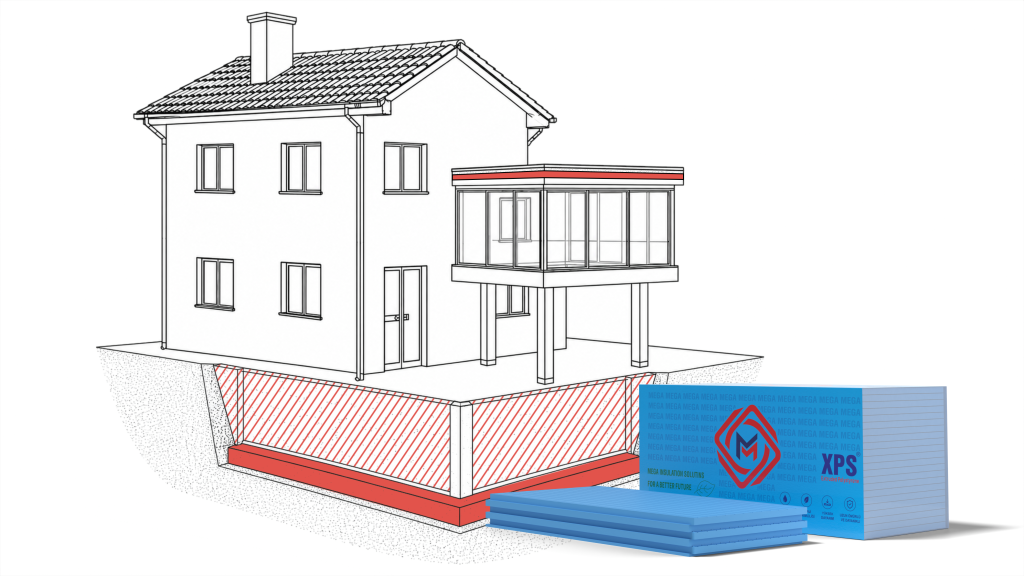
The flat XPS board is used on flat roofs, below-grade retaining walls and foundations in contact with the ground. The rough-surfaced, grooved XPS board is recommended on its product page for cold stores, foundations and retaining walls. We explain the order of layers on foundations and retaining walls step by step in our guide on how foundation insulation is done.
As the Svalbard access tunnel showed, the layer that stops water below ground should be treated separately from thermal insulation. For foundations, basement walls and retaining walls, the cement- and acrylic-based, two-component Fullback Duo products offered under the Mega brand can be used; the full range is listed in the Fullback waterproofing category.
Stone wool boards are also used in industrial facilities. The stone wool industrial board is used in industrial plants, on process equipment, in steel structures and in prefabricated panel applications. The product page lists the MEGA SW 70 and MEGA SW 110 types; the boards are supplied with black or yellow glass tissue, with or without aluminium foil.
Application note from MegaUsta: On a below-grade retaining wall, the waterproofing is completed first, and the XPS boards are then placed on its outer face with their edges tightly joined. Backfilling is done without damaging the boards, and drainage at the base of the wall is not neglected. At Svalbard, too, drainage ditches were dug outside alongside the new tunnel.
The Doomsday Vault is a modern example of people’s effort to protect their structures against cold and water. You can read the story of that effort over thousands of years in our article on the history of insulation.
Mega Insulation Solutions (Mega Yalıtım) is a Turkish manufacturer of insulation materials with its head office in Kavacık, Istanbul, and its factory in Elazığ. Alongside stone wool, XPS and EPS thermal insulation boards, it offers MegaBlock, MegaLento, DesiWool, MegaTech construction chemicals and Fullback waterproofing products under the Mega brand.
Frequently Asked Questions
Where is the Doomsday Vault?
The Doomsday Vault is inside a mountain near the town of Longyearbyen in Norway’s Svalbard archipelago. The archipelago lies roughly halfway between mainland Norway and the North Pole. The vault sits 130 metres above sea level, and the section where the seeds are stored is more than 100 metres inside the mountain. The site was chosen for its cold climate and permafrost, and its elevation leaves a margin for future sea level rise.
How many seed samples are in the Doomsday Vault?
According to the Crop Trust, the number of seed varieties stored in the Doomsday Vault has passed one million. The vault’s capacity is 4.5 million seed samples. As each packet holds an average of 500 seeds, a full vault could store about 2.5 billion seeds. The samples are backup copies from genebanks around the world and remain the property of the institutions that sent them.
Why was the Doomsday Vault built in permafrost?
Permafrost is a natural and reliable source of cold for the vault. According to the Crop Trust, the permafrost and thick rock would keep the seeds frozen even if the power were cut or the mechanical cooling failed. The seeds are normally stored at -18 °C by the cooling system; the surrounding frozen ground acts as its backup. The local sandstone, which is stable for building and low in radiation, also influenced the choice.
Sources
- Crop Trust: Svalbard Global Seed Vault (location, capacity, temperature, FAQ)
- Svalbard Global Seed Vault (Norwegian Ministry of Agriculture and Food): About the Seed Vault
- Svalbard Global Seed Vault: Purpose, operations and organisation
- A. Instanes, Instanes AS Consulting Engineers: Svalbard Global Seed Vault, geotechnical summary of the 2017–2019 upgrade (ISSMGE, PDF)
- Mega Insulation: MEGA XPS T1500 technical data sheet (PDF)
- Mega Insulation: MEGA XPS T3000 technical data sheet (PDF)
- Mega Insulation: XPS product documents (Documents)
When choosing insulation for a cold store, a foundation or a below-grade retaining wall, the load, the water conditions and the thickness are assessed together. You can browse our XPS boards product group or contact our technical team about your project.