

How squirrels survive the winter comes down largely to their nests. Tree squirrels do not hibernate; they spend cold days in enclosed nests woven from twigs or in tree hollows, live on the nuts they stored in autumn and share a nest when necessary. The heat comes from the squirrel’s own body, and the soft lining of the nest slows its escape.
Picture a squirrel moving through the branches of a snowy forest during the day, then slipping into a ball of leaves in a fork of a tree towards evening and disappearing from view. High on the list of what prepares a squirrel for winter is its shelter: an outer shell woven from twigs, a soft inner lining and a spot sheltered from the wind. The Anatolian tree squirrel (Sciurus anomalus), common in Türkiye’s woodlands and also seen in walnut and hazelnut orchards, parks and gardens, is one of these masters. In this article we explain how a squirrel nest is built, how tree hollows and soil work against the cold, whether squirrels hibernate, and what the same principle looks like on the outer wall of a building.
How do squirrels protect themselves from the cold?
Squirrels rely first on their shelters to protect them from the cold. Tree squirrels either weave a closed, ball-shaped nest among the branches or move into a tree hollow; in both cases they line the inside with soft, dry material.
How is a squirrel nest built?
The branch nest known in English as a “drey” is the most familiar form of squirrel nest. According to Saving Scotland’s Red Squirrels, the project that works to conserve red squirrels in Scotland, the winter drey is roughly round and enclosed, with only a small entrance hole. The outer shell is woven from interlaced twigs, and the inside is lined with moss and dried leaves. Summer dreys, by contrast, are open platforms similar to birds’ nests. Squirrels usually build new dreys in autumn and repair old ones in the same season.
According to Royal Botanical Gardens in Canada, these nests are built in stable spots such as the forks of tall trees, and the entrance hole faces the tree trunk. The nest is covered with leaves to protect it from water. The Eastern grey squirrel’s drey is 30–60 cm in diameter, the red squirrel’s 20–50 cm. Coarse material goes into the outer shell and fine material into the lining: Eastern grey squirrels build the exterior from bark and twigs and line the inside with moss, thistle seeds, dried grass and feathers. Red squirrels use coarse layers of bark outside and finely shredded birch or white cedar bark, grass and moss inside. The nests of Northern flying squirrels contain shredded birch bark, lichens and mosses.
The same source reports that the inside of a well-insulated drey can be 20–30 °C warmer than the outside air. The heat is not produced by the nest, but by the body of the squirrel inside it. The nest’s job is to slow the escape of that heat. In a house, too, the boiler produces the heat, while keeping it inside is the job of the wall insulation.
Squirrels do not depend on a single nest either. According to Saving Scotland’s Red Squirrels, they often use several dreys and switch to a spare one if the main drey is damaged or becomes infested with parasites.
Why does a tree hollow stay warm?
A tree hollow is a ready-made room surrounded by a thick wall that conducts heat slowly. According to an article published in TÜBİTAK’s Bilim Genç, the Anatolian tree squirrel nests in old woodpecker holes or tree hollows and lines the inside with moss, bark, leaves and grass.
According to the table in OpenStax’s university physics textbook, the thermal conductivity of wood is in the range of 0.08–0.16 W/mK. The wall of the hollow therefore lets the outside cold through only slowly. The moss and grass laid inside form a second, soft layer between the squirrel’s body and the wooden wall. A hollow has one more advantage: wind and rain cannot get straight in.
Why do squirrels share the same nest?
When several squirrels crowd into the same nest on cold days, they are sharing out their heat loss. Saving Scotland’s Red Squirrels notes that squirrels commonly share dreys and that one reason is the shared body heat. According to Royal Botanical Gardens, Eastern grey squirrels occasionally share a nest to keep warm, while as many as ten Northern flying squirrels have been found together in one nest during the winter months.
What do squirrels eat in winter, and how do they store their food?
In winter squirrels rely on the nuts they stored in autumn. Some species keep this supply in one large pile, while others spread it across many small holes in the ground.
According to a review published in Scientific American, a single squirrel can bury up to 3,000 nuts in one season. Eurasian red squirrels, fox squirrels and Eastern grey squirrels generally scatter-hoard, meaning they divide their supply among many locations. American red squirrels, on the other hand, usually pile the cones they collect in one large heap near their home tree. A study cited in the review found that grey squirrels could remember up to 24 cache locations for up to two months. According to TÜBİTAK, hard-shelled nuts are also the staple food of the Anatolian tree squirrel.
Burying also has a soil side to it. Soil conducts heat slowly and stores it; temperature changes at the surface become both smaller and later as you go deeper. In the example from Tyson Ochsner’s soil physics textbook, a daily temperature swing of 7 °C at the surface shrinks to 3 °C at a depth of 10 cm. It is hard to say that squirrels use this physics deliberately; the real gain of burying is that the food stays spread out and hidden throughout the winter. Even so, the inside of the soil is a more stable place for food than the surface.
The table below brings together the methods squirrels use against the cold and the principle behind each one.
| Squirrel strategy | How does it work? | Benefit |
|---|---|---|
| Enclosed branch nest | The twig and leaf cover blocks wind and rain; the moss and dry-leaf lining traps air | Body heat stays in the nest |
| Tree hollow | The wooden wall conducts heat slowly (0.08–0.16 W/mK); the lining forms a second layer | A windless, dry shelter |
| Several nests | Open platform in summer, enclosed nest in winter, plus spare nests | The best shelter for the conditions |
| Sharing the nest | Several squirrels pool their body heat in the same enclosed space | Less heat loss per animal |
| Burying in the ground | Soil damps the daily temperature swing with depth | Food stays hidden and in a stable environment all winter |
What insulation lesson does a squirrel nest teach buildings?
The lesson of the squirrel nest is this: what holds the heat is not so much the material itself as the air the material keeps still. In the small gaps between moss, dry grass and bark fibres, air cannot move and conducts heat very slowly.
According to the table in OpenStax’s physics textbook, the thermal conductivity of air at around 0 °C is 0.023 W/mK, and that of down feathers is 0.025 W/mK. The book explains that good insulators such as fiberglass, wool and goose down take advantage of air’s poor conductivity because they all contain many small pockets of air. The same is true of fur and feathers: because the air is held in small pockets, any circulation loops inside stay small and heat transfer by convection slows down. According to the same source, the roughly 9 cm gap between the inner and outer walls of a house is wide enough for air to circulate; adding insulation to this gap stops the airflow.
That is why an air gap alone is not enough as insulation. In a wide, empty air layer the air turns over and carries heat from the warm surface to the cold one. Fill that gap with a fine fibrous or porous material, as the squirrel does, and the air stays put.
Keeping the nest dry matters for the same reason. The same table gives the thermal conductivity of water as 0.6 W/mK; when water takes the place of air, the insulating power of the layer drops markedly. That is why it makes sense for the squirrel to cover the outside of the nest with leaves that keep the rain out.
- Layered nest: The fibrous lining traps air in small pockets; a porous insulation board works on the same principle.
- Leaf cover: The outer shell blocks rain and wind, much like the render and outer cladding that protect the insulation layer on a building.
- Small entrance: A winter nest has a single small entrance; on a building, too, openings left in the insulation layer open a path for heat to escape.
- Shared heat: Squirrels keep warm together; in a building, too, less heat passes through a wall between two heated rooms than through an external wall, because the temperature difference across it is small.
What does this mean for your building?
On the outer wall of a building, the thermal insulation board does the work of the squirrel nest’s inner lining. Porous materials such as stone wool and EPS hold air still between fibres or in small cells, and it is this layer of still air that slows heat loss.
How do porous insulation materials trap air?
Stone wool holds air in the gaps between its fine, interwoven fibres, while EPS holds it in the cells of its expanded polystyrene beads. How easily a material lets heat through is expressed by its λ (lambda) value; the lower the value, the better the insulation. In Mega’s technical data sheets, the λD values of the carbon/graphite-enhanced grey EPS types range from 0.031 to 0.036 W/mK, and those of the white EPS types from 0.034 to 0.042 W/mK. We explain the concept in detail in our article on thermal conductivity, and the basic principles of insulation in our guide what is thermal insulation.
The table below compares the thermal conductivity of natural materials with the technical data sheet values of Mega’s external wall boards.
| Material | Thermal conductivity (W/mK) | Source |
|---|---|---|
| Still air (around 0 °C) | 0.023 | OpenStax College Physics 2e |
| Down feathers | 0.025 | OpenStax College Physics 2e |
| Wood | 0.08–0.16 | OpenStax College Physics 2e |
| Water | 0.6 | OpenStax College Physics 2e |
| MEGA SW-35L stone wool board | ≤0.035 (λD) | Mega technical data sheet |
| MEGA SW F150 stone wool board | ≤0.037 (λD) | Mega technical data sheet |
| Grey EPS 40G | 0.034 (λD) | Mega technical data sheet |
| Grey EPS 50 (G) | 0.032 (λD) | Mega technical data sheet |
| Grey EPS 70 (G) | 0.031 (λD) | Mega technical data sheet |
Note: Mega’s figures are declared thermal conductivity values at 10 °C (λD). The OpenStax figures are general table values at around 0 °C, so the comparison only gives an idea of magnitude. It is no coincidence that the boards’ values come close to that of still air: these materials also work by holding air in a great many small pockets.
Which board creates the still-air layer on a wall?
On an external wall this task is usually taken on by the insulation board of the ETICS (external thermal insulation composite system). Mega Insulation’s stone wool ETICS board is used, according to its product page, for thermal and acoustic insulation in rendered external wall insulation systems; according to Mega’s technical data sheets, stone wool boards are class A1 for reaction to fire. The grey EPS ETICS board, on the other hand, is a carbon/graphite-enhanced EPS board used for the thermal insulation of external walls; according to their technical data sheets, EPS boards are class E. Which board is used, and at what thickness, depends on the area of use, fire requirements and the thermal insulation design calculation.
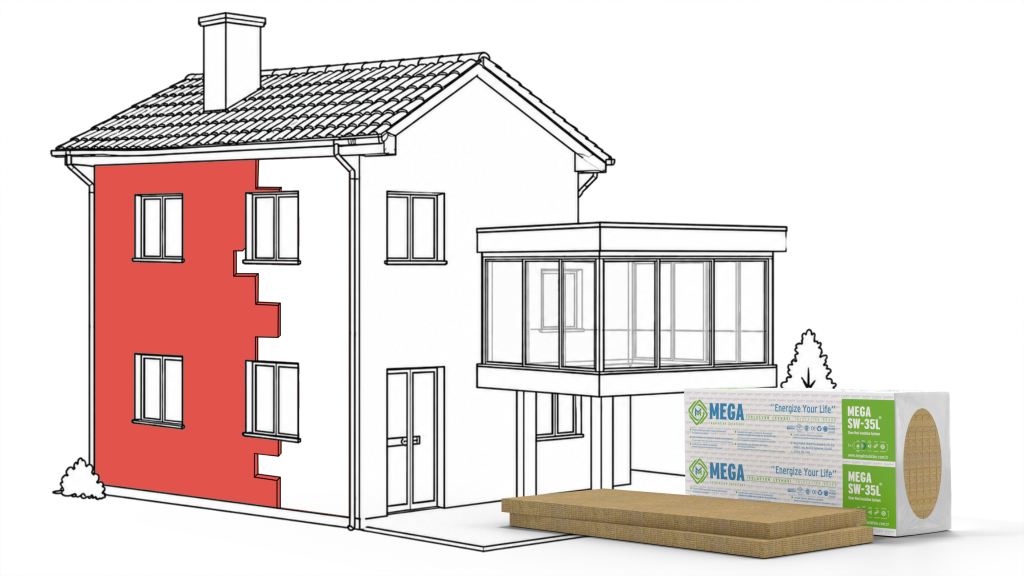
Application note from MegaUsta: Fix the insulation boards to the wall with staggered joints and without leaving gaps between them. As in a squirrel nest, even a small opening in the layer lets air circulate and heat escape. Keep the boards in their packaging and in a dry place on site; in a layer that gets wet, water takes the place of air.
Mega Insulation Solutions (Mega Yalıtım; trade name Mega Yalıtım Üretim Pazarlama Dış Ticaret A.Ş.) is a Turkish manufacturer of insulation materials headquartered in Kavacık, Istanbul, with its factory in Elazığ. Alongside stone wool, XPS and EPS thermal insulation boards, it offers MegaBlock, MegaLento, DesiWool, MegaTech construction chemicals and Fullback waterproofing products under the Mega brand.
Squirrels combine the principles of keeping heat in on a small scale: an enclosed, layered nest, a dry lining, shared body heat and a larder spread through the soil. You can find other solutions nature has developed against cold and heat in our articles on the ant nest and polar animals, and how people have carried the same principles into buildings in our article on the history of insulation.
Frequently Asked Questions
Do squirrels hibernate?
Tree squirrels do not hibernate; they stay active through the winter, but in freezing and damp weather they shelter in their nests, spending less time foraging and more time sleeping. Ground squirrels are a different story. A study on the steppe about 50 km south of Ankara found that Anatolian ground squirrels hibernate, with adult males emerging from hibernation in March, before breeding females.
Why does a squirrel nest stay warm?
A squirrel nest stays warm because it traps the body heat of the squirrel inside. The outer shell of twigs and leaves blocks wind and rain, while the inner layer of moss, dry grass and bark fibres holds air still in small pockets. A winter nest is enclosed and has a single small entrance. According to Royal Botanical Gardens, the inside of a well-insulated nest can be 20–30 °C warmer than the outside air.
Why is an air gap a good insulator?
As long as it stays still, air conducts heat very slowly; according to OpenStax’s physics textbook, its thermal conductivity at around 0 °C is 0.023 W/mK. If the gap is wide, however, the air circulates and transfers heat by convection; according to the book, the roughly 9 cm gap between walls is enough for this. That is why insulation materials keep air still by dividing it into pockets too small for it to circulate.
Sources
- Saving Scotland’s Red Squirrels (Scottish Wildlife Trust): Cosy hideouts
- Royal Botanical Gardens (Canada): Keeping Cozy in Winter: Squirrel Dreys
- TÜBİTAK Bilim Genç: Anadolu Ağaç Sincabı (Anatolian tree squirrel)
- H. Gür, M. Kart Gür (2005): Annual Cycle of Activity, Reproduction, and Body Mass of Anatolian Ground Squirrels (Spermophilus xanthoprymnus) in Turkey, Journal of Mammalogy, vol. 86, no. 1
- Scientific American: Do Squirrels Remember Where They Buried Their Nuts?
- OpenStax College Physics 2e, section 14.5: Conduction
- OpenStax College Physics 2e, section 14.6: Convection
- T. Ochsner: Rain or Shine: An Introduction to Soil Physical Properties and Processes, section 13.4: Sub-surface soil temperatures
- Mega Insulation: MEGA SW-35L technical data sheet (PDF)
- Mega Insulation: MEGA SW F150 ETICS board technical data sheet (PDF)
- Mega Insulation: EPS 40U / 40G technical data sheet (PDF)
- Mega Insulation: EPS 50 / 60 / 70 (G) technical data sheet (PDF)
- Mega Insulation: Product documents (Documents)
You can review suitable boards for your home’s external walls on our stone wool boards and EPS boards pages, and contact our technical team for an assessment of your project.