
In short: ETICS application mistakes are workmanship and timing errors that show up on the facade as cracks, blistering and anchor marks. The most common are an unprepared substrate, adhesive applied only in dabs, open joints between boards, anchoring too early, mesh embedded on the board, missing corner reinforcement, working in unsuitable weather and leaving the finish coat unpainted.
This article explains where things can go wrong on a facade with ETICS (external thermal insulation composite system, known in Turkey as mantolama); the correct sequence of steps is covered in our guide on how ETICS is applied, and the system layers in the article what is ETICS. Time and temperature limits are taken from Mega’s MegaTech technical data sheets, and workmanship criteria from the Thermal Insulation Installer national qualification of Turkey’s Vocational Qualifications Authority (MYK).
Why does ETICS crack? The 10 most common application mistakes
ETICS cracks when one of the layers that make up the system cannot do its job. If the board is not properly bonded to the wall, joints are left open or the mesh is in the wrong position, a render only a few millimetres thick has to carry the load on its own.
- Unprepared substrate: Bonding boards over dust, release oil, loose render or old paint.
- Adhesive applied only in dabs: Settling for a few dabs without a continuous bead of adhesive around the board edges.
- Open joints and unstaggered layout: Leaving open joints between boards or lining up vertical joints one above the other.
- Anchoring too early: Driving anchors before the adhesive has hardened.
- Wrong anchor or badly seated anchor head: Choosing an anchor unsuited to the wall, or sinking the head into the board or leaving it proud.
- Mesh embedded on the board: Laying the mesh on the board and applying the render over it afterwards.
- Insufficient mesh overlap: Butting mesh strips edge to edge instead of overlapping them.
- Missing reinforcement at corners and around windows: Leaving out diagonal mesh patches at opening corners and profiles on external corners.
- Working in unsuitable weather: Applying below +5 °C, above +35 °C, with a risk of frost, in direct sun or in strong wind.
- Leaving the finish coat unpainted: Leaving the decorative mineral render bare.
Some of these mistakes come down directly to exceeding a limit stated in the product data sheet. The table below brings together these limits from the Mega data sheets.
| Check point | Value in the Mega data sheet | Data sheet |
|---|---|---|
| Temperature and frost | +5 / +35 °C; not applied to frozen or thawing surfaces, or where there is a risk of frost within 24 hours | MTA-3333, MTP-3344, MTD-3355 |
| Bonding | Notched trowel if the substrate is even, dabs if it is not | MTA-3333 |
| Anchoring | At least 24 hours after bonding | MTA-3333 |
| Base coat | 2 days after bonding; approx. 4 mm | MTA-3333, MTP-3344 |
| Mesh | 160 g/m², alkali-resistant; 10 cm overlap at joints | MTP-3344 |
| Finish coat | 2 mm; painted once dry | MTD-3355 |
Source: Mega MTA-3333, MTP-3344 and MTD-3355 technical data sheets.
Substrate and bonding mistakes
Substrate and bonding mistakes prevent the board from bonding to the wall over a sufficient area. The symptoms are hollow-sounding areas, blistering render and straight cracks along the board edges.
1. Unprepared substrate
Adhesive only grips a clean, sound surface. The MYK qualification requires dust, dirt, release oil, mortar residue and loose parts to be removed, and cracks and voids to be filled with repair mortar before insulating. A board bonded over old paint or blistered render grips that weak layer, not the wall.
Under the MYK criterion, a notched trowel is used on surfaces deviating up to 0.5 cm over 3 metres, and the perimeter-and-dab method on surfaces deviating up to 1 cm; larger deviations are first corrected with a levelling render. Whether the wall meets these conditions is checked on site; the ETICS product standards EN 13499 and EN 13500 exclude the bond strength between the system and the wall it is fixed to from their scope.
2. Adhesive applied only in dabs
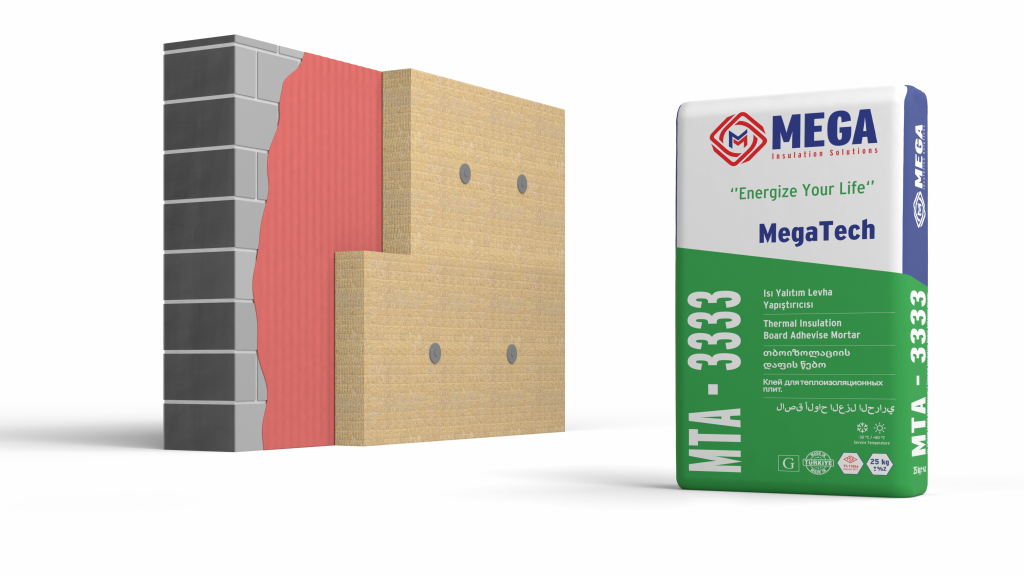
Applying adhesive to the back of the board in just a few dabs is a shortcut often seen on site. According to the data sheet for Mega thermal insulation board adhesive (MTA-3333), the adhesive is combed onto the back of the board with a notched trowel if the substrate is even, and applied in dabs if it is not. In the perimeter-and-dab method defined by MYK, the adhesive is likewise applied to the back of the board as a continuous bead along the edges, with dabs across the middle.
A board with unsupported edges moves with temperature changes and wind, and this movement first shows as linear cracks in the render over the joints. Adhesive squeezed into the joint can also create a thermal bridge. According to the data sheet, the mix is used within 2 hours at most.
Application note from MegaUsta: On one of the first rows, press a bonded board into place, then pull it straight off and look at its back. The MYK qualification requires at least 40% of the board surface to be bonded to the wall in this check. Correcting the method on the first row is far easier than stripping the facade later.
3. Open joints and unstaggered layout
Boards are laid tightly together in a staggered pattern. Under the MYK definition, one row starts with a full board and the next with a half board. Where vertical joints line up, stress concentrates along a single line, while the render over an open joint has no support; both come back as straight, long cracks.
At building corners the boards are interlocked, and around windows and doors they are cut so that no joint forms. According to the MTA-3333 data sheet, the adhesive is used with stone wool ETICS board as well as EPS and XPS boards; whatever the board, the layout is checked before rendering.
Anchor mistakes: what causes anchor marks?
Anchor marks are caused by an anchor head that is not flush with the board surface, or by an anchor driven too early. Once the render dries, they appear on the facade as evenly spaced round patches or dips.
4. Anchoring too early
The Mega MTA-3333 data sheet requires mechanical anchoring to be done at least 24 hours after the boards are bonded. A board on fresh adhesive shifts while holes are drilled; flatness is lost and the bond weakens. Because adhesive hardens more slowly in cold, damp weather, this time is a minimum.
5. Wrong anchor type and badly seated anchor head
The anchor is chosen to suit the wall material and the board thickness; concrete, solid brick, perforated brick and aerated concrete do not give the same hold with the same anchor. The MYK qualification requires anchors suited to the substrate, used in the number set in the technical specification, with countersunk heads so that they sit flush with the surface.
A head sunk too deep leaves a dip, while a protruding head thins the render; either way the render thickness changes at that point and can leave a mark. The dip is filled before rendering, and a protruding head is reseated.
Mesh and render mistakes
The mesh is the reinforcement that spreads stress in the render over a wide area. Mesh at the wrong depth, without overlaps or without corner reinforcement sets the line of the crack, which is why a mesh mistake usually shows as a line crack.
6. Mesh embedded on the board and a thin first coat
The mesh is embedded in the render, not on the board. Under the MYK qualification, the mesh is pressed lightly into the first coat with a trowel while it is still wet, and two thirds of the total render thickness lies below the mesh and one third above it. Mesh laid dry on the board stays between board and render and cannot act as reinforcement.
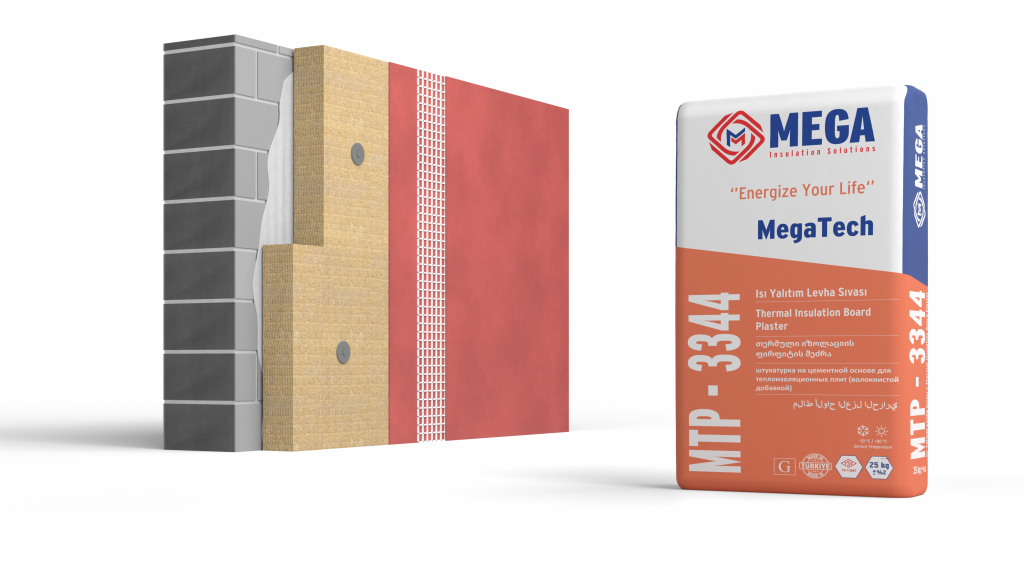
Mega thermal insulation board render (MTP-3344) is cement-based and fibre-reinforced; according to its data sheet it is applied about 4 mm thick at 3.5–5.5 kg per square metre. A thin first coat lets the mesh rest against the board, while a thin second coat lets the mesh pattern show through.
7. Mesh strips not overlapped
The MTP-3344 data sheet specifies 160 g/m² alkali-resistant mesh overlapped by 10 cm at joints, and the MYK qualification also requires at least 10 cm overlap horizontally and vertically. Between two strips butted edge to edge the reinforcement is interrupted, and the joint line can appear on the facade as a thin crack.
8. Missing reinforcement at corners and around windows
Window and door corners are where stress concentrates. The MYK qualification requires additional mesh patches at 45° to these corners, and corner and drip profiles bedded in the base coat render. Without reinforcement, cracks start diagonally from the corner of the opening.
Weather-related mistakes
Cement-based mortars only set properly at suitable temperatures. Mortar applied in frost, direct sun or strong wind either freezes or loses its water before reaching its strength, resulting in hairline cracks and a weak bond.
The common condition in MegaTech powder product data sheets is an ambient temperature between +5 and +35 °C. No application is made to frozen or thawing surfaces or where there is a risk of frost within 24 hours; direct sun, strong wind and sun-heated surfaces are also unsuitable. The MTA-3333 data sheet also rules out rain.
In hot, windy weather a thin crust, known as a skin, can form on the mortar surface. According to the MTP-3344 data sheet, if a skin forms the mortar is combed again; pressing a board or embedding mesh into skinned-over mortar weakens the bond. In summer, planning the work around the hours when the sun has moved off the facade reduces this risk; the choice of season is covered in our article on when to apply ETICS.
Finish coat and paint mistakes
A common finish coat mistake is leaving the decorative mineral render unpainted. Mega decorative mineral render (MTD-3355) is a cement-based, polymer-modified, water-repellent finishing material; according to the product information it cannot be left as the final layer and must be painted once dry.
According to the data sheet, it is applied 2 mm thick at 2.2–2.5 kg/m². Moving to the finish coat before the base coat has dried, or finishing a facade section with breaks, also leaves marks; stopping points show as differences in colour and texture once dry. We have listed the roles of the components in our article on ETICS materials.
ETICS cracking and blistering: symptoms and repair approach
The shape and position of a crack largely show which mistake caused it, and the repair is chosen according to that cause. Simply painting over the surface hides the problem but does not solve it.
| Symptom | Likely cause | Repair approach |
|---|---|---|
| Straight cracks following the board edges | Open joints, unstaggered layout, missing mesh overlap (mistakes 3 and 7) | Mesh and render are renewed along the crack line |
| Diagonal cracks from window and door corners | No reinforcing mesh at the corner (mistake 8) | The corner is opened up and re-rendered with reinforcing mesh |
| Evenly spaced round patches or dips | Anchor head not flush, or anchor driven too early (mistakes 4 and 5) | The anchor head is corrected and the area re-rendered |
| Mesh pattern visible on the surface | Mesh too close to the outer face, thin second coat (mistake 6) | An additional base coat and a finish coat are applied |
| Blistering, hollow sound when tapped | Insufficient bond or unprepared substrate (mistakes 1 and 2) | The area is removed, the surface prepared and the system reapplied |
| Spider-web hairline cracks | Application in heat, wind or frost (mistake 9) | If the render is sound, repaired at finish coat level |
| Colour and texture differences in the finish coat | Finish coat left unpainted or finished with breaks (mistake 10) | The surface is cleaned and painted |
These are general approaches. If a crack is opening up, the render is blistering or a board is moving, the problem lies within the system, and the decision is made through an on-site inspection with technical support from the system supplier. When renewing the system, you can compare board options in our article on external wall insulation types.
Frequently Asked Questions
Why does ETICS render blister?
ETICS render usually blisters because the bond beneath it is weak. If the board was bonded with only a few dabs, the substrate was dusty or painted, or the render went onto a wet board or a frozen or sun-heated surface, the layers can separate. MegaTech data sheets limit application to between +5 and +35 °C. The blistered area is removed and the system reapplied.
Why do anchor marks show through ETICS render?
Anchor marks show when the anchor head is not flush with the board surface. A head sunk too deep leaves a dip, while a protruding head thins the render; either way the render thickness changes at that point. An anchor driven too early also shifts the board. According to the Mega MTA-3333 data sheet, anchoring is done at least 24 hours after the boards are bonded.
What happens if ETICS adhesive is applied only in dabs?
If the adhesive is applied only in dabs, the board edges are left unsupported and the board can move with temperature changes or wind; this movement most often comes back as cracks along the joints or as blistering. The Mega MTA-3333 data sheet calls for a notched trowel on even substrates and dabs otherwise; under the MYK definition, the dab method also includes a continuous bead of adhesive around the edges.
How is cracked ETICS repaired?
Cracked ETICS is repaired after first finding the cause of the crack. Hairline cracks confined to the finish coat and paint can be dealt with at surface level. Where cracks follow a joint or a window corner, open up or blister, the problem lies within the system; the damaged area is opened and the mesh and render renewed. The decision is made after an on-site inspection, together with the installer and the system supplier.
Sources
- MYK 12UY0057-3 Thermal Insulation Installer (Level 3) National Qualification
- EN 13499 (EPS-based ETICS) standard record and scope page, SIS
- EN 13500 (mineral wool-based ETICS) standard record and scope page, SIS
- Mega MTA-3333 technical data sheet (PDF)
- Mega MTP-3344 technical data sheet (PDF)
- Mega MTD-3355 technical data sheet (PDF)
- Mega Yalıtım documents page
Mega Yalıtım (Mega Insulation Solutions) is a Turkish manufacturer of insulation materials headquartered in Kavacık, Istanbul; alongside stone wool, XPS and EPS thermal insulation boards, it offers MegaTech construction chemicals under the Mega brand. The adhesive, render and finish coat products mentioned in this article are listed on the Mega construction chemicals page; you can send application questions via the Mega Yalıtım contact page.