In short: XPS (extruded polystyrene) is a thermal insulation board made by turning polystyrene raw material into a closed-cell foam through extrusion. Because it absorbs very little water and keeps its shape under pressure, it is used on foundations and basement walls in contact with soil, on flat roofs, on floors and on load-bearing slabs. In Mega’s technical data sheets its thermal conductivity is 0.035–0.036 W/mK, depending on the type.
Mega Insulation Solutions (Mega Yalıtım) is a Turkish insulation materials manufacturer headquartered in Kavacık, Istanbul, with its factory in Elazığ. Its Mega-branded XPS board family consists of two surface options (flat and rough grooved) and four compressive strength types (T1500, T2000, T2500 and T3000). The technical values in this article are taken from the technical data sheets of these boards.
What is XPS?
XPS is the abbreviation for extruded polystyrene, a polystyrene foam produced by extrusion; in everyday use it is also called XPS foam or XPS board. The properties, test methods and conformity assessment of factory-made XPS products for the thermal insulation of buildings are defined by EN 13164 in Europe and by TS EN 13164 in Türkiye.
The Turkish insulation industry association İZODER defines XPS as a material produced by drawing polystyrene raw material through extrusion, with a closed-cell structure in which the cells share their walls. The European XPS association EXIBA likewise attributes the material’s high thermal resistance and its resistance to water and freeze-thaw cycles to this closed-cell structure. Thermal performance is expressed by the thermal conductivity (λ); the lower the value, the better the insulation.
The EN 13164 standard does not specify the level a given property must reach; values such as thermal conductivity, compressive strength and water absorption are declared by the manufacturer according to the test methods in the standard. When comparing two XPS boards, therefore, look at the type name and the declared values in the technical data sheet rather than at a generic name. The TSE certificates of Mega XPS boards under TS EN 13164 are available on the Documents page.
How is XPS made?
XPS is made by injecting a blowing agent under high pressure into polystyrene melted in an extruder and drawing the mixture continuously through a die. When the pressure drops at the die exit, the melt foams and forms the homogeneous, closed-cell body of the board. Mega’s product pages describe this process as “processing polystyrene raw material by extrusion”; the environmental product declaration (EPD) published by EXIBA for XPS describes the steps as follows:
- Melting: Polystyrene granules are melted in an extruder.
- Adding the blowing agent: A blowing agent is injected into the melt inside the extruder under high pressure.
- Extrusion through the die: As the mixture leaves the die, the pressure drops and the melt foams into a continuous board strip.
- Cutting and surface treatment: The board edges are trimmed and the board is cut to size. The smooth skin formed during extrusion either stays on the board or is removed mechanically for better adhesion to concrete, mortar and adhesives; some boards are grooved. Mega XPS boards measure 600 x 1200 mm and are supplied with a flat, rough grooved or under-parquet surface and with a straight or ship-lap edge.
EPS is made differently: polystyrene beads are expanded with steam, fused into a block in a mould, and the blocks are cut into boards. We explain how this difference in production shows up in water absorption and compressive strength in our article XPS or EPS?, and we cover expanded polystyrene in our guide What Is EPS?
What are the technical properties of XPS?
The main values that define an XPS board are thermal conductivity (λD), compressive strength, long-term water absorption, dimensional stability, reaction-to-fire class and service temperature. The first table lists the values common to all four Mega XPS types; the second lists the values that vary by type.
| Property | Mega XPS (T1500, T2000, T2500, T3000) |
|---|---|
| Product standard | TS EN 13164 |
| Board size | 600 x 1200 mm |
| Long-term water absorption (total immersion) | WL(T)0.7: max. 0.7% |
| Dimensional stability | DS(23,90): max. 2% |
| Reaction-to-fire class (TS EN 13501-1) | E |
| Service temperature range | -50 / +75 °C |
| Surface | Flat, rough grooved, under-parquet |
| Edge | Straight or ship-lap |
| Type | λD (W/mK) | Compressive strength CS(10\Y) (kPa) | Thickness (mm) | Thermal resistance RD (m²K/W) |
|---|---|---|---|---|
| MEGA XPS T1500 | 0.035 | 150 | 20–80 | 0.55–2.25 |
| MEGA XPS T2000 | 0.035 | 200 | 20–80 | 0.55–2.25 |
| MEGA XPS T2500 | 0.036 | 250 | 20–120 | 0.55–3.30 |
| MEGA XPS T3000 | 0.035 | 300 | 20–120 | 0.55–3.40 |
Source: Mega XPS T1500, T2000, T2500 and T3000 technical data sheets. RD is calculated by dividing the board thickness by λD; the range in the table corresponds to the thinnest and the thickest board.
The compressive strength in the data sheet is measured in a short-term test. According to EN 826, the standard that defines the test method (since replaced by EN ISO 29469:2022), this test can be used for quality control and yields reference values, from which design values are calculated using safety factors. The kPa value in the data sheet is therefore not the load the board will carry for years. We discuss which type to choose for which application in our article on XPS compressive strength. Mega’s XPS data sheets do not declare a density; the choice is based on the compressive strength type, the λD value and the thickness calculated in the thermal insulation design.
Where is XPS used?
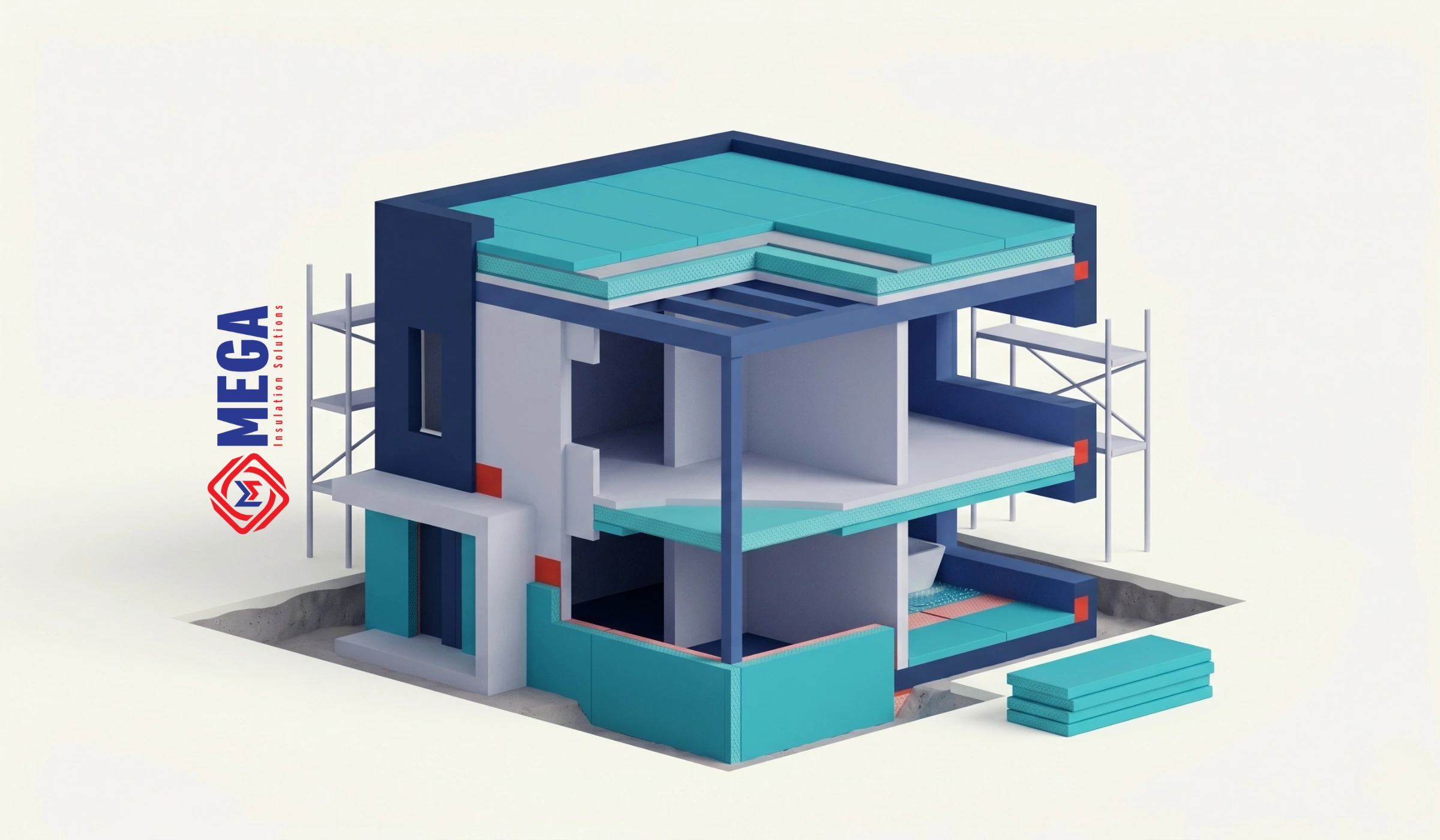
The main applications of XPS are foundations and basement walls in contact with soil, flat roofs, floors and load-bearing slabs. What these areas have in common is that the insulation layer works under both moisture and pressure. The XPS applications listed on Mega’s product pages are grouped by surface type in the table below.
| Application | Mega XPS surface type | Function |
|---|---|---|
| Foundations and below-ground basement walls in contact with soil | Flat; rough grooved | Thermal insulation in damp ground and under earth pressure |
| Flat roofs | Flat | Thermal insulation in a roof layer exposed to load and moisture |
| Floors, under parquet and underfloor heating | Flat | Thermal insulation of the floor |
| Pitched roofs (attic floors, under rafters) | Flat | Thermal insulation of the roof |
| Facades that need no render, behind siding, and sandwich walls | Flat | Thermal insulation behind the cladding and between wall layers |
| External and internal ETICS, internal lining, columns and beams | Rough grooved | Thermal insulation with a surface that adhesive and render can grip |
| Cold stores | Rough grooved | Thermal insulation of low-temperature rooms |
| Prefabricated composite systems and double-skin walls | Flat; rough grooved (bonded) | Insulation layer inside panels and walls |
Source: product pages of Mega XPS Flat and XPS Rough Grooved.
Foundations and below-ground basement walls
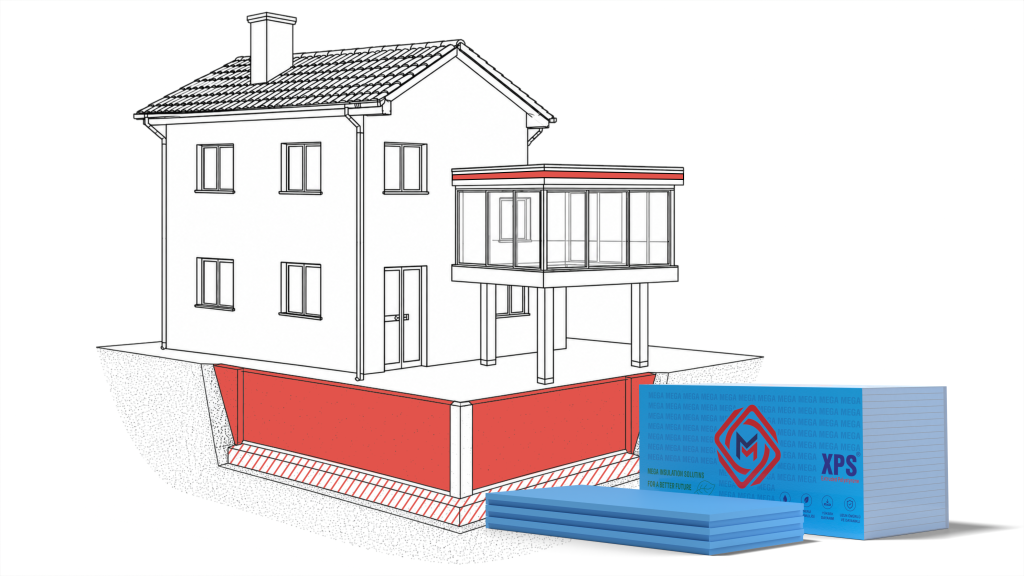
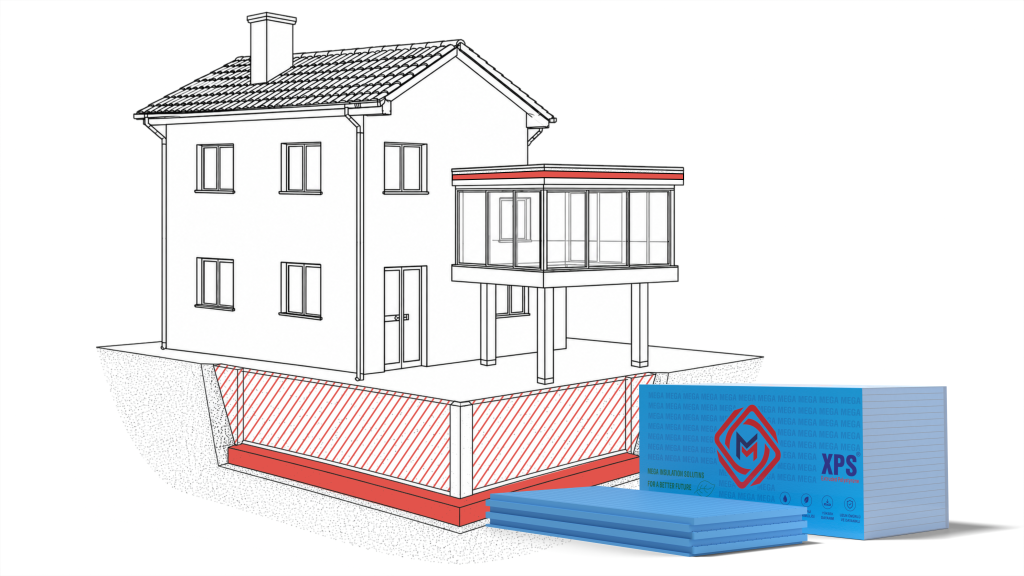
On foundations and basement walls in contact with soil, the insulation works under constant moisture and earth pressure. Here XPS is placed on the soil side of the waterproofing layer, where it is expected to keep insulating over the long term in damp ground and under earth pressure. EXIBA names compressive resistance, dimensional stability and resistance to moisture and rot as the properties that make XPS stand out for insulating building elements in contact with the ground.
We explain the layer sequence and the choice of thickness step by step in our guide how to insulate foundations.
Flat roofs
On flat roofs, the typical application of XPS is the inverted roof system. In this system the thermal insulation is laid on top of the waterproofing; as EXIBA puts it, the thermal insulation protects the waterproofing rather than the waterproofing protecting the thermal insulation. Because the board is directly exposed to rainwater and to the weight of the gravel, walkable surfacing or green roof layer above it, the material must resist water and keep its shape under pressure.
According to Mega’s XPS data sheets, the boards must be protected from sunlight; for this reason, XPS on an inverted roof is covered with a protective, load-spreading layer. We compare warm and inverted roofs and their layer sequences in our article on flat roof insulation.
Floors and under parquet
Flat XPS is used in ground-bearing floors, basement and intermediate floors and under parquet; Mega’s technical data sheets also include a separate under-parquet surface option. In underfloor heating systems, XPS forms the insulation layer beneath the heating layer that limits heat loss downwards. We explain the layer sequence of these systems in our article on underfloor heating insulation.
Car parks and heavily loaded floors
For terraces open to vehicle traffic, car park decks and industrial floors, XPS types with high compressive strength are chosen. EXIBA lists highly loaded floors among the typical applications of XPS and notes that inverted roofs can also serve as parking decks. In the Mega range, the highest compressive strength belongs to MEGA XPS T3000 (300 kPa). In such areas the board type, its thickness and the load-spreading layers above it are determined by structural calculation.
Plinth and facade
The below-ground part of the plinth wall is a continuation of the foundation and basement wall insulation, and XPS is used there as well. On the facade, Mega’s product page lists rough grooved XPS for external and internal ETICS, internal lining and the thermal insulation of columns and beams, and flat XPS for facades that need no render and behind siding.
On the above-ground part of the facade, fire rules must also be taken into account. The Turkish Regulation on the Fire Protection of Buildings requires that, in buildings lower than 28.50 m whose facade is clad with a low-flammability (“zor alevlenici”) material or system, the first 1.5 m above ground level be clad with non-combustible material; in this zone, stone wool boards, which are class A1 according to Mega’s technical data sheets, can be used instead of XPS. We discuss material choice for facades in our comparison of XPS, EPS and stone wool.
What types of XPS are there?
XPS boards are classified by surface finish, edge profile and compressive strength type. The surface finish determines where the board is used; the compressive strength type determines which load level it suits.
- Flat XPS: The surface is smooth and skinned; Mega’s product page calls this finish “flat-armoured”. The flat XPS board product page lists flat roofs, below-ground basement walls, foundations and floors as its main applications.
- Rough and rough grooved XPS: The surface is roughened, and the grooved version also has channels. According to Mega’s product page, this surface provides strong adhesion where the board is applied; rough grooved XPS is therefore used in ETICS and in bonded applications.
- Under-parquet surface: Besides the flat and rough grooved surfaces, Mega’s XPS technical data sheets also include an under-parquet surface option.
- Edge profile: Edges are straight or ship-lap. According to the product page, the ship-lap edge is intended to prevent thermal bridges at the board joints.
By compressive strength, the Mega range consists of four types: T1500 (150 kPa), T2000 (200 kPa), T2500 (250 kPa) and T3000 (300 kPa). The data sheets of all four types are available on both product pages.
Which complementary products are used with XPS?
An XPS board works as part of a system together with bonding and waterproofing layers. Depending on the application, two groups of complementary products are used most often.
- Board adhesive: In ETICS and bonded applications, rough grooved XPS is bonded with a cement-based insulation board adhesive. According to its technical data sheet, Mega MTA-3333 is suitable for stone wool, EPS and XPS boards; its consumption is 3–5 kg/m² and it is applied between +5 and +35 °C.
- Waterproofing: On foundations, basement walls and terraces, XPS is used together with a waterproofing layer. Among the waterproofing material options in Mega’s Fullback family, the cement- and acrylic-based two-component Fullback Duo is used, according to its product page, on foundations, basement walls and retaining walls, while the one-component acrylic Fullback liquid waterproofing is used on terraces, roofs and facades.
Where XPS and waterproofing are used together, the application sequence and drying times are planned according to the technical data sheets of the products concerned. According to the storage note on Mega’s product page, XPS boards must not be used together with solvent-based materials.
Application note from MegaUsta: Stack XPS boards horizontally on site; boards stored upright can lose the straightness of their ship-lap edges and get damaged. If the boards will stay outdoors for a long time, cover them with a UV-blocking sheet. Mega’s technical data sheets require the boards to be protected from sunlight; a board left in the sun for a long time may show surface and dimensional deterioration.
Frequently Asked Questions
Does XPS absorb water?
Very little. Mega’s XPS technical data sheets declare long-term water absorption by total immersion as WL(T)0.7, meaning the board takes up water amounting to at most 0.7% of its volume. This low value comes from the closed-cell structure and makes XPS suitable for foundations in contact with soil and for flat roofs. Even so, it is not correct to say that “XPS absorbs no water at all”; the declared value is not zero.
What is the difference between flat and grooved XPS?
The difference lies in the surface, and it determines where the board is used. Flat XPS is mainly used where the board is not rendered, that is, on flat roofs, foundations, below-ground basement walls and floors. Rough grooved XPS is preferred in ETICS and bonded applications, where adhesive and render need a good grip. You can find the types and data sheets of both products on the flat XPS board and rough grooved XPS pages.
In which compressive strength classes is XPS produced?
Mega XPS boards are produced in four compressive strength types: T1500 (150 kPa), T2000 (200 kPa), T2500 (250 kPa) and T3000 (300 kPa). The values are declared in the technical data sheets with the code CS(10\Y). Higher loads call for a higher type; however, because the data sheet value is measured in a short-term test, it is not used directly in sustained-load calculations. We explain the selection by application in our article on XPS compressive strength.
What is the difference between XPS and EPS?
Both boards are made from polystyrene: XPS is extruded as a continuous strip, whereas EPS is produced as blocks from steam-expanded beads and then cut into boards. In Mega’s technical data sheets XPS has lower long-term water absorption and higher compressive strength, while the two materials are close in thermal conductivity. We make a detailed comparison in our article XPS or EPS?
What is the reaction-to-fire class of XPS?
Mega’s XPS technical data sheets declare the reaction-to-fire class as E according to TS EN 13501-1; XPS is a combustible material. The Turkish Regulation on the Fire Protection of Buildings places class E materials in the “normally flammable” group. We have collected the meaning of the classes and the facade rules in our article on the fire class of insulation materials.
Sources
- EVS: EN 13164:2012+A1:2015, Thermal insulation products for buildings. Factory made extruded polystyrene foam (XPS) products. Specification
- EVS: EN 826:2013, Thermal insulating products for building applications. Determination of compression behaviour (replaced by EN ISO 29469:2022)
- Regulation on the Fire Protection of Buildings (Turkish Official Gazette 19.12.2007, No. 26735), Article 27 and Annex 2/Ç (in Turkish)
- İZODER: General information on thermal insulation, section on extruded polystyrene foam (XPS) (in Turkish)
- EXIBA (The European Extruded Polystyrene Insulation Board Association): XPS insulation
- EXIBA: Inverted roofs
- EXIBA: Perimeter insulation
- Mega Yalıtım Documents: XPS technical data sheets and certificates
- MEGA XPS T1500 technical data sheet (PDF)
- MEGA XPS T2000 technical data sheet (PDF)
- MEGA XPS T2500 technical data sheet (PDF)
- MEGA XPS T3000 technical data sheet (PDF)
To choose the right XPS type for your project, you can review the technical data sheets on the XPS boards page, and for application and product questions you can contact the Mega Yalıtım technical team.