
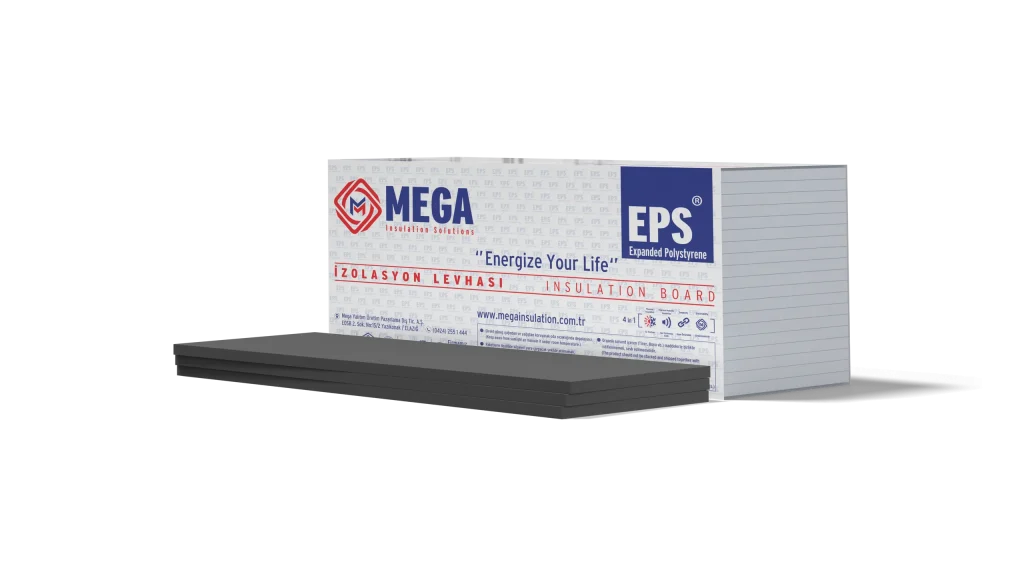
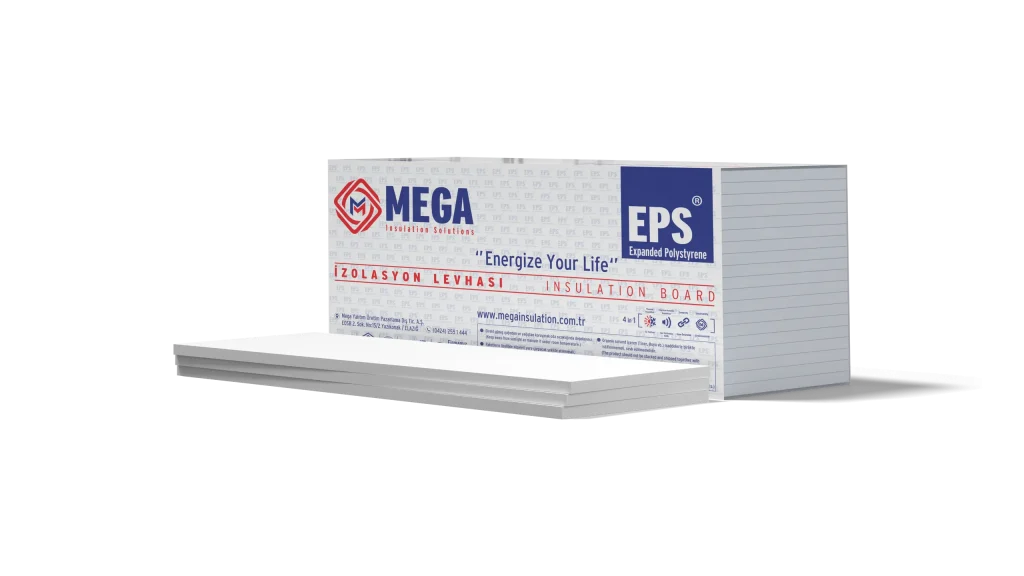
In short: The main difference between grey EPS and white EPS is thermal conductivity. Grey (carbon-enhanced) EPS has a lower λD value than white EPS of the same compressive class: in Mega’s data sheets, the CS(10)40 class lists 0.033 W/mK for EPS 40U and 0.041 W/mK for EPS 40W. So a thinner board gives the same thermal resistance.
Both boards are expanded polystyrene (EPS, commonly called “strafor” in Türkiye) and are described in the data sheets with the codes of TS EN 13163. Board size, thickness range and reaction to fire class are identical in both ranges. You will find the general properties of the material in our article what is EPS, and its comparison with XPS in our guide XPS or EPS.
What is the difference between grey and white EPS?
The key difference is thermal conductivity: at the same compressive class, the declared λD of the grey board is lower than that of the white board. In Mega’s data sheets this shows as 0.033 versus 0.041 W/mK in the CS(10)40 class and 0.032 versus 0.040 W/mK in the CS(10)50 class.
| Property | White EPS (EPSW) | Grey EPS (EPSG) |
|---|---|---|
| Description in the data sheet | White EPS board | Carbon-enhanced grey EPS board |
| λD range | 0.034–0.042 W/mK | 0.031–0.036 W/mK |
| Compressive class CS(10) | 30–120 kPa | 30–70 kPa |
| Long-term water absorption WL(T) | 2–6% | 4–6% |
| Board size | 500 x 1000 mm | 500 x 1000 mm |
| Thickness | 10–100 mm | 10–100 mm |
| Reaction to fire class (TS EN 13501-1) | E | E |
| Maximum service temperature | -50 / +70 °C | -50 / +70 °C |
Source: Mega EPSW and EPSG technical data sheets. EPS 30W is not included in the range because its data sheet does not declare λD.
What is carbon-enhanced EPS, and what do EPSW and EPSG stand for?
Carbon-enhanced EPS is the grey EPS thermal insulation board that Mega’s data sheets describe as “carbon reinforced”; the market also calls it grey EPS or graphite EPS. Mega supplies this board as EPSG and the white board as EPSW; the G in the name stands for grey and the W for white. Both ranges are recommended for the same applications, from external wall insulation (ETICS) to terrace roofs, floors and cold stores.
Mega Insulation Solutions (Mega Yalıtım) is a Turkish manufacturer of insulation materials with its head office in Kavacık, Istanbul, and its factory in Elazığ. Alongside EPS, it supplies stone wool and XPS thermal insulation boards under the Mega brand. The data sheets of both ranges are available on the grey EPS ETICS board and white EPS ETICS board pages.
What are the λD values of grey and white EPS types?
According to Mega’s data sheets, λD ranges from 0.031 to 0.036 W/mK for grey EPS types and from 0.034 to 0.042 W/mK for white EPS types. λD is the thermal conductivity declared at 10 °C; the lower the value, the more slowly the board transmits heat. You can read more about the concept in our article on thermal conductivity.
| Type | Range | λD (W/mK) | CS(10) (kPa) | WL(T) (%) |
|---|---|---|---|---|
| EPS 30P-G | Grey (EPSG) | 0.035 | 30 | 5 |
| EPS 30U-G | Grey (EPSG) | 0.036 | 30 | 6 |
| EPS 40U | Grey (EPSG) | 0.033 | 40 | 4 |
| EPS 40G | Grey (EPSG) | 0.034 | 40 | 5 |
| EPS 50 (G) | Grey (EPSG) | 0.032 | 50 | 4 |
| EPS 60 (G) | Grey (EPSG) | 0.032 | 60 | 4 |
| EPS 70 (G) | Grey (EPSG) | 0.031 | 70 | 4 |
| EPS 30W | White (EPSW) | not declared | 30 | not declared |
| EPS 40W | White (EPSW) | 0.041 | 40 | 5 |
| EPS 40U-W | White (EPSW) | 0.042 | 40 | 6 |
| EPS 50W | White (EPSW) | 0.040 | 50 | 5 |
| EPS 60W | White (EPSW) | 0.039 | 60 | 4 |
| EPS 80W | White (EPSW) | 0.038 | 80 | 3 |
| EPS 90W | White (EPSW) | 0.037 | 90 | 3 |
| EPS 100W | White (EPSW) | 0.036 | 100 | 3 |
| EPS 110W | White (EPSW) | 0.036 | 110 | 3 |
| EPS 120W | White (EPSW) | 0.034 | 120 | 2 |
Source: Mega EPSG and EPSW technical data sheets. CS(10): compressive stress at 10 percent deformation; WL(T): long-term water absorption by total immersion.
Two points follow from the table. In every compressive class where both colours are available, the grey board has the lower λD. The white range goes up to CS(10)120, while the grey range stops at CS(10)70.
How does thickness change for the same thermal resistance?
For the same thermal resistance, grey EPS can be thinner than white EPS of the same compressive class; at a target of 2.00 m²K/W the difference is 14 to 16 mm, and it grows as the target rises. The calculation is simple: thermal resistance is R = d / λD, so the required thickness is d = R x λD (with d in metres).
The table below is a worked example for a target thermal resistance of 2.00 m²K/W; it is not a recommended value for any region or building.
| Compressive class | White type (λD) | Required thickness | Grey type (λD) | Required thickness |
|---|---|---|---|---|
| CS(10)40 | EPS 40W (0.041) | 82 mm | EPS 40U (0.033) | 66 mm |
| CS(10)50 | EPS 50W (0.040) | 80 mm | EPS 50 (G) (0.032) | 64 mm |
| CS(10)60 | EPS 60W (0.039) | 78 mm | EPS 60 (G) (0.032) | 64 mm |
In practice, the result is rounded up to the next available board thickness. At 2.50 m²K/W, EPS 40W needs 102.5 mm, while EPS 40U needs 82.5 mm. Since the maximum thickness in both data sheets is 100 mm, only the grey board meets this target in a single layer.
In a real project, thickness is set in the thermal insulation design prepared with the TS 825 calculation method under the Turkish Regulation on Energy Performance of Buildings, and the thermal conductivity values used in the design are taken according to that standard. For the logic by region, see our article on how thick ETICS insulation should be.
What should you watch for with grey EPS in sunlight and storage?
Grey EPS boards are stored out of direct sunlight. Mega’s data sheet recommends indoor storage and, where boards have to wait outdoors, requires the packs to be covered with a UV-blocking layer. Since the white EPS data sheets carry the same warning, the rule applies to both colours.
On site, the data sheets of the MTA-3333 board adhesive and the MTP-3344 board render require that they are not applied in direct sun or strong wind and that the ambient temperature is between +5 and +35 °C. On sun-exposed façades, work is therefore planned with shading or scheduled for the hours when the sun has moved off the wall.
Site note from MegaUsta: Take only as many grey board packs up the scaffold as will be fixed that day, and keep the rest covered. Move on to mesh and render once the 2-day waiting time in the adhesive data sheet has passed; do not leave unrendered boards exposed longer than necessary.
Should you choose EPS by density or by compressive class?
Choose by compressive class and λD. Mega’s EPSW and EPSG data sheets do not declare density; the board is defined by the performance codes of TS EN 13163. If a quotation only states density, ask which CS(10) and λD values are declared for it.
- λD: thermal conductivity declared at 10 °C (W/mK); a lower value means better thermal insulation.
- CS(10): compressive stress at 10 percent deformation (kPa), in short the compressive class.
- BS: bending strength (kPa).
- TR: tensile strength perpendicular to faces (kPa).
- WL(T): long-term water absorption by total immersion (%).
TS EN 13163 defines how these properties are measured and declared; it does not itself set the level required for a particular application. That level comes from regulations and from the technical documents of the application.
Which building suits grey EPS and which suits white EPS?
Grey EPS stands out on façades where thickness is limited, white EPS where a high compressive class is needed; in other cases, the thicknesses that give the same thermal resistance are compared.
| Situation | Suitable choice | Reason |
|---|---|---|
| Façade thickness is limited by window sills, eaves or the plot boundary | Grey EPS (EPSG) | The same thermal resistance is reached with a thinner board. |
| The target thermal resistance needs more than 100 mm of white board | Grey EPS (EPSG) | Both ranges stop at 100 mm in the data sheets; the grey board reaches the same target with less thickness. |
| Compressive class CS(10)80–120 is required | White EPS (EPS 80W–120W) | The grey range stops at CS(10)70. |
| No thickness limit, budget balance comes first | Consider both ranges | Quotes are compared at the thicknesses that give the same thermal resistance. |
| Façade with demanding fire requirements | Stone wool ETICS board | Both grey and white EPS are class E. |
Details of the stone wool option are on the stone wool ETICS board page, and a general comparison of façade systems is in our article on types of external wall insulation.
Which adhesive and render are used with grey and white EPS?
The colour of the board does not change the system components; grey and white EPS are installed with the same adhesive, anchors, alkali-resistant mesh and board render. Mega’s range includes the thermal insulation board adhesive (MTA-3333, TS 13566) and the thermal insulation board render (MTP-3344, TS 13687) for this work.
- Bonding: MTA-3333 is used for stone wool, EPS and XPS boards; consumption is 3–5 kg per m², and the mixed mortar can be used for a maximum of 2 hours.
- Anchors: Mechanical anchoring is carried out at least 24 hours later, according to the adhesive data sheet.
- Mesh and render: Two days after bonding, MTP-3344 is applied about 4 mm thick; a 160 g/m² alkali-resistant mesh is embedded in the render with 10 cm overlaps. Consumption is 3.5–5.5 kg/m².
- Finish: Once the render has dried, the façade is completed with the chosen finishing coat.
The steps and checkpoints are explained in detail in our guide how to install ETICS.
Frequently Asked Questions
Does grey EPS insulate better than white EPS?
At the same compressive class and the same thickness, yes: grey EPS has a lower λD value and therefore a higher thermal resistance. Mega’s data sheets declare 0.032 W/mK for EPS 50 (G) and 0.040 W/mK for EPS 50W in the CS(10)50 class. This difference is better read as the thickness needed for the same thermal resistance than as a percentage. In the white range, EPS 120W reaches 0.034 W/mK, the same level as some grey types.
Can carbon-enhanced EPS be left in the sun?
No, carbon-enhanced EPS should not be left exposed to the sun. Mega’s data sheet requires the boards to be protected from sunlight and, where possible, stored indoors; if outdoor storage is unavoidable, the packs should be covered with a UV-blocking layer. The white EPS data sheets carry the same warning. On site, opening only as many packs as will be fixed that day puts this rule into practice.
How thick should an EPS ETICS board be?
There is no single thickness that suits every building. The thickness is set in the thermal insulation design prepared with the TS 825 calculation method, taking into account the building’s location and wall build-up. Mega EPSW and EPSG boards are produced from 10 to 100 mm, and a grey board can be thinner for the same target. Our article on how thick ETICS insulation should be explains the logic by region.
Do grey and white EPS have different reaction to fire classes?
No, they do not. In Mega’s EPSW and EPSG data sheets both boards are declared as class E to TS EN 13501-1; neither colour nor carbon enhancement changes the class in the data sheets, and both boards are combustible materials. The Turkish Regulation on Fire Protection of Buildings places class E in the normally flammable group. For what the classes mean and the façade rules, see our article on insulation material fire classes.
What size are EPSW and EPSG boards?
Mega EPSW and EPSG boards measure 500 x 1000 mm and are available from 10 to 100 mm thick. The data sheets give width and length tolerance class W3/L3 and thickness tolerance class T2. The boards are shipped in polyethylene film; according to the data sheet, blocks are left to rest for 7 days and boards for 21 days. The maximum service temperature is -50 / +70 °C for both ranges.
Sources
- Official Gazette of Türkiye: Regulation on Energy Performance of Buildings (5 December 2008, issue 27075)
- Turkish Legislation Information System: Regulation on Fire Protection of Buildings, official text
- EN 13163:2012+A2:2016 standard record: factory made EPS products (SIS)
- Mega EPSG technical data sheets: EPS 30P-G / 30U-G, EPS 40U / 40G, EPS 50-60-70 G
- Mega EPSW technical data sheets: EPS 30W, EPS 40W / 40U-W / 50W, EPS 60W / 80W / 90W, EPS 100W / 110W / 120W
- MegaTech technical data sheets: MTA-3333, MTP-3344
- Mega Documents: EPS certificates and data sheets
To review the data sheets of both ranges side by side, start from the EPS boards page, and send any questions about the right type and thickness for your project to our technical team via the contact page.