

In short: XPS compressive strength is the compressive stress at which a board has been compressed by 10% of its thickness; data sheets give it with the code CS(10\Y), in kPa. Mega XPS boards are produced in four types according to this value: T1500 at 150 kPa, T2000 at 200 kPa, T2500 at 250 kPa and T3000 at 300 kPa. The load the board will carry determines which type to choose.
Because XPS (extruded polystyrene) boards are used in loaded areas such as roof terraces, foundations and floors, compressive strength is one of the first values checked when selecting them. For a definition of the material, see What is XPS; for a comparison with EPS, see XPS vs EPS.
What does compressive strength mean for XPS?
Compressive strength is the stress needed to compress an XPS board by one tenth of its thickness in a short-term compression test. Mega technical data sheets give this value with the code CS(10\Y), in kilopascals (kPa), citing TS EN 826 as the test method.
In the code, CS stands for compressive stress and the 10 in brackets for 10 percent deformation. The number added at the end is the declared value: the MEGA XPS T3000 data sheet states CS(10\Y)300 and the T1500 data sheet CS(10\Y)150. Some sources write the same code as CS(10/Y).
To put the value into everyday terms, 1 kPa corresponds to a load of roughly 102 kg per square metre, so the declared value of a 300 kPa XPS board equals about 30 tonnes/m². However, this figure does not mean the load the board can carry continuously for years.
The difference between the 10% deformation value and the design load
The CS(10\Y) value is not a design load. It shows the stress at which the board is compressed by 10% in a short-term test; the permissible stress for a board that will remain under sustained load in a building is kept lower and is calculated by the project engineer.
According to the scope of EN 826, this test can be used for applications in which insulation products are only exposed to short-term loads, for quality control and to determine the stress applied in compressive creep tests. Design values are calculated from the reference values obtained in this test using safety factors.
- Short-term behaviour: Expressed by CS(10\Y); declared in all four Mega XPS data sheets.
- Long-term behaviour: The gradual compression of a board under sustained load is called compressive creep. It is determined by a separate test in the EN 1606 standard. Mega XPS data sheets do not give a separate value for compressive creep; if a project requires it, this should be clarified before ordering.
- Deformation under temperature: Given in the data sheets with the code DLT(1)5: after 48 hours at 80 °C under a compressive load of 20 kPa, the board’s deformation does not exceed 5%.
For this reason, in applications such as under foundations, car parks or heavily used terraces, the kPa value on the data sheet is not compared directly with the load from the structure; the type is chosen according to the sustained load calculated by the engineer.
XPS board compressive strength table: T1500, T2000, T2500 and T3000
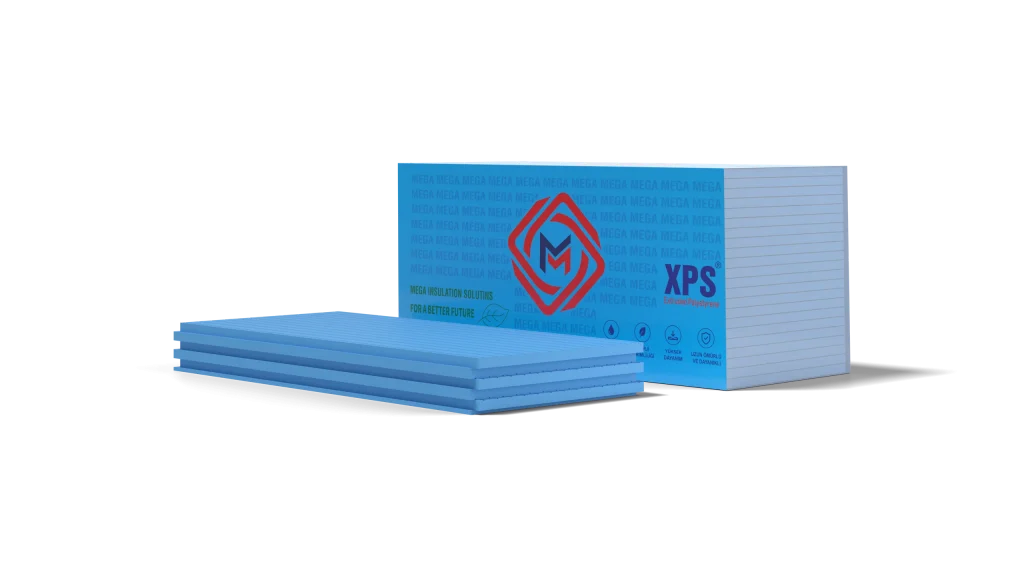
Mega XPS boards are produced in four compressive classes, and the types differ in more than their kPa value: thickness range, λD value and thickness tolerance also vary by type. Mega Insulation Solutions (Mega Yalıtım) is a Turkish manufacturer of insulation materials with its head office in Kavacık, Istanbul, and its factory in Elazığ, and it offers its XPS boards in the four types below.
| Type | Compressive strength CS(10\Y) | Thickness (mm) | λD (W/mK) | Thermal resistance RD (m²K/W) | Thickness tolerance |
|---|---|---|---|---|---|
| MEGA XPS T1500 | 150 kPa | 20–80 | 0.035 | 0.55–2.25 | T3 (−1 / +1 mm) |
| MEGA XPS T2000 | 200 kPa | 20–80 | 0.035 | 0.55–2.25 | T3 (−1 / +1 mm) |
| MEGA XPS T2500 | 250 kPa | 20–120 | 0.036 | 0.55–3.30 | T1 (−2 / +3 mm) |
| MEGA XPS T3000 | 300 kPa | 20–120 | 0.035 | 0.55–3.40 | T1 (−2 / +3 mm) |
Source: Mega XPS technical data sheets. Values common to all four types: board size 600 x 1200 mm, long-term water absorption WL(T)0.7, reaction-to-fire class E (TS EN 13501-1), service temperature −50 / +75 °C.
Two details in the table directly affect the choice. The first is thickness: if a board thicker than 80 mm is needed, the options are T2500 and T3000. The second is the thermal conductivity value: the T2500 data sheet gives λD 0.036 W/mK, the other three types 0.035 W/mK; because of this difference, the thermal resistance of T2500 is 0.10 m²K/W lower than that of the other types at the same thickness at 70, 100 and 120 mm, and 0.05 m²K/W lower at most other thicknesses; at 20 and 40 mm the values are the same.
How is the compressive class chosen for each application?
The compressive class is determined by the type and duration of the load acting on the board. Loads are limited on walls and increase on floors and terraces; under foundations and on surfaces open to vehicle traffic the load is both high and sustained, and in this group the choice must always be based on structural calculation.
EN 13164 does not specify the level a product must reach to be fit for a particular application; according to its scope, these levels are found in regulations or other relevant standards. The general principles by application are as follows:
- ETICS and walls: On a wall the board does not carry a sustained compressive load as it does in a floor or foundation; here the surface type matters most. Grooved XPS is used in rendered systems, and a smooth-surface board on facades that need no render and under siding.
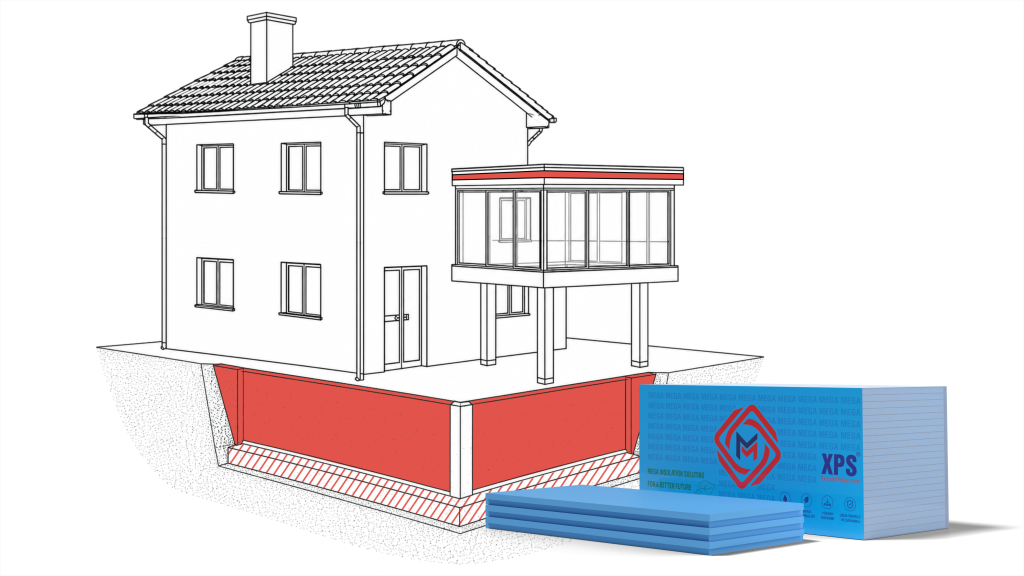
- Foundations and basement walls: On a basement wall in contact with soil the board is exposed to ground moisture and earth pressure; under a foundation it carries the building’s load continuously. In these zones the class is set in the structural design according to soil and building loads.
- Floors and under parquet: The XPS smooth board product page lists floors, under-parquet use and underfloor heating systems; the choice takes into account the imposed load and the layers, such as screed, on top of the board.
- Roof terraces and inverted roofs: In an inverted roof the board sits above the waterproofing and, together with the protective layers, carries the terrace’s imposed load; on trafficable and garden terraces the load increases. For the layer order, see our article on flat roof insulation.
- Car parks and heavy loads: Vehicle traffic and point loads create stress that is both sustained and repeated. The highest class in the Mega data sheets is T3000 at 300 kPa; the compressive strength required by the structural design is compared with this value before a choice is made.
Thickness is a separate decision. Article 10 of Turkey’s Regulation on Energy Performance in Buildings requires a thermal insulation project prepared by an authorised mechanical engineer using the TS 825 calculation method at the building permit stage, and the board thickness is set by this project. We explain the basic concepts in our article What is thermal insulation.
MegaUsta’s application note: When taking delivery, compare the type name on the delivery note with the compressive class required by the project; since all four types have the same board size, they are not easy to tell apart by eye on site. On a floor that will carry load, lay the boards on a flat, clean substrate without gaps between them; a board with voids beneath it concentrates the load on a few points.
What is the thermal resistance (RD) of XPS by thickness?
For Mega XPS boards, thermal resistance starts at 0.55 m²K/W at 20 mm; for the types with a λD of 0.035 it rises to 2.25 m²K/W at 80 mm and, for T3000, to 3.40 m²K/W at 120 mm. For T2500 the values at the same thicknesses are 2.20 and 3.30 m²K/W. The RD value is obtained by dividing the thickness by the λD value; the data sheets give it rounded down to steps of 0.05.
| Thickness (mm) | T1500 / T2000 / T3000, λD 0.035 (RD, m²K/W) | T2500, λD 0.036 (RD, m²K/W) |
|---|---|---|
| 20 | 0.55 | 0.55 |
| 30 | 0.85 | 0.80 |
| 40 | 1.10 | 1.10 |
| 50 | 1.40 | 1.35 |
| 60 | 1.70 | 1.65 |
| 70 | 2.00 | 1.90 |
| 80 | 2.25 | 2.20 |
| 90 | 2.55 | 2.50 |
| 100 | 2.85 | 2.75 |
| 110 | 3.10 | 3.05 |
| 120 | 3.40 | 3.30 |
Source: Mega XPS technical data sheets. T1500 and T2000 are produced up to 80 mm; in the 90–120 mm rows the values in the first column apply to T3000 only.
For example, a 50 mm T2000 board has a thermal resistance of 1.40 m²K/W on its data sheet: dividing the 0.05 m thickness by 0.035 W/mK gives about 1.43, which the data sheet states as 1.40. The total thermal transmittance of a wall or floor, however, is calculated with all of its layers, not with the board alone.
What is the density of XPS in kg/m³? Is density or compressive class decisive?
Mega XPS technical data sheets do not give a density value; the board types are defined by compressive class, not by density. The decisive value in selection is the CS(10\Y) value declared on the data sheet.
If you are looking for an “XPS density table” to compare boards by load-bearing capacity, the document-based yardstick for Mega XPS is the compressive class of the four types: 150, 200, 250 and 300 kPa. Write the type name and the CS(10\Y) value in specifications and orders instead of density; for a board described only by its density, ask separately for its declared compressive strength and λD value.
What do the water absorption and temperature values on the data sheet tell you?
According to the Mega XPS data sheets, long-term water absorption by total immersion does not exceed 0.7% in any of the four types (WL(T)0.7), and the boards are used within −50 / +75 °C.
On foundations and basement walls in contact with soil and in inverted roofs, the board is exposed to moisture for long periods, which is where low water absorption becomes important. The DS(23,90) value on the data sheets shows that the board’s dimensions change by no more than 2% after 48 hours at 23 °C and 90% relative humidity.
Storage is also described on the data sheet: boards must be protected from sunlight and, if kept outdoors, covered with a UV-blocking sheet. The data sheets give the reaction-to-fire class as E under TS EN 13501-1, meaning XPS is a combustible material. We explain what the classes mean in detail in our article on insulation material fire classes.
Frequently Asked Questions
How many kPa should XPS be?
There is no single correct value; the required compressive class depends on the size and duration of the load the board will carry. Mega XPS comes in four classes: 150, 200, 250 and 300 kPa. Under foundations, in car parks and on heavily used terraces the class is chosen by structural calculation. The kPa value on the data sheet comes from a short-term test and is not used directly as a design load.
Which XPS type is produced in which thicknesses?
According to the Mega technical data sheets, MEGA XPS T1500 and T2000 are produced in 20–80 mm and T2500 and T3000 in 20–120 mm. The data sheets list thicknesses in 10 mm steps. So where a single layer thicker than 80 mm is needed, the options are T2500 at 250 kPa and T3000 at 300 kPa.
Where is 300 kPa XPS used?
300 kPa is the highest compressive class in the Mega XPS range and corresponds to the MEGA XPS T3000 type. This type is chosen when a project calls for a compressive strength above 250 kPa in an application such as a flat roof, a foundation or a loaded floor. T3000 is produced in 20–120 mm, and at 120 mm its thermal resistance is 3.40 m²K/W.
What are the dimensions of XPS boards?
Mega XPS boards measure 600 x 1200 mm in all four types. Thickness ranges from 20 to 80 mm for T1500 and T2000 and from 20 to 120 mm for T2500 and T3000. The surface can be smooth, rough-grooved or under-parquet, and the edge can be straight or shiplap. Thickness tolerance is −1 / +1 mm for T1500 and T2000 and −2 / +3 mm for T2500 and T3000.
Which XPS is used under parquet flooring?
Under parquet, smooth-surface XPS or the surface type defined as under-parquet in the data sheet is used. The Mega XPS smooth board product page lists floors, under-parquet use and underfloor heating systems among its applications. The compressive class is chosen according to the floor’s imposed load and the layers above the board.
Sources
- EN 826:2013, determination of compression behaviour: standard record and scope (EVS; replaced by EN ISO 29469:2022)
- EN 1606:2013, determination of compressive creep: standard record and scope (EVS; listed as withdrawn)
- EN 13164:2012+A1:2015, extruded polystyrene foam (XPS) product standard: record and scope (EVS)
- Regulation on Energy Performance in Buildings (Turkey), Official Gazette, 5 December 2008, issue 27075
- MEGA XPS technical data sheets: T1500, T2000, T2500, T3000
- Mega Insulation Documents page
When choosing the right type for your project, you can use the technical data sheets on the XPS insulation boards page, and reach our technical team with load and thickness questions via our contact page.