
In short: MegaBlock is a masonry block with stone wool layers inside its body, so the wall provides thermal or sound insulation as it is being laid. The system, offered under the Mega brand, comprises MegaBlock Thermal for thermal insulation, MegaBlock Acoustic for sound insulation and MegaBlock BC for the faces of columns and beams. The blocks come in 145, 195, 245 and 295 mm widths.
In conventional construction the wall is built first, and thermal insulation is applied to the facade afterwards as a separate job. With MegaBlock the insulation layer comes inside the block, so it is in place as soon as the wall is laid. The values in this guide are based on Mega’s technical data sheets, product pages and TSE National Technical Approval documents.
What is a thermal insulation block?
A thermal insulation block is a lightweight masonry unit that carries the insulation material inside its body and provides insulation as the wall is built. MegaBlock Thermal is such a block: according to the definition in its TSE National Technical Approval, it is a Category II sandwich lightweight masonry unit made of pumice, cement and stone wool layers, within the scope of TS 13565.
The term sandwich reflects a division of labour between two materials. The pumice-cement body on the outer faces gives the block its shape and provides the surface the plaster bonds to, while the stone wool layer inside does the insulating. Because the insulation sits inside the body, MegaBlock is also referred to as a stone wool-filled block. We describe the material itself in our guide what is stone wool.
What is MegaBlock?
MegaBlock is the name of Mega Yalıtım’s family of stone wool-layered masonry blocks. Described on the product pages as having a patented structure, the blocks provide insulation at the same time as the wall is laid; when the wall is finished, the insulation layer is in place too. The family comprises two block types and one complementary insulation element:
- MegaBlock Thermal: a thermal insulation block whose lightweight pumice-cement body puts the emphasis on thermal performance.
- MegaBlock Acoustic: a sound insulation block whose denser body puts the emphasis on sound insulation.
- MegaBlock BC: an acrylic-render-coated stone wool board bonded to the faces of columns and beams.
Mega Insulation Solutions (Mega Yalıtım) is a Turkish manufacturer of insulation materials with its head office in Kavacık, Istanbul, and its factory in Elazığ. Alongside stone wool, XPS and EPS thermal insulation boards, it offers MegaBlock, MegaLento, DesiWool, MegaTech construction chemicals and Fullback waterproofing products under the Mega brand. The patent and utility model documents registered to Mega Yalıtım are listed on our patents and utility models page.
How does MegaBlock work? Block body and stone wool layers
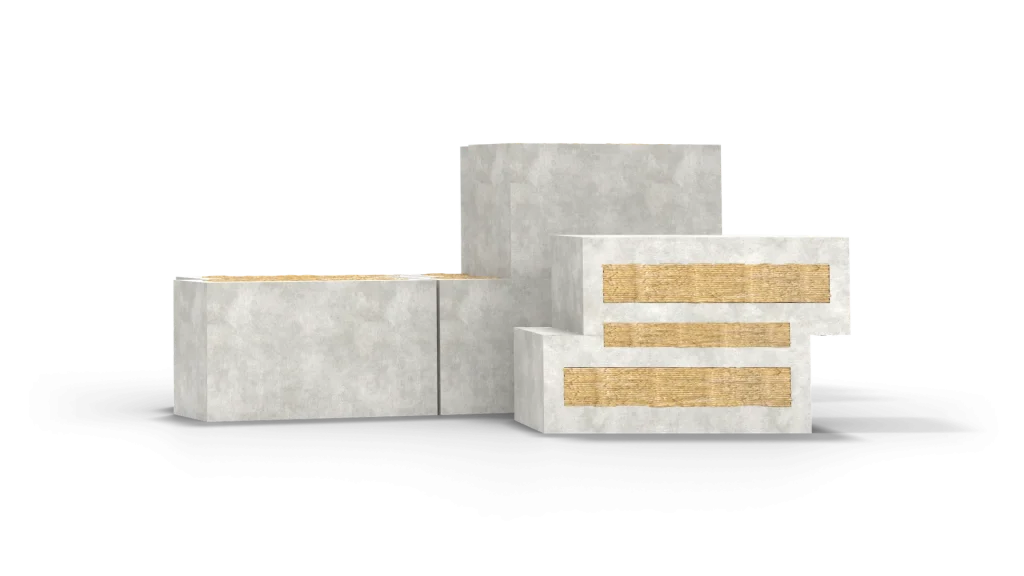
In MegaBlock, the insulating work is done by stone wool layers set inside the pumice-cement body. As the block gets wider, the number and total thickness of the layers increase: a 145 mm block has a single 50 mm layer, while the 295/15 block contains three 50 mm layers.
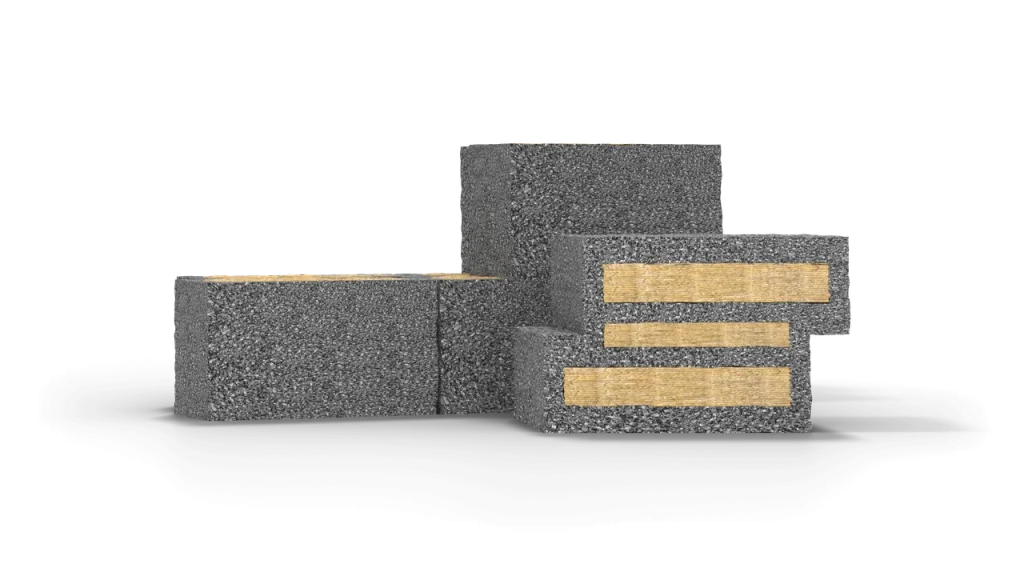
The effect of the layers shows up in the wall’s thermal conductivity. According to the TSE National Technical Approval, the design thermal conductivity of a wall built with 145 mm MegaBlock Thermal and 3 mm joints is 0.075 W/mK. The same document states that this value is used in the thermal insulation design calculation instead of the TS 825 table value.
What is the difference between MegaBlock Thermal and Acoustic?
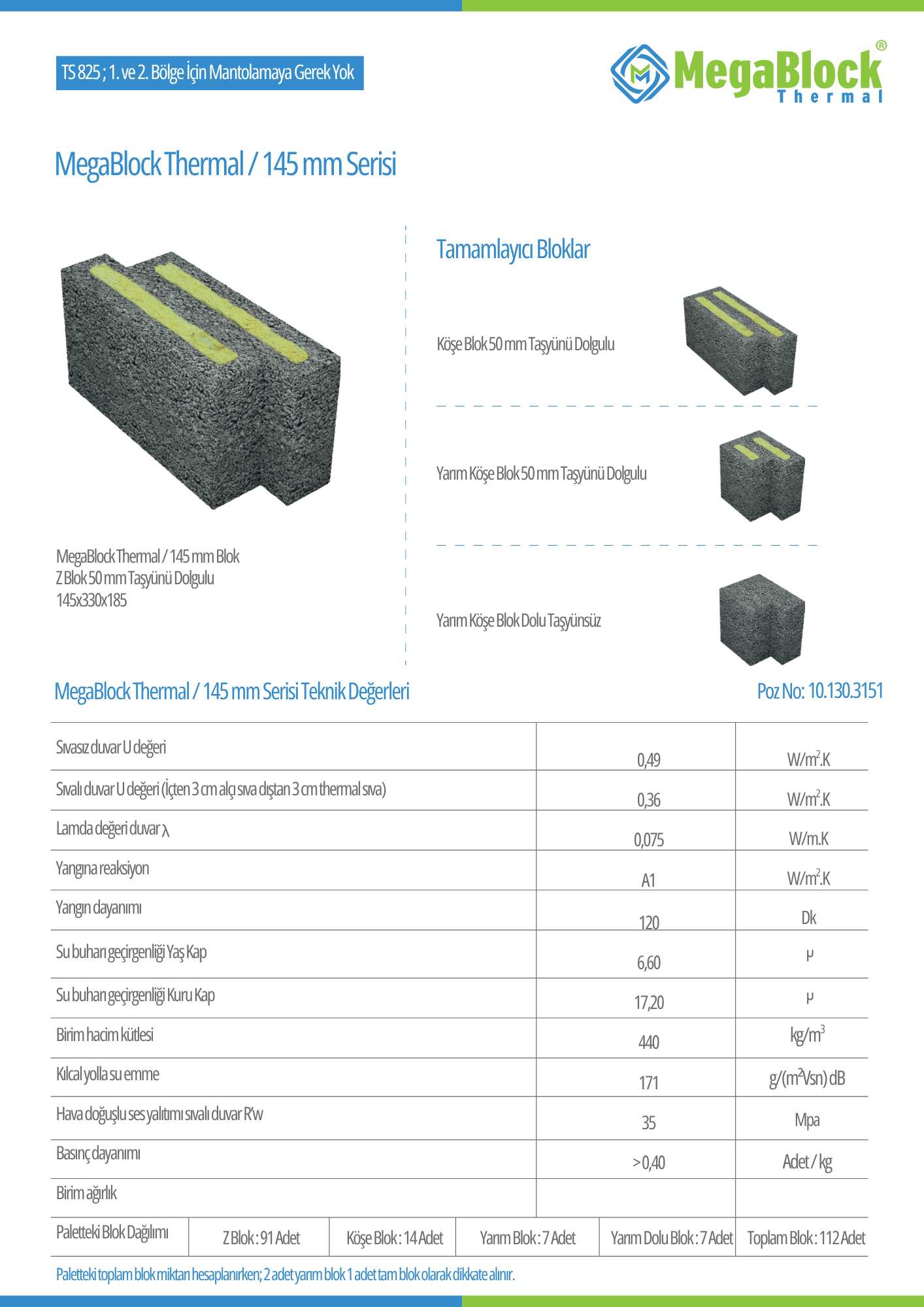
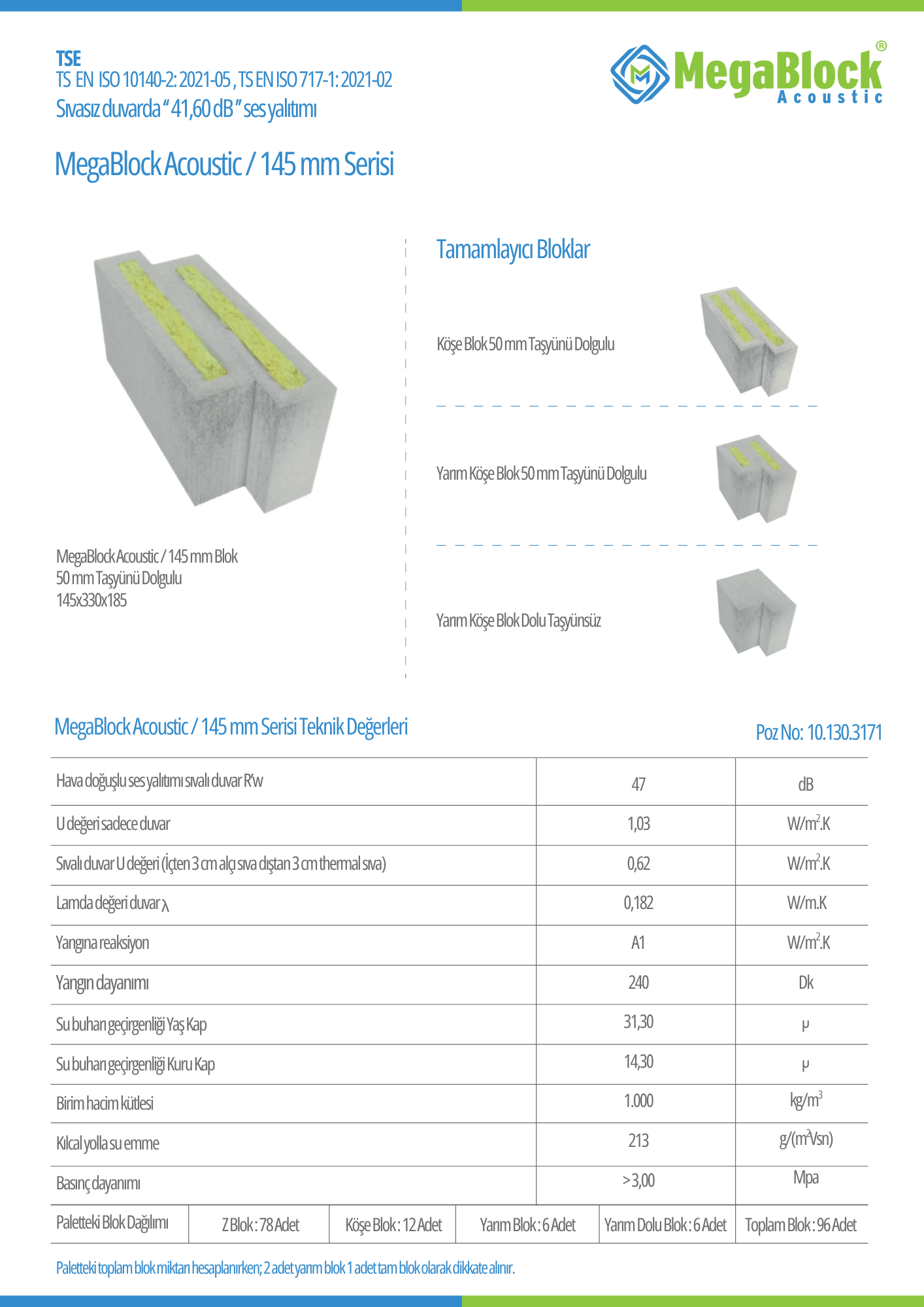
Thermal and Acoustic come in the same block dimensions and with the same stone wool layer arrangement; the difference lies in the body. Thermal’s light body gives it low thermal conductivity, while Acoustic’s heavier body favours high sound insulation. The table below compares the main properties of the two blocks in the 145 mm series, using values from Mega’s technical data sheets.
| Property (145/50SW series) | MegaBlock Thermal | MegaBlock Acoustic |
|---|---|---|
| Block size | 145 x 330 x 185 mm | 145 x 330 x 185 mm |
| Stone wool layer | 50 mm | 50 mm |
| Bulk density | 440 kg/m³ | 1,000 kg/m³ |
| Thermal conductivity of the wall (λ) | 0.075 W/mK | 0.182 W/mK |
| U-value, unplastered wall | 0.49 W/m²K | 1.03 W/m²K |
| U-value, plastered wall | 0.36 W/m²K | 0.62 W/m²K |
| Sound insulation, plastered wall (R’w) | 35 dB | 47 dB |
| Sound insulation, unplastered wall | Not given in the data sheet | 41.60 dB (TSE test) |
| Reaction to fire class | A1 | A1 |
| Fire resistance | 120 minutes | 240 minutes |
| Item (poz) number | 10.130.3151 | 10.130.3171 |
Source: MegaBlock Thermal and Acoustic 145/50SW technical data sheets. Plastered U-values refer to a wall with 3 cm of gypsum plaster inside and 3 cm of thermal render outside.
MegaBlock Thermal (thermal insulation block)
MegaBlock Thermal is the block designed for thermal insulation. Heat transmission falls as the series gets wider: according to the data sheets, the U-value of the plastered wall is 0.36 W/m²K for the 145 mm series and 0.19 W/m²K for the 295 mm series. The lower the U-value, the less heat passes through the wall; we explain the difference between λ and U in our article on the thermal conductivity coefficient.
MegaBlock Acoustic (sound insulation block)
MegaBlock Acoustic is designed for sound insulation. According to its data sheet, a plastered wall built with the 145 mm block achieves an R’w of 47 dB. The same wall, unplastered, was tested at TSE in accordance with TS EN ISO 10140-2 and TS EN ISO 717-1 and gave a result of 41.60 dB. Wider series reach higher values for the plastered wall: 56 dB for the 245 mm series and 60 dB for the 295 mm series.
Laboratory measurements such as the TSE test cited in the data sheet are made, under EN ISO 10140-2, in test facilities where flanking transmission is suppressed; the standard states that the results cannot be transferred directly to the situation in a building. On site, the junctions with floors, columns and services affect the outcome. We cover the subject separately in our articles on wall sound insulation and stone wool sound insulation.
Series dimensions: 145, 195, 245 and 295 mm blocks
The other two dimensions of the blocks are 330 x 185 mm in every series; the series differ in block width, which sets the wall thickness. The 245 and 295 mm series each come with two stone wool arrangements. The thermal and fire values in the table refer to the Thermal blocks.
| Series | Block size | Stone wool layers | Plastered wall U (W/m²K) | Wall λ (W/mK) | Fire resistance |
|---|---|---|---|---|---|
| 145 | 145 x 330 x 185 mm | 50 mm | 0.36 | 0.075 | 120 minutes |
| 195 | 195 x 330 x 185 mm | 45 + 45 = 90 mm | 0.28 | 0.070 | 120 minutes |
| 245/10 and 245/13 | 245 x 330 x 185 mm | 50 + 50 = 100 mm or 50 + 30 + 50 = 130 mm | 0.26 | 0.081 | 180 minutes |
| 295/10 and 295/15 | 295 x 330 x 185 mm | 50 + 50 = 100 mm or 50 + 50 + 50 = 150 mm | 0.19 | 0.065 | 240 minutes |
Source: the series table on Mega’s product pages and the MegaBlock Thermal technical data sheets. In the 245 and 295 mm series, both stone wool arrangements are covered by a single data sheet.
Which complementary elements complete a MegaBlock wall?
A MegaBlock wall is completed with corner and solid blocks, MegaBlock BC for column and beam faces, and MegaLento SW for openings. A wall’s insulation does not end with the plain courses; corners, the faces of columns and beams, and the heads of doors and windows need the same continuity.
- Corner block and solid block: according to the product page, these options allow the wall to be built homogeneously, efficiently and without waste.
- MegaBlock BC: an acrylic-render-coated stone wool board used for column and beam thermal insulation. According to the product page, it is also used on other building elements where a thermal bridge may form. It has a density of 150 kg/m³ and comes in 30 x 60 x 5 cm and 40 x 50 x 5 cm sizes.
- MegaLento SW: a stone wool-based composite masonry lightweight lintel used to span door and window openings. According to its declaration of performance, its load-bearing capacity is at least 3.76 kN/m and its dry density is at most 400 kg/m³. We explain the role of a lintel in our article what is a lintel.
Which projects is MegaBlock used in?
MegaBlock is used in residential and commercial buildings where insulation is to be dealt with together with the masonry. The product pages list the areas of use by block type as follows:
- MegaBlock Thermal: shafts and party walls; kitchen and bathroom walls carrying pipework; walls that will take cabinets and built-in appliances.
- MegaBlock Acoustic: party walls, kitchens, bathrooms and bedrooms in homes; hotel rooms, opera houses and cinemas, concert and wedding halls, studios and plant rooms; shafts exposed to high noise levels and industrial areas.
- MegaBlock BC: columns and beams; roofs, terraces and garages.
In projects with ambitious energy-efficiency targets, such as passive house design, the block’s insulation value is not enough on its own. Column, beam and lintel details must be resolved with the same care.
How is a MegaBlock wall built and what should you watch for?
A MegaBlock wall is laid course by course; the essence of the job is to resolve, during laying, the points that could break the continuity of the insulation. The points below are based on Mega’s product pages, catalogue and UTO documents. Ask Mega’s technical team for project-specific details on mortar and laying.
- Choose the series by calculation: the wall thickness is set by the U-value target in the thermal insulation design or by the sound insulation requirement, and the series is chosen accordingly.
- Keep joints thin and mortar light: according to the UTO document, the design thermal conductivity of a 145 mm Thermal wall is 0.075 W/mK with 3 mm joints of 900 kg/m³ mortar and 0.092 W/mK with 7 mm joints of 1,800 kg/m³ mortar. The thicker the joint and the heavier the mortar, the higher the wall’s thermal conductivity and the lower its insulation performance.
- Cover column and beam faces: following the method in the catalogue, the MegaBlock Thermal wall is built projecting at least 6 cm beyond the concrete face, and the MegaBlock BC boards are bonded to the concrete surface with a notched trowel of at least 5 mm.
- Span openings with lintels: MegaLento SW is used over doors and windows; according to its declaration of performance, the minimum bearing length is 150 mm at each end.
- Plan cutting and services: the blocks are easy to cut, and the layered structure makes it easier to chase service runs.
- Match the plaster to the data sheet: the plastered U-values in the data sheets apply to a wall with 3 cm of gypsum plaster inside and 3 cm of thermal render outside. A different plaster build-up will change the wall’s U-value.
Application note from MegaUsta: before you start laying, mark the door and window openings, the column faces and the service routes on the wall plan. Your lintel, corner block and BC requirements follow from this plan, and there is less breaking and cutting to do later on site.
Does a MegaBlock wall need additional insulation?
Whether additional insulation is needed is decided by the building’s thermal insulation design calculation; if the MegaBlock wall meets the target U-value on its own, no extra layer is required. Under Turkey’s Regulation on Energy Performance in Buildings, a thermal insulation design is prepared and the calculation follows the TS 825 standard. The wall’s U-value is assessed together with the building’s climate zone and the heat loss calculation for the whole building.
For MegaBlock Thermal, the wall thermal conductivity values in the TSE National Technical Approval documents are used in this calculation instead of the TS 825 table values. If the calculation falls short of the target, a wider series can be chosen or additional insulation added to the wall; on external walls the usual route is external facade insulation, which we explain in our guide what is ETICS. Thermal bridges at points such as columns, beams and lintels must also be addressed separately in the calculation.
Frequently Asked Questions
What thicknesses does MegaBlock come in?
MegaBlock Thermal and Acoustic blocks are available in 145, 195, 245 and 295 mm widths; the other two dimensions are 330 x 185 mm in every series. The total stone wool thickness is 50 mm in the 145 mm block and 90 mm in the 195 mm block. The 245 mm series offers 100 or 130 mm of stone wool, and the 295 mm series 100 or 150 mm.
Can cabinets and services be installed on a MegaBlock wall?
Yes. According to the product page, the layered structure of MegaBlock Thermal makes it easy to run water supply and waste pipes in kitchen and bathroom walls, and cabinets and built-in appliances can be mounted on the wall. Because the blocks are easy to cut, chasing service runs is not laborious. For heavy wall-hung loads, the type and layout of the fixings should be agreed with Mega’s technical team before installation.
How many dB of sound insulation does MegaBlock Acoustic provide?
According to the MegaBlock Acoustic data sheet, a plastered wall built with the 145 mm block has an R’w of 47 dB. The same wall, unplastered, gave 41.60 dB in a test carried out at TSE. Wider series give higher values for the plastered wall: 56 dB for the 245 mm series and 60 dB for the 295 mm series. The result measured in a building may differ from the laboratory value depending on the floor and column junctions.
Does MegaBlock burn?
No. The technical data sheets for MegaBlock Thermal and Acoustic give a reaction to fire class of A1, and Turkey’s Regulation on the Fire Protection of Buildings defines class A1 as “non-combustible” material. The data sheets also state the fire resistance of the wall: 120 minutes for Thermal 145 mm and 240 minutes for Acoustic 145 mm. A building’s fire requirements are assessed project by project by an authorised engineer.
What is MegaBlock’s item (poz) number?
MegaBlock technical data sheets give a separate item (poz) number for each series. For Thermal blocks, the 145 mm series is 10.130.3151, the 195 mm series 10.130.3152, the 245 mm series 10.130.3153 and the 295 mm series 10.130.3154. For Acoustic blocks the numbers are, in the same order, 10.130.3171, 10.130.3172, 10.130.3173 and 10.130.3174. The material is identified by this code when quantity take-offs and bills of quantities are prepared.
Sources
- EN ISO 10140-2:2021, laboratory measurement of airborne sound insulation (SIS)
- EN ISO 717-1:2020, rating of airborne sound insulation (SIS)
- Regulation on the Fire Protection of Buildings, Annex 2 (mevzuat.gov.tr)
- MegaBlock Thermal 145/50SW technical data sheet
- MegaBlock Acoustic 145/50SW technical data sheet
- MegaBlock documents (Mega Yalıtım Documents page)
You can find the series data sheets for MegaBlock Thermal and Acoustic, and the product details for MegaBlock BC, on the product pages in the MegaBlock wall systems category. For the right series and application details for your project, write to Mega Yalıtım’s technical team via our contact page.