
In short: Thermal insulation materials are products with low thermal conductivity that are made to reduce heat transfer through building elements. The most common in buildings are stone wool, glass wool, EPS and XPS. The materials are compared by λ value, reaction to fire class, water absorption and compressive strength; the right choice is made according to the building element in which the material will be used.
This guide explains the types of thermal insulation material, the values looked at when comparing them and which one is used in which building element. You can find how thermal insulation works in our article what is thermal insulation, and all the groups including waterproofing, sound and fire insulation in our guide to insulation materials.
What are thermal insulation materials?
Thermal insulation materials fall into two large groups: fibrous mineral wools (stone wool and glass wool) and foam materials (EPS, XPS, polyurethane, phenolic foam). Cellular glass, perlite, cork and wood fibre boards are also among these products. As İZODER defines them, thermal insulation materials are lightweight products that provide high thermal resistance at reasonable thicknesses.
| Material | Structure | Design thermal conductivity, TS 825 (W/mK) | Reaction to fire class | Water vapour diffusion resistance factor (μ) | In the Mega product range |
|---|---|---|---|---|---|
| Stone wool (MW) | Fibres obtained from basalt and diabase; open-pored | 0.035–0.050 | A1 or A2 | 1 | Stone wool boards |
| Glass wool (MW) | Fibres obtained from silica sand; open-pored | 0.035–0.050 | A1 or A2 | 1 | None |
| Expanded polystyrene (EPS) | Expanded polystyrene beads | 0.035–0.040 | D or E | 20–100 | EPSW white and EPSG grey boards |
| Extruded polystyrene (XPS) | Closed-cell foam with shared cell walls | 0.030–0.040 | D or E | 80–250 | XPS smooth and rough grooved boards |
| Polyurethane foam (PUR/PIR) | Foam formed by the reaction of two components; board, panel or spray | 0.025–0.040 | D, E or F | 30–100 | None |
| Phenolic foam (PF) | Phenol-formaldehyde based foam | 0.030–0.045 | Unfaced B-s2,d0 | 10–50 | None |
| Cellular glass (CG) | Closed-cell glass | 0.045–0.060 | A | Infinite (vapour-tight) | None |
Source: İZODER, “Thermal insulation: general information”, section 5. The values are the general range of the material group and are the design values in TS 825; a product’s own value is the declared value (λD) in its technical data sheet.
Mega Insulation Solutions (Mega Yalıtım) offers stone wool, EPS and XPS boards from these groups under the Mega brand. You can find the types on the stone wool, EPS and XPS category pages.
What sets a thermal insulation material apart from other building materials?
What sets a thermal insulation material apart is its very low thermal conductivity. According to the design values İZODER quotes from TS 825, concrete conducts heat dozens of times more easily than an insulation material.
| Material | Design thermal conductivity (W/mK) |
|---|---|
| Metals | 35.0–384.0 |
| Reinforced concrete | 2.20–2.50 |
| Brick | 0.19–1.40 |
| Autoclaved aerated concrete | 0.11–0.29 |
| Thermal insulation materials such as mineral wool, EPS, XPS and polyurethane | 0.020–0.045 |
Source: İZODER, “Thermal insulation: general information”, Table 1.
The difference shows in thickness as follows: in İZODER’s example, a 30 cm building material with a thermal conductivity of 0.9 W/mK has a thermal resistance of 0.33 m²K/W, while a 4 cm thermal insulation material with a thermal conductivity of 0.04 W/mK has a thermal resistance of 1.0 m²K/W. This is why thinly applied plaster and paint cannot take the place of thermal insulation on their own.
By which values are thermal insulation materials compared?
Thermal insulation materials are compared by five data sheet values: thermal conductivity, reaction to fire class, water absorption, compressive strength and water vapour diffusion resistance; thermal resistance is calculated from thermal conductivity and thickness. Which one is decisive depends on where the material will be used.
- Thermal conductivity (λD, W/mK): The smaller it is, the less heat a board of the same thickness lets through. We explained what the value means in our article on the thermal conductivity coefficient.
- Thermal resistance (R, m²K/W): Thickness divided by the λ value; the larger it is, the greater the insulation.
- Reaction to fire class (A1–F): Shows the extent to which the material contributes to fire. On facades, roofs and internal surfaces it is tied to a regulatory requirement.
- Water absorption: Decisive below ground and on terraces; the smaller it is, the less water the board takes up in a wet environment.
- Compressive strength (kPa): Decisive in floors, terraces and foundations; the larger it is, the less the board is crushed under load.
- Water vapour diffusion resistance factor (μ): The smaller it is, the more easily the material lets vapour through; it is used in the condensation calculation.
How do stone wool, EPS and XPS differ in the technical data sheets?
In Mega’s technical data sheets the three materials differ clearly: the stone wool board is class A1, grey EPS gives the lowest λD value, and XPS has the highest compressive strength and, by total immersion, lower water absorption than EPS. The table below shows four types side by side.
| Property | Stone wool, MEGA SW F150 | White EPS, EPS 50W | Grey EPS, EPS 70 (carbon-enhanced) | XPS, MEGA XPS T3000 |
|---|---|---|---|---|
| Declared thermal conductivity, λD (W/mK) | ≤0.037 | 0.040 | 0.031 | 0.035 |
| Reaction to fire class | A1 | E | E | E |
| Compressive strength at 10% deformation | At least 40 kPa (the data sheet gives three values: 40, 45 and 55 kPa) | 50 kPa | 70 kPa | 300 kPa |
| Long-term water absorption | ≤3 kg/m² (partial immersion) | ≤5% (total immersion) | ≤4% (total immersion) | ≤0.7% (total immersion) |
| Service temperature | No more than +750 °C | -50 / +70 °C | -50 / +70 °C | -50 / +75 °C |
| Board size (mm) | 1200 x 600 | 500 x 1000 | 500 x 1000 | 600 x 1200 |
| Thickness range (mm) | 40–120 | 10–100 | 10–100 | 20–120 |
| Product standard | TS EN 13162 | TS EN 13163 | TS EN 13163 | TS EN 13164 |
Source: Mega technical data sheets. Values vary from type to type within the same product family; the data sheet is read with the type name on the packaging. Water absorption values are declared by different test methods, so stone wool cannot be compared one to one with EPS and XPS.
In the data sheet of the stone wool boards the water vapour diffusion resistance factor is μ = 1. You can find detailed comparisons of the materials in our articles stone wool or EPS, XPS or EPS and the difference between grey EPS and white EPS.
Which thermal insulation material is used in which building element?
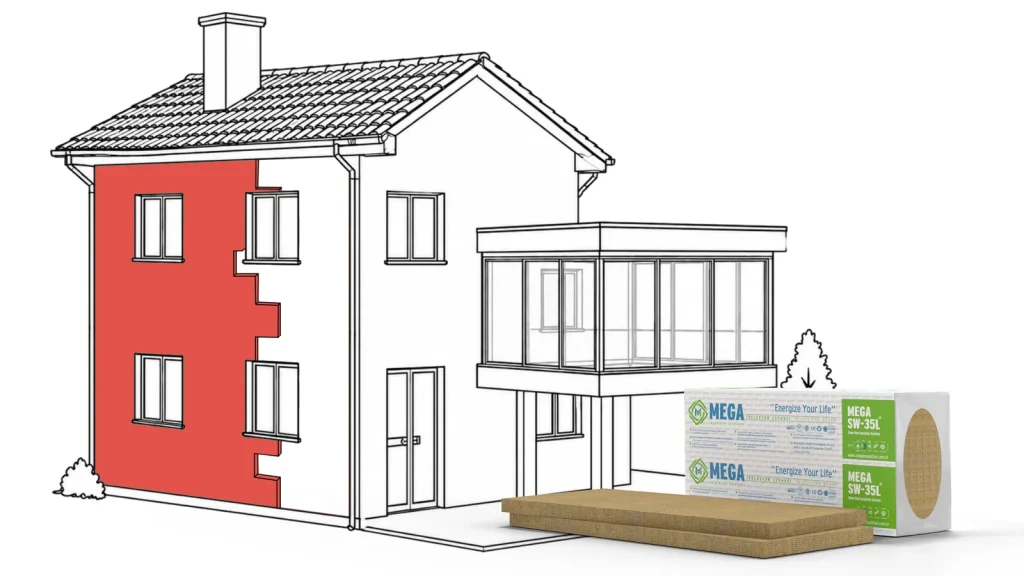
The material is chosen according to the action the building element is exposed to: on a facade the reaction to fire class, below ground water and earth pressure, in a floor the load and in an intermediate floor impact sound are decisive. The table below summarises the building elements and their counterparts on Mega’s product pages.
| Building element | Decisive condition | Material | Mega product and data sheet value |
|---|---|---|---|
| External wall, rendered system (ETICS) | Reaction to fire class, thermal resistance | Stone wool, EPS or XPS board | ETICS Board (MEGA SW F150: λD ≤0.037 W/mK, A1); EPSW and EPSG boards; XPS rough grooved board (EPS and XPS boards are class E; where the building height exceeds 28.50 m the external facade must be of limited-combustibility material, Article 27) |
| Ventilated facade | Reaction to fire class | Stone wool board | Ventilated Facade Board (MEGA SW EF 70/80/90: λD ≤0.035 W/mK, A1) |
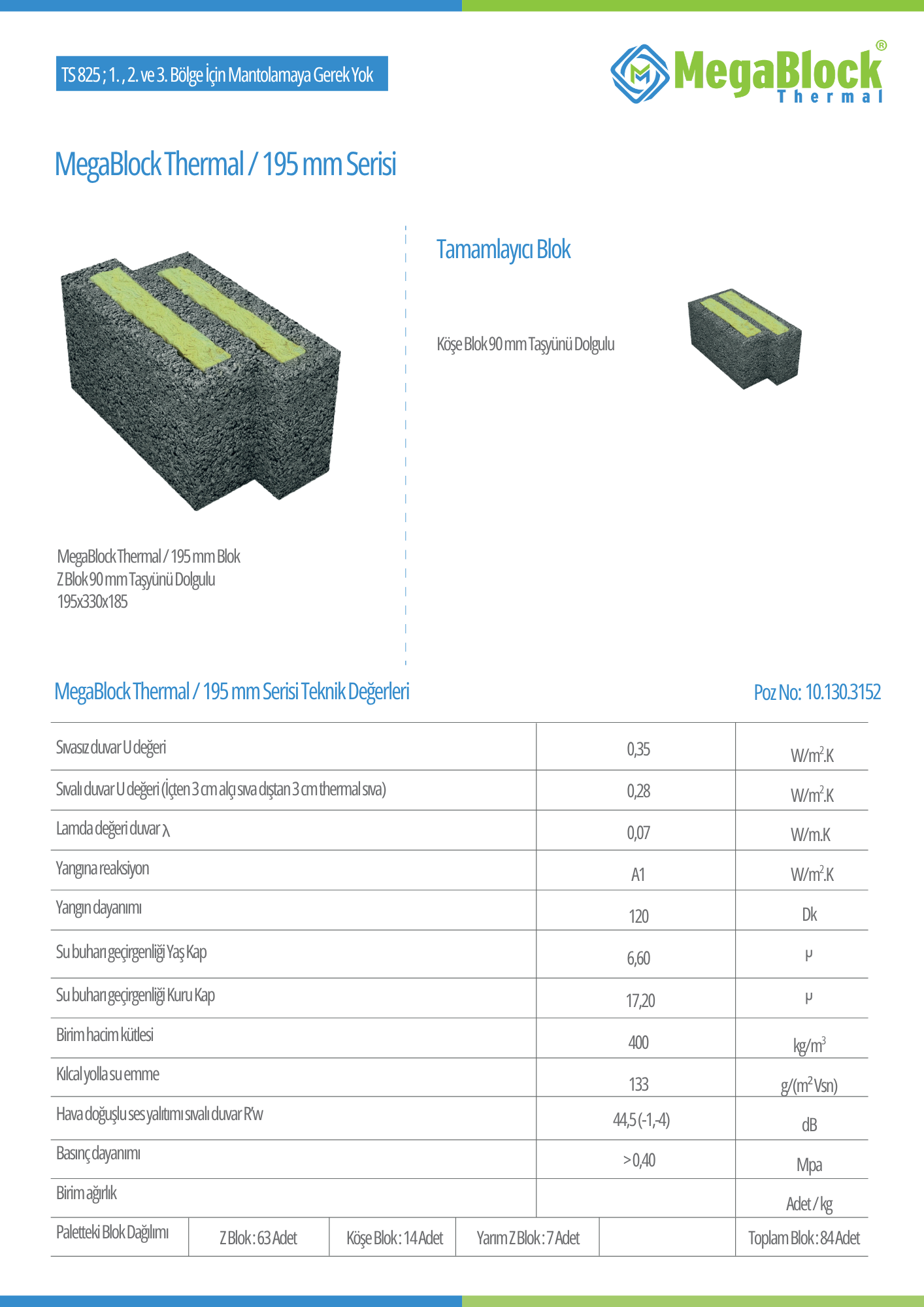
| Newly built external wall | Insulation solved within the body of the wall | Block with stone wool layers | MegaBlock Thermal (195/90SW: U 0.35 W/m²K for the unplastered wall; whether this is sufficient for a building is decided by the thermal insulation design calculation) |
| Inner face of an external wall | Insulation from the outside not being possible | Stone wool and gypsum board composite panel | DesiWool (λD ≤0.035 W/mK; 15–80 mm; with internal insulation the condensation check is made in the design) |
| Flat roof | Load, water | Stone wool (warm roof) or XPS (inverted roof) and waterproofing | Terrace Roof Board (compressive strength at least 30–70 kPa depending on type; λD ≤0.039 W/mK); XPS smooth board |
| Pitched roof | Position of the insulation: on the loft floor or under the rafters | XPS board | XPS smooth board (used in both applications according to the product page) |
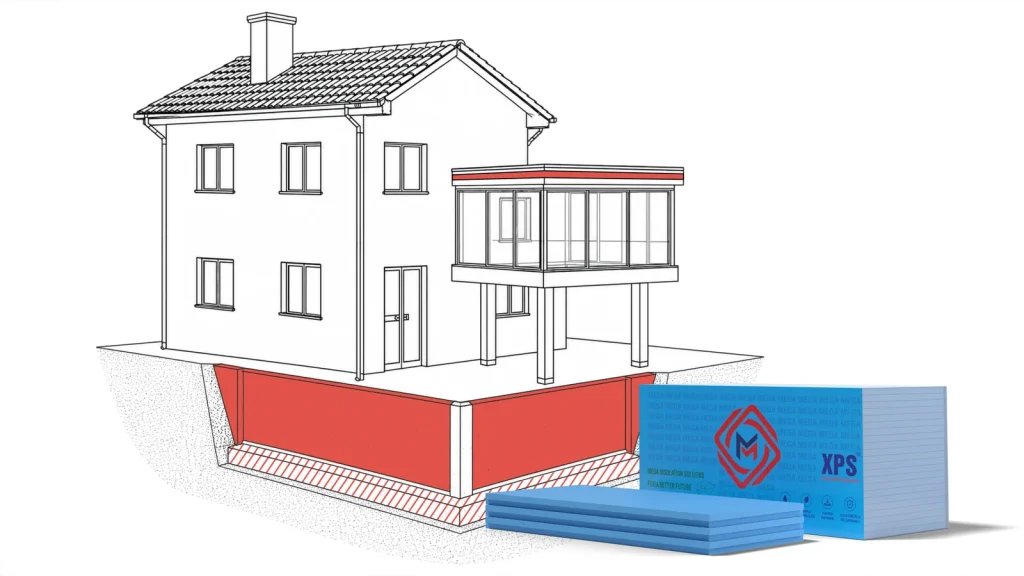
| Foundation and below-grade basement wall | Water, earth pressure | Waterproofing with XPS board over it | XPS smooth board (MEGA XPS T3000: 300 kPa; long-term water absorption ≤0.7%) |
| Ground-bearing slab, under screed | Load, moisture | XPS board | XPS smooth board (compressive strength 150 kPa for type T1500, 300 kPa for type T3000) |
| Intermediate floor, under screed | Impact sound and heat | Stone wool board | Floating Floor Board (MEGA SW FF100/110/120: 30 mm; λD ≤0.036 W/mK; 25 kPa) |
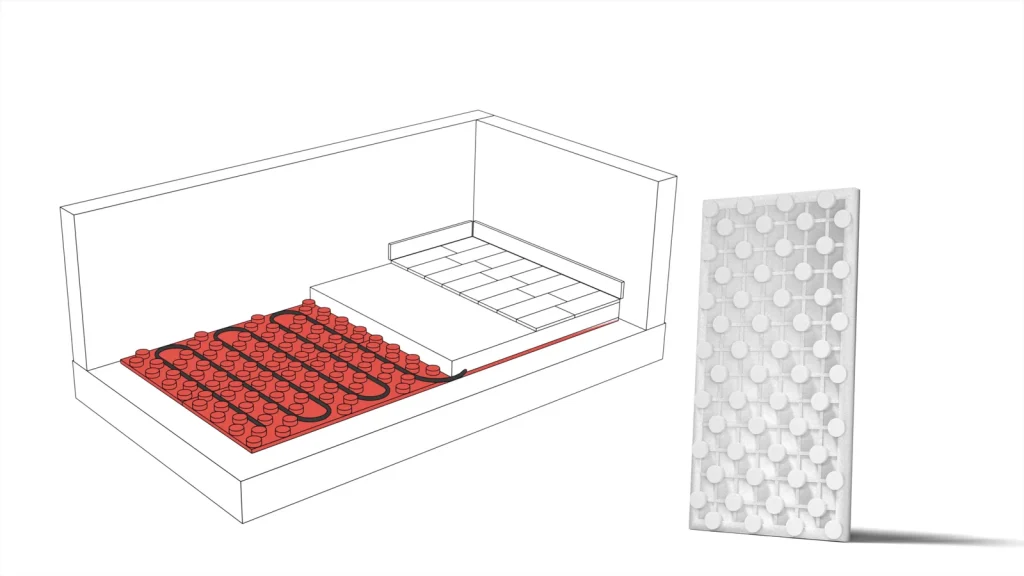
| Floor with underfloor heating | Fixing the pipes, insulation beneath | EPS board; XPS or EPS beneath it | EPS underfloor heating board (it has no data sheet; the thermal calculation is made with the board beneath) |
| Column and beam faces | Preventing thermal bridges | Stone wool slab or XPS board | MegaBlock BC (150 kg/m³ stone wool, coated with acrylic render); XPS rough grooved board |
| Pipes and ducts | Heat loss, condensation | Stone wool pipe section and foil-faced board | Prefabricated pipe section; duct board |
Source: Mega product pages and technical data sheets. The table is general guidance; thickness and layer order are determined in the design. We cover the methods for each wall type in our guide to wall insulation.
What are the thermal insulation materials for floors?
Three materials stand out in floors: XPS in a ground-bearing slab, the stone wool floating floor board in an intermediate floor, and the EPS board that holds the pipes in underfloor heating. The choice is determined by what lies beneath the slab. We explain the layers for each floor type in our guide to floor insulation.
- Ground-bearing slab: The board takes both load and moisture. In Mega’s XPS data sheets the compressive strength is between 150 and 300 kPa depending on the type, and long-term water absorption by total immersion is no more than 0.7%. XPS is not a waterproofing material; it is applied together with a waterproofing layer. We explained the layer order on surfaces in contact with the ground in our article on foundation and basement wall insulation.
- Intermediate floor: The stone wool floating floor board laid under the screed reduces impact sound and contributes to thermal insulation. The details are in our article what is a floating floor.
- Floor with underfloor heating: The insulation beneath the pipes limits the heat escaping downwards. For the layer order and the choice of thickness, see our guide to underfloor heating insulation.
Why does the fire class matter when choosing a thermal insulation material?
Because the Regulation on Fire Protection of Buildings ties the class of the insulation material to requirements that depend on the building element. The regulation treats class A1 as non-combustible, class A2-s1,d0 as limited combustibility and class E as normally flammable. In Mega’s data sheets stone wool boards are class A1 and EPS and XPS boards are class E.
- External facade: In buildings with a building height of more than 28.50 m the external facade must be of limited-combustibility material, and in other buildings of at least low-flammability material (Article 27).
- Roof: The surface or insulation beneath the roof covering must be of at least low-flammability material; if the covering is of non-combustible material, the surface to which the covering is applied is allowed to be at least normally flammable (Article 28).
- Internal surfaces: Thermal and sound insulation applied internally on walls is made of at least normally flammable material, and in high-rise buildings and halls with a capacity of more than 100 people of at least low-flammability material (Article 29).
In ETICS the class of the board alone is not enough: the regulation requires the system consisting of board, adhesive, anchor, mesh and render to be certified as a system by an accredited laboratory. You can find what the classes mean in our article on the fire class of insulation materials. We explain the layers of the stone wool system in our guide to stone wool ETICS.
How is a thermal insulation material chosen?
A thermal insulation material is chosen in this order: first the building element, then the conditions of that element, the regulatory requirement and the data sheet values. The order is as follows:
- Identify the building element. External walls, roofs, floors and below-ground elements call for different material groups.
- Look at the moisture and load condition. Where there is contact with the ground or the surface is walked on, water absorption and compressive strength come to the fore.
- Check the reaction to fire requirement. On an external facade the requirement changes with the building height.
- Compare λD values by type name. Within the same family the value varies from type to type; for Mega white EPS boards λD is between 0.034 and 0.042 W/mK.
- Leave the thickness to the design. The Regulation on Energy Performance of Buildings requires the thermal insulation design to be prepared using the calculation method in TS 825.
- Check the documents. The product standard, technical data sheet and declaration of performance must match the type name on the packaging.
The basis of the thickness calculation is thermal resistance. A thermal resistance of 2.0 m²K/W requires 70 mm of MEGA XPS T3000 board with a λD of 0.035 W/mK and 80 mm of EPS 50W board with a λD of 0.040 W/mK. We covered the whole calculation in our article on insulation thickness and what the standard requires in our article on TS 825.
Application note from MegaUsta: Compare the type name, thickness and λD value on the label of the board delivered to site with the values in the thermal insulation design. If a board with a higher λD is installed at the same thickness on a wall calculated with a lower λD in the design, the wall does not achieve the calculated value.
Frequently Asked Questions
What are thermal insulation materials?
Thermal insulation materials are products that reduce the heat passing through a building element because their thermal conductivity is low. In buildings, mineral wools (stone wool and glass wool) and foam boards (EPS and XPS) are used most; polyurethane, phenolic foam, cellular glass, perlite, cork and wood fibre boards also belong to this group. In İZODER’s table the design thermal conductivity of materials such as mineral wool, EPS, XPS and polyurethane is given as between 0.020 and 0.045 W/mK.
Which is the best thermal insulation material?
There is no single thermal insulation material that is best everywhere; the right material depends on the building element. According to Mega’s technical data sheets, the long-term water absorption of XPS boards is no more than 0.7% and these boards stand out below ground. Stone wool boards are class A1 and are preferred where there are fire and sound requirements. EPS boards are used in ETICS. The decision is made by the data sheet values and the thermal insulation design.
Which thermal insulation material is used in floors?
In floors the material is chosen according to what lies beneath the slab. XPS boards are used in ground-bearing slabs that are exposed to moisture and load; in Mega’s data sheets the compressive strength is 150 kPa for type T1500 and 300 kPa for type T3000. In an intermediate floor, a stone wool floating floor board that also reduces impact sound is laid under the screed. In underfloor heating the pipes are held by the EPS underfloor heating board. The thickness is determined in the thermal insulation design.
What should the lambda value of a thermal insulation material be?
There is no single threshold for lambda (λ); the smaller the value, the less heat a board of the same thickness lets through. In Mega’s technical data sheets the declared value (λD) is 0.031 for carbon-enhanced grey EPS 70 board, 0.035 for MEGA XPS T3000 board, no more than 0.037 for the stone wool ETICS board MEGA SW F150 and 0.040 W/mK for white EPS 50W board. The result is determined by the thermal resistance that λ and thickness give together.
Stone wool, EPS or XPS?
All three are thermal insulation materials; the choice is made according to where they are used. In Mega’s data sheets stone wool boards are class A1; stone wool lets water vapour through easily; it is used on the facades of tall buildings, in partition walls and under screeds. EPS is light and is preferred in ETICS. With its closed-cell structure XPS absorbs little water and has high compressive strength; it is used in damp, load-bearing places such as foundations, basement walls and terraces. In Mega’s data sheets EPS and XPS boards are class E.
How thick should thermal insulation be?
The thickness is calculated in the thermal insulation design prepared in accordance with TS 825; no single figure suits every building. The basis of the calculation is thermal resistance: thickness divided by the λ value. For example, a thermal resistance of 2.0 m²K/W requires 70 mm of a board with a λD of 0.035 W/mK and 80 mm of a board with a λD of 0.040 W/mK. The climate zone of the building and the other layers of the building element also change the result.
Sources
- İZODER: Thermal insulation, general information (Table 1 and section 5, thermal insulation materials; in Turkish)
- Regulation on Energy Performance of Buildings, current text, Articles 9 and 10 (Legislation Information System; in Turkish)
- Communiqué on the TS 825 Thermal Insulation Requirements for Buildings Standard (No: MHGM-2025/1), Official Gazette, 20.02.2025, No. 32819 (in Turkish)
- Regulation on Fire Protection of Buildings, Articles 27, 28, 29 and Annex 2 (Legislation Information System; in Turkish)
- Mega technical data sheet: MEGA SW F150 ETICS Board (PDF, in Turkish)
- Mega technical data sheet: EPS 40W / 40U-W / 50W (PDF, in Turkish)
- Mega technical data sheet: EPS 50 / 60 / 70 carbon-enhanced (PDF, in Turkish)
- Mega technical data sheet: MEGA XPS T1500 (PDF, in Turkish)
- Mega technical data sheet: MEGA XPS T3000 (PDF, in Turkish)
- Mega technical data sheet: Ventilated Facade Board (PDF, in Turkish)
- Mega technical data sheet: Floating Floor Board (PDF, in Turkish)
- Mega technical data sheet: Terrace Roof Board 30 kPa (PDF, in Turkish)
- Mega technical data sheet: Terrace Roof Board 70 kPa (PDF, in Turkish)
- Mega technical data sheet: DesiWool (PDF)
- Mega technical data sheet: MegaBlock Thermal 195/90SW (image, in Turkish)
The technical data sheets and documents of Mega products are on the Documents page. You can review the product groups on our insulation products page and contact us through our contact page with questions about your project.