
In short: Stone wool ETICS is the rendered external thermal insulation system in which external walls are clad with stone wool boards. According to the technical data sheets, Mega stone wool ETICS boards are class A1; the declared thermal conductivity is no more than 0.035 or 0.037 W/mK depending on the type. In buildings whose building height exceeds 28.50 m the regulation requires the external facade to be of limited-combustibility material.
This guide explains in which buildings stone wool ETICS is preferred, the board types, the layers of the system and the order of application. For the system in general see our article what is ETICS, and for the material itself what is stone wool.
What is stone wool ETICS?
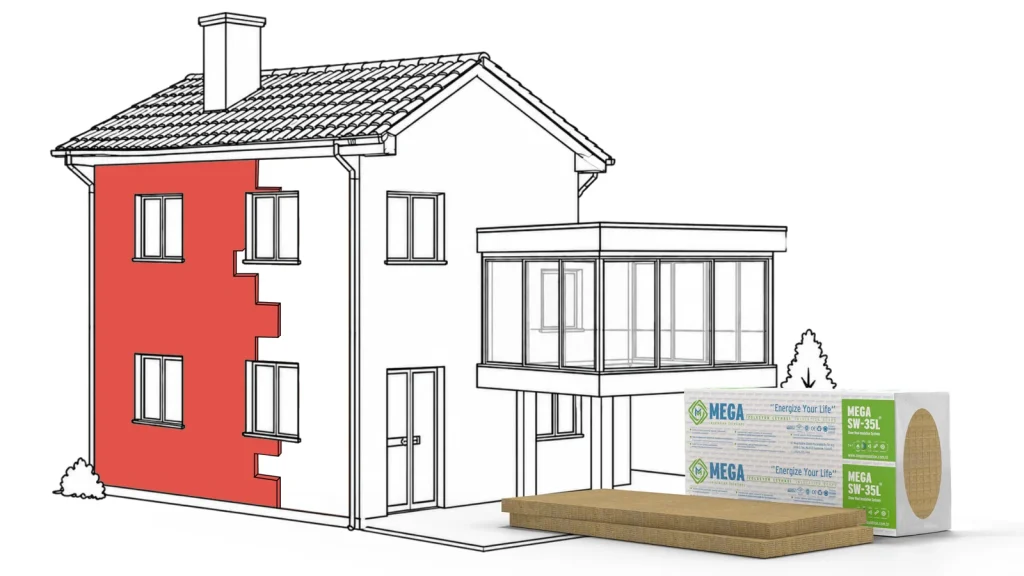
Stone wool ETICS is the external insulation system in which stone wool is used as the thermal insulation board: the boards are bonded and anchored to the wall, covered with a mesh-reinforced base coat and finished with a finishing coat. In European standards these systems are called ETICS; those based on mineral wool fall under TS EN 13500.
According to Mega’s product page, the stone wool ETICS Board is an unfaced stone wool board produced to the TS EN 13162 standard and is used in rendered external insulation systems for thermal insulation, sound insulation and fire safety. The boards measure 1200 x 600 mm.
In which buildings is stone wool ETICS preferred?
Stone wool ETICS is preferred most in buildings where the reaction to fire requirement for the external facade is high. The Regulation on Fire Protection of Buildings does not name materials; it sets a class requirement, and the A1 class of the stone wool board becomes decisive under these requirements.
| Situation | Requirement of the regulation (Article 27) | Where the stone wool board stands |
|---|---|---|
| Building height of more than 28.50 m | The external facade must be of limited-combustibility material (at least A2-s1,d0) | The board is class A1; the class of the system is read from the system certificate |
| Building height of less than 28.50 m, facade clad with a low-flammability material or system | The section up to 1.5 m above ground level is clad with non-combustible material | The class A1 board is among the materials that can be used in this strip |
| In the same building, a height of more than 6.50 m | Fire barriers of non-combustible material at least 15 cm wide at the sides and at least 30 cm wide at the top of windows and similar openings | The class A1 board is among the materials that can be used in the barrier |
| Open-jointed or ventilated cladding facade | Facade and insulation materials must be at least of limited combustibility | A separate product, the Ventilated Facade Board, is used on these facades |
Source: Regulation on Fire Protection of Buildings, Article 27 and Annex 2. The regulation treats class A1 as non-combustible and class A2-s1,d0 as limited combustibility. The decision for a specific project rests with the authorised engineer.
The board being A1 does not mean that the system is A1 as well. The regulation requires the system consisting of board, adhesive, anchor, render mesh and render to be certified as a system by an accredited laboratory; the class that applies to the facade is stated in that certificate. We explained what the classes mean in our article on the fire class of insulation materials and how stone wool behaves at high temperature in does stone wool burn.
Besides fire, two more properties play a part in the preference. The product page states that the board is also used for sound insulation. In the technical data sheets the water vapour diffusion resistance factor is μ = 1; that is, the board’s resistance to vapour is the same as that of still air of the same thickness.
What are the types of stone wool ETICS board?
The Mega stone wool ETICS board is offered in five types: MEGA SW F150, F120, PLUS, ULTRA and SW-35L. The types differ in thermal conductivity, compressive strength and tensile strength perpendicular to faces.
| Type | Density (kg/m³) | λD (W/mK) | Thickness (mm) | Compressive strength (kPa) | Tensile strength perpendicular to faces, TR (kPa) | Facing |
|---|---|---|---|---|---|---|
| MEGA SW F150 | 150 (±10%) | ≤0.037 | 40–120 | At least 40, 45 and 55 (three values in the data sheet) | At least 10 | Unfaced |
| MEGA SW F120 | 120 (±10%) | ≤0.037 | 40–120 | At least 30 | At least 10 | Faced and unfaced |
| MEGA SW PLUS | Not declared in the data sheet | ≤0.037 | 40–120 | At least 25 | At least 7.5 | Unfaced |
| MEGA SW ULTRA | Not declared in the data sheet | ≤0.037 | 40–120 | At least 30, 35 and 40 (three values in the data sheet) | At least 7.5 | Unfaced |
| MEGA SW-35L | Not declared in the data sheet | ≤0.035 | 50–120 | At least 25 | At least 7.5 | Unfaced |
Source: Mega stone wool ETICS board technical data sheets. For all types the size is 1200 x 600 mm, the reaction to fire class is A1, μ = 1 and the maximum service temperature is +750 °C; water absorption by partial immersion is no more than 1 kg/m² in the short term and no more than 3 kg/m² in the long term.
Which type is used is determined by the project specification and the system certificate; a verbal description such as “150 density stone wool” does not show the difference in compressive and tensile strength between the types. You can find what density tells you in our guide to stone wool density and the other boards on the stone wool category page.
What layers does a stone wool ETICS consist of?
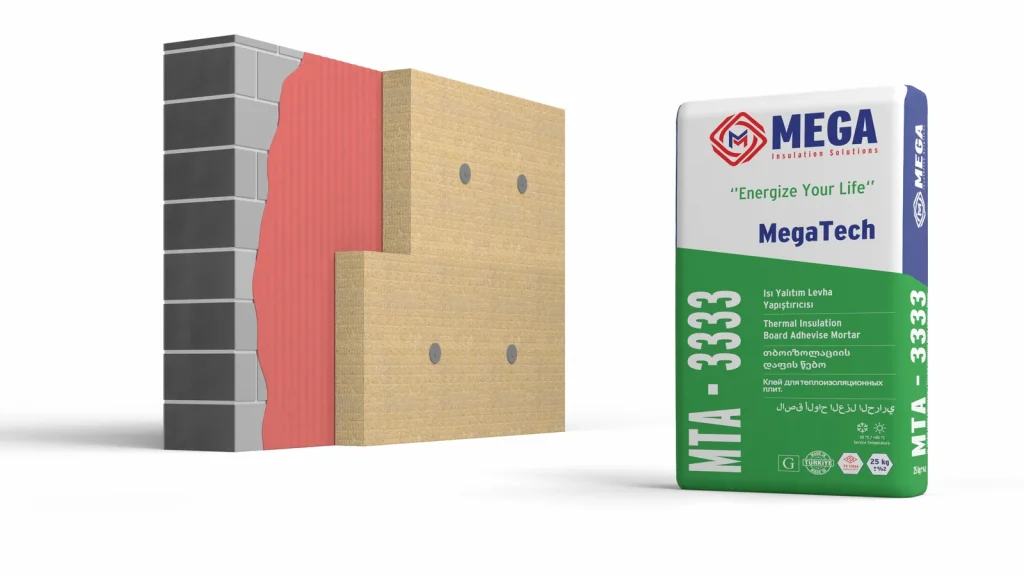
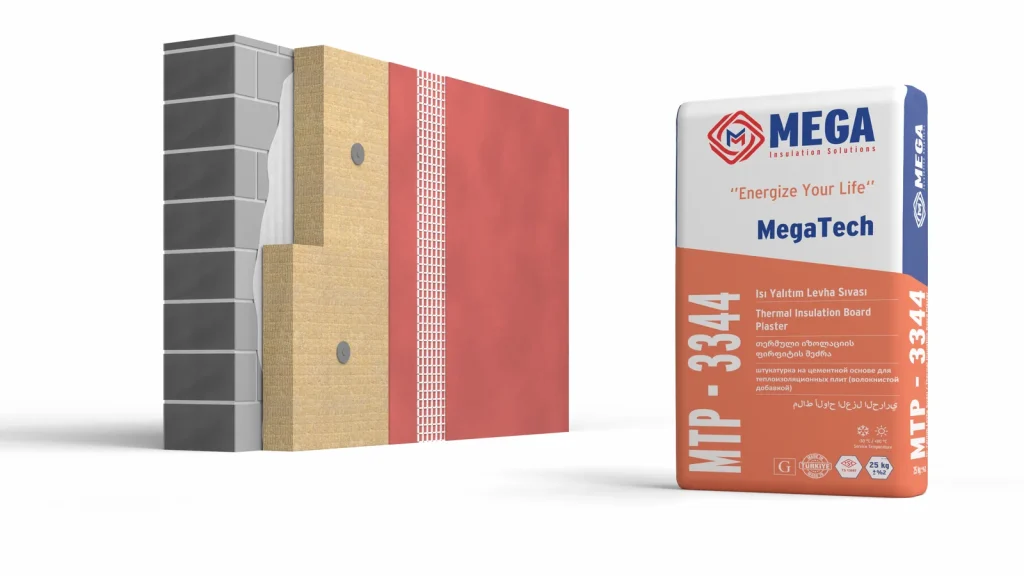
From the wall outwards the system consists of five layers: adhesive, stone wool board, anchors, a base coat reinforced with mesh, and a finishing coat. TS EN 13500 treats the system as a kit whose components are supplied together; this is why the components are chosen from a single system.
| Layer | Function | Mega product | Data sheet value |
|---|---|---|---|
| Adhesive | Bonds the board to the wall and carries the weight of the board | Thermal Insulation Board Adhesive MTA-3333 | 3–5 kg/m²; the mortar is used within 2 hours at most |
| Thermal insulation board | Reduces heat transfer through the wall | Stone Wool ETICS Board | λD ≤0.035 or ≤0.037 W/mK depending on type; A1 |
| Anchor | Fixes the board mechanically against wind suction | Not in the Mega range; the anchor in the system certificate | Driven at least 24 hours after bonding |
| Base coat and reinforcing mesh | Strengthens the board surface and limits cracking | Thermal Insulation Board Base Coat MTP-3344 | 160 g/m² alkali-resistant mesh, 10 cm overlap; about 4 mm in total; 3.5–5.5 kg/m² |
| Finishing coat | Forms a water-repellent surface and sets the texture of the facade | Decorative Mineral Render MTD-3355 | 2 mm; 2.2–2.5 kg/m²; painted after drying |
Source: Mega MTA-3333, MTP-3344 and MTD-3355 technical data sheets and product pages.
According to Mega’s product pages, the board adhesive is suitable for stone wool, EPS and XPS boards; the base coat is cement-based and fibre-reinforced. The full list of components is in our guide to ETICS materials.
How is stone wool ETICS applied?
Stone wool ETICS is applied in the same seven steps as EPS ETICS; the differences lie in the weight and size of the board and in the choice of anchor. According to the MTA-3333 data sheet, the adhesive is applied between +5 and +35 °C; the MTP-3344 data sheet requires the ambient and surface temperature not to exceed +30 °C during application and curing.
- Prepare the surface and fit the starter track. The surface must be clean, cured and sound. The starter track is fixed level at the lower edge of the insulation; the MYK thermal insulation installer qualification specifies at least 3 anchors per metre.
- Prepare the adhesive. MTA-3333 is mixed with water and the prepared mortar is used within 2 hours at most.
- Bond the boards in a staggered pattern. If the wall is flat the adhesive is combed onto the back of the board; if not, it is applied in dabs. The boards are laid from the bottom up so that the joints do not line up; at building corners they are interlocked.
- Anchor. The anchors are driven at least 24 hours after bonding. Their type, length and number are determined according to the system certificate.
- Apply the first base coat and embed the mesh. At least two days after bonding, the first coat of MTP-3344 is applied; the 160 g/m² alkali-resistant mesh is pressed into it while it is wet, with an overlap of at least 10 cm.
- Apply the second base coat. The second coat covers the mesh completely; the total thickness is about 4 mm. Additional pieces of mesh are placed at the corners of windows and doors at an angle of 45° to the corner.
- Apply the finishing coat. According to the MTP-3344 data sheet, the decorative render can follow 1 day after the base coat in summer and 2 days after it in winter. The decorative mineral render is applied 2 mm thick and painted after it dries.
The details of the steps are in our guide how ETICS is applied. We explained the precautions to take on days with a risk of frost, rain or great heat in our article when to apply ETICS.
Application note from MegaUsta: Store stone wool boards on site on timber battens and under cover; bond the boards you take up the scaffold on the same day. Do not apply base coat to a board that has got wet; wait for the board to dry.
Why are anchors planned separately for stone wool boards?
Because the tensile strength perpendicular to faces of a stone wool board is lower than that of an EPS board, and the board is heavier. In Mega’s data sheets this strength is at least 10 kPa for MEGA SW F150 board and 100 kPa for grey EPS 50 board. The pull-through resistance of the anchor depends on the plate diameter and on this strength of the board.
- Weight: One square metre of F150 board with a density of 150 kg/m³ weighs about 15 kg at a thickness of 100 mm. The weight of the board is carried by the adhesive, not by the anchors; this is why a sound bonding surface matters.
- Size: With a 1200 x 600 mm board there are about 1.4 boards per square metre. With the figure of 6 anchors per m² in the MYK qualification, this gives an average of 4.3 anchors per board.
- Anchor type: The plate diameter, its stiffness and the number of anchors are chosen according to the system certificate and the construction drawings; the pattern may become denser in corner zones where the wind load is high.
For anchor length, anchorage depth and mesh details, see our guide to anchors and mesh in ETICS.
What is the difference between stone wool ETICS and EPS ETICS?
The application steps are the same; the difference lies in the board’s reaction to fire class, thermal conductivity, weight and tensile strength. The table below compares one type of each from Mega’s data sheets.
| Property | Stone wool ETICS board, MEGA SW F150 | Grey EPS ETICS board, EPS 50 |
|---|---|---|
| Reaction to fire class | A1 | E |
| Declared thermal conductivity, λD (W/mK) | ≤0.037 | 0.032 |
| Thickness for a thermal resistance of 2.70 m²K/W | 100 mm | About 86 mm |
| Tensile strength perpendicular to faces (kPa) | At least 10 | 100 |
| Board size (mm) | 1200 x 600 | 500 x 1000 |
| Thickness range (mm) | 40–120 | 10–100 |
| System standard | TS EN 13500 | TS EN 13499 |
Source: Mega technical data sheets. The thickness row is calculated by multiplying the thermal resistance by λD.
You can find a detailed comparison of the three materials in our article stone wool or EPS and all thermal insulation boards in our guide to thermal insulation materials.
How thick should stone wool ETICS be?
The thickness is not given as a single figure; it is determined in the TS 825 calculation from the climate zone of the building, the wall build-up and the λD value of the board. The Regulation on Energy Performance of Buildings requires the thermal insulation design prepared with this method at the building permit stage.
The thermal resistance of the board is found by dividing the thickness by the λD value. In the MEGA SW F150 data sheet the thermal resistance is 1.35 for 50 mm and 2.70 m²K/W for 100 mm. These are the values of the board; the U-value of the insulated wall also depends on the material and thickness of the wall beneath. We explained how the calculation is made in our article how thick should ETICS be. The comparison of external insulation with internal insulation and insulating blocks is in our guide to wall insulation.
What are the common mistakes in stone wool ETICS?
Most mistakes stem from the boards getting wet, from the wrong choice of anchor and from collecting components from different systems.
- Leaving the boards in the open on site and applying base coat to wet boards.
- Driving the anchors before the adhesive has set, before 24 hours have passed.
- Using the anchor type and pattern chosen for EPS unchanged on stone wool boards.
- Laying the mesh directly on the board instead of embedding it in the base coat.
- Choosing the board, adhesive, base coat and anchors from separate systems. The regulation requires the system to be certified as a whole.
- Not comparing the type name on the packaging with the type name in the design.
We gathered the other defects seen on site in our article on ETICS application mistakes.
Frequently Asked Questions
What is stone wool ETICS?
Stone wool ETICS is the cladding of a building’s external walls from the outside with a rendered system made up of stone wool board, adhesive, anchors, reinforcing mesh, base coat and finishing coat. The standard for these mineral wool based systems is TS EN 13500. According to the technical data sheets, the reaction to fire class of Mega stone wool ETICS boards is A1; the class of the system is read from the system certificate.
Is stone wool ETICS mandatory?
The regulation does not name materials; it sets a reaction to fire class requirement. Under the Regulation on Fire Protection of Buildings, in buildings with a building height of more than 28.50 m the external facade must be of limited-combustibility material, that is, at least class A2-s1,d0. In lower buildings at least low-flammability material is sufficient; where the facade is clad with a low-flammability material or system, the section up to 1.5 m above ground level and, if the building height exceeds 6.50 m, the fire barriers around windows are made of non-combustible material.
Stone wool ETICS or EPS ETICS?
Both are rendered systems applied in the same steps; the difference lies in the values of the board. In Mega’s data sheets the stone wool ETICS board is class A1 and EPS boards are class E. The declared thermal conductivity of grey EPS 50 board is 0.032 and that of MEGA SW F150 stone wool board no more than 0.037 W/mK; for the same thermal resistance the stone wool board is chosen slightly thicker. The choice is determined by the building height, the fire requirement and the design calculation.
How thick should stone wool ETICS be?
The thickness is calculated in the thermal insulation design prepared in accordance with TS 825. Mega stone wool ETICS boards are offered in thicknesses between 40 and 120 mm (50 to 120 mm for the SW-35L type). In the MEGA SW F150 data sheet the thermal resistance is 1.35 for 50 mm and 2.70 m²K/W for 100 mm. In the same building, the required thickness changes as the climate zone and the other layers of the wall change.
Are anchors required in stone wool ETICS?
Application without anchors is possible only if the system certificate defines a purely bonded application. The data sheet of Mega board adhesive MTA-3333 does not describe a method without anchors; the anchors are driven at least 24 hours after the boards are bonded. Because the tensile strength perpendicular to faces of a stone wool board is lower than that of an EPS board, the plate diameter, type and number of the anchors are chosen according to the system certificate.
What happens if stone wool ETICS gets wet in the rain?
Stone wool boards are protected from rain until the application is finished, and the base coat is applied to dry boards. In Mega’s data sheets the short-term water absorption of the boards by partial immersion is no more than 1 kg/m² and the long-term water absorption no more than 3 kg/m². The adhesive data sheet also requires that no application is carried out in rain and that the application is protected from getting wet until it is fully dry.
Sources
- Mega technical data sheet: MEGA SW F150 ETICS Board (PDF, in Turkish)
- Mega technical data sheet: MEGA SW F120 ETICS Board (PDF, in Turkish)
- Mega technical data sheet: MEGA SW PLUS ETICS Board (PDF, in Turkish)
- Mega technical data sheet: MEGA SW ULTRA ETICS Board (PDF, in Turkish)
- Mega technical data sheet: MEGA SW-35L ETICS Board (PDF, in Turkish)
- Mega technical data sheet: EPS 50 / 60 / 70 carbon-enhanced (PDF, in Turkish)
- MegaTech MTA-3333 Thermal Insulation Board Adhesive technical data sheet (PDF, in Turkish)
- MegaTech MTP-3344 Thermal Insulation Board Base Coat technical data sheet (PDF, in Turkish)
- MegaTech MTD-3355 Decorative Mineral Render technical data sheet (PDF, in Turkish)
- Regulation on Fire Protection of Buildings, Article 27 and Annex 2 (Legislation Information System; in Turkish)
- Regulation on Energy Performance of Buildings, current text, Articles 9 and 10 (Legislation Information System; in Turkish)
- EN 13500, external thermal insulation composite systems (ETICS) based on mineral wool, standard record (SIS)
- EN 13162:2012+A1:2015, factory made mineral wool products, standard record (EVS)
- MYK 12UY0057-3 Thermal Insulation Installer (Level 3) National Qualification (PDF, in Turkish)
- EOTA EAD 040083: External thermal insulation composite systems (ETICS)
- EOTA EAD 330196: Plastic anchors for ETICS
You can review the types of stone wool ETICS board on the ETICS Board page and contact us through our contact page with questions about your project.