
There is no single answer to the question of glass wool or stone wool; the choice depends on the application. Both are mineral wools and fall within the same thermal conductivity range. The real differences lie in raw material, density and temperature resistance: stone wool is usually preferred where high temperatures or fire protection matter, and glass wool where low weight is decisive.
Both materials are fibrous, are made as mats, slabs or pipe sections and fall under the same product standard in buildings. Below we compare the two using general values published by public bodies and the industry association; for stone wool we also give the values from the technical data sheets of Mega stone wool boards. If you are new to the material, start with our article what is stone wool.
Mega Insulation Solutions (Mega Yalıtım) is a Turkish manufacturer of insulation materials with its head office in Kavacık, Istanbul, and its plant in Elazığ. Its mineral wool products are stone wool based and, according to the note on the data sheets, are manufactured at the facilities of the group company Megataş A.Ş. in accordance with TS EN 13162+A1. Since Mega does not offer glass wool, the glass wool values in this article come from independent sources.
Glass wool or stone wool? What is the basic difference?
The basic difference is the raw material: glass wool is made from sand and other glass raw materials, stone wool from volcanic rock such as basalt. According to the glass sector reference document of the European Commission’s Joint Research Centre (JRC), the two products are used in essentially the same applications and differ mainly in their raw materials and melting method.
The same document groups mineral wool types into two main categories: glass wool and stone/slag wool. The difference in raw material carries over into density and temperature resistance; İZODER, the Turkish association of thermal, water, sound and fire insulation companies, gives higher density and service temperature ranges for stone wool. According to the JRC, stone wool is usually favoured for high-temperature and fire-protection applications, while glass wool is frequently used where light weight is critical.
What are glass wool and stone wool made of, and how?
Both materials are made by melting the raw materials, turning the melt into fibres and binding the fibres into a mat or slab. According to the JRC document, the two part ways at the melting stage.
- Glass wool: Sand, soda ash, dolomite, limestone and minerals containing boron and alumina are used; cullet (broken glass) is also a common raw material. The batch is melted in an electric or gas-fired furnace, at 1200–1250 °C according to İZODER, and drawn into fibres in rotating centrifugal spinners.
- Stone wool: The rock, usually basalt, is melted together with limestone or dolomite and sometimes blast furnace slag; the most common melting technique for traditional stone wool is the coke-fired hot blast cupola. İZODER gives the melting temperature as 1350–1400 °C. The melt falls onto rapidly rotating wheels and is turned into fibres by blown air.
- Shared steps: A phenolic resin-based binder is sprayed onto the fibres, the mat is dried and the binder cured in an oven at about 250 °C, then the product is cooled and cut to size. Aluminium foil or glass tissue facings can be applied on the production line.
In the standards both materials are referred to by the abbreviation MW (mineral wool); Mega data sheets list the material as “MW, stone wool”.
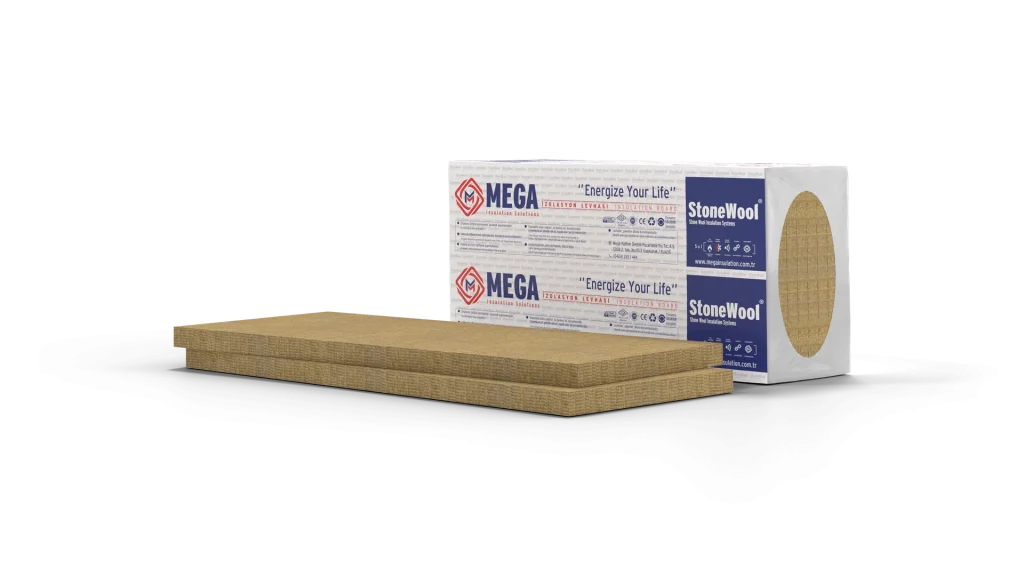
What is the difference between glass wool and stone wool? A 7-criterion comparison
The two materials share the same thermal conductivity design range; the clear differences in the sources lie in density and service temperature. The table sets the general values side by side with the data sheet values of Mega stone wool boards.
| Criterion | Glass wool | Stone wool | Mega stone wool boards (data sheet) |
|---|---|---|---|
| 1. Raw material | Sand, soda ash, dolomite, limestone, cullet | Rock such as basalt and diabase; limestone or dolomite | Stone wool (MW) |
| 2. Density | 14–100 kg/m³ | 30–200 kg/m³ | From 40–60 kg/m³ (partition) to 150 kg/m³ (F150) |
| 3. Thermal conductivity | 0.035–0.050 W/mK (TS 825 design value) | 0.035–0.050 W/mK (TS 825 design value) | λD from ≤0.035 to ≤0.039 W/mK |
| 4. Sound insulation | Fibrous; used in walls, floors and roofs | Fibrous; used in walls, floors and roofs | Partition wall board in partitions, floating floor board under screed |
| 5. Reaction to fire class | A1 or A2, depending on the product | A1 or A2, depending on the product | A1 (TS EN 13501-1) |
| 6. Service temperature | -50 / +250 °C | -50 / approx. +650–750 °C | Maximum +750 °C |
| 7. Mechanical strength | No value in the source; check the product declaration | Compressive strength 0.5–500 kPa | Compressive: ETICS at least 25–55 kPa, flat roof at least 30–70 kPa |
Source: İZODER thermal insulation information page and JRC reference document (glass wool and stone wool columns), Mega stone wool board data sheets (last column). The product’s own declared values govern the choice; for the concept of λ, see our article on thermal conductivity.
How should the reaction to fire class be read?
İZODER shows both materials as class A1 or A2 depending on the product, so the comparison has to be made at product level. The Turkish Regulation on Fire Protection of Buildings defines A1 as “non-combustible” and A2-s1,d0 as “hardly combustible”. According to their technical data sheets, Mega stone wool boards are class A1 (TS EN 13501-1); details are in our article does stone wool burn.
Which one is used at high temperatures and in industry?
Stone wool comes to the fore at high temperatures: according to İZODER, the upper service temperature limit is +250 °C for glass wool and approximately +650–750 °C for stone wool. Mega stone wool board data sheets give a maximum service temperature of +750 °C; this is a service limit, not a melting point.
Glass wool and stone wool products used for building services insulation fall under TS EN 14303 rather than TS EN 13162, which covers buildings. In this field Mega offers its stone wool industrial board with glass tissue or aluminium foil facing for industrial plants, process equipment, steel structures and sandwich panels, and a duct board and preformed pipe insulation for air-conditioning ducts and service pipes.
Why is mechanical strength decisive on façades and roof terraces?
Because in ETICS the board carries the adhesive, the mesh and the render, and on a flat roof it sits under the layers above it and the imposed load. For these jobs, compressive strength and tensile strength perpendicular to faces must be declared on the board’s data sheet.
According to the JRC, stone wool products are significantly denser than glass wool products, particularly in the lower density range; İZODER gives a compressive strength range of 0.5–500 kPa for stone wool. In Mega data sheets, the compressive strength of the MEGA SW F150 ETICS board is at least 40/45/55 kPa and that of MEGA SW F120 at least 30 kPa; both have a tensile strength perpendicular to faces of at least 10 kPa. The other types are on the stone wool ETICS board page.
Flat roof boards are named after their compressive strength in the data sheets: 30, 40, 50, 60 and 70 kPa. All have λD ≤0.039 W/mK, and the class is chosen in the design according to the load on the roof. The layer sequence is in our article on flat roof insulation, the types on the flat roof board page, and density selection in our stone wool density guide.
Glass wool or stone wool: which one for which application?
In the stone wool or glass wool question, the decision comes from what the application requires, not from the name of the material. The table summarises the deciding criterion for common applications and the matching Mega stone wool product.
| Application | Deciding criterion | Preferred choice | Mega product |
|---|---|---|---|
| Rendered external wall insulation (ETICS) | Compressive and tensile strength; system certificate | High-density board with declared tensile strength | Stone wool ETICS board (F120, F150) |
| Ventilated rainscreen façade | Insulation at least hardly combustible (regulation) | Mineral wool with a declared class | Ventilated façade board (A1) |
| Flat roof | Compressive strength | Board with a declared compressive class | Flat roof board (30–70 kPa) |
| Floating floor under screed | Compressive strength; sound and vibration | Board with declared compressive strength | Floating floor board (25 kPa) |
| Lightweight partition (plasterboard) | Sound and thermal insulation; no load on the board | Both materials are used | Partition wall board (40–60 kg/m³) |
| Building services and industry | High service temperature | Stone wool | Industrial board, technical products |
| Jobs where light weight is critical | Low weight | Frequently glass wool (JRC) | Mega’s mineral wool products are stone wool |
The ventilated façade condition comes from Article 27 of the Regulation on Fire Protection of Buildings. For a comparison with foam boards see stone wool or EPS, and for where stone wool boards are used in a building see stone wool applications.
Application note from MegaUsta: Do not accept material under a general description such as “wool” or “mineral wool”. Compare the product name and type code on the label with the project, and confirm from the data sheet whether it is glass wool or stone wool, its density and its reaction to fire class. The data sheet of an ETICS board must state its tensile strength perpendicular to faces (TR).
Are glass wool and stone wool harmful to health?
In its Volume 81 monograph, published in 2002, the International Agency for Research on Cancer (IARC) placed insulation glass wool, stone wool and slag wool in Group 3, not classifiable as to their carcinogenicity to humans. Special-purpose glass fibres such as E-glass and refractory ceramic fibres are in Group 2B in the same evaluation; these fibres are assessed separately from building insulation wools.
The precautions on site are the same for both materials. Because cutting and installation produce dust and fibres, gloves, long-sleeved work clothing, safety glasses and a dust mask are worn, the cutting area is ventilated, and offcuts are vacuumed rather than swept.
Frequently Asked Questions
Which insulates better, glass wool or stone wool?
There is no clear difference between the two in thermal insulation: İZODER gives the thermal conductivity design value under TS 825 as 0.035–0.050 W/mK for both. Comparisons should be based on the product’s declared λD value and thickness; the declared λD of Mega stone wool boards ranges from ≤0.035 to ≤0.039 W/mK, depending on the type. The choice is usually decided by temperature, fire and load conditions.
Do glass wool and stone wool differ in sound insulation?
Both are fibrous and are used for the same purpose in sound insulation; İZODER lists both among sound insulation materials for walls, floors and roofs. In a lightweight partition the wool alone does not decide the result; the facings on both sides and junction details that may form sound bridges also affect it. Mega’s product for this job is its 40–60 kg/m³ partition wall board.
Can glass wool be used in ETICS?
In ETICS what matters is not the type of wool but whether the board is declared for the system. Because the board carries the adhesive, mesh and render, its compressive strength and tensile strength perpendicular to faces must be on the data sheet. Mineral wool-based external thermal insulation composite systems fall under TS EN 13500, and Turkish regulation requires the system to be certified as a whole by an accredited laboratory. Mega’s ETICS boards are stone wool.
Which standard are glass wool and stone wool made to?
Because both are mineral wools, products used for the thermal insulation of buildings fall under TS EN 13162, which specifies factory-made mineral wool (MW) products. Glass wool and stone wool products used to insulate pipes, ducts and building services fall under TS EN 14303 instead. According to their data sheets, Mega stone wool boards are manufactured in accordance with TS EN 13162+A1.
What is glass wool?
Glass wool is a mineral wool insulation material made by melting glass raw materials such as sand, soda ash, dolomite and limestone, together with cullet, and turning the melt into fibres. The fibres are bound into mats, slabs or pipe sections. According to İZODER it is produced at densities of 14–100 kg/m³, with a service temperature of -50 to +250 °C.
Sources
- İZODER: Thermal insulation, general information
- İZODER: Sound insulation, general information
- JRC: Glass manufacturing BAT reference document (2013), Sections 1.8 and 2.9: Mineral wool
- IARC Monographs Volume 81 (2002): Man-made Vitreous Fibres
- EN 13162:2012+A1:2015 mineral wool (MW) products, standard record (EVS)
- Regulation on Fire Protection of Buildings (Türkiye), Art. 27 and Annex 2/Ç (mevzuat.gov.tr)
- Mega: MEGA SW F150 ETICS board data sheet (PDF)
- Mega: Flat roof board 50 kPa data sheet (PDF)
- Mega Yalıtım Documents page
When choosing mineral wool, assess the application, temperature and loads together with the data sheets. You can review Mega’s products on the stone wool boards page and reach the technical team about your project via the contact page.