
The effects of noise on human health show up most clearly in sleep and in daytime annoyance. The World Health Organization (WHO) also associates noise with cardiovascular and metabolic problems, cognitive impairment and hearing loss. When the WHO released its 2018 Environmental Noise Guidelines for the European Region, it called noise one of the top environmental hazards to physical and mental health.
A drill running all day, heavy traffic, a neighbour’s renovation or the constant hum of the city are often treated as minor nuisances that simply have to be tolerated. According to the European Environment Agency (EEA), however, environmental noise triggers both physical and psychological stress responses in the body. Türkiye’s Regulation on the Protection of Buildings against Noise, published in 2017, likewise defines its purpose as minimising the adverse effects of noise from inside or outside buildings on people’s peace and quiet and on their physical and mental health.
In this article we look at how noise affects health, how strong the evidence for these effects is, which noise levels are considered acceptable at home and how noise in living spaces can be reduced with building layers.
Is noise harmful to health?
Yes. Continuous or frequently repeated noise is a source of stress that keeps the body on alert. According to the EEA, long-term exposure disrupts sleep and the body’s daily (circadian) rhythm and activates the body’s stress system.
The effects listed by the WHO Regional Office for Europe are as follows:
- Sleep: Noise interrupts sleep and makes it harder to rest.
- Cardiovascular, metabolic and birth outcomes: It is associated with cardiovascular, metabolic and psychophysiological problems and with adverse birth outcomes.
- Cognitive function: It can lead to cognitive impairment and reduces performance.
- Hearing: Loud sound can cause hearing loss.
- Annoyance and social behaviour: It provokes annoyance responses and leads to changes in social behaviour.
Not all of these effects are equally common. According to a 2018 paper describing how the WHO guidelines were developed, the most prevalent effects of noise are sleep disturbance and annoyance, both mostly related to road traffic.
European data show the scale of the problem. According to the EEA report Environmental Noise in Europe 2025, more than 20 percent of Europeans, that is more than one in five, are exposed to harmful levels of transport noise. Around 4.6 million people suffer from severe sleep disturbance. The EEA identifies road transport as the most significant contributor to environmental noise in the European Union.
How are noise and stress linked?
The link between noise and stress comes from the way the body reacts to sound. Unexpected or continuous sounds repeatedly trigger the physical and psychological stress response described by the EEA. If the noise continues at night, sleep is interrupted and the body does not get the rest it needs to recover. It is therefore not surprising that someone whose sleep is disturbed finds it hard to concentrate at work or school the next day; the WHO also notes that noise reduces performance.
How well proven is the effect of noise on mental health?
The effect of noise on mental health is being researched, but the evidence in this area is not as strong as it is for sleep and annoyance. Most studies on depression and anxiety are cross-sectional, meaning they look at a single point in time, and the quality of the evidence is therefore rated as low.
The systematic review prepared for the WHO guidelines and published in 2018 examined outcomes such as depression, anxiety, medication use and emotional problems in children. The authors rated most of the evidence as very low quality and observed effects only for some noise sources and outcomes. The same review stresses that a lack of evidence does not mean there is no effect, but rather that these areas have not yet been studied robustly for different noise sources. The EEA’s 2025 report also states that transport noise could contribute to thousands of cases of depression.
Based on the available evidence, the strongest links concern sleep and annoyance. If you have had sleep problems, constant tension or anxiety for a long time, the first step is to see a doctor. Sound insulation is not a treatment; it is a structural measure that reduces the noise load in a living space.
How many decibels is each sound?
A quiet rural area is around 30 dB, conversation at home 50 dB, a radio or television 70 dB and a jackhammer 100 dB. According to the US National Institute on Deafness and Other Communication Disorders (NIDCD), sounds at or below 70 dBA are unlikely to cause hearing loss, even after long exposure. Long or repeated exposure to sounds at or above 85 dBA, however, can cause hearing loss.
The decibel is a logarithmic scale. According to Purdue University’s comparison table, an 80 dB sound is perceived as twice as loud as a 70 dB sound, and a 90 dB sound as four times as loud. Seen the other way round, a reduction of 10 dB means the sound is heard as roughly half as loud.
| Sound level | Example sound sources | Perception and hearing note |
|---|---|---|
| 10 dB | Breathing | Barely audible |
| 30 dB | Quiet rural area | Very quiet |
| 40 dB | Library, bird calls | Perceived as one-eighth as loud as 70 dB |
| 50 dB | Quiet suburb, conversation at home | Perceived as one-quarter as loud as 70 dB |
| 60 dB | Conversation in a restaurant or office, background music | Fairly quiet; perceived as half as loud as 70 dB |
| 70 dB | Radio or television, vacuum cleaner | Reference level for comparison; the upper 70s are annoyingly loud to some people |
| 80 dB | Dishwasher, freight train at 15 metres, food blender (88 dB) | Hearing damage possible with 8-hour exposure |
| 90 dB | Motorcycle at about 7.5 metres, power mower (96 dB) | Hearing damage likely with 8-hour exposure |
| 100 dB | Jackhammer, garbage truck, farm tractor | Serious hearing damage possible with 8-hour exposure |
| 110 dB | Car horn at 1 metre, live rock music | Average human pain threshold |
| 120 dB | Thunderclap, chainsaw | Painful |
Source: Purdue University noise comparison table; NIDCD. The values are typical examples; the actual level varies with the source and the distance. We explained how people are protected from much louder sounds such as jet engines in our article on the F-16 cockpit.
What noise level is acceptable at home and at work?
In Türkiye, the permitted noise levels inside buildings are set by the Regulation on the Protection of Buildings against Noise. New buildings must achieve at least acoustic performance class C. In this class the upper limit is 34 dB at night in residential bedrooms and 39 dB around the clock in living areas and kitchens.
The regulation divides buildings into acoustic performance classes from A to F. Class A is the strictest, and the permitted indoor noise level rises by 4 dB with each class. The table below is a selection of the values in Annex 4 of the regulation.
| Building and room | Time period | Class A upper limit (LAeq) | Class C upper limit (LAeq, minimum for new buildings) |
|---|---|---|---|
| Residential: bedrooms | Night (23:00–07:00) | 26 dB | 34 dB |
| Residential: living areas and kitchens | 24 hours | 31 dB | 39 dB |
| Education: classrooms | Day and evening (07:00–23:00) | 31 dB | 39 dB |
| Healthcare: private patient rooms | 24 hours | 26 dB | 34 dB |
| Healthcare: multi-bed rooms | 24 hours | 31 dB | 39 dB |
| Offices: meeting rooms | Day and evening (07:00–23:00) | 31 dB | 39 dB |
| Offices: open-plan areas | Day and evening (07:00–23:00) | 36 dB | 44 dB |
Source: Regulation on the Protection of Buildings against Noise, Annex 4, Table 4.1. According to the regulation, this table is used for acoustic design purposes only; the provisions of the Regulation on the Assessment and Management of Environmental Noise remain reserved.
The table also shows which rooms need quiet the most. The limits for bedrooms and private patient rooms are stricter than those for living areas and classrooms, while a higher level is allowed in open-plan offices.
The WHO Night Noise Guidelines for Europe, published in 2009, look at the outside of the building. The target value for average outdoor noise over the night (Lnight,outside) is 40 dB; 55 dB is recommended as an interim target for countries where this target cannot be achieved in the short term. How much of the outdoor noise reaches the bedroom depends on the sound insulation of the façade and the windows. The regulation therefore also sets minimum sound insulation values for the external building elements of noise-sensitive rooms.
Where does noise at home come from and how can it be reduced?
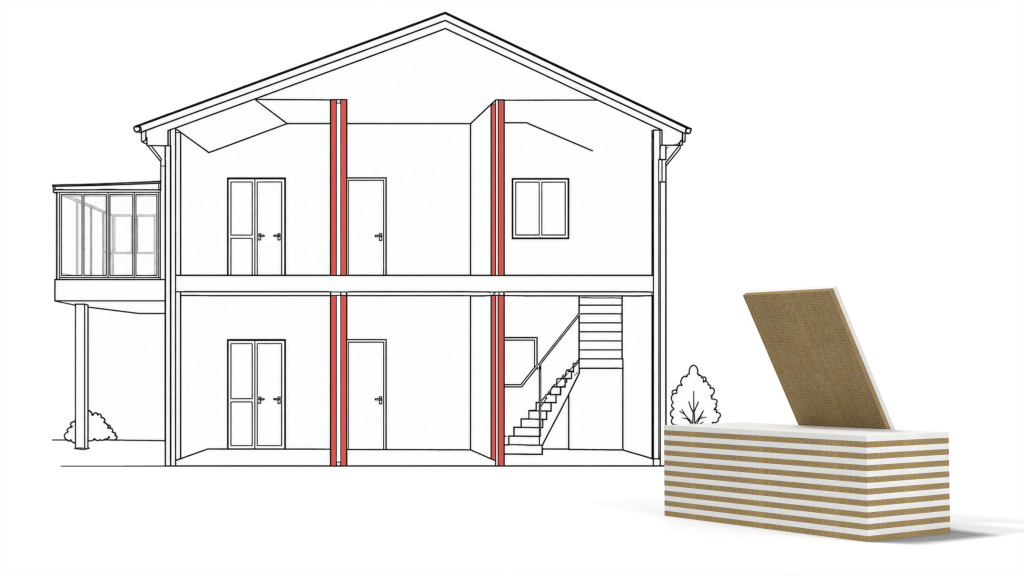
Noise at home usually comes by four routes: through the party wall, through the floor, through the façade and from the building services. Each route needs a different solution, so the first step is to find out where the sound is coming from.
The regulation also distinguishes between sounds in a building. Sounds that travel through the air, such as speech, television and music, are airborne sound. Sounds generated directly in the floor or wall, such as a door slamming, footsteps or furniture being dragged, are defined as impact sound. Noise from the mechanical and electrical services inside the building is also included in indoor noise.
| Noise source | Route of the sound | Direction of the solution | Relevant Mega product |
|---|---|---|---|
| Speech, television and music in the neighbouring flat | Party wall | Adding a second, stone-wool-layered skin to the existing wall, or building the new wall with sound insulation blocks | DesiWool, sound insulation block |
| Footsteps and furniture being dragged in the flat above | Floor | A floating floor that separates the screed from the structural slab with a resilient layer | Floating floor board |
| Sound passing between rooms in the same home | Lightweight partition walls | Filling the cavity inside the partition wall with stone wool | Partition wall board |
| Street and traffic noise | Windows, frames and external wall | First checking the airtightness of windows and frames, then applying an additional layer to the inner face of the external wall | DesiWool |
| Lift, staircase, service shaft | Walls adjoining shafts and stairwells or lift wells | Building or lining these walls with sound-insulating materials | MegaBlock Acoustic, DesiWool |
The product matches are based on the areas of use stated on Mega’s product pages: for DesiWool these include the inner faces of external walls and walls adjoining staircases and lift wells, and for MegaBlock Acoustic they include shafts exposed to high noise levels.
For new homes, the regulation sets separate limits for these routes. In class C, at least 52 dB (DnT,A) of airborne sound insulation must be achieved between two independent residential units, and the impact sound level from the floor of the unit above (L’nT,w) must not exceed 54 dB. We explain how to choose a solution for a party wall in our guide to wall sound insulation, and how stone-wool-filled partition walls work in our article on stone wool sound insulation.
One distinction is worth keeping in mind here. Sound insulation reduces the transmission of sound from one space to another, whereas reducing echo inside a room is the job of sound-absorbing surfaces. You can find the extreme example of this second approach in our article on the anechoic chamber, where we describe rooms in which sound is almost completely absorbed. For noise coming from neighbours or the street, the solution lies in insulating layers. We also looked at how vibration transmitted to the structure by machinery and building services is cut off, using vibration isolation on submarines as an example.
Application note from MegaUsta: Sound passes through even the smallest gap. When lining a wall, do not leave socket and switch boxes, service penetrations or the lines where the wall meets the ceiling and the floor open. Gaps left at these points cancel out part of the insulation gained from the new layer.
How do Mega’s stone-wool-based products reduce noise?
DesiWool, MegaBlock Acoustic, the floating floor board and the partition wall board, which Mega recommends for sound insulation in walls and floors, are stone-wool-based and work as an additional layer in the building. The sound insulation performance of the wall products is expressed by the sound reduction index R’w (dB), measured in tests and declared in the technical data sheets; the higher the value, the less sound the wall lets through.
| Product | Structure | Where is it used? | Technical data sheet or test value |
|---|---|---|---|
| DesiWool | Composite panel with plasterboard on one face and stone wool on the other; 2700 x 1200 mm, 15–80 mm thick | Inner faces of external walls, internal partition walls, party walls between adjoining flats | DesiWool W15 tests: R’w 29 dB applied on one side, R’w 42 dB applied on both sides |
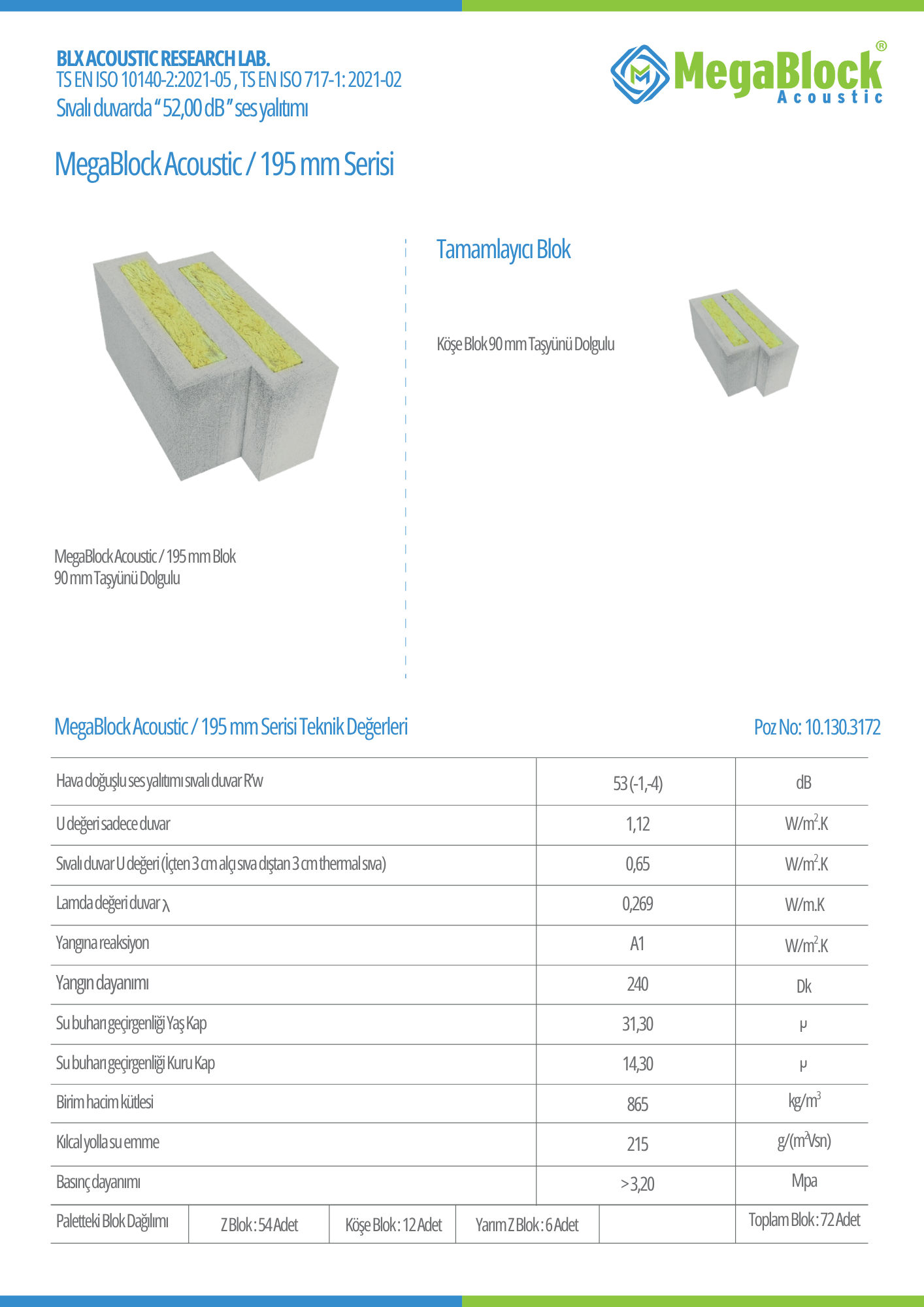
| MegaBlock Acoustic (sound insulation block) | Outer shell of pumice and cement, inner stone wool layer | Party walls, bedrooms, kitchens and bathrooms, hotel rooms, studios | R’w on plastered wall: 145/50SW 47 dB, 195/90SW 53 dB, 245 series 56 dB, 295 series 60 dB |
| Floating Floor Board | MEGA SW FF100/110/120 stone wool board; 100–120 kg/m³, 30 mm | Under screed between two concrete floors, floor finishes, foundations exposed to vibration | Compressive strength 25 kPa; λD ≤0.036 W/mK |
| Partition Wall Board | MEGA SW PB 40/50/60 stone wool board; 40–60 kg/m³, 40–120 mm | Lightweight partition wall systems | λD ≤0.035 W/mK |
Source: Mega technical data sheets and DesiWool W15 test reports (ISO/IEC 17025 accredited laboratory; EN ISO 10140-2 and EN ISO 717-1). The MegaBlock values apply to plastered walls; values measured on unplastered walls are lower. All products in the table are stone-wool-based, and their technical data sheets declare reaction to fire class A1 (A1-s1-d0 for DesiWool).
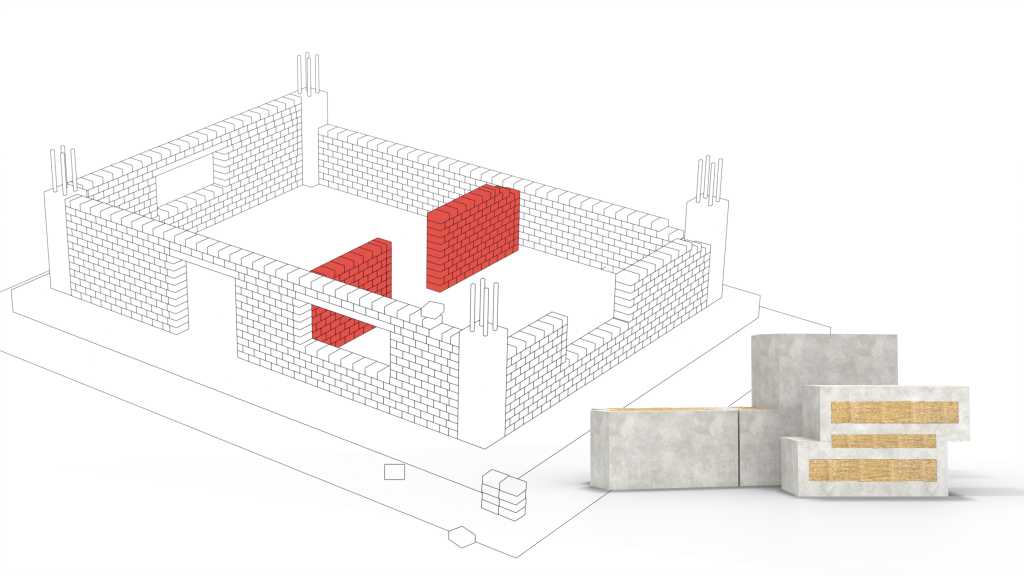
All blocks developed for thermal and sound insulation are listed in the MegaBlock category. We explained which walls DesiWool is applied to in existing buildings, and how, in our article on interior wall insulation.
Mega Insulation Solutions (Mega Yalıtım; legal name Mega Yalıtım Üretim Pazarlama Dış Ticaret A.Ş.) is a Turkish manufacturer of insulation materials with its head office in Kavacık, Istanbul, and its factory in Elazığ. In addition to stone wool, XPS and EPS thermal insulation boards, it offers MegaBlock, MegaLento, DesiWool, MegaTech construction chemicals and Fullback waterproofing products under the Mega brand. Technical data sheets and test reports for the products are available on the Documents page.
Frequently Asked Questions
How does noise affect mental health?
Noise triggers a physical and psychological stress response in the body and interrupts sleep at night. Its link with depression and anxiety is being researched; the 2018 review prepared for the WHO guidelines rated most of the evidence in this area as very low quality, but stressed that this does not mean there is no effect. Anyone with long-lasting sleep problems, tension or anxiety should see a doctor.
What noise level is acceptable at home in dB?
In new homes in Türkiye, the indoor noise level in bedrooms must not exceed 34 dB at night, and in living areas and kitchens it must not exceed 39 dB around the clock. These limits belong to acoustic performance class C, the minimum that the Regulation on the Protection of Buildings against Noise requires for new buildings. In class A, the strictest class, the same limits are 26 and 31 dB respectively.
How can noise pollution be reduced?
Noise pollution is reduced both at the source and in the building. The EEA lists measures such as lower speed limits for cars in urban areas, better planning and access to quiet, green spaces. In the building, the solution is chosen according to the route the sound takes: an additional insulating layer on the party wall, a floating floor, stone wool infill in partition walls and airtight windows and frames on the façade.
Does sound insulation improve sleep quality?
Yes. To the extent that it reduces the noise reaching the bedroom, sound insulation creates a better environment for sleep. The work that went into the WHO guidelines identifies sleep disturbance as one of the most prevalent effects of noise, and the regulation sets the strictest indoor noise limit in homes for bedrooms at night. Because sleep problems can have other causes, persistent sleeplessness calls for a doctor’s advice.
Sources
- WHO Regional Office for Europe: Noise
- WHO Regional Office for Europe: New WHO noise guidelines for Europe released (10 October 2018)
- WHO Regional Office for Europe: Environmental noise guidelines for the European Region (2018)
- WHO Regional Office for Europe: Night noise guidelines for Europe (2009)
- Jarosińska, D. et al. (2018). Development of the WHO Environmental Noise Guidelines for the European Region: An Introduction. International Journal of Environmental Research and Public Health, 15(4), 813
- Clark, C., Paunovic, K. (2018). WHO Environmental Noise Guidelines for the European Region: A Systematic Review on Environmental Noise and Quality of Life, Wellbeing and Mental Health. International Journal of Environmental Research and Public Health, 15(11), 2400
- European Environment Agency (EEA): Environmental noise in Europe 2025
- European Environment Agency (EEA): Noise
- Official Gazette of Türkiye: Regulation on the Protection of Buildings against Noise (31 May 2017, issue 30082)
- Official Gazette of Türkiye: Annexes to the Regulation on the Protection of Buildings against Noise (tables in Annexes 3 and 4, PDF)
- NIH / NIDCD: Noise-Induced Hearing Loss
- Purdue University: Noise Comparisons
- Mega Yalıtım: DesiWool technical data sheet (PDF)
- Mega Yalıtım: MegaBlock Acoustic 195/90SW technical data sheet
- Mega Yalıtım: Floating Floor Board (MEGA SW FF100/110/120) technical data sheet (PDF)
- Mega Yalıtım: Partition Wall Board (MEGA SW PB 40/50/60) technical data sheet (PDF)
In building terms, reducing the health effects of noise means cutting off the route the sound takes with the right layer. You can explore stone-wool-based solutions for walls, partitions and floors on the stone wool boards page, and contact us to choose the right product for your project.