
The F-16 cockpit is protected from noise by several complementary layers. The canopy and cockpit structure keep part of the engine and airflow noise outside; the sound that remains in the cabin is then reduced at the ear by the pilot’s helmet, ear cups and earplugs. In some helmets and headsets, active noise cancellation electronically suppresses the low-frequency rumble that passive measures struggle to stop.
The F-16 Fighting Falcon carries a six-barrel, 20 mm M61A1 aircraft gun capable of firing 6,000 shots per minute and flies on a powerful jet engine. The pilot sits in the middle of all that power, in a cabin where the airflow strikes the fuselage and canopy, the air-conditioning and pressurisation systems run non-stop and radio traffic has to be followed constantly. Expecting silence in a cockpit is unrealistic. The aim is to keep the noise at a level that does not harm the pilot’s hearing, radio communication or mission performance.
This article explains where fighter cockpit noise comes from, the layers that protect an F-16 pilot and how the same principles are used in homes and workplaces.
How loud does fighter cockpit noise get?
The average noise level in a fighter cockpit is reported to be between 95 and 105 dB. A 2023 study on how Republic of Korea Air Force pilots perceive cockpit noise cites this range and points out that it exceeds the 90 dB permissible exposure limit of the US Occupational Safety and Health Administration (OSHA).
To read this figure correctly, it helps to know how the decibel scale works. According to the US National Institute for Occupational Safety and Health (NIOSH), the decibel is a logarithmic unit: a sound that is 10 dB louder is ten times more intense. The US National Institute on Deafness and Other Communication Disorders (NIDCD) puts normal conversation at 60–70 dBA. On that basis, the 35 dB gap between a 100 dB cockpit rumble and 65 dB conversation corresponds to a difference in sound intensity of more than three thousand times. NIOSH’s recommended limit for an eight-hour working day is 85 dBA.
Outside the aircraft, close to the engine, the sound is even louder. The noise comparison table published by Purdue University gives a jet take-off at a distance of 25 metres as 150 dB and a take-off at 305 metres as 100 dB. The cockpit structure blocks part of this external noise; the 95–105 dB that remains inside is then reduced once more by the pilot’s helmet.
Where does the noise in an F-16 cockpit come from?
The noise in an F-16 cockpit has several sources: the engine, the airflow striking the fuselage and canopy, the cockpit air-conditioning and pressurisation system, radio traffic, electronic equipment and warning tones. Some of these sources are outside the aircraft and some are inside the cabin.
- External sources: Engine noise and the noise produced as the airflow rubs against the fuselage, wings and protrusions such as missiles, infrared sensors and refuelling probes. The level of noise caused by the external airflow depends on the dynamic pressure acting on the aircraft.
- Internal sources: Air-conditioning and pressurisation systems, radio transmissions, electronic devices and warning tones. The 2023 study reports that the noise from the F-16’s cockpit conditioning system is dominated by both low and high frequencies.
- External noise carried inside: The same study also lists the external airflow among the sources of noise inside the cabin; part of the noise generated outside reaches the cabin and adds to the internal noise.
The frequency of the noise determines how protection has to be designed. Passive protectors such as earplugs and ear cups work well at mid and high frequencies but fall short at low frequencies, where a large share of the sound energy is concentrated. That is why a low-frequency rumble drowning out, or masking, radio messages is treated as a separate safety issue in the cockpit.
How is an F-16 pilot protected from noise?
An F-16 pilot is protected from noise by a layered system, and each layer targets a different part of the noise. A 2021 study comparing the hearing of fighter pilots and ground staff states that, with the engine running, pilots are relatively well protected by the windshield, their helmets and earplugs; ground staff working next to the aircraft remain outside this shell.
| Protective layer | How does it work? | Where it is most effective |
|---|---|---|
| Cockpit structure and canopy | Limits the passage of engine and airflow noise into the cabin | Noise from external sources |
| Helmet and ear cups | The hard helmet shell and the cups around the ears absorb and dissipate sound energy and impede its passage; a flight helmet is reported to provide around 50 dB of attenuation | Mid and high frequencies |
| Earplug | A passive protector inserted into the ear canal; reductions of 16–23 dB(A) have been measured in heavy noise | Mid and high frequencies |
| Active noise cancellation (ANC) | A microphone inside the ear cup picks up the noise; the system produces a sound 180 degrees out of phase to reduce the noise in the ear canal | Low frequencies |
The information in the table is based on the research compiled by Hwang, Lee and Lee (2023) and on the active noise reduction study in NASA’s technical reports archive (Wheeler et al., 1978).
What does active noise cancellation do in the cockpit?
Active noise cancellation reduces the low-frequency rumble that passive protectors struggle with, making radio messages easier to understand. This method was already being developed for aircrew helmets in the late 1970s: in a 1978 study by researchers at the University of Southampton, held in the NASA archive, a miniature microphone inside the ear defender picked up the noise and an antiphase signal was fed back to the communications earphone inside the same ear defender.
Measurements during air combat manoeuvring, cited in the 2023 study, found that, with ANC switched on, average noise exposure fell by a further 10–15 dB compared with the same helmet with ANC switched off. Even so, this technology is not standard in every fighter helmet. The same study reports that in the Republic of Korea Air Force, cargo and helicopter pilots use headsets with ANC, while most fighter pilots other than those flying the F-35 still fly with conventional helmets without ANC. The helmet and hearing protection used by an F-16 pilot can vary by air force and period.
Layered acoustic protection also appears in other vehicles and spaces. We described a similar approach in our article on submarine acoustic insulation, and test rooms in which sound is almost completely absorbed in our article on the anechoic chamber.
How does cockpit noise affect the pilot?
Cockpit noise strains the pilot’s hearing, communication and attention at the same time. Long exposure to high noise can lead to permanent hearing loss, a low-frequency rumble masks radio messages, and constant noise can have a negative effect on concentration and reaction time.
According to the NIDCD, long or repeated exposure to sounds at or above 85 dBA can cause hearing loss. Noise-induced hearing loss is mostly caused by damage to, and the eventual death of, the hair cells in the inner ear, and in humans these cells do not grow back. Because the average level in the cockpit is well above this threshold, personal protection is an inseparable part of flying.
The second price of noise is paid in communication. Of the 154 Republic of Korea Air Force pilots who took part in the 2023 study, 88.3% said they had had to ask an air traffic controller or a fellow crew member to repeat a message because of noise, and about 27% reported having experienced a risky situation linked to noise. More than half of the respondents also agreed that noise has a negative effect on concentration, sharpness of perception and decision-making.
We cover the effects of noise beyond the ear in detail in our article on the health effects of noise.
What does this mean for your building?
The logic of the cockpit also applies to buildings: find the path by which noise arrives and cut that path with the right layer. In homes, sound insulation is achieved largely with passive layers, that is, the mass of the building elements, the resilient interlayer between layers and correct detailing of the contact points through which sound can leak. Its two basic applications are walls that work on the mass-spring-mass principle and floating floors.
The Regulation on the Protection of Buildings against Noise, published in the Turkish Official Gazette on 31 May 2017, defines the two concepts needed to understand a neighbour’s noise. Airborne sound is sound spread through the air by the vibration of a source in the air; speech, television and music are examples of this type. Impact sound is sound generated directly in a solid medium, such as a door slamming, footsteps or furniture being dragged, and it is transmitted through the building’s structural system and elements. In an apartment, a neighbour’s noise arrives by these two paths; as in the cockpit, the first step in choosing the right measure is knowing which path the sound takes.
How does a mass-spring-mass wall work?
In a mass-spring-mass system, a resilient interlayer is placed between two heavy layers. The heavy layers reflect most of the airborne sound; the resilient layer between them acts like a spring and makes it harder for vibration on one face to pass directly to the other. Stone wool is used in this interlayer as a resilient, porous infill that damps the sound in the cavity.
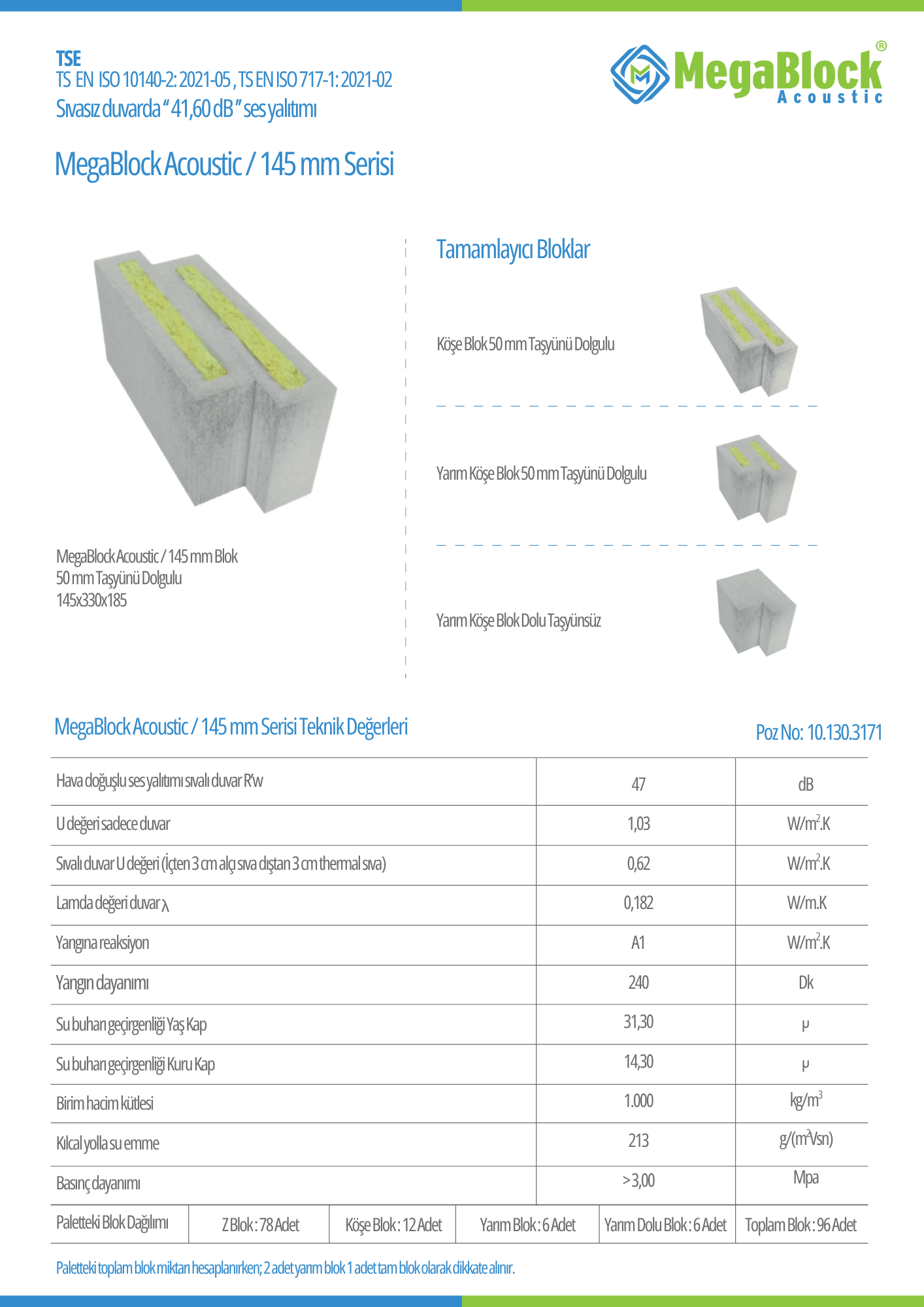
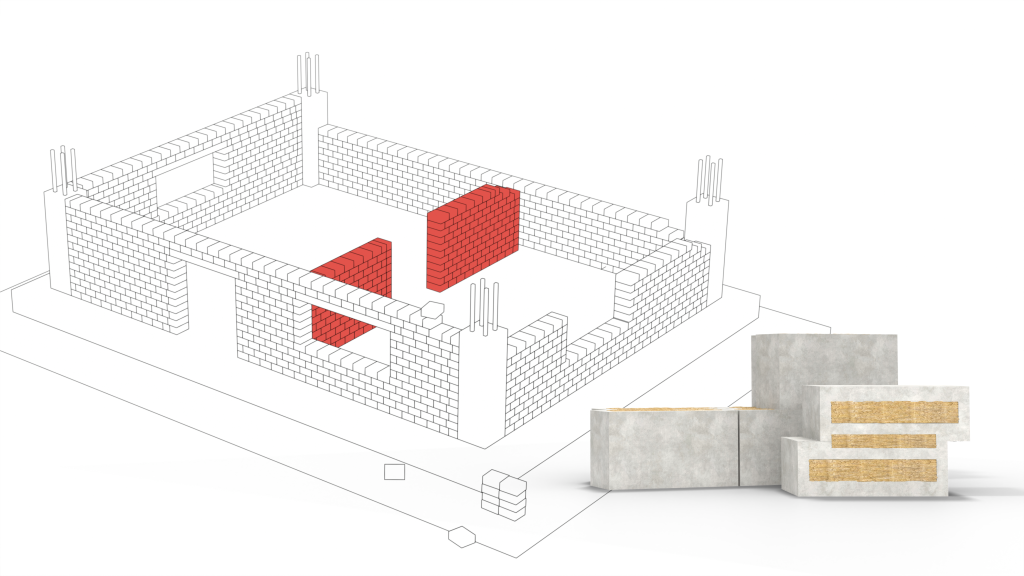
Mega products apply this principle in different ways. DesiWool is a composite panel with gypsum board on one face and stone wool on the other; applied to the inner face of an existing wall, it adds a second layer to the wall. The sound insulation block, also known as MegaBlock Acoustic, has a stone wool core inside an outer shell of pumice and cement. In lightweight partition walls, the partition wall board fills the cavity between the two linings.
We cover choosing the right solution for a party wall in our guide to wall sound insulation.
How is impact sound from the floor blocked?
Impact sound in a floor is blocked by a floating floor, which separates the screed from the structural slab with a resilient board. The regulation itself defines a floating floor as a floor type in which the connection between complementary components such as the screed and the floor slab and walls is broken horizontally and vertically by an impact sound insulation layer.
As a study presented at the 2023 congress of the European Acoustics Association notes, a floating floor behaves, as a first approximation, like a mass-spring system: the screed on top is the mass and the resilient board beneath it is the spring. The resonance frequency of the system is set by the dynamic stiffness of the resilient layer and the mass per unit area of the screed; the improvement in impact sound becomes clear above this frequency. We describe the installation steps in our guide what is a floating floor.
According to its technical data sheet, the Mega floating floor board is a stone wool board in the MEGA SW FF100, FF110 and FF120 types, with a density of 100–120 kg/m³ and a thickness of 30 mm; its compressive strength is 25 kPa and its declared thermal conductivity is λD ≤0.036 W/mK. The product page lists under-screed applications between two floors, floor finishes and foundations subject to vibration among its areas of use.
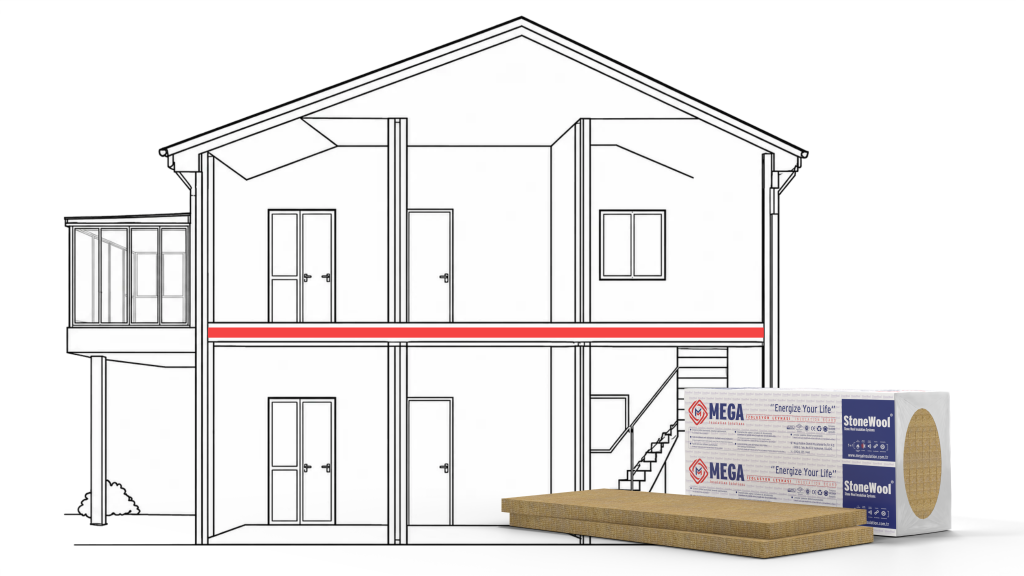
Installation note from MegaUsta: In a floating floor, the screed must not touch walls, door frames or service pipes directly. Screed poured without a resilient edge strip along the base of the walls carries the vibration of footsteps into the structure through these contact points and cancels out the separation provided by the board.
Which Mega product is used in the wall and which in the floor?
The table below summarises Mega’s stone wool based products used for sound insulation in walls and floors, with their data sheet and test values.
| Product | Construction | Where is it used? | Data sheet / test value |
|---|---|---|---|
| DesiWool | Composite panel with gypsum board on one face and stone wool on the other; 2700 x 1200 mm | Inner face of external walls, internal partitions and party walls, walls adjoining stairwells and lift shafts | DesiWool W15 tests: R’w 29 dB applied on one side, R’w 42 dB applied on both sides |
| MegaBlock Acoustic (sound insulation block) | Pumice and cement outer shell, stone wool core | Party walls, bedrooms, hotel rooms, studios, plant rooms, shafts exposed to high noise | R’w of the plastered wall: 145 series 47 dB, 195 series 53 dB, 245 series 56 dB, 295 series 60 dB |
| Floating Floor Board | Stone wool board (MEGA SW FF100/110/120); 100–120 kg/m³, 30 mm | Under screed between floors, floor finishes, foundations subject to vibration | Compressive strength 25 kPa; λD ≤0.036 W/mK |
| Partition Wall Board | Stone wool board (MEGA SW PB 40/50/60); 40–60 kg/m³ | Lightweight partition wall systems | λD ≤0.035 W/mK |
Source: Mega technical data sheets and DesiWool W15 test reports. According to the data sheets, the MegaBlock values are for a plastered wall; the values the data sheets give for an unplastered wall are lower. All the products in the table are stone wool based, and their technical data sheets declare reaction to fire class A1 (A1-s1-d0 for DesiWool).
Mega Insulation Solutions (Mega Yalıtım; trade name Mega Yalıtım Üretim Pazarlama Dış Ticaret A.Ş.) is a Turkish manufacturer of insulation materials with its head office in Kavacık, Istanbul, and its factory in Elazığ. Alongside stone wool, XPS and EPS thermal insulation boards, it offers MegaBlock, MegaLento, DesiWool, MegaTech construction chemicals and Fullback waterproofing products under the Mega brand. You can find the products’ technical data sheets and test reports on the Documents page.
Frequently Asked Questions
How many decibels does a jet engine produce?
How loud a jet engine sounds depends largely on distance. Purdue University’s noise comparison table gives a jet take-off at 25 metres as 150 dB, at 305 metres as 100 dB, and an aircraft carrier deck as 140 dB. Inside a fighter cockpit, the average noise is reported to be between 95 and 105 dB. These levels are far above normal conversation, which is around 60–70 dBA.
How does active noise cancellation work?
Active noise cancellation picks up noise with a microphone inside the headset or helmet ear cup and plays a copy of the same sound 180 degrees out of phase through the earphone. When the two waves overlap, the noise in the ear canal is reduced. The method is most effective at low frequencies, where passive protectors struggle, so it is used together with passive measures such as ear cups and earplugs.
How is vibration-borne noise blocked in buildings?
In buildings, vibration-borne noise is blocked with a resilient interlayer where the vibration enters the structure. In floors this is done with a floating floor: a resilient board such as stone wool separates the screed from the structural slab, and the screed does not touch the walls. Walls use layered solutions with a resilient infill between two masses. The regulation also lists impact sound insulating layers and vibration isolators among products whose acoustic performance must be declared.
Sources
- General Dynamics Ordnance and Tactical Systems: F-16 20 mm Gatling Gun System, technical data sheet (PDF)
- Hwang, K., Lee, G., Lee, K. (2023). The Study on Air Force Pilot’s Recognition about Cockpit Noise to Foster Aviation Safety by the Use of Active Noise Cancellation (ANC). Journal of the Korean Society for Aviation and Aeronautics, 31(1) (PDF)
- Kuo, C.-Y. et al. (2021). The Immediate and Long-Term Impact of Military Aircraft Noise on Hearing: A Cross-Sectional Comparison of Fighter Pilots and Ground Staff. International Journal of Environmental Research and Public Health
- NASA Technical Reports Server: Wheeler, P. D. et al. (1978). An active noise reduction system for aircrew helmets
- CDC / NIOSH: About Noise (the decibel scale and the 85 dBA recommended exposure limit)
- NIH / NIDCD: Noise-Induced Hearing Loss
- Purdue University: Noise Comparisons (noise level comparison table)
- Turkish Official Gazette: Regulation on the Protection of Buildings against Noise (31 May 2017, issue 30082)
- Crispin, C. et al. (2023). Impact of Standing Waves in Thermal Layers on the Acoustic Performance of Floating Floors. Forum Acusticum 2023, European Acoustics Association (PDF)
- Mega Yalıtım: Floating Floor Board (MEGA SW FF100/110/120) technical data sheet (PDF)
- Mega Yalıtım: DesiWool technical data sheet (PDF)
- Mega Yalıtım: MegaBlock Acoustic 145/50SW technical data sheet
As in the cockpit, a quiet environment in a building comes from bringing the right layers together in the right place. You can explore wall and floor solutions on our stone wool boards page and reach our technical team for your project through our contact page.