
An anechoic chamber is a test room isolated from outside noise, in which sound-absorbing wedges on the walls, ceiling and floor ensure that almost none of the sound produced inside is reflected. Its name means “without echo”. These rooms are built to carry out acoustic measurements of devices such as microphones, loudspeakers and hearing aids without reflections mixing in.
Imagine a space cut off from the outside world, where even echo disappears. Steven Orfield, founder of Orfield Laboratories, which according to Guinness World Records holds the record for the quietest place on Earth, describes how inside you hear your own heartbeat, sometimes your lungs, and your stomach gurgling loudly. In this article we look at how an anechoic chamber can be so quiet, how wedge-shaped sound absorbers work and what the same acoustic knowledge means for homes.
What is an anechoic chamber?
An anechoic chamber is a measurement room whose inner surfaces are entirely covered with sound-absorbing wedges, so that almost no reflections occur inside. When you speak in an ordinary room, part of the sound bounces back from the walls, ceiling and floor; what reaches the ear is a mix of the direct sound from the source and these reflections. In an anechoic chamber the reflections are absorbed, so only the direct sound from the source reaches the ear or the microphone.
In acoustics this environment is called a free field. The US National Institute of Standards and Technology (NIST) also uses its anechoic chamber for acoustic measurements under free-field conditions and has covered all six surfaces of the room with sound-absorbing wedges. This is where the name “echo-free room” comes from.
How quiet is the quietest room in the world?
According to a Guinness World Records news article from August 2024, the title of the quietest place on Earth belongs to the anechoic test chamber of Orfield Laboratories in Minneapolis, USA. The ambient sound level measured in this room is -24.9 dBA. The room regained the record in 2021 and had held it up to the date of the article.
The same room first set the record in 2004 with -9.4 dBA and reached -13 dBA after improvements in 2012. In 2015 the anechoic chamber built for audio and device testing on Microsoft’s campus in Washington State briefly took over the record with an average background noise level of -20.35 dBA.
What does a negative decibel value mean?
A negative decibel value shows that the measured sound is lower than the zero point of the decibel scale, that is, the standardised threshold of hearing. According to the technical manual of the US Occupational Safety and Health Administration (OSHA), decibels are measured on a logarithmic scale and 0 dB is, by definition, the reference sound pressure of 20 micropascals at 1,000 Hz. The same source defines this reference as the standardised threshold of hearing, the quietest sound that can typically be heard by a young person with undamaged hearing.
How does an anechoic chamber absorb sound?
An anechoic chamber controls sound with two layers. The wedge-shaped absorbers inside absorb the sound produced in the room without reflecting it, while the heavy outer shell, separated from vibration, keeps outside noise and vibration from reaching the room.
How do sound-absorbing wedge panels work?
Wedge panels are sound absorbers made of porous, fibrous material and arranged side by side with their tips pointing into the room. According to Guinness, the Orfield chamber uses glass fibre wedges about one metre thick and suppresses 99.99% of sound. NIST likewise states energy absorption of at least 99% at frequencies above 45 Hz for its own chamber.
Materials science explains how fibrous material absorbs sound. The sound attenuation chapter of an MPhil dissertation on aluminium foams, prepared at the University of Cambridge Department of Materials Science and Metallurgy, lists mineral wools, glass fibre, carpet and open-cell foam among porous sound absorbers. In these materials the sound wave pumps air into and out of the pores, and the losses in this movement turn part of the sound energy into heat. The same dissertation notes that sealing the surface of a porous absorber with a paint film greatly reduces its absorption.
How is outside noise kept out of the room?
Outside noise is kept out by the heavy, double-shell structure around the room and by resilient mounts that separate the room from the building structure. Eliminating reflections inside is not enough on its own; if the sound of traffic, building services or a machine in the next room reaches the chamber, the measurement is spoiled. NIST’s chamber is a double shell with 0.3 m thick concrete walls and rests on 52 springs. The Orfield chamber has double walls of insulated steel and about 30 cm of concrete.
| Element | Function | Example |
|---|---|---|
| Wedge-shaped absorbers | Absorb the sound produced inside without reflecting it | NIST: at least 99% energy absorption above 45 Hz; Orfield: 99.99% of sound |
| Porous, fibrous material | Converts part of the sound energy into heat | Glass fibre, mineral wool, open-cell foam |
| Heavy, double-shell structure | Limits the transmission of outside noise into the room | NIST: double shell with 0.3 m concrete walls; Orfield: double walls of insulated steel and about 30 cm of concrete |
| Spring mounting | Cuts vibration coming from the building structure | NIST: 52 springs, 3 Hz resonance frequency |
Source: NIST anechoic chamber specifications, Guinness World Records (2024) and the sound attenuation dissertation prepared at the University of Cambridge.
What does a person experience in an anechoic chamber?
After a while in an anechoic chamber, people begin to hear body sounds they normally never notice, and some say they feel sick and disorientated. According to the Guinness article, visitors have reported hearing the blood moving through their veins and even their eyelids closing as they blink. Steven Orfield also says that after 30 minutes in the room he could hear the mechanical valve in his heart working loudly.
The effect of silence on the mind has also been studied. As summarised in a 2014 study, Mason and Brady’s small pilot study in 2009 deprived 19 volunteers of sight and sound for 15 minutes in an anechoic chamber; perceptual distortions were seen mostly in participants prone to hallucinations. In 2014 a team including Oliver Mason kept 36 people in an anechoic chamber for 25 minutes and reported that psychotic-like experiences occurred statistically significantly more often during sensory deprivation in both groups. The researchers also note that short-term sensory deprivation is safe at these durations.
At the other end of the scale is constant noise; we cover its effects on people in detail in our article on the health effects of noise.
What is an anechoic chamber used for?
Anechoic chambers are built to measure sound accurately, not to test people. NIST’s chamber is used to measure the sensitivity, frequency response, directionality, total harmonic distortion and self-noise of electroacoustic devices such as microphones, loudspeakers and hearing aids.
According to Guinness, the Orfield chamber is also used mainly for product testing and research. A motorcycle manufacturer has worked there on making its motorcycles quieter while keeping their signature sound, and a washing machine manufacturer has used it to develop metaphors for how its machines should sound. Microsoft, too, built its record-setting chamber for audio and device testing.
We explain how the principles of absorbing sound and cutting vibration work underwater in our article on submarine acoustic insulation.
What does this mean for your building?
The three principles that make an anechoic chamber possible, namely absorbing sound, limiting sound transmission with mass and layers, and cutting vibration with a resilient layer, are also the basis of acoustic insulation in buildings. Your home does not need to be as quiet as an anechoic chamber, but telling echo, neighbour noise and footstep noise apart is the first step in choosing the right solution.
The Cambridge dissertation draws this distinction clearly: sound generated within a room is reduced by absorption, airborne sound from outside is kept out by insulation, and sound transmitted through the structure is cut by isolating the structure from the source of vibration. According to the same source, porous materials are good sound absorbers and can help with vibration isolation, but on their own they do not provide good insulation against airborne sound. Insulation depends on the mass law: the heavier the layer, the better it insulates.
Turkish legislation also measures these two concepts separately. The Regulation on the Protection of Buildings against Noise defines the acoustic character of a room by the reverberation time, the time it takes for the sound pressure level to fall by 60 dB after the source stops, and expresses the absorption of surfaces with the weighted sound absorption coefficient (αw). Unless the acoustic design calculation shows that the reverberation times are met, the regulation requires ceiling finishes in buildings such as schools, healthcare facilities, office and administrative buildings and libraries to have an αw of at least 0.75. The sound insulation performance of building elements, on the other hand, is stated with the weighted sound reduction index R’w.
Which products apply the anechoic chamber principles at home?
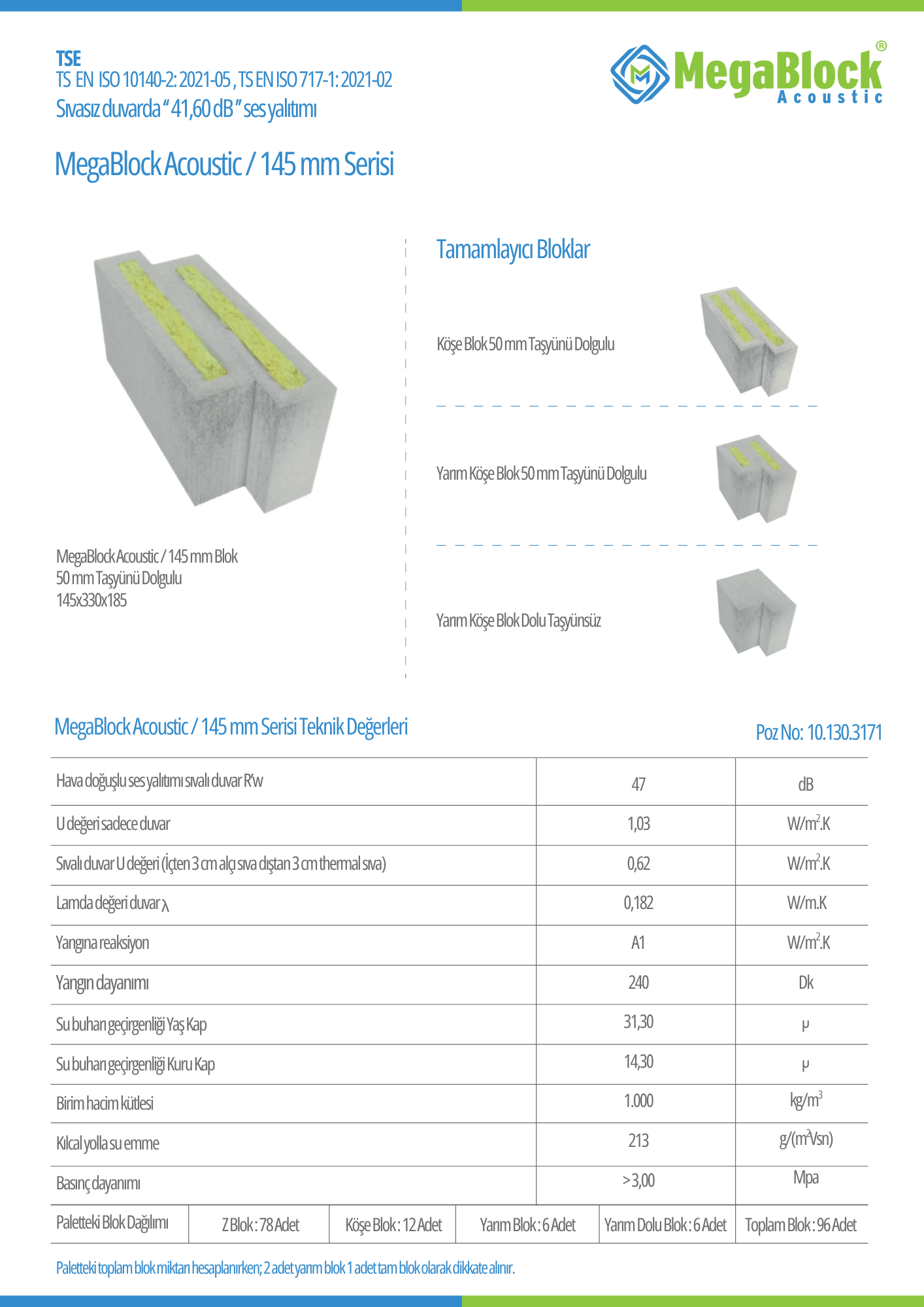
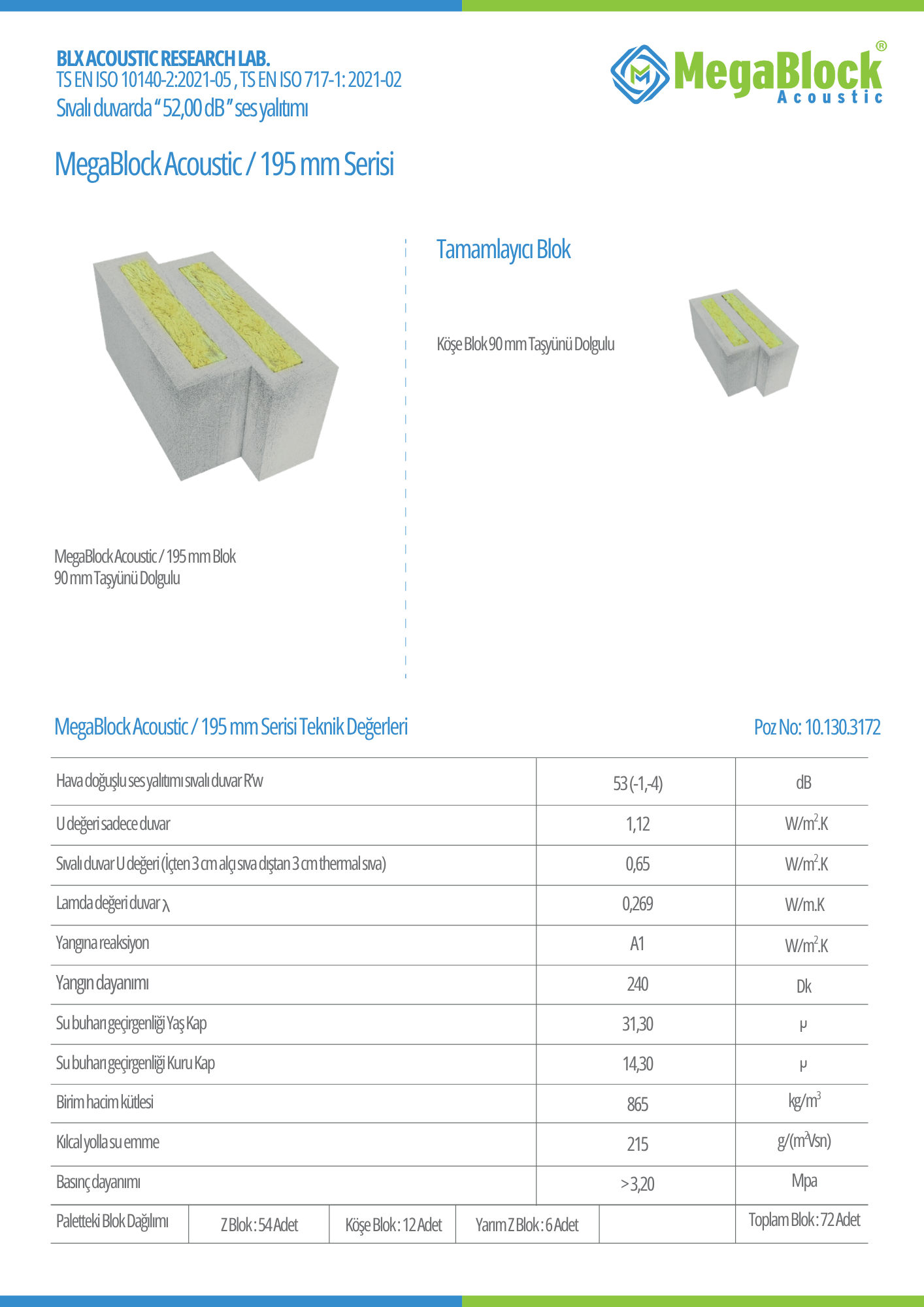
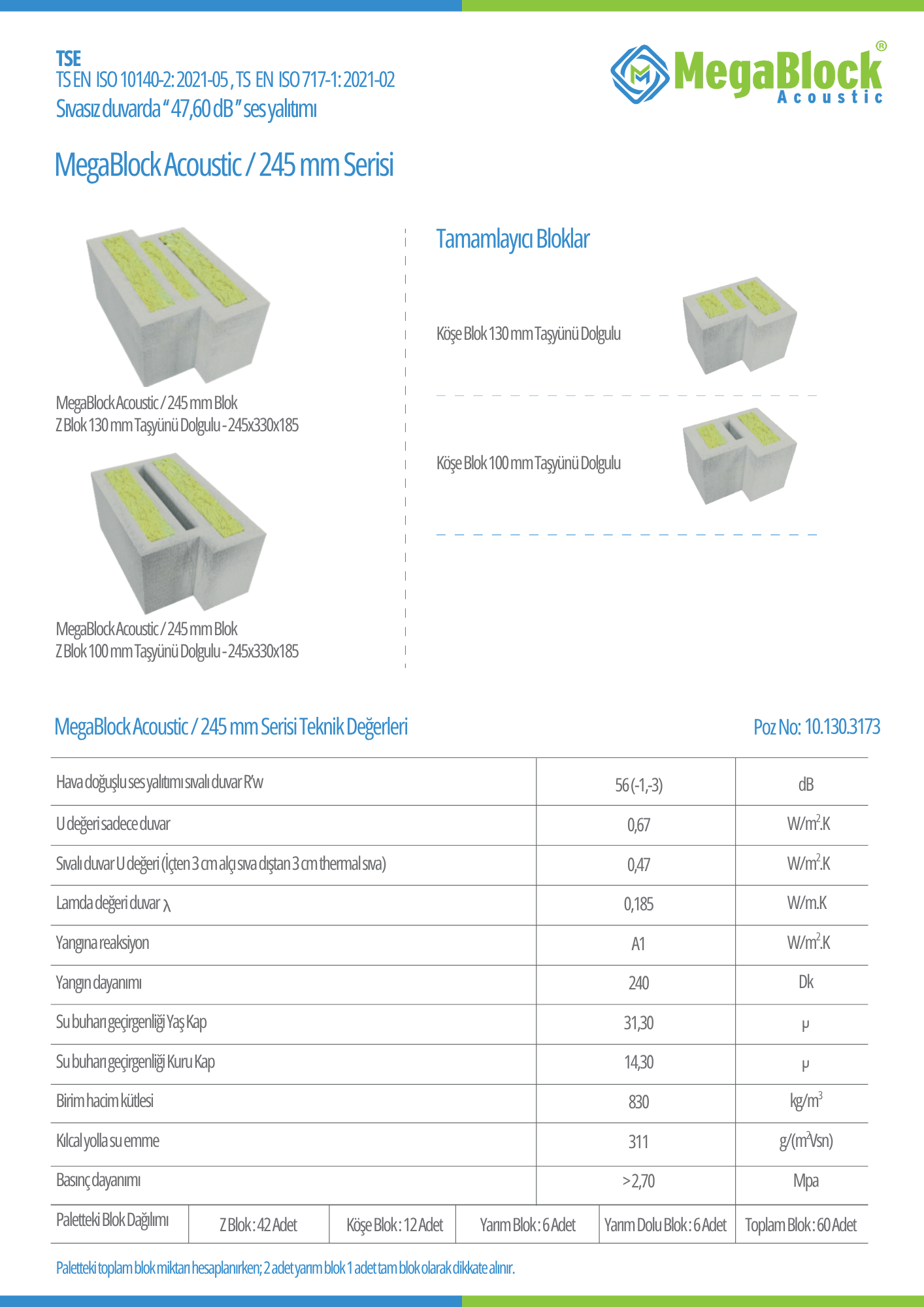
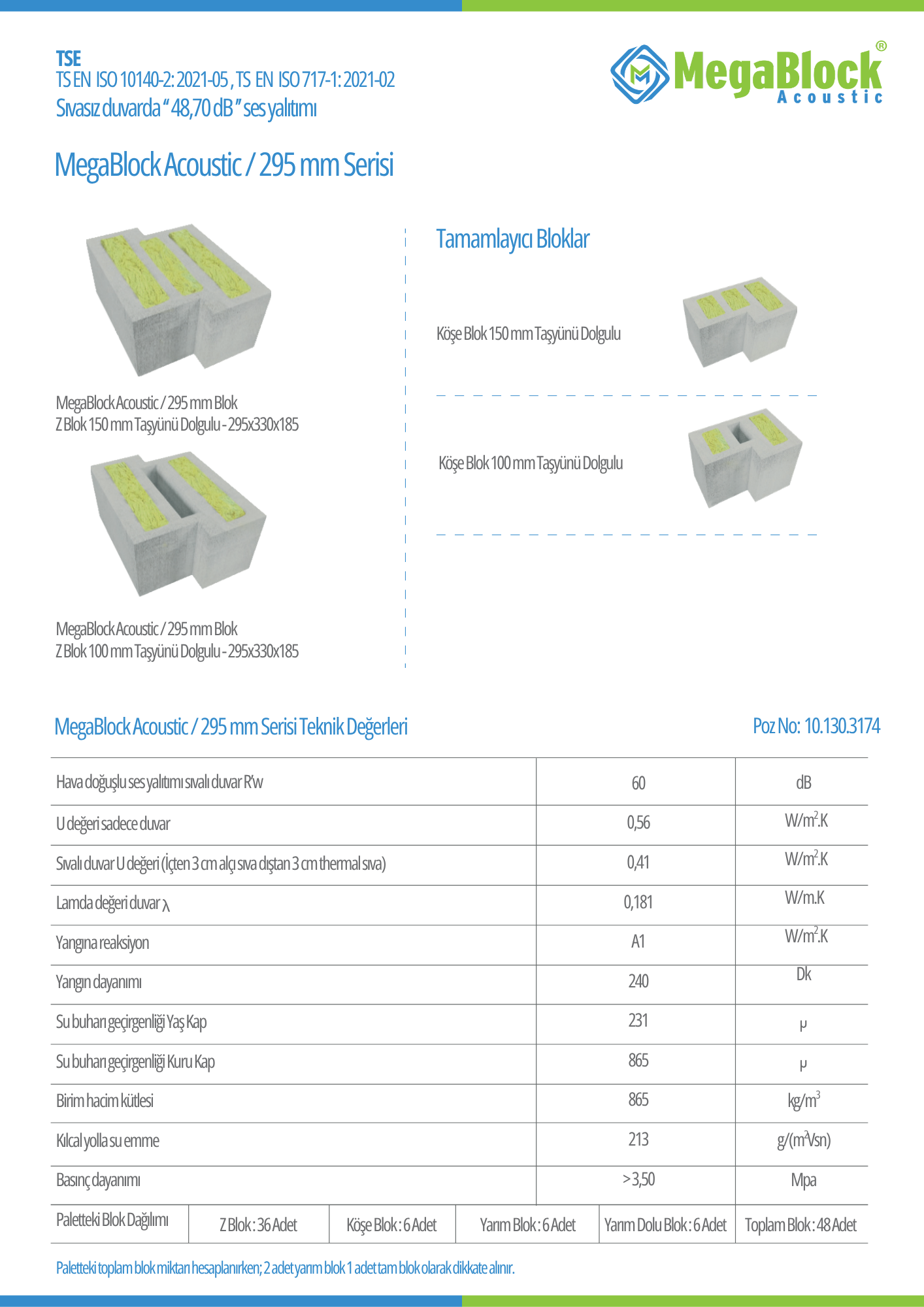
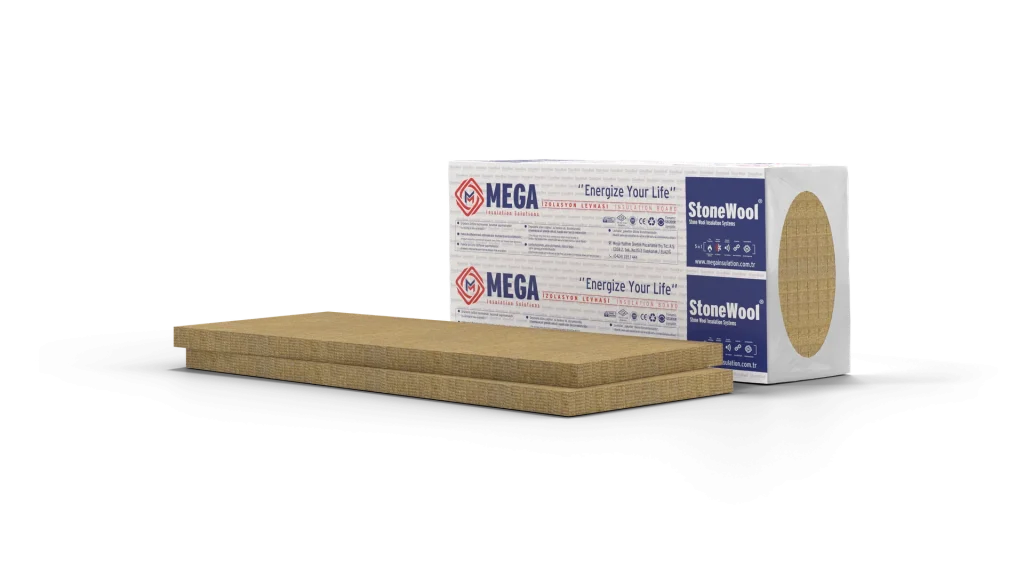
These principles are reflected in Mega products in different ways. In lightweight partition walls, the partition wall board fills the cavity between the two linings; the stone wool in the cavity works as a porous sound absorber, like the fibrous absorbers in an anechoic chamber. DesiWool is a composite panel with plasterboard on one face and stone wool on the other, applied to the inner face of an existing wall to add a second layer. DesiWool is not an echo absorber but an insulation panel that reduces sound transmission through the wall. The sound insulation block, also known as MegaBlock Acoustic, has a stone wool core inside an outer shell of pumice and cement.
| Principle in the anechoic chamber | Equivalent in the building | Mega product and data sheet / test value |
|---|---|---|
| Porous, fibrous absorber | Placing stone wool in the cavity between the two linings of a lightweight partition | Partition Wall Board (MEGA SW PB 40/50/60): 40–60 kg/m³, λD ≤0.035 W/mK |
| Multi-layer shell | Adding a second layer of plasterboard and stone wool to an existing wall | DesiWool: 2700 x 1200 mm composite panel; in DesiWool W15 tests R’w 29 dB applied on one side, 42 dB applied on both sides |
| High-mass shell with fibrous core | Building the party wall with stone-wool-core blocks | MegaBlock Acoustic: R’w on plastered wall 47 dB for the 145 series, 53 dB for the 195 series, 56 dB for the 245 series, 60 dB for the 295 series |
| Spring mounting | Separating the screed from the structural slab with a resilient board (floating floor) | Floating Floor Board (MEGA SW FF100/110/120): 100–120 kg/m³, 30 mm, compressive strength 25 kPa |
Source: Mega technical data sheets and DesiWool W15 test reports. According to the data sheet, MegaBlock values apply to plastered walls; the values given for unplastered walls in the data sheets of the 145, 245 and 295 series are lower. The floating floor board product page lists under-screed applications between two storeys among its uses.
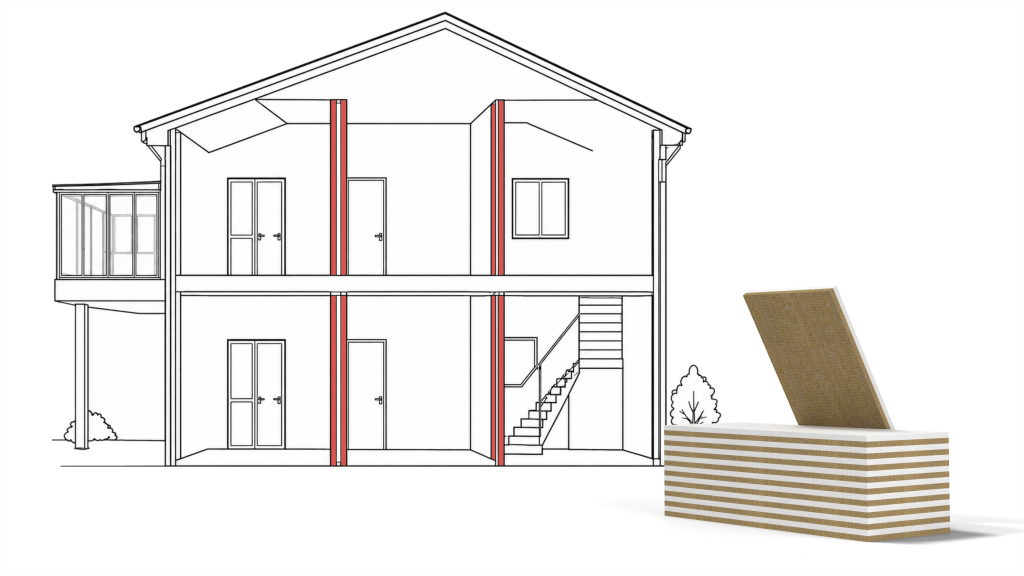
We cover choosing the right solution for a party wall in our wall sound insulation guide, the role of stone wool in partition walls in our article on stone wool sound insulation, and where DesiWool is applied in our article on interior wall insulation.
Application note from MegaUsta: In a partition wall, fit the stone wool boards snugly between the studs without compressing them and without leaving gaps. Gaps at the board edges and socket boxes placed back to back on both faces of the wall are shortcuts that sound uses to get through the wall.
Mega Insulation Solutions (Mega Yalıtım; registered name Mega Yalıtım Üretim Pazarlama Dış Ticaret A.Ş.) is a Turkish insulation materials manufacturer with its head office in Kavacık, Istanbul, and its factory in Elazığ. Alongside stone wool, XPS and EPS thermal insulation boards, it offers MegaBlock, MegaLento, DesiWool, MegaTech construction chemicals and Fullback waterproofing products under the Mega brand. The technical data sheets and test reports of the products are available on the Documents page.
Frequently Asked Questions
What is an anechoic chamber used for?
An anechoic chamber is used to measure sound under free-field conditions, without reflections mixing in. NIST’s chamber is used to measure the sensitivity, frequency response, directionality and self-noise of electroacoustic devices such as microphones, loudspeakers and hearing aids. The Orfield chamber is also used mainly for product testing and research; manufacturers study the sound of products ranging from motorcycles to washing machines in rooms like this.
What is the sound level in an anechoic chamber?
In the quietest anechoic chambers the ambient sound level is below zero. According to Guinness World Records, -24.9 dBA was measured in the Orfield Laboratories chamber; Microsoft’s chamber briefly held the record in 2015 with an average of -20.35 dBA. On the decibel scale, 0 dB is the 20-micropascal reference pressure taken as the standardised threshold of hearing. A negative value means the background sound in the room is below even that reference.
How can echo be reduced at home?
Echo at home comes from hard, flat surfaces reflecting sound back into the room, so it is reduced by adding porous, sound-absorbing surfaces. Carpets, heavy curtains and porous acoustic ceiling tiles belong to this group. Sealing the surface of a porous absorber with paint markedly reduces its absorption. Reducing echo does not stop noise from the neighbours; that requires sound insulation that adds mass and layers to the wall.
Sources
- NIST (US National Institute of Standards and Technology): Acoustic Anechoic Chamber, technical specifications
- Guinness World Records: Inside quietest place on Earth where you can hear your blood pumping and eyes blinking (27 August 2024)
- Guinness World Records: Microsoft lab sets new record for the world’s quietest place (2 October 2015)
- OSHA Technical Manual, Section III, Chapter 5: Noise (decibels and reference sound pressure)
- Daniel, C., Lovatt, A., Mason, O. J. (2014). Psychotic-Like Experiences and Their Cognitive Appraisal Under Short-Term Sensory Deprivation. Frontiers in Psychiatry
- Official Gazette of Türkiye: Regulation on the Protection of Buildings against Noise (31 May 2017, No. 30082)
- Amjad, S. (2001). Thermal Conductivity and Noise Attenuation in Aluminium Foams, MPhil dissertation, University of Cambridge, Department of Materials Science and Metallurgy: Chapter 5, Sound Attenuation (PDF)
- Mega Insulation: Partition Wall Board (MEGA SW PB 40/50/60) technical data sheet (PDF)
- Mega Insulation: DesiWool technical data sheet (PDF)
- Mega Insulation: MegaBlock Acoustic 145/50SW technical data sheet
- Mega Insulation: MegaBlock Acoustic 195/90SW technical data sheet
- Mega Insulation: MegaBlock Acoustic 245 series technical data sheet
- Mega Insulation: MegaBlock Acoustic 295 series technical data sheet
- Mega Insulation: Floating Floor Board (MEGA SW FF100/110/120) technical data sheet (PDF)
Nobody needs a home as quiet as an anechoic chamber, but applying the same principles in the right places makes calmer rooms possible. You can explore wall and floor solutions on the stone wool boards page and reach our technical team for your project through our contact page.