

Submarine acoustic insulation treats the outside and the inside of the hull together to make the submarine harder to detect by sonar. The anechoic coating around the hull weakens the echo of the sound wave sent by enemy sonar, while resilient mounts and floating rafts that separate the machinery from the hull limit the transfer of machinery vibration into the hull and from there into the water.
What makes a submarine moving through deep water dangerous is its silence as much as its weapons. A sonar operator never sees the submarine; it is found either from the sound it emits or from the echo of the operator’s own sound wave returning from the hull. That is why sound is taken as seriously in submarine design as hull shape or propulsion. In this article we explain how the vibration and noise sources inside a submarine are isolated, how the coatings used against sonar work, and where the same physics appears in buildings.
What is sonar and why must a submarine be quiet?
Sonar is a system that uses sound waves to detect and locate objects underwater; the name is short for “Sound Navigation and Ranging”. A submarine must be quiet because sound travels much farther in water than light and radar waves, and listening is the main way to find a submarine underwater.
The US National Oceanic and Atmospheric Administration (NOAA) distinguishes two types of sonar. Active sonar sends a pulse of sound into the water and works out the range and orientation of a target from the returning echo. Passive sonar emits no signal of its own and only listens; it is used to detect the noise made by ships, submarines and whales. On its own, passive sonar cannot measure the range of a target; to do so it has to work together with other listening devices.
For a submarine, these two methods mean two separate threats. Against passive sonar, the submarine has to reduce the noise it makes itself; against active sonar, it has to weaken the echo returning from its hull. The hum of an engine, the turning of a propeller or the vibration of a machine inside leaves traces that passive sonar can hear. A study on vibration isolation in ship systems by researchers at Beihang University (Beijing University of Aeronautics and Astronautics) also stresses that excessive vibration and noise can expose an underwater vehicle to the enemy and weaken its acoustic stealth. The same noise also degrades the crew’s working and living environment and makes communication on board harder.
What layers make up submarine acoustic isolation?
Submarine acoustic isolation is not achieved with a single material but with layers that deal separately with every path by which sound can escape. The main ones are:
- Anechoic outer coating: A rubber or polyurethane based layer around the hull reduces the part of the sonar wave reflected back from the hull and suppresses the acoustic vibration response of the hull.
- Resilient machinery mounts: Machines are not fixed directly to the hull but seated on resilient connections such as elastomer mounts; the vibration of the machine is cut in this resilient intermediate layer.
- Floating raft (two-stage mounting): Machines are attached by resilient mounts to a heavy intermediate raft, and this raft is connected to the hull’s supporting foundation through a second resilient stage. Vibration is filtered twice before it reaches the hull.
- Interior noise control: Airborne noise inside the compartments is also reduced. This supports both stealth and the crew’s comfort and communication.
| Layer | Against which threat? | What does it do? |
|---|---|---|
| Anechoic coating | Active sonar | Weakens the echo returning from the hull and suppresses the hull’s acoustic vibration response |
| Resilient machinery mounts | Passive sonar | Limits the transfer of machinery vibration into the hull |
| Floating raft | Passive sonar | Filters vibration in two resilient stages before it reaches the hull |
| Interior noise control | Passive sonar, crew comfort | Reduces airborne noise inside the compartments |
The table is based on NOAA’s definition of sonar, the review of underwater anechoic coatings by Jia, Jin and Ye (2025), and studies on machinery isolation in ships and submarines (Peters et al., 2012; Ma et al., 2014).
None of these layers is enough on its own. The anechoic coating works against active sonar and vibration isolation against passive sonar; what hides a submarine acoustically is applying both together.
How does an anechoic coating weaken the sonar echo?
An anechoic coating weakens the echo returning to the sonar by damping an incoming sound wave inside itself instead of reflecting it back; it is a polymer layer applied to the outer surface of a submarine hull. According to the 2025 review by Jia, Jin and Ye, these coatings usually consist of a rubber or polyurethane matrix layer and are used to suppress the hull echo and the acoustic vibration response of the hull at the same time.
The most common structure in these coatings is cavities formed inside the material. When the sound wave reaches these cavities, the longitudinal wave that travels by compression and expansion is converted into a shear wave with much higher losses, and the viscoelastic material damps this wave through internal friction. Part of the sound energy is thus turned into heat inside the coating, and the echo returning to the sonar becomes weaker.
Depth makes this harder. According to the same review, the rubber matrix deforms considerably under high hydrostatic pressure, and as pressure increases the frequency band in which the coating absorbs sound best shifts towards higher frequencies. This is why, the deeper a submarine dives, the harder it becomes for the coating to maintain the performance it was designed for. We explained how surfaces that absorb almost all sound are used on land in our article on the anechoic chamber.
How does vibration isolation keep a submarine quiet?
Vibration isolation reduces the sound a submarine radiates into the water by cutting the vibration produced by machinery in a resilient intermediate layer before it reaches the hull. The real problem here is not airborne sound but structural vibration travelling through the metal hull: vibration that reaches the hull is radiated from its surface into the water as sound.
A study presented at the 2012 conference of the Australian Acoustical Society (Peters et al.) defines the primary aim of machinery isolation in submarines as isolating the structural vibration of the onboard machinery from the hull. The study uses finite element and boundary element models to examine how machinery separated from the hull by resilient mounts changes the acoustic signature of the submarine.
One of the solutions widely used in ships is the floating raft system. In the 2014 study by Ma and colleagues, the system is described in five parts: the machine to be isolated, the upper damper, the intermediate raft, the lower damper and the supporting foundation. According to the results, the heavier the intermediate raft, as far as conditions permit, and the softer the supporting mounts, as far as stability allows, the better the isolation works; increasing the thickness of the foundation up to a certain limit also improves the result.
The same principle applies to buildings. If the vibration of a lift motor, a pump set or an air handling unit is not properly separated, it can travel through the reinforced concrete structure to other floors of the building. In buildings where quiet matters, such as concert halls, recording studios and hospitals, separating vibration sources with resilient layers is therefore part of the design. You can read how similar layered protection is built into a fighter aircraft in our article on the F-16 cockpit.
What does this mean for your building?
The logic of the submarine also works in a building: separate vibration from the structure at its source with a resilient intermediate layer. In homes, the best-known application of this is the floating floor; on walls, layered solutions that place a resilient, porous infill between two masses are used.
The Turkish Regulation on the Protection of Buildings Against Noise (Official Gazette, 31 May 2017, issue 30082) defines sound in a building by the path it takes. Airborne sound is sound generated by the vibration of a source in the air and spreading through the air. Impact sound arises directly in a solid medium, for example in the floor, through a door slamming, footsteps or furniture being dragged, and is transmitted to the building’s structural system and building elements. Machinery vibration in a submarine is a close relative of impact sound in a building: both travel through a solid structure.
How are vibration and impact sound cut in floors?
In floors, vibration and impact sound are cut by a floating floor, which separates the screed from the structural slab with a resilient board. The regulation defines a floating floor as a floor type in which the connection between complementary components such as the floor covering or the screed and the floor and wall bodies is cut horizontally and vertically by a resilient, pressure-resistant impact sound insulation layer. Article 6 of the regulation also lists impact sound insulating layers and vibration isolators among the products whose acoustic performance must be declared.
The Mega floating floor board is, according to its technical data sheet, a stone wool board in types MEGA SW FF100, FF110 and FF120, with a density of 100–120 kg/m³ and a thickness of 30 mm; its compressive strength is 25 kPa and its declared thermal conductivity is λD ≤0.036 W/mK. The product page lists vibration-generating foundations among its uses, alongside floor coverings, under screed between two concrete floors and floors over open passages. We described the installation steps in our guide what is a floating floor.
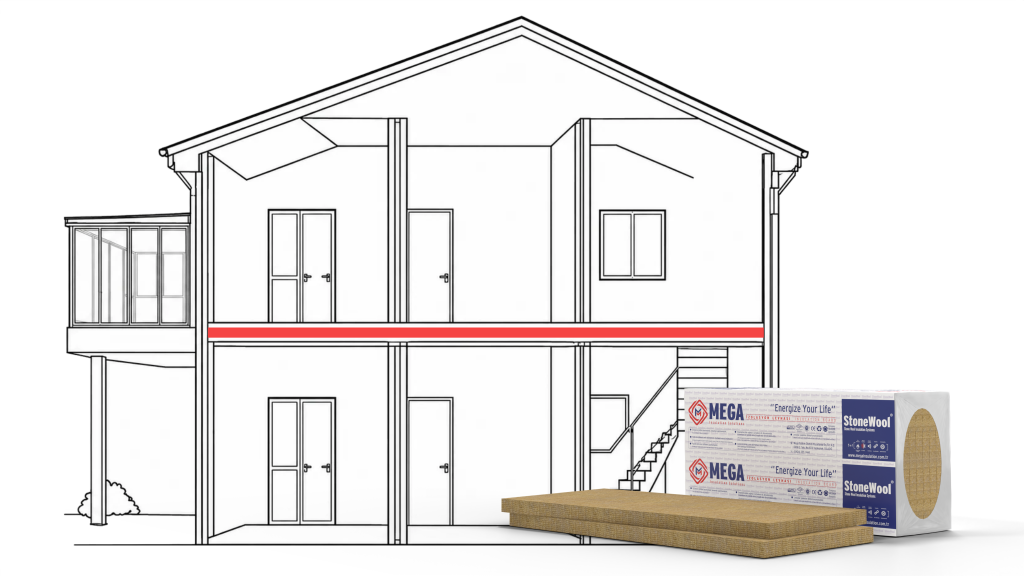
Site note from MegaUsta: Once you have separated a screed or a vibrating machine with a resilient layer, do not undo that separation with a single point of contact. Screed poured without an edge strip along the walls, a pipe fixed to the floor or a rigid connection carries vibration straight into the structure. Whatever bolting a resilient mount to the hull would do in a submarine, the same happens in a building.
Which Mega products are used on walls?
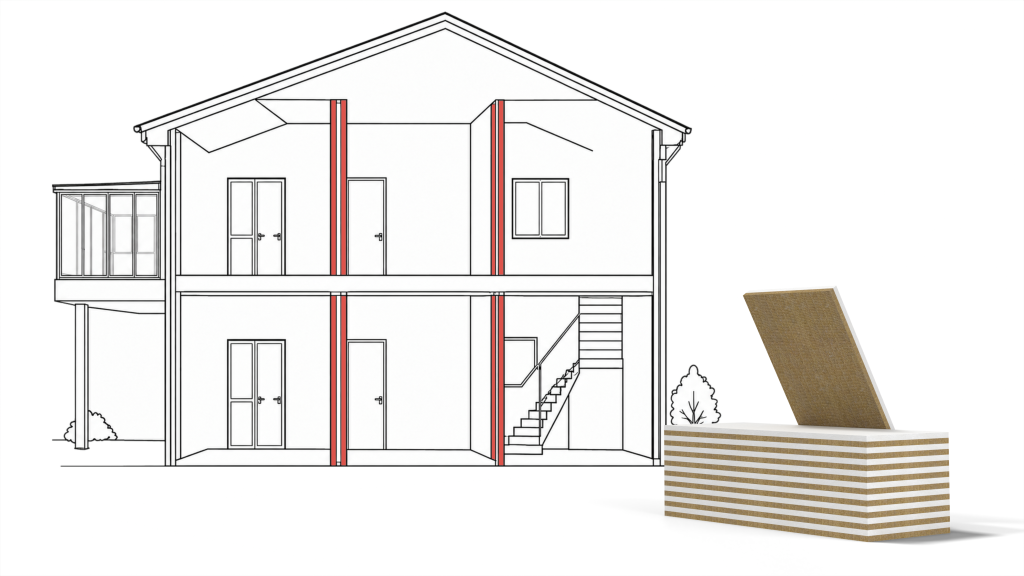
Stone wool based layers are used on walls to reduce airborne sound. DesiWool is a composite panel with a plasterboard face on one side and stone wool on the other, applied to the face of an existing wall. In lightweight partition walls, the partition board fills the cavity between the two linings. We covered how to choose a solution for party walls in our guide to wall sound insulation.
| Product | Construction | Where is it used? | Data sheet / test value |
|---|---|---|---|
| Floating Floor Board | Stone wool board (MEGA SW FF100/110/120); 100–120 kg/m³, 30 mm | Under screed, floor coverings, vibration-generating foundations | Compressive strength 25 kPa; λD ≤0.036 W/mK |
| DesiWool | Plasterboard and stone wool composite panel; 2700 x 1200 mm | Inner face of external walls, internal partitions and party walls, walls adjoining stair and lift shafts | DesiWool W15 tests: R’w 29 dB applied on one side, R’w 42 dB applied on both sides |
| Partition Board | Stone wool board (MEGA SW PB 40/50/60); 40–60 kg/m³ | Lightweight partition wall systems | λD ≤0.035 W/mK |
Source: Mega technical data sheets and DesiWool W15 test reports. All products in the table are stone wool based, and their data sheets declare reaction to fire class A1 (A1-s1-d0 for DesiWool).
We looked in detail at how noise affects not only comfort but also health in our article on the health effects of noise.
Mega Insulation Solutions (Mega Yalıtım; legal name Mega Yalıtım Üretim Pazarlama Dış Ticaret A.Ş.) is a Turkish manufacturer of insulation materials with its head office in Kavacık, Istanbul, and its factory in Elazığ. In addition to stone wool, XPS and EPS thermal insulation boards, it offers MegaBlock, MegaLento, DesiWool, MegaTech construction chemicals and Fullback waterproofing products under the Mega brand. You can find the technical data sheets and test reports for the products on the Documents page.
Frequently Asked Questions
Why do submarines have to be quiet?
Submarines have to be quiet because the main ways of finding them underwater are listening to the sound they make or catching the echo that returns from their hull. Passive sonar listens to engines, propellers and machinery; active sonar measures the echo of the sound pulse it sends out. Since sound travels much farther in water than light or radar waves, reducing vibration and noise is the basic condition for staying hidden.
What is an anechoic coating?
An anechoic coating is a polymer layer applied to the outside of a submarine hull to weaken the echo of a sonar wave. It is usually based on rubber or polyurethane and contains cavities. In these cavities the sound wave is converted into high-loss shear waves and damped inside the viscoelastic material. The coating also suppresses the acoustic vibration response of the hull, although water pressure affects its performance as depth increases.
How is vibration isolation done in buildings?
In buildings, vibration isolation is done by separating the vibration source from the structure with a resilient intermediate layer. On floors, the screed is separated from the structural slab by a resilient, pressure-resistant board such as stone wool and does not touch the walls; this is called a floating floor. Machines such as lift motors, pumps or air handling units are set on resilient mounts, and pipes and fixed connections are detailed so that they do not carry vibration.
Sources
- NOAA (US National Oceanic and Atmospheric Administration): What is sonar?
- Jia, X., Jin, G., Ye, T. (2025). Review of Underwater Anechoic Coating Technology Under Hydrostatic Pressure. Journal of Marine Science and Application, 24(1)
- Peters, H., Kinns, R., Kessissoglou, N., Marburg, S. (2012). Effect of internal mass isolation on the radiated sound power of a submerged hull. Acoustics 2012, Australian Acoustical Society
- Ma, Y., Yang, Y., Lin, K., Lou, P. (2014). Effects and Analysis of Floating Raft Vibration Isolator Parameters on the Performance of Vibration Isolation. MEIC 2014 (PDF)
- Official Gazette of Türkiye: Regulation on the Protection of Buildings Against Noise (31 May 2017, issue 30082)
- Mega Insulation: Floating Floor Board (MEGA SW FF100/110/120) technical data sheet (PDF)
- Mega Insulation: DesiWool technical data sheet (PDF)
In a building, as in a submarine, quiet starts with cutting the path that vibration and sound take with the right layer. You can explore floor and wall solutions on the stone wool boards page and reach our technical team for your project through our contact page.