
In short: ETICS (external wall insulation) materials consist of the insulation board, board adhesive, anchors, starter and corner profiles, reinforcing mesh, base coat, and a finishing coat of decorative render and paint. These components work as a single system on the facade: the board reduces heat transfer, the adhesive and anchors fix the board to the wall, the mesh-reinforced base coat protects the surface, and the finishing coat gives the facade its texture and colour.
This guide brings together the role of each component, the coverage and waiting times given in Mega’s technical data sheets, and the storage conditions. For a definition, see what is external wall insulation; for the application sequence, see how to apply external wall insulation.
What materials does an ETICS facade need?
An ETICS is made up of seven basic components. Often referred to together on the market as an “ETICS package”, they do the following:
- Insulation board: The insulating layer of the system; stone wool, white or grey EPS, or rough-surfaced XPS boards are used.
- Board adhesive: A cement-based mortar that bonds the board to the wall.
- Anchors: Fix the board mechanically to the wall once the adhesive has hardened.
- Starter and corner profiles: Give the bottom edge of the system, building corners and window reveals a straight, protected finish.
- Reinforcing mesh: An alkali-resistant glass fibre mesh embedded in the base coat; it increases the strength of the render layer.
- Base coat: A fibre-reinforced intermediate render applied over the board together with the mesh.
- Finishing coat: Decorative mineral render and paint; it gives the facade texture and colour and covers the layers beneath.
Why should ETICS be treated as a system?
How an ETICS performs on the facade depends on how well its components work together. An adhesive that does not grip the board properly, or an incompatible render, raises the risk of blistering and cracking on the facade.
The standards also treat ETICS as a whole. TS EN 13499 covers external thermal insulation composite systems (ETICS) based on EPS, and TS EN 13500 covers those based on mineral wool. Both define the system as factory-made products supplied as a kit and count starter and corner profiles as part of the system.
Turkish legislation takes the same approach. Under Article 27(2) of the Regulation on the Fire Protection of Buildings, a thermal insulation system made up of insulation material, adhesive, anchors, render mesh and render must be certified as a system by an accredited laboratory under the relevant standards, and the system details and technical properties must be included in the documents supplied when it is placed on the market.
Mega Insulation Solutions (Mega Yalıtım) is a Turkish insulation materials manufacturer headquartered in Kavacık, Istanbul, with its factory in Elazığ. For ETICS it offers stone wool, EPS and XPS boards together with MegaTech adhesives and renders under the Mega brand. Facade solutions other than ETICS are covered in our article on types of external wall insulation.
Insulation board: stone wool, white and grey EPS, XPS
The insulation board is the layer in an ETICS that actually reduces heat transfer; its type is chosen according to the position of the wall, the building’s requirements and the calculation in the thermal insulation design. Mega’s ETICS boards and their data sheet values are as follows:
| Board | Mega type (examples) | λD (W/mK) | Size (mm) | Reaction to fire class (EN 13501-1) | Product standard |
|---|---|---|---|---|---|
| Stone wool ETICS board | MEGA SW F150 · F120 · SW-35L | ≤0.037 (F150, F120) · ≤0.035 (SW-35L) | 1200 × 600 | A1 | TS EN 13162 |
| White EPS (EPSW) | EPS 40W … EPS 120W | 0.041 (EPS 40W) … 0.034 (EPS 120W) | 500 × 1000 | E | TS EN 13163 |
| Grey EPS (EPSG) | EPS 30P-G … EPS 70 (G) | 0.035 (EPS 30P-G) … 0.031 (EPS 70 (G)) | 500 × 1000 | E | TS EN 13163 |
| Rough-surfaced grooved XPS | MEGA XPS T1500 · T2000 · T2500 · T3000 | 0.035 (T1500, T2000, T3000) · 0.036 (T2500) | 600 × 1200 | E | TS EN 13164 |
Source: Mega stone wool, EPS and XPS technical data sheets. The lower the λD value, the higher the thermal resistance at the same thickness. The reaction to fire classes in the table refer to the boards themselves: stone wool boards are class A1, and EPS and XPS boards are class E. The class of the installed system is stated separately in the system certificate.
For the difference between carbon-enhanced grey EPS and white EPS, see grey EPS or white EPS; for a comparison of the two polystyrene types, see XPS or EPS. Data sheets for all types are on the stone wool ETICS board, grey EPS ETICS board, white EPS ETICS board and grooved XPS pages.
What is used to bond the boards to the wall?
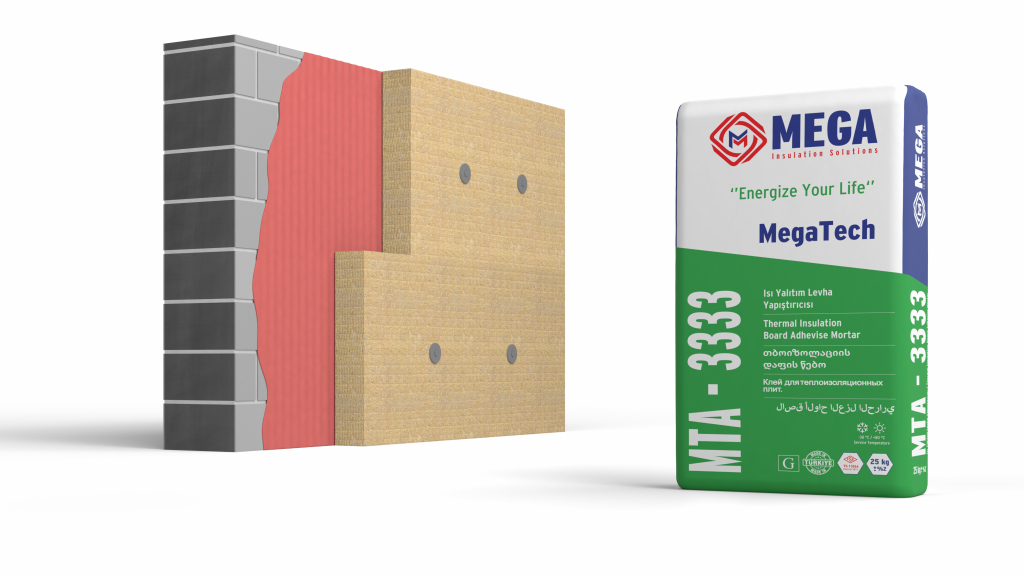
The boards are bonded to the wall with a cement-based insulation board adhesive. According to its technical data sheet, Mega’s thermal insulation board adhesive MegaTech MTA-3333 is used for bonding stone wool, EPS and XPS boards and complies with TS 13566. Adhesives and renders belong to the product family described in our article what are construction chemicals.
The application values in the MTA-3333 technical data sheet are as follows:
- Mixing: 5.5–6 litres of water per 25 kg bag.
- Coverage: 3–5 kg/m².
- Pot life: The mixed mortar must be used within 2 hours at most; working time is 10–15 minutes at most.
- Application method: On a flat wall the mortar is spread on the back of the board with a notched trowel; on an uneven wall it is applied in dabs.
- Waiting time: Anchoring is done at least 24 hours later; wait 2 days before applying the base coat.
- Weather: Apply between +5 °C and +35 °C; do not apply in direct sun, rain or strong wind.
- Bond strength: At least 0.08 N/mm² to the board and at least 0.5 N/mm² to the substrate.
Which base coat and mesh go over the board?
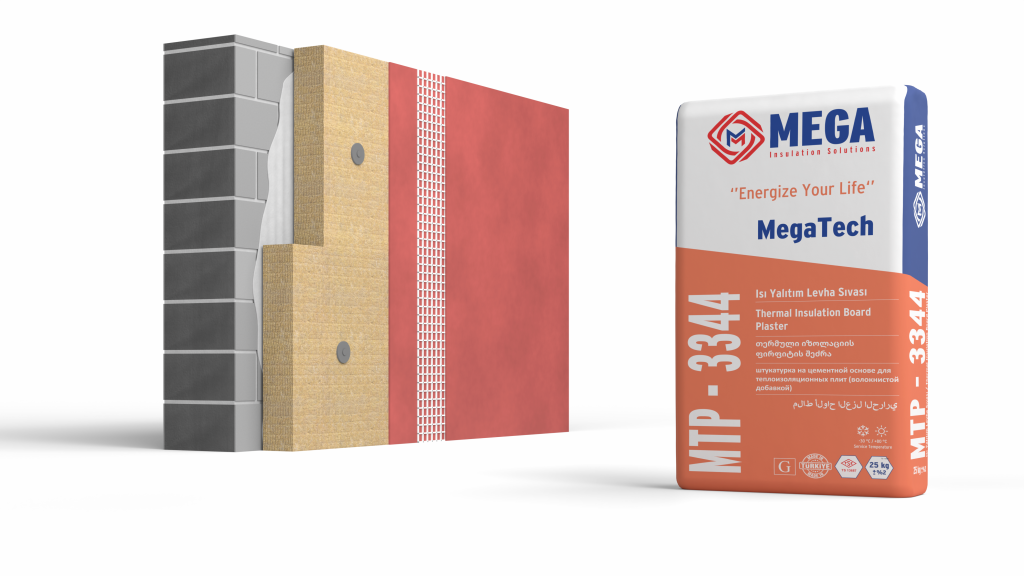
A cement-based base coat with an embedded alkali-resistant reinforcing mesh is applied over the board. Mega’s thermal insulation board base coat MegaTech MTP-3344 is fibre-reinforced and complies with TS 13687.
According to the data sheet, the base coat is applied over the boards at a thickness of about 4 mm once anchoring is complete. The 160 g/m² alkali-resistant mesh is overlapped by 10 cm at the edges and pressed into the render before it dries. Coverage is 3.5–5.5 kg/m².
The laboratory values given in the data sheet are: adhesion to the board at least 0.08 N/mm² (EN 13494), water absorption at most 0.50 kg/m² (EN 1015-18), water vapour diffusion resistance factor μ at most 15 (EN 1015-19). A render with a low μ value lets water vapour pass more easily.
What do anchors and profiles do?
Anchors fix the bonded board mechanically to the wall, while profiles give a straight, protected finish where the system starts, ends and turns a corner. Anchors and profiles are not part of the Mega product range, so these parts are selected according to the documentation of the system being used.
The anchor type, length and number depend on the board type, the wall material and the system documentation. EN 13499 and EN 13500 do not cover the strength of the connection between the system and the wall; this detail is confirmed through the project and system documentation. You can find the details in our guide on how many ETICS anchors are needed.
The starter profile lets the ETICS begin along a straight line at the base and protects the lower edge of the boards. Corner profiles give building corners and window reveals a clean edge; the MTP-3344 data sheet recommends mesh-backed corner profiles at corners.
Which render and paint are used for the finishing coat?
Once the base coat has dried, a cement-based decorative render is applied as the finishing coat, followed by paint. According to the MTP-3344 data sheet, the decorative render can follow the base coat after 1 day in summer and 2 days in winter. Mega’s decorative mineral render MegaTech MTD-3355 is cement-based, polymer-modified and water-repellent; it is applied 2 mm thick and complies with TS 7847.
According to the data sheet, this render is not left bare and must be painted once dry. For a line texture, the white-cement-based line-textured mineral render MTD-3355L can be used; it is applied over ETICS and can be painted. Both products have a coverage of 2.2–2.5 kg/m².
How much ETICS material is needed per m²?
According to Mega’s technical data sheets, 1 m² of ETICS requires 3–5 kg of board adhesive, 3.5–5.5 kg of base coat and 2.2–2.5 kg of decorative render, while the boards are calculated according to the wall area. Where you end up within each range depends on how even the wall is and on the application method.
| Material | Mega product | Coverage (kg/m²) | Packaging | Application note |
|---|---|---|---|---|
| Board adhesive | MTA-3333 | 3–5 | 25 kg bag | 5.5–6 L water per 25 kg |
| Base coat | MTP-3344 | 3.5–5.5 | 25 kg bag | About 4 mm, with 160 g/m² mesh |
| Decorative mineral render | MTD-3355 | 2.2–2.5 | 25 kg bag | 2 mm; painted once dry |
| Line-textured mineral render | MTD-3355L | 2.2–2.5 | 25 kg bag | Line-textured finishing coat; can be painted |
Source: MTA-3333, MTP-3344, MTD-3355 and MTD-3355L technical data sheets. As for the boards, stone wool and XPS boards measure 1200 × 600 mm (0.72 m²) and EPS boards 500 × 1000 mm (0.50 m²), which works out at about 1.4 stone wool or XPS boards, or 2 EPS boards, per m² of wall.
For example, on a 100 m² facade the data sheet ranges correspond to 300–500 kg of adhesive (12–20 bags) and 350–550 kg of base coat (14–22 bags). The budget calculation, including window openings and waste allowance, is covered in our article on ETICS cost.
What should you watch for in compatibility and storage?
Components from a single system should be used on the same facade, and bags should be stored in a dry, covered area off the ground. Mixing adhesives, renders and meshes from different systems takes the application outside the detail described in the system documentation.
- Shelf life: According to the MTA-3333, MTP-3344 and MTD-3355 data sheets, product stored under suitable conditions can be used for 12 months from the production date.
- Stacking: Kraft bags of these products are stacked no more than 8 high (the data sheets for hand and machine plasters set the limit at 6 bags).
- Storage conditions: Bags are kept in a dry, covered area away from sunlight and off the ground.
- Boards: The XPS data sheet requires boards to be protected from sunlight and covered with a UV-blocking sheet if left outdoors. Stone wool boards must be dry before rendering (MTP-3344 data sheet).
- Weather: The powder products are applied between +5 °C and +35 °C and must not be applied to frozen or thawing surfaces, or where there is a risk of frost within 24 hours. The MTP-3344 data sheet also requires air and surface temperatures to stay at or below +30 °C during application and curing. For choosing the right season, see when to apply external wall insulation.
Application note from MegaUsta: Do not add water or powder to loosen mortar that has already been mixed; the data sheets allow no additions once the mix is homogeneous. Discard mortar that has skinned over in the bucket or passed its pot life, and mix a fresh batch.
Frequently Asked Questions
Are ETICS adhesive and ETICS base coat the same product?
No, they are made for different jobs. The adhesive bonds the board to the wall, while the base coat is applied over the board together with the mesh to protect the surface. In Mega’s range the adhesive is MTA-3333, which complies with TS 13566, and the base coat is the fibre-reinforced MTP-3344, which complies with TS 13687. Their coverage also differs: 3–5 kg/m² for the adhesive and 3.5–5.5 kg/m² for the base coat.
How many kg of ETICS adhesive are needed per m²?
According to the MTA-3333 technical data sheet, board adhesive coverage is 3–5 kg/m². On a flat wall the mortar is spread on the back of the board with a notched trowel; on an uneven wall it is applied in dabs, and consumption moves towards the upper end of the range. On these figures, one 25 kg bag bonds roughly 5–8 m² of board. Repairing defects in the wall with a repair mortar beforehand makes consumption easier to control.
How do you choose the finishing render for ETICS?
The finishing render is chosen according to the texture you want and its compatibility with the base coat. In Mega’s range you can use MTD-3355 decorative mineral render, which is textured with the trowel, or MTD-3355L, which gives a line-textured surface. Both have a coverage of 2.2–2.5 kg/m². MTD-3355 is applied 2 mm thick and is not left bare; the colour of the facade comes from the paint applied once the render has dried.
Can paint be applied directly over the base coat?
Yes. The MTP-3344 technical data sheet states that paint can be applied directly over the thermal insulation board base coat. If a textured facade is wanted, decorative mineral render is applied first and painted once it has dried; the MTD-3355 data sheet does not allow the decorative render to be left bare as the final layer. Follow the paint manufacturer’s data sheet for the paint type and number of coats.
How long can ETICS materials be stored?
Mega’s board adhesive, base coat and decorative render can be used for 12 months from the production date when stored as the data sheet specifies. The bags should be kept in a dry, covered area away from sunlight, off the ground and stacked no more than 8 high. The data sheets also warn that unsuitable storage or exceeding this period can impair the product’s properties.
Sources
- Regulation on the Fire Protection of Buildings, Article 27 (mevzuat.gov.tr, in Turkish)
- EN 13499: ETICS based on EPS, standard record (SIS)
- EN 13500: ETICS based on mineral wool, standard record (SIS)
- Mega MTA-3333 technical data sheet (PDF, in Turkish)
- Mega MTP-3344 technical data sheet (PDF, in Turkish)
- Mega MTD-3355 technical data sheet (PDF, in Turkish)
- Mega MTD-3355L technical data sheet (PDF, in Turkish)
- Mega Yalıtım technical documents
Base coats and decorative renders are listed with their technical data sheets in the MegaTech renders category. To choose the right materials for your project, you can contact the Mega Yalıtım technical team via our contact page.