
In short: There is no single fixed anchor count for ETICS (external thermal insulation composite systems); it is set in the system documentation and application design according to building height, wind load, board type and wall material. The installer qualification of Turkey’s Vocational Qualifications Authority (MYK) calls for 6 anchors per m². Anchors go in at least 24 hours after bonding; the mesh is embedded in the base coat with 10 cm overlaps.
The waiting times and coverage values in this guide come from Mega’s MTA-3333 and MTP-3344 technical data sheets; the application rules come from the MYK national qualification and from documents of the European Organisation for Technical Assessment (EOTA). For an overview, see our article What is ETICS?; for every step, see How to apply ETICS.
What does an anchor do in ETICS?
An anchor is the fixing that mechanically ties the insulation board to the wall and resists the suction that wind creates on the façade. The weight of the board is carried by the adhesive, not by the anchor; the anchors’ share of the wind load depends on the system’s fixing method.
According to EOTA’s anchor assessment document EAD 330196, plastic anchors resist only the tension caused by wind load; the dead load of the system is transferred to the wall by the adhesive. The document treats anchors as “multiple fixings”: if one anchor slips or fails, its load passes to the neighbouring anchors. That is why the distribution of anchors across the façade matters as much as their number.
ETICS anchors come in two basic types: the nailed-in anchor, whose pin is driven with a hammer, and the screwed-in anchor, which expands as its screw is tightened. The expansion element can be steel or plastic; the system documentation sets the type.
ETICS anchor count: how many anchors per m²?
The number of anchors per m² is set by the system documentation and the application design. The MYK national qualification for thermal insulation installers describes drilling 6 anchor holes per m² in line with the technical specification; this is a starting value that a building-specific calculation can change. The number depends on the following factors:
- Wind load: In the EN 1991-1-4 approach, the wind pressure acting on a façade varies with building height and terrain roughness.
- Position on the façade: The same standard divides walls into zones; the highest suction occurs in the edge strips next to the building corners.
- Board type: The board’s tensile strength perpendicular to the faces and its size affect the anchor’s pull-through resistance and the number of anchors per board.
- Wall material: EAD 330196 assesses anchors separately for concrete, solid masonry, hollow or perforated masonry, lightweight aggregate concrete and autoclaved aerated concrete; the anchor’s assessment must cover the wall it is used in.
When and where are anchors fixed?
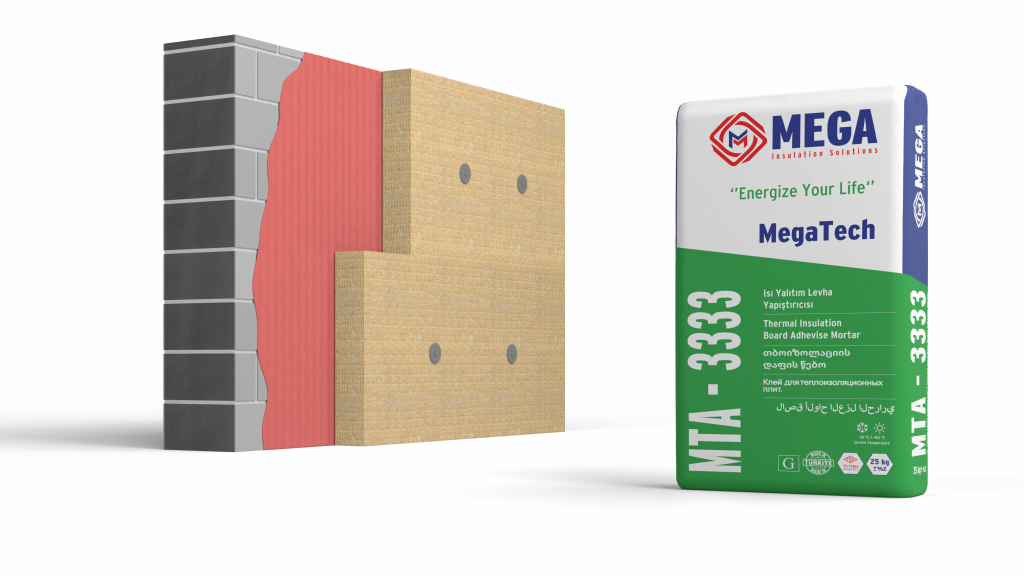
Anchors are fixed at least 24 hours after the boards are bonded and before the base coat. The data sheet of Mega’s MTA-3333 thermal insulation board adhesive gives this as a minimum that depends on ambient temperature and the substrate; drilling and fixing into adhesive that has not set can shift the board.
| Step | Product | When? | Data sheet value |
|---|---|---|---|
| Bonding the boards | MTA-3333 board adhesive | +5 / +35 °C; no direct sun, rain or strong wind | 3–5 kg/m²; mixed mortar used within 2 hours at most |
| Anchoring | Anchor specified in the system documentation | At least 24 hours after bonding | Type, length and number per the system documentation |
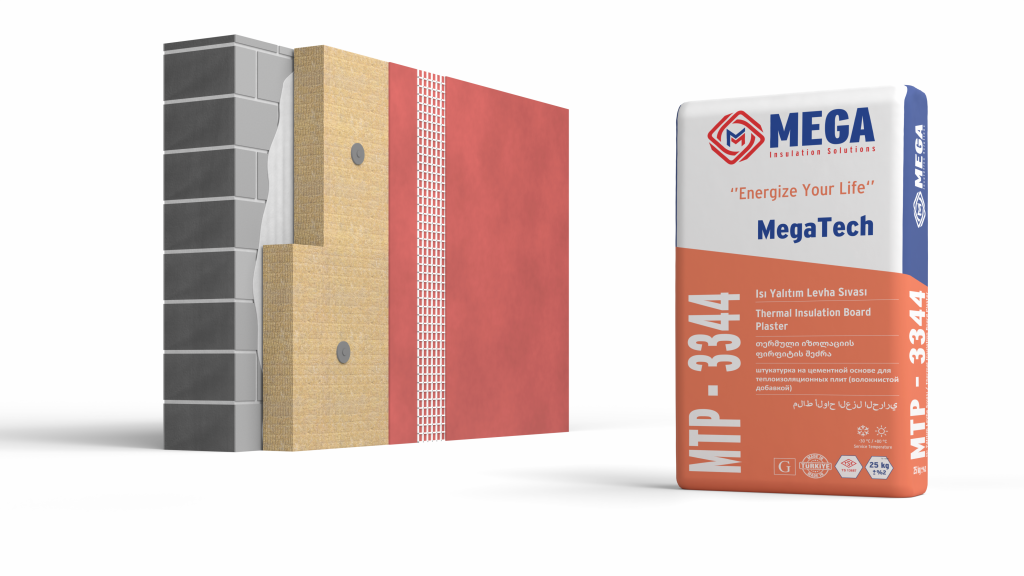
| First coat and mesh | MTP-3344 board render | 2 days after bonding | 160 g/m² alkali-resistant mesh, 10 cm overlap |
| Second coat | MTP-3344 board render | While the first coat is wet, or after it dries if the documentation requires | About 4 mm in total; 3.5–5.5 kg/m² |
Source: Mega MTA-3333 and MTP-3344 data sheets; second-coat sequence from MYK 12UY0057-3.
When placing anchors, the following rules apply:
- Length: The anchor must be at least as long as the board thickness, the adhesive layer, any existing render and the anchorage depth added together. EAD 330196 requires an effective anchorage depth of at least 25 mm; the product’s value is stated in its own ETA.
- Where it anchors: Anchorage depth is measured inside the load-bearing wall; existing render does not count towards it. EAD 330196 also excludes anchorages made in screeds or toppings on concrete.
- Edge distance and spacing: For anchors assessed to EAD 330196, the distance to the edge of the load-bearing member and the spacing between anchors are at least 100 mm.
- Head level: According to the MYK specification, a countersinking tool is used so that the anchor head sits flush with the board surface. A head that sinks too deep or stands proud shows through the render; we cover such defects in our article on common ETICS application mistakes.
- On-site testing: Where there are no national requirements and the anchor’s ETA covers that type of wall, EOTA TR 051 allows the anchor’s resistance to be determined on site with at least 15 pull-out tests.
Application note from MegaUsta: If you apply the adhesive with the frame-and-dab method, place the dabs where the anchors will go. This detail, part of MYK’s definition of the frame-and-dab method, leaves no void behind the anchor, so the board does not dish inwards when the anchor is driven.
Can ETICS be installed without anchors?
ETICS can be installed without anchors only if the documentation of the system in use defines a purely bonded application and the wall meets the conditions in that documentation. Without such documentation, anchors are not skipped. EAD 040083 divides ETICS into four groups by fixing method:
- Purely bonded: There are no anchors; the adhesive carries the load and the bonded area must be at least 20%.
- Bonded with supplementary anchors: The adhesive still carries the load; the anchors are a temporary connection that keeps the board flat until the adhesive reaches its final strength.
- Mechanically fixed with supplementary adhesive: The anchors carry the horizontal load.
- Purely mechanically fixed: The bonded area is below 20%; the board is held to the wall by mechanical fixings.
Mega’s MTA-3333 data sheet does not describe an anchor-free method; in MYK’s external wall specification, anchoring is likewise a separate step.
What is ETICS mesh and why must it be alkali-resistant?
ETICS mesh is the glass fibre reinforcing mesh embedded in the base coat. According to EAD 040083, most of the mechanical properties of the render layer come from the mesh together with the base coat it is embedded in.
The cement-based render that holds the mesh is an alkaline environment. EAD 040083 requires standard mesh to retain, after alkali conditioning, at least 50% of its as-delivered tensile strength and at least 20 N/mm. Mega’s MTP-3344 data sheet likewise specifies a 160 g/m² alkali-resistant mesh.
The EAD distinguishes standard mesh, embedded over the whole surface and overlapped at the joints, from reinforced (armour) mesh, embedded in addition for impact resistance. The system documentation states whether reinforced mesh is needed.
How is ETICS mesh applied, and where in the render does it go?
The mesh goes into the first base coat, not onto the board: it is pressed lightly into the wet render with a steel trowel, and the second coat covers it completely. According to the MYK specification, about two thirds of the render thickness lies beneath the mesh and one third above it.
- Two days after bonding, the first coat of MTP-3344 thermal insulation board render is applied over the anchored surface.
- The mesh is laid while the render is wet and pressed in lightly with a steel trowel, leaving no creases or bulges.
- Adjacent strips overlap by at least 10 cm horizontally and vertically.
- The second coat is applied while the first is still wet, or after it dries if the system documentation requires, and covers the mesh completely.
- According to Mega’s data sheet, total thickness is about 4 mm and coverage is 3.5–5.5 kg/m².
Laying the mesh on the board first and rendering over it is wrong: the mesh ends up at the bottom, against the board, instead of in the outer third described by MYK, and cannot reinforce the render properly.
According to Mega’s data sheets, the board render is applied between +5 and +35 °C and never to a frozen surface or one at risk of frost within 24 hours. For the choice of season, see when to apply ETICS.
How are corners and window openings reinforced?
Corner profiles go on the building corners, and extra pieces of mesh set at 45° to the corner go on the corners of window and door openings. MYK treats window and door corners as critical details.
- External corners: As MYK defines it, a corner profile increases the impact resistance of the external corner and keeps it straight and square; it is set in place with the board render.
- Window and door corners: In the MYK specification, 25 x 40 cm pieces cut from the reinforcing mesh are placed at a 45° angle to the corner.
- Undersides of balconies and projections: A drip-edge corner profile sheds rainwater away without damaging the façade.
Under EAD 040083, the system manufacturer specifies the type or performance of the profiles. For all components, see our guide to ETICS materials.
How do anchors differ for stone wool and EPS boards?
The anchor does the same job in both boards; the difference comes from the board’s tensile strength perpendicular to the faces and from its size. In Mega’s data sheets this strength is min. 10 kPa for MEGA SW F150 stone wool board and 100 kPa for EPS 50 (G) and EPS 80W boards. EAD 040083 states an anchor’s pull-through test result together with the plate diameter, the plate stiffness and the board’s tensile strength.
| Property | Stone wool ETICS board | EPS ETICS board |
|---|---|---|
| Mega type (example) | MEGA SW F150, F120 | EPS 50 (G), EPS 80W |
| Board size | 1200 x 600 mm | 500 x 1000 mm |
| Boards per 1 m² | About 1.4 | 2 |
| Tensile strength perpendicular to faces (TR) | Min. 10 kPa (PLUS, ULTRA, SW-35L: min. 7.5 kPa) | 100 kPa (50–150 kPa depending on type) |
| Value that defines the type | Density: F150 = 150 kg/m³ | Compressive stress: EPS 50 (G) = CS(10) 50 kPa |
| Per board at 6 anchors/m² | 4.3 anchors on average | 3 anchors |
Source: Mega stone wool and EPSW/EPSG data sheets; counts calculated from board size.
For this reason, on façades with stone wool ETICS board the plate diameter and stiffness of the anchor are chosen according to the system documentation, and the pattern is made denser where the documentation requires. Because grey EPS ETICS board is smaller, the same number per m² means fewer anchors per board. We compare stone wool types in our stone wool density guide.
Frequently Asked Questions
Why are more anchors used at building corners?
Wind suction in the edge strips next to building corners is higher than in the middle of the façade, so the anchor pattern may be denser in these strips. EN 1991-1-4 divides walls into zones and assigns the highest suction to the corner strips. The number of anchors in the strip is set by the system documentation and the wind calculation in the design.
When are anchors fixed?
Anchors are fixed at least 24 hours after the boards are bonded and before the base coat. Mega’s MTA-3333 data sheet gives this as a minimum that depends on ambient temperature and the substrate. Because the base coat follows 2 days after bonding, anchoring is completed between these two stages.
Can ETICS be installed without anchors?
ETICS is installed without anchors only if the documentation of the system in use defines a purely bonded application and the wall meets the conditions in that documentation. EAD 040083 treats this method as a separate system type with a minimum bonded area of 20%. Mega’s MTA-3333 data sheet, however, lists anchoring as a step of the application.
How much should ETICS mesh overlap?
ETICS mesh overlaps by at least 10 cm at the joints. The data sheet of Mega’s MTP-3344 board render specifies a 160 g/m² alkali-resistant mesh with a 10 cm overlap, and the MYK thermal insulation installer specification also requires at least 10 cm at horizontal and vertical joints. The second coat must cover the overlap area completely as well.
Which anchor is used for stone wool ETICS?
Stone wool ETICS uses the anchor specified by the system documented for stone wool boards, suited to the wall material and with a plate that resists pull-through from the board. In Mega’s data sheets the tensile strength perpendicular to the faces of these boards is min. 7.5–10 kPa depending on type, which makes plate diameter and stiffness important. Anchor length must be at least the board thickness, adhesive and anchorage depth combined.
Sources
- MYK 12UY0057-3 Thermal Insulation Installer National Qualification
- EOTA EAD 040083: ETICS with renderings
- EOTA EAD 330196: Plastic anchors for ETICS
- EOTA TR 051: Job-site tests of plastic anchors
- European Commission JRC: Eurocodes Handbook 3, wind actions and wall pressure zones
- Mega MTA-3333 technical data sheet
- Mega MTP-3344 technical data sheet
- Mega SW F150 technical data sheet
- Mega EPS 50-60-70 (G) technical data sheet
- Mega EPS 60W-80W-90W technical data sheet
- Mega Insulation technical documents
Mega Insulation Solutions (Mega Yalıtım) is a Turkish manufacturer of insulation materials that offers stone wool, XPS and EPS thermal insulation boards as well as MegaTech construction chemicals under the Mega brand. Data sheets for the board adhesive and render are available in the construction chemicals category, and for project-specific questions you can use our contact page.