
In short: Does stone wool burn? For Mega stone wool boards, the answer is no. Their technical data sheets give a reaction to fire class of A1 under TS EN 13501-1, and Turkey’s Regulation on the Fire Protection of Buildings defines this class as “non-combustible”. The same data sheets state a maximum service temperature of +750 °C. For faced boards and ETICS, the class is read separately from the relevant document.
The question looks simple, but the answer rests on three separate concepts: reaction to fire class, service temperature, and the fire resistance time of a building element. Below we explain all three using Mega’s technical data sheets and the regulation. If you would like to get to know the material first, start with our article what is stone wool.
Does stone wool burn?
Mega stone wool boards do not burn: every Mega stone wool data sheet lists A1 in the “Non-combustibility Class / Reaction to Fire” row, with TS EN 13501-1 as the reference standard. According to Annex 2/A of the regulation, class A1 materials do not contribute to fire at any stage of combustion, including a fully developed fire. Annex 2/Ç also places A1 in the “non-combustible” group.
In practice, this means the board adds no fuel to a fire. The relevant values in the data sheets of Mega stone wool products are as follows:
| Product | Types in the data sheet | Thickness (mm) | Reaction to fire class | Maximum service temperature |
|---|---|---|---|---|
| ETICS board | MEGA SW F120, F150, PLUS, ULTRA, SW-35L | 40–120 (SW-35L: 50–120) | A1 | +750 °C |
| Ventilated façade board | MEGA SW EF 70, 80, 90 | 40–120 | A1 | +750 °C |
| Partition wall board | MEGA SW PB 40, 50, 60 | 40–120 | A1 | +750 °C |
| Floating floor board | MEGA SW FF100, FF110, FF120 | 30 | A1 | +750 °C |
| Flat roof board | 30, 40, 50, 60 and 70 kPa | 40–100 | A1 | +750 °C |
Source: Mega stone wool technical data sheets (TDS). Product standard TS EN 13162+A1; board size 1200 × 600 mm.
Mega Insulation Solutions (Mega Yalıtım) is a Turkish manufacturer of insulation materials that offers stone wool, XPS and EPS thermal insulation boards under the Mega brand. The data sheets are published on the Documents page; to see which board is used where, read our article on stone wool applications.
Is stone wool fire resistant?
A stone wool board is class A1 in terms of reaction to fire; in technical usage, “fire resistant” describes a building element that withstands fire for a specified time. The regulation defines fire resistance as a building element’s ability to maintain its load-bearing capacity, integrity and insulation for a specified time. A time in minutes therefore belongs to the tested wall or door, not to the board.
For example, the MegaBlock Thermal thermal insulation block, whose data sheet gives reaction to fire class A1, is declared with a fire resistance of 120 to 240 minutes depending on the wall series. The same distinction applies to elements such as a fire door.
What does class A1 mean? The Euroclasses in one table
A1 is the top level of the European reaction to fire classification (Euroclass) and denotes materials that do not contribute to fire. Under TS EN 13501-1, construction products fall into seven main classes from A1 to F; their Turkish equivalents are given in the Annex 2 tables of the regulation.
| Class | Essence of the regulation’s definition | Category in the Turkish regulation |
|---|---|---|
| A1 | Does not contribute to fire at any stage of combustion, including a fully developed fire | Non-combustible (hiç yanmaz) |
| A2 | In a fully developed fire, does not contribute significantly to the fire load or fire growth | A2-s1,d0: limited combustibility (zor yanıcı); other suffixes: hardly flammable (zor alevlenici) |
| B | Meets stricter requirements than class C | Hardly flammable (zor alevlenici) |
| C | Meets stricter requirements than class D; lateral flame spread is limited | Hardly flammable (zor alevlenici) |
| D | Resists a small flame attack for a long period | Normally flammable (normal alevlenici) |
| E | Resists a small flame attack for a short period | Normally flammable (normal alevlenici) |
| F | Fire performance not determined | Easily flammable (kolay alevlenici) |
Source: Regulation on the Fire Protection of Buildings, Annex 2/A and Annex 2/Ç.
On this scale, Mega stone wool boards are class A1, i.e. non-combustible. Mega EPS and XPS boards are class E according to their data sheets; in other words, they are combustible and belong to the “normally flammable” group. For details, see our articles on the fire class of insulation materials and stone wool or EPS.
The difference between A1 and A2
An A1 material makes no contribution to fire at all; the A2 definition requires no “significant” contribution, which allows a limited one. A2-s1,d0 is therefore classed not as “non-combustible” but as “limited combustibility”. Since the regulation deems A1 materials to satisfy all properties of the lower classes, an A1 material also meets the class requirement wherever limited combustibility is required.
What do the smoke and droplet suffixes mean?
The s suffixes next to the class letter classify smoke, and the d suffixes classify burning droplets and particles:
- s1, s2, s3: s3 sets no limit on smoke production; s2 limits total smoke and its rate of increase; s1 is the most stringent class.
- d0, d1, d2: d0 means no burning droplets; d1 means none persisting longer than a specified time; d2 sets no limit.
In Annex 2/Ç of the regulation, the “non-combustible” category appears only as A1, without any suffix.
What temperature can stone wool withstand?
The technical data sheets of Mega stone wool boards declare a maximum service temperature of +750 °C. The value is the same in the data sheets of the ETICS, ventilated façade, partition wall, floating floor and flat roof boards.
The different temperature figures for stone wool found online may belong to other products or to other concepts such as the melting point. For Mega products, the value to rely on is the +750 °C in the data sheet.
Service temperature versus melting point
Service temperature and melting point are not the same thing. The maximum service temperature is the upper limit declared by the manufacturer, which should not be exceeded in use. The melting point is the temperature at which the fibres soften and melt, and Mega data sheets do not give it. So +750 °C is not a melting threshold but a service limit.
How is the class assessed for faced stone wool boards?
The class of a faced stone wool board is not automatically derived from that of the unfaced board; it is read from the product’s own technical data sheet or declaration of performance.
Annex 2/C of the regulation names mineral wool among the materials that may be deemed A1 without testing. Its general notes, however, cap the organic content of such materials and exclude panel materials with organic layers from this acceptance. A foil or glass tissue facing adds a new layer to the board, so the class of a faced board is read from the product’s own documentation, not from the general list.
Mega’s ventilated façade board, partition wall board and stone wool industrial board are offered with black or yellow glass tissue or aluminium foil facings as well as unfaced. Check the class of a faced variant in the document for the product you order; if there is none, request it in writing at the quotation stage.
If the board is A1, is the ETICS also A1?
An A1 stone wool board does not mean that the ETICS (external thermal insulation composite system) built with it is also A1. The system consists of the board, adhesive, anchors, reinforcing mesh, render and finish coat, and its fire behaviour is classified as a whole.
Article 27 of the regulation requires a thermal insulation system built from these components to be certified as a system by an accredited laboratory, and TS EN 13501-1 considers products in relation to their end use application. The A1 class in the data sheets of the Mega stone wool ETICS board therefore describes the board; the class of the system is read from the system certificate.
We describe the layers in detail in our article what is ETICS (mantolama). Staying with the components in the system certificate keeps the certified class valid on the building.
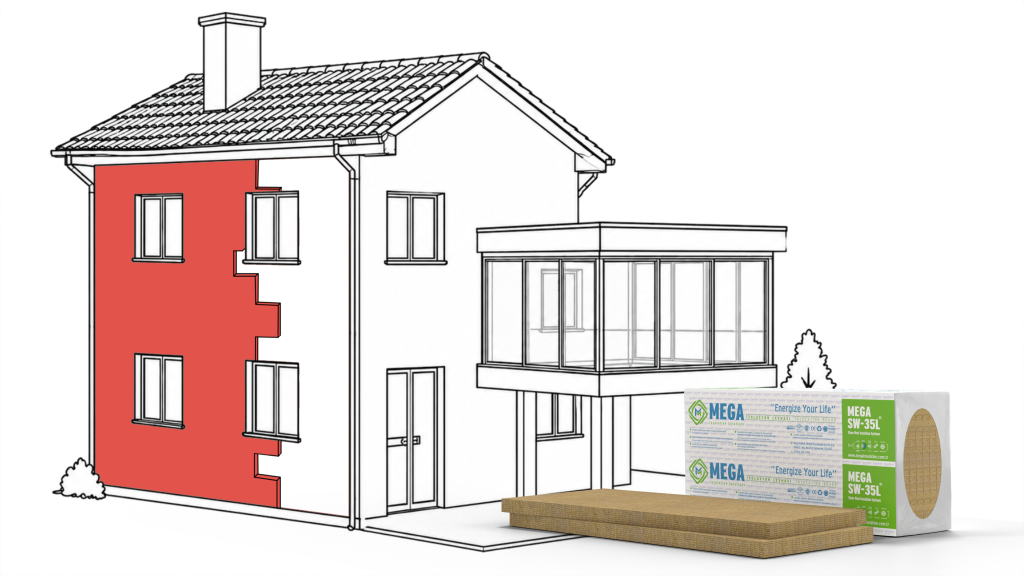
Application note from MegaUsta: Compare the product type on the labels of delivered packs with the technical data sheet. For barrier strips around windows, use the board type defined in the project and the system certificate.
What do the rules say about building façades?
Under Article 27 of the Regulation on the Fire Protection of Buildings, external façades must be of limited combustibility in buildings taller than 28.50 m and at least hardly flammable in other buildings. The façade provisions of the article were set by the 2015 amendment; the points that directly concern stone wool boards are:
- In buildings taller than 28.50 m, the external façade must be of limited combustibility (A2-s1,d0); an A1 material also meets this requirement.
- In buildings below 28.50 m whose façade is a hardly flammable material or system, the first 1.5 m above ground level is clad with non-combustible material.
- If such a building is taller than 6.50 m, fire barriers of non-combustible material at least 15 cm wide on the sides and at least 30 cm wide above windows and similar openings are required.
- In curtain walls with open joints or ventilated cladding, façade and insulation materials must be at least of limited combustibility.
Under the regulation, building height is the distance from the point at which the building takes its level up to the eaves. This summary is for general information; class selection, height calculation and barrier details are decided project by project by a qualified engineer and fire consultant.
Common misconceptions
Some frequently repeated statements about stone wool and fire are incomplete or wrong:
- “Stone wool produces no smoke at all.” The A1 definition says nothing about smoke; a smoke class, if any, is read from the document.
- “Stone wool withstands any temperature.” The limit in Mega data sheets is +750 °C; no value outside the data sheet should be assumed.
- “All insulation materials have the same class.” Mega stone wool boards are A1, while Mega EPS and XPS boards are class E according to their data sheets and are combustible.
- “ETICS made with an A1 board is also A1.” The system class is read from the system certificate.
Frequently Asked Questions
Does stone wool melt?
According to Mega data sheets, stone wool boards are declared for use up to +750 °C; the data sheets give no melting point. Service temperature and melting point are different quantities: the first is the use limit declared by the manufacturer, the second the temperature at which the fibres soften and melt. Melting figures found online should not be assumed for Mega products. Projects should rely on the +750 °C limit and the A1 reaction to fire class in the data sheet.
Can stone wool be used as a fire barrier?
Yes. Class A1 stone wool boards meet the regulation’s definition of a “non-combustible material” and can be used for the fire barriers required on façades. For buildings below 28.50 m whose façade is a hardly flammable system, the regulation requires the first 1.5 m above ground level and, in buildings taller than 6.50 m, the 15 cm and 30 cm barriers around windows to be non-combustible. Details follow the system certificate and the project.
Does stone wool produce smoke?
No general claim such as “stone wool produces no smoke” can be made; smoke behaviour is read from the product’s documentation. The regulation defines class A1 as a material that does not contribute to fire, and that definition says nothing separately about smoke. If a smoke class is stated in the document, that class applies. For example, the data sheet of the Mega DesiWool panel, made of stone wool and gypsum board, gives its class as A1-s1-d0.
How does the fire behaviour of stone wool compare with EPS and XPS?
According to Mega data sheets, the stone wool boards are class A1, whereas the EPS and XPS boards are class E, which means they are combustible. Class E materials fall into the regulation’s “normally flammable” group and resist a small flame attack for a short time. Where each material may be used depends on building height, façade type and the system certificate. For a detailed comparison, see our article on the fire class of insulation materials.
Where can I find the fire class of a stone wool board?
The fire class of a stone wool board is found in the product’s technical data sheet (TDS) or declaration of performance. In Mega data sheets it appears in the “Non-combustibility Class / Reaction to Fire” row, together with the reference standard. For faced variants, check the document for that variant; for systems such as ETICS, check the system certificate. Mega stone wool data sheets and certificates are available on the Documents page.
Sources
- Regulation on the Fire Protection of Buildings, official Turkish text (mevzuat.gov.tr)
- Official Gazette, 9 July 2015, No. 29411: amendment to the regulation (Decision 2015/7401)
- SS-EN 13501-1:2019 reaction to fire classification, standard record (SIS)
- Mega ETICS Board 150 technical data sheet (TDS, PDF)
- Mega Insulation certificates and documents (Documents)
To choose the right board for each application, review the products and data sheets on the stone wool boards page. For documents on faced variants or project-specific questions, contact Mega Insulation via the contact page.