
In short: When should ETICS (mantolama) be applied? On days when the air temperature stays between +5 °C and +35 °C during working hours, no frost is expected within the next 24 hours, and there is no rain or strong wind. Across most of Turkey these conditions come together most easily between May and October. In winter, work is possible only on days that meet them; in summer, the hottest hours and direct sun are avoided.
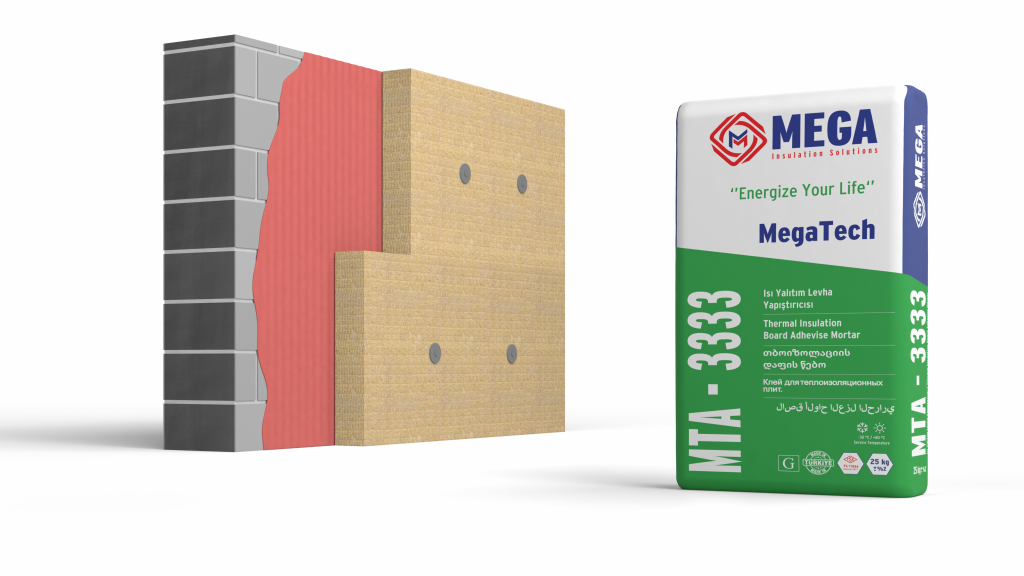
In ETICS, the adhesive that bonds the board to the wall, the base coat that carries the reinforcing mesh and the mineral decorative render are cement-based mortars; all three harden with water. In freezing weather this water turns to ice, extreme heat and wind evaporate it too quickly, and rain washes the fresh surface. That is why the deciding factor is not the name of the season but the temperature, rainfall and wind on the days of application. We explain the layers of the system in what ETICS is and the board options used on facades in our guide to types of ETICS.
What weather conditions are suitable for ETICS?
Suitable weather for ETICS means temperatures between +5 °C and +35 °C during working hours, a frost-free night, and a dry, calm day. The technical data sheets of the MegaTech mortars that Mega supplies for ETICS list these conditions one by one.
The table below brings together the application requirements in the data sheets for MTA-3333 thermal insulation board adhesive, MTP-3344 thermal insulation board render and MTD-3355 decorative mineral render, together with what they mean on site.
| Condition | Requirement in the Mega technical data sheet | What does it mean on site? |
|---|---|---|
| Ambient temperature | Between +5 °C and +35 °C (MTA-3333, MTP-3344, MTD-3355) | The first working hours in the morning and the last in the evening must also stay within this range. |
| Frost | Not applied to frozen or thawing surfaces, or to surfaces at risk of frost within 24 hours | Besides the working day, the next night’s minimum temperature is also checked. |
| Sun and surface temperature | Not applied in direct sun or on hot surfaces | The facade to work on is chosen according to the sun’s path. |
| Rain | Not applied in rain (MTA-3333) | No mortar is applied to a new facade on a day when rain is forecast. |
| Wind | Not applied in strong wind | Mortar loses water quickly; the facade is protected with scaffold netting or sheeting. |
| Pot life of the mortar | MTA-3333: the mix is used within 2 hours at most; open working time 10–15 minutes | In hot weather, mortar is mixed in small batches. |
| Anchors | At least 24 hours after bonding (MTA-3333) | These 24 hours must also be frost-free and dry. |
| Base coat | 2 days after bonding (MTA-3333) | Suitable weather is also needed for the two days between bonding and rendering. |
Source: MegaTech technical data sheets (MTA-3333, MTP-3344, MTD-3355). The table summarises the requirements in the data sheets; on site, the current data sheet of the product being used always takes precedence.
Reading the weather is part of the craft. The Thermal Insulation Applicator (Level 3) national qualification of Turkey’s Vocational Qualifications Authority (MYK) also lists, among the pre-insulation checks, the ability to explain the weather conditions required for the work.
Mega Insulation Solutions (Mega Yalıtım) is a Turkish manufacturer of insulation materials that supplies stone wool, XPS and EPS thermal insulation boards as well as MegaTech construction chemicals under the Mega brand. You can read what each of these mortars does in what are construction chemicals, and find the other components that complete the system in our guide to ETICS materials.
Which months are best for ETICS?
Across most of Turkey the most favourable period for ETICS is May to October; in July and August, the midday heat needs extra attention. The calendar below is a general guide; the final decision depends on your province’s climate and the forecast for the week of application.
| Period | General assessment | What to watch for |
|---|---|---|
| December–February | Mostly unsuitable in Central and Eastern Anatolia; in coastal cities only on dry, mild days | Night frost, frequent rain, short days |
| March–April | Varies by region | Sudden cold spells and spring rain; night temperatures are monitored |
| May–June | Suitable in most regions | In some provinces the number of rainy days peaks in May; the schedule is shifted according to the forecast |
| July–August | Suitable, except during the hottest hours | The +35 °C limit, direct sun and heated surfaces |
| September–October | Suitable in most regions; at higher altitudes night frost may begin in October | A good period for finishing the work before the heating season |
| November | Limited | Shorter days and falling night temperatures; work already started should be completed before winter |
How does the ETICS season change by region?
The suitable period for ETICS becomes a few months longer or shorter depending on the climate of your region. In the high parts of Eastern Anatolia the work is squeezed into the summer months; on the Mediterranean coast winters are mild, but winter rain and summer heat narrow the calendar.
Four examples taken from the long-term provincial statistics of the Turkish State Meteorological Service (MGM) show the difference clearly. In the months listed in the second column, night temperatures stay above +5 °C on average; this is when the data sheet requirement of “no risk of frost within 24 hours” is most easily met.
| Province | Months when the average minimum temperature exceeds +5 °C | Average maximum temperature in the hottest month | Month with the most rainy days |
|---|---|---|---|
| Erzurum | June–September | 27.4 °C (August) | May (16.0 days on average) |
| Ankara | April–October | 30.6 °C (August) | May (12.3 days on average) |
| Istanbul | March–December | 29.7 °C (July and August) | January (16.3 days on average) |
| Antalya | All year | 34.2 °C (July) | January (12.4 days on average) |
Source: MGM official climate statistics, long-term provincial averages. Averages give an indication; the decision on the day of application is always made by checking the current weather forecast.
- In high, cold provinces such as Erzurum: The average minimum temperature is 4.3 °C in May and 1.7 °C in October. Work is therefore planned to start in early June and finish by the end of September.
- In Central Anatolian provinces such as Ankara: April (5.5 °C) and October (7.2 °C) are borderline; May to September is safer. The number of rainy days peaks in May and falls to 2.7 days on average in August.
- In Istanbul: Winters are mild; even in January and February the average minimum temperature is 4.2 °C. In these months the calendar is usually set by rain: December and January have 15–16 rainy days on average.
- In Antalya: The average minimum temperature stays above +5 °C all year (the lowest value is 6.1 °C, in January). On the other hand, in July and August the average maximum exceeds 34 °C, very close to the +35 °C limit in the data sheets, while December and January are the wettest months of the year. Here, spring and autumn are the easier working periods.
What are the risks of applying ETICS in winter?
The main risk of winter ETICS work is the mortar freezing before it hardens. Frozen mortar loses adhesion, and cracks, blistering and colour differences may appear in the render. Because hardening slows down in cold, damp weather, the waiting times in the data sheets should also be treated as minimums.
Even so, winter is not a closed season everywhere. If a weather window with temperatures above +5 °C, no night frost expected and no rain can be found, work can continue. In that case the following precautions are taken:
- The schedule is based on a forecast of at least three days; bonding, anchoring 24 hours later and the base coat 2 days later must all fit into the same suitable window.
- Work starts after the sun has warmed the air, and the day’s application is finished before the evening chill; render applied late in the day can be caught by night frost.
- The scaffold is covered with sheeting to protect the fresh surface from wind and rain.
- Bags are stored in a dry, enclosed, frost-free place, off the ground; mortar is never mixed with icy water or frozen material.
- No additives that are not listed in the data sheet, and no extra water, are added to the mortar.
The general rules of cold-weather render and tiling work are covered in can you render in winter. For buildings whose ETICS will not be finished before winter, measures to limit heat loss are collected in our guide on heat loss at home.
What should you watch for when applying ETICS in extreme summer heat?
ETICS can be applied in summer; the points to watch are that the ambient temperature must not exceed +35 °C and the mortar must not be applied in direct sun or to a surface heated by the sun. A hot wall and board draw water out of the mortar quickly; the mortar dries out before it hardens, adhesion weakens and fine cracks may form in the render.
- Facade sequence: In the morning the west facade is in shade; in the afternoon work moves to the east facade. The north facade receives the least sun during the day, while the south facade is worked in the early hours or under shading sheets.
- Midday break: During the hottest hours, work stops on sun-exposed facades and moves to the cooler part of the day.
- Small batches: According to the MTA-3333 data sheet, the mix is used within 2 hours at most and its open working time is 10–15 minutes. Because mortar stiffens faster in heat, only as much as can be used up quickly is mixed at a time.
- Surface skin: According to the data sheets, if a skin forms on the surface of the applied mortar, it is combed again; boards are never pressed into mortar that has skinned over.
- Preparing the surface: Sun-heated, absorbent surfaces are lightly dampened before application, and fresh render is kept in shade so that it does not lose water too quickly.
- Protecting the boards: The Mega XPS data sheet requires the boards to be protected from sunlight and, if they are left outdoors, covered with a UV-blocking sheet. Other boards on site are also kept under cover.
How do rain, wind and humidity affect ETICS?
ETICS is not applied while it is raining or when rain is expected, and no work is done in strong wind. The Mega MTA-3333 data sheet states that the adhesive must not be applied in rain or strong wind; the strong-wind requirement also appears in the data sheets for the board render and the decorative render.
When can work resume after rain?
Wait until there is no running water or water film left on the wall and the boards. A stone wool board that gets wet must dry before it is rendered, which is why stone wool boards are stored under cover on site. Newly applied work is also protected from rain until it dries.
What difference do humidity and fog make?
Mega data sheets do not give a separate numerical limit for relative humidity. Even so, cement-based mortars harden more slowly in cool, damp weather, and render applied late in the afternoon can be damaged if it stays under dew and fog overnight. On such days, the waiting times in the data sheet are taken as minimums and extended if necessary.
Why is wind a problem?
Wind can draw water out of the mortar as quickly as the sun, and it makes carrying boards on the scaffold harder. On facades exposed to wind, scaffold netting or sheeting protects both the fresh surface and the crew.
How is an ETICS work schedule built around the weather forecast?
Because ETICS is not finished in a single day, you look for a run of suitable days rather than one fine day. According to the Mega MTA-3333 data sheet, anchors are installed at least 24 hours after bonding and the base coat follows 2 days later; the decorative mineral render is applied once the base coat has dried. According to the MTD-3355 data sheet, the decorative mineral render is not left as the final layer and must be painted once dry, so this step also belongs in the schedule.
The way to make good use of a suitable period is to sequence the facades: while the base coat goes onto a facade whose waiting time is over, bonding continues on another. On days when rain or frost is expected, no mortar is applied to a new facade; those days are set aside for preparing materials and for checks. The order and details of the steps are in our guide on how ETICS is applied, and you can find how board thickness is determined in how thick ETICS should be.
What are the advantages of applying ETICS in summer and autumn?
The main advantage of ETICS applied in summer and autumn is that the mortars can harden properly in dry, frost-free weather. On top of that, the work is finished before the heating season starts.
- Proper hardening: In mild, dry weather the adhesive and render harden under the conditions given in the data sheet, and the risk of bonding defects caused by frost or rain is reduced.
- Fewer interruptions: In many regions the number of rainy days falls markedly in summer. According to MGM data, August averages 2.7 rainy days in Ankara and 5.2 in Erzurum, which means fewer disruptions to the work schedule.
- A building ready for winter: ETICS finished in late summer or September reduces heat loss through the walls from the first heating season onwards.
- Summer comfort: ETICS also reduces the heat that passes indoors through sun-heated walls. We cover this in more detail in our article on keeping your home cool in summer.
- The autumn window: Except at higher altitudes, September and the first half of October are a period when the summer heat has passed but night frost has not yet begun.
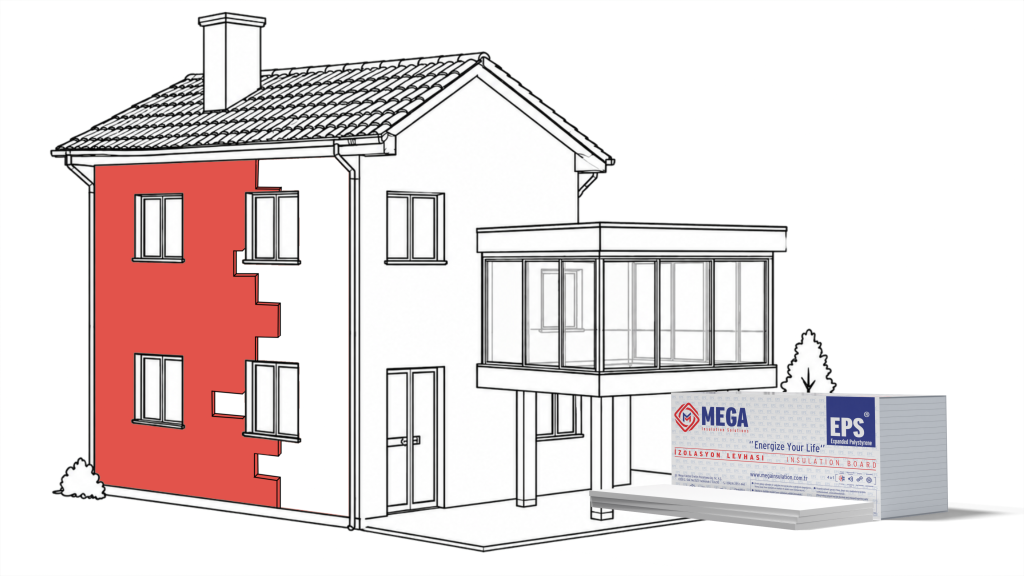
Materials are chosen according to the building, not the season. Mega’s boards for rendered facades include the stone wool ETICS board, the white EPS ETICS board and the grey EPS ETICS board; according to the MTA-3333 data sheet, the same adhesive is used for stone wool, EPS and XPS boards. The differences between the two materials are covered in our comparison stone wool or EPS.
Which weather-related mistakes are most common?
Most season-related mistakes come from rushing to finish the job on an unsuitable day. The most common ones on site are:
- Applying render late in the afternoon and having it caught by night frost.
- Spreading adhesive onto a heated board on a sun-exposed facade in the midday heat.
- Starting a new facade despite a chance of rain and leaving the fresh surface exposed.
- Reusing mortar that has skinned over or passed its pot life by adding water.
- Rendering a wet stone wool board before it has dried.
- Cutting the waiting times in the data sheet in cold weather.
Application defects that are not related to the season are covered in common ETICS application mistakes, and choosing whom to entrust the job to in how to choose an ETICS applicator.
Application note from MegaUsta: Before starting work in the morning, check the next night’s minimum temperature as well as that day’s forecast. If night frost is expected, do not apply fresh mortar that day, and make sure that the two days between bonding and rendering will also be dry and frost-free.
Frequently Asked Questions
Can ETICS be applied in winter?
In winter, ETICS can only be applied on days when the ambient temperature is above +5 °C, the surface is not frozen and no frost is expected within the next 24 hours; Mega’s adhesive and render data sheets require these conditions. In Central and Eastern Anatolia they rarely come together in winter. In coastal cities, mild but rainy days mean the schedule is built around the forecast and the scaffold is protected with sheeting.
At what temperature is ETICS applied?
ETICS is applied when the ambient temperature is between +5 °C and +35 °C. This range is a common requirement in the data sheets for Mega’s MTA-3333 board adhesive, MTP-3344 board render and MTD-3355 decorative render. The temperature range alone is not enough: the surface must not be frozen or heated by the sun, and no frost should be expected within 24 hours of application.
Can ETICS be applied in rainy weather?
No, ETICS is not applied while it is raining or when rain is expected. The Mega MTA-3333 data sheet states that the adhesive must not be applied in rain. Rain can wash out fresh mortar, delay its hardening and leave marks on the surface. After rain, wait until no water film remains on the wall and boards; a wet stone wool board is not rendered before it dries, and new work is protected with sheeting until it dries.
Can ETICS be applied in hot weather?
Yes, but the ambient temperature must not exceed +35 °C and the mortar must not be applied in direct sun. According to Mega data sheets, adhesives and renders are also not applied to surfaces heated by the sun. On hot days, work moves to the shaded facade, mortar is mixed in small batches, and work stops on sun-exposed facades during the hottest hours.
In which season should ETICS be applied?
Across most of Turkey, the most favourable period for ETICS runs from late spring to mid-autumn; frost risk is low then and in many regions there are fewer rainy days. In midsummer, the hottest hours should be avoided. In the high parts of Eastern Anatolia this period narrows to June–September, while on the Mediterranean coast spring and autumn are easier.
Sources
- Turkish State Meteorological Service (MGM), official climate statistics: Erzurum (long-term monthly averages)
- Turkish State Meteorological Service (MGM), official climate statistics: Ankara
- Turkish State Meteorological Service (MGM), official climate statistics: Istanbul
- Turkish State Meteorological Service (MGM), official climate statistics: Antalya
- Vocational Qualifications Authority (MYK), 12UY0057-3 Thermal Insulation Applicator (Level 3) National Qualification
- MegaTech MTA-3333 Thermal Insulation Board Adhesive technical data sheet
- MegaTech MTP-3344 Thermal Insulation Board Render technical data sheet
- MegaTech MTD-3355 Decorative Mineral Render technical data sheet
- Mega Yalıtım certificates and technical documents
When planning ETICS, you can review the stone wool board and EPS board options on the product pages and their technical data sheets on the Documents page. Questions about application timing and product selection can be sent to our technical team via the contact page.
Prepared by: Mega Yalıtım Technical Team. Application conditions are taken from MegaTech technical data sheets, and climate data from the statistics of the Turkish State Meteorological Service.