

Istanbul’s earthquake history shows that, over the centuries, the city has been shaken again and again by major earthquakes centred in the Sea of Marmara and around the Gulf of İzmit. AFAD’s records highlight the earthquakes of 1509, 1719, 1754, 1766 and 1894, while the 1999 Gölcük and 2025 off-Silivri earthquakes are the recent links in this history. This past makes it clear that preparedness and sound buildings cannot be postponed.
In this article we summarise the city’s earthquake history with its sources, and look at the faults that affect Istanbul, AFAD’s advice for before, during and after an earthquake, and where material selection comes in when buildings are renewed.
What is an earthquake and how does it happen?
An earthquake is the shaking of the ground surface by vibrations that are released suddenly by ruptures in the Earth’s crust and spread out as waves. As AFAD explains, when the friction between plates pushing against each other is overcome, the rock blocks on either side of the fault shift suddenly and the energy stored over a long period travels outwards as seismic waves.
In AFAD’s words, Türkiye lies on one of the most active earthquake belts in the world. The agency stresses that destructive earthquakes will occur in the future, as they have in the past.
The damage an earthquake leaves behind does not depend on its magnitude alone. AFAD defines magnitude as a measure of the energy released at the source of the earthquake, and intensity as a measure of its effect on structures, nature and people. Intensity varies with focal depth, distance and the earthquake resistance of buildings. That is why two earthquakes of the same magnitude can have very different outcomes on different ground and in buildings of different quality.
Which major earthquakes has Istanbul experienced?
The major historical earthquakes that affected Istanbul include those of 1509, 1719, 1754, 1766 and 1894; AFAD gives the intensity of most of them as IX and that of the 1894 earthquake as X. In the instrumental period, the 1999 Gölcük earthquake and the 2019 and 2025 earthquakes off Silivri affected the city and its surroundings.
| Year | Epicentre or affected area | Intensity (Io) / magnitude (Mw) | Key information in the records |
|---|---|---|---|
| 1509 | Between Çınarcık and the Princes’ Islands, Sea of Marmara | IX | Remembered as the “lesser apocalypse”; waves overtopped the city walls at Yenikapı and flooded Aksaray |
| 1719 | Istanbul | Not given in AFAD’s list | Much of the sea walls between Yedikule and Ahırkapı collapsed; Risâle-i Zelzele, the first known standalone book on earthquakes, was written afterwards |
| 1754 | Istanbul, Gulf of İzmit | IX | Included in AFAD’s list of historical earthquakes affecting Istanbul and its surroundings |
| 1766 | Eastern Sea of Marmara | IX | The Fatih Mosque was completely destroyed; the sea flooded İzmit and Galata |
| 1894 | Princes’ Islands, İzmit, Istanbul | X | Waves ran up to about 4.5 metres; the sea withdrew 100 metres at Yeşilköy |
| 1999 | Gölcük, Kocaeli | Mw 7.6 | Tsunami effects were concentrated in the Gulf of İzmit and remained minor in the Bosphorus |
| 2019 | Off Silivri | Mw 5.8 | Included in AFAD’s list of instrumental-period earthquakes |
| 2025 | Sea of Marmara, off Silivri (23 April) | Mw 6.2 | Occurred on the Kumburgaz segment of the northern branch of the North Anatolian Fault; 272 aftershocks were recorded by 11:05 the next day |
Sources: the historical and instrumental-period list in AFAD’s report on the 23 April 2025 Sea of Marmara earthquake, the Istanbul Metropolitan Municipality tsunami hazard analysis and Lemi Akın’s article on Risâle-i Zelzele. For historical earthquakes the value given is the intensity determined from observed effects (Io, in Roman numerals); for the instrumental period it is the measured magnitude (Mw).
Why is the 1509 earthquake called the “lesser apocalypse”?
Referred to in the sources as kıyamet-i suğra, the lesser apocalypse, the 1509 earthquake is regarded as the largest to strike Istanbul in the Ottoman period; the name reflects the scale of destruction it caused in the city. According to historical records, many buildings in the city were razed and the damage spread beyond Istanbul. Estimates of the death toll, though not certain, range from five to ten thousand.
According to the Istanbul Metropolitan Municipality’s tsunami study, the waves in this earthquake ran up to about 6 metres, overtopped the walls at Yenikapı and flooded Aksaray; this is the record run-up height known for Istanbul. A major rebuilding effort followed in the city after the earthquake.
What happened in the 1766 and 1894 earthquakes?
The 1766 earthquake is compared to that of 1509 in terms of its intensity and the area it affected. The sources describe about 4,000 deaths, the complete destruction of the Fatih Mosque and partial damage to the other great mosques; the reigning sultan, Mustafa III, stayed in a tent for a while and then left for Edirne. According to the municipality’s study, the sea flooded İzmit and Galata, and Beşiktaş and the inner Bosphorus were also hit by waves.
In Istanbul’s recent history, the earthquake of 10 July 1894 is remembered as the largest to strike the city before the 1999 earthquake. Although its intensity was very high, the loss of life remained relatively limited; later studies of the records established 280 deaths and 295 injuries. At Yeşilköy the sea withdrew 100 metres, and the waves that followed entered the Golden Horn and flooded the Karaköy waterfront.
Where does Istanbul’s earthquake risk come from?
AFAD’s list of historical earthquakes shows that most of the earthquakes that have affected Istanbul were centred in the Sea of Marmara to the south of the city and around the Gulf of İzmit. The agency’s report states that the Mw 6.2 earthquake of 23 April 2025 occurred on the Kumburgaz segment, about 40 km long, in the central part of the northern branch of the North Anatolian Fault.
According to the same report, 636 earthquakes of magnitude 4.0 or greater, the largest being 7.6, were recorded in the study area from 1900 up to the date of the report, and there are 449 records of historical earthquakes before 1900. These figures show that seismic activity in the Marmara region is far more than a few isolated events.
The date of the next major earthquake, however, is unknown. AFAD’s earthquake glossary states that, under present conditions, it is not possible to predict an earthquake in advance. Rather than date predictions, the focus should therefore be on preparing the building and the household. AFAD’s Istanbul Provincial Directorate recommends checking the earthquake hazard at your building’s location on the Türkiye Earthquake Hazard Map (tdth.afad.gov.tr).
What should you do before, during and after an earthquake?
AFAD’s advice can be summed up in three stages: before an earthquake, secure furniture, make a family plan and prepare a disaster and emergency kit; during an earthquake, apply the Drop-Cover-Hold On drill; after an earthquake, shut off the valves and stay out of damaged buildings.
- Before an earthquake: Fix cupboards and other furniture that could topple to each other and to the wall, and secure water heaters, the refrigerator and gas fittings to the wall or floor. Make a family disaster plan and agree on a meeting point, keep copies of important documents in waterproof storage and prepare a disaster and emergency kit. Do not allow anyone to tamper with the load-bearing columns and walls of the building.
- During an earthquake: Drop to your knees in a safe place, cover your head and neck, and hold on to something fixed so that you do not fall. Do not run to the stairs or exits; do not go out onto a balcony, do not use the lift, and keep away from windows and unsecured furniture.
- After an earthquake: Do not light matches or lighters and do not touch electrical switches. Shut off the gas and water valves, and also the main electrical switch if there is no smell of gas; take your emergency kit and go to the assembly area. Aftershocks can cause further damage to damaged buildings, so stay out of them until the shaking has completely stopped.
AFAD points out that fires breaking out after earthquakes are common secondary disasters: if you smell gas, shut off the valve, open the windows and doors and leave the building at once. AFAD also recommends finding out in advance, via e-Devlet, where your nearest assembly area is.
What does this history mean for today’s buildings?
The real safeguard against earthquakes is a building whose structural system has been designed to the Turkish Building Earthquake Regulation and built according to its design. This is a matter for the structural engineering project; insulation material does not make a building earthquake resistant. The place of insulation in this picture is that every material used in a renewed building is chosen and inspected in line with the standards.
The Turkish Building Earthquake Regulation was published in the Official Gazette on 18 March 2018 and entered into force on 1 January 2019. It sets the rules for the earthquake-resistant design and construction of buildings that are newly built, altered or extended, and for assessing and strengthening the performance of existing buildings.
Law No. 6306 on the Transformation of Areas under Disaster Risk governs the procedures for creating healthy and safe living environments, in line with engineering norms and standards, in risk areas and on plots with risky buildings. The law defines a risky building as one that has reached the end of its economic life or that has been found, on the basis of scientific and technical data, to be at risk of collapse or heavy damage.
Material inspection in a new building is also defined by law. Law No. 4708 on building inspection requires the building inspection firm to check that the materials and workmanship used in construction comply with the design, technical specifications and standards, and to have the necessary tests carried out. The Regulation on Energy Performance in Buildings also requires a thermal insulation project prepared with the TS 825 calculation method at the building permit stage; the materials to be used in the external walls, ceilings and floors and their thicknesses are specified in this project. The thickness of external wall insulation (ETICS) on the facade is also determined by this calculation.
In external wall insulation, one of the things to check in the data sheet is the material’s reaction to fire class. According to Mega technical data sheets, the reaction to fire class of stone wool boards is A1 under TS EN 13501-1; Mega’s EPS and XPS boards, according to the same data sheets, are class E, which means they are combustible materials. We explain what the classes mean and the rules for facades in detail in our article on fire classes of insulation materials.
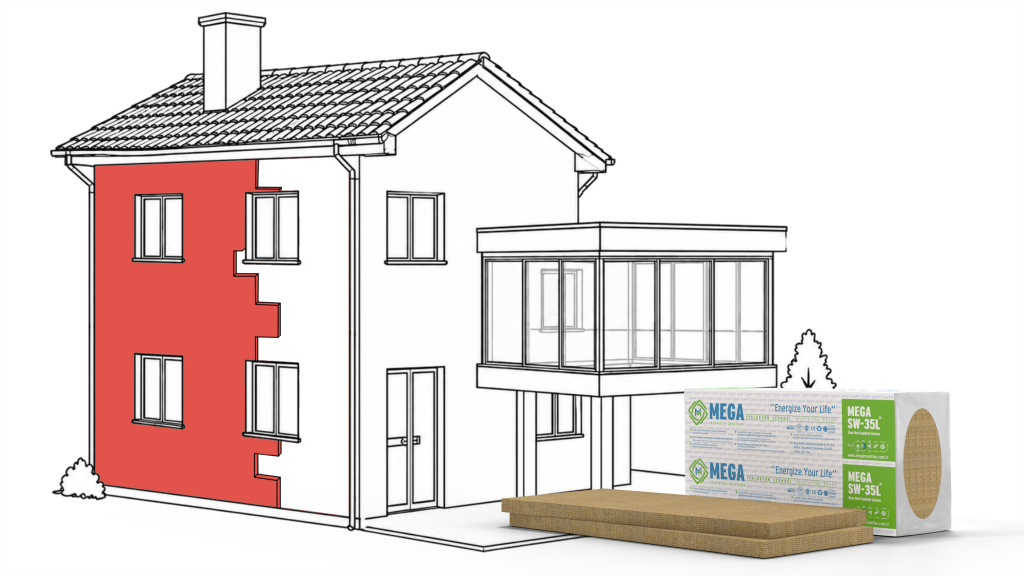
One example of a stone wool board is the stone wool ETICS board used in rendered external wall insulation systems: according to the Mega technical data sheet, the MEGA SW F150 type is produced at a density of 150 kg/m³ (±10%) in thicknesses of 40–120 mm, with a declared thermal conductivity of λD ≤0.037 W/mK. You can find the other board types and their applications among our stone wool products.
Application note from MegaUsta: When insulation boards arrive on an urban regeneration site, compare the product name and type on the packaging with the material list in the thermal insulation project. The data sheet states the product standard, the λD value, the thickness and the reaction to fire class; if the project and the data sheet do not match, ask the building inspection firm before work starts.
Mega Insulation Solutions (Mega Yalıtım; trade name Mega Yalıtım Üretim Pazarlama Dış Ticaret A.Ş.) is a Turkish manufacturer of insulation materials, headquartered in Kavacık, Istanbul, with its factory in Elazığ. Alongside stone wool, XPS and EPS thermal insulation boards, it offers MegaBlock, MegaLento, DesiWool, MegaTech construction chemicals and Fullback waterproofing products under the Mega brand.
The products’ technical data sheets and certificates are available on the Documents page. We cover the effect of the right materials and workmanship on building service life in a separate article.
Frequently Asked Questions
Which were the largest earthquakes in Istanbul?
Among the earthquakes recorded since the Ottoman period, those of 1509, 1766 and 1894 stand out as the ones that hit Istanbul hardest; AFAD gives the intensity of the first two as IX and that of 1894 as X. The 1509 earthquake, remembered in the sources as the lesser apocalypse, is regarded as the largest Istanbul earthquake of the Ottoman period. More recently, the 1999 Gölcük (Mw 7.6) and 2025 off-Silivri (Mw 6.2) earthquakes also affected Istanbul and its surroundings.
What should an earthquake kit contain?
According to AFAD, a disaster and emergency kit is prepared to cover your needs during the first 72 hours after an earthquake, until rescue teams arrive. It should hold enough drinking water for every family member, long-life food, a first aid kit, a blanket, a whistle, a battery-powered radio, a torch and spare batteries, hygiene supplies, clothing suited to the climate and photocopies of documents such as ID cards, title deeds and the compulsory earthquake insurance policy. Check the food and drink in it regularly.
How should insulation be chosen in urban regeneration?
In urban regeneration, insulation is chosen according to the thermal insulation project prepared with the TS 825 calculation method and to where the material will be used. The project specifies the materials and their thicknesses in the external walls, ceilings and floors, and the building inspection firm checks that the materials comply with the standards. Check the reaction to fire class of the facade material in its data sheet. You will find the details in our guide to insulation in urban regeneration.
Sources
- AFAD: Measures to take before, during and after an earthquake (in Turkish)
- AFAD: How to prepare a disaster and emergency kit (in Turkish)
- AFAD Istanbul Provincial Directorate: Take precautions for yourself and your loved ones (in Turkish)
- AFAD: What is an earthquake? (in Turkish)
- AFAD Bursa Provincial Directorate: Earthquake glossary (in Turkish)
- AFAD: Report on the 23 April 2025 Mw 6.2 Sea of Marmara earthquake off Silivri, Istanbul (PDF, in Turkish)
- Istanbul Metropolitan Municipality, Earthquake and Ground Research Directorate: Tsunami hazard analysis report (PDF, in Turkish)
- Lemi Akın: The first independent book on earthquakes, Risâle-i Zelzele (DergiPark, PDF, in Turkish)
- Official Gazette: Turkish Building Earthquake Regulation (18 March 2018, issue 30364 bis)
- Legislation Information System: Law No. 6306 on the Transformation of Areas under Disaster Risk (PDF, in Turkish)
- Legislation Information System: Law No. 4708 on Building Inspection (PDF, in Turkish)
- Official Gazette: Regulation on Energy Performance in Buildings (5 December 2008, issue 27075)
- Mega Insulation: MEGA SW F150 stone wool ETICS board technical data sheet (PDF)
- Mega Insulation: Documents (technical data sheets and certificates)
When choosing insulation material for a renewed or newly built building, the thermal insulation project and the product’s data sheet need to be assessed together. You can reach our technical team with your questions through our contact page.