
There are two answers to how to lower a natural gas bill: make the home lose less heat and run the boiler only as much as needed. Insulation in the roof, external walls and windows delivers the lasting effect, while a room thermostat, thermostatic valves, boiler settings and regular servicing keep the heat that is produced from being wasted. The best results come from doing both.
Some of the ways to keep a home warm in winter can be done over a weekend; others need a design and an installation crew. In this guide we rank five measures by what they achieve and how difficult they are, and we explain how to insulate the attic, how to set the boiler and thermostat, what tenants can do and how to track consumption on the gas meter. You can read which surfaces of a home lose heat in our guide to heat loss in the home, and the basic concepts of insulation in what is thermal insulation.
Where do the biggest gas savings come from?
In an uninsulated or poorly insulated home, the biggest and most lasting savings come from insulation, which reduces heat loss. Boiler settings and the thermostat are the second step: they control when and in which room heat is produced, but they do not stop the heat escaping through the walls and roof.
The reason is a simple rule of physics. The heat flowing out through a wall, roof or window depends on three things: the thermal transmittance of that building element (its U-value), its area and the temperature difference between inside and outside. Since the area does not change, two factors remain that you can influence. Insulation lowers the U-value, and that effect lasts every day of every winter. Setting the thermostat to a reasonable temperature reduces the temperature difference. The gas the boiler burns is spent replacing the heat the home loses; the smaller the loss, the shorter the boiler runs.
How much insulation will save cannot be stated as a single percentage. The result depends on the climate, the existing construction of the walls and roof, the floor the flat is on and the thickness of the insulation applied. Under Turkey’s Regulation on Energy Performance in Buildings, the thermal insulation design is prepared by an authorised mechanical engineer using the calculation method in the TS 825 standard. That calculation gives the correct answer for a specific building.
Five ways to keep your home warm in winter: which comes first?
Measures that reduce heat loss come first, followed by measures that control the heating. The table below compares the five measures by what they achieve, how difficult they are and who can carry them out. Cost is not included because it varies with the building and the work.
| Measure | What does it achieve? | Difficulty | Who can do it? |
|---|---|---|---|
| 1. External wall and roof insulation | Reduces heat loss permanently; the effect lasts every winter. | High: requires a design, an installation crew and, in apartment buildings, a joint decision. | Owner or building management |
| 2. Sealing windows and doors | Stops cold air entering around frames and through worn seals. | Low (seals, draught strips); medium (replacing windows). | Anyone; window replacement by the owner |
| 3. Attic insulation | Reduces heat escaping to the roof from the top floor. | Medium: requires access to the attic and a sound floor. | Owner of a detached house; building management in an apartment block |
| 4. Boiler settings and servicing | Helps the boiler run more efficiently. | Low; servicing is done by an authorised service. | Anyone; servicing by an authorised service |
| 5. Room thermostat and thermostatic valves | Produces heat only at the times and in the rooms where it is needed. | Low; installed by a qualified heating engineer. | Anyone; installation by a qualified heating engineer |
The logic of the order is this: a measure that reduces heat loss also amplifies the effect of boiler and thermostat settings. In an insulated home, the temperature set on the thermostat is reached with less gas. If you rent or your budget is limited, you can carry out steps 2, 4 and 5 straight away; steps 1 and 3 need planning.
1. How does insulation reduce gas consumption?
Insulation slows the heat passing through external walls and the roof, reducing the heat demand the boiler has to meet. The effect lasts as long as the insulation stays in place; it does not need renewing every year.
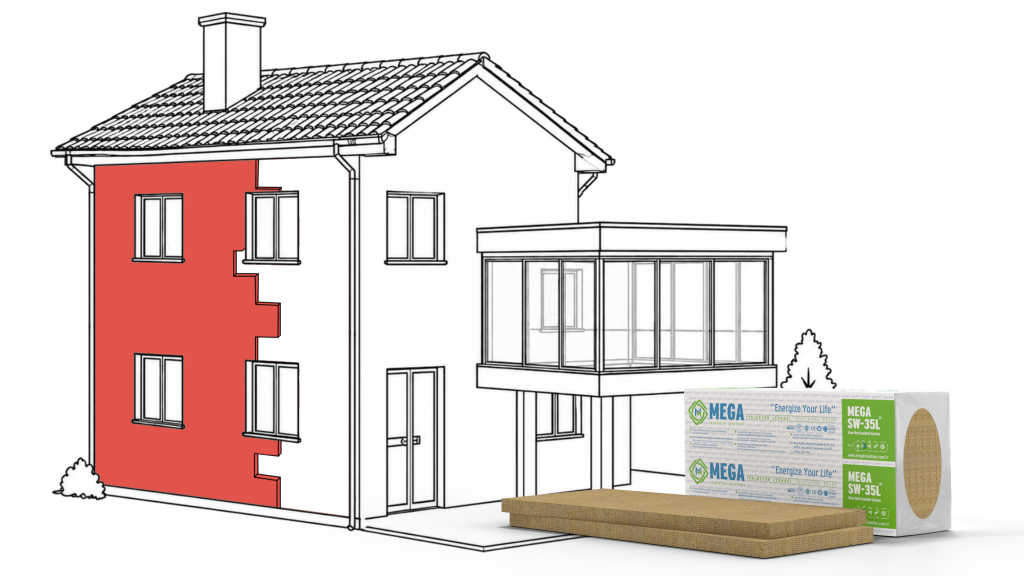
In apartment buildings, external walls are insulated with an external thermal insulation composite system (ETICS): insulation boards are bonded and anchored to the outer surface and then covered with mesh-reinforced render. Because external insulation also covers the face of columns and beams, it reduces thermal bridges in the same operation. Two types of board stand out in the Mega range for ETICS:
- Stone wool: The stone wool ETICS board is made for rendered facade systems. According to the MEGA SW F150 data sheet, its λD value is ≤0.037 W/mK, and the board is produced in thicknesses from 40 to 120 mm. Its reaction-to-fire class is A1, and it is a vapour-permeable board with a water vapour diffusion resistance factor of μ = 1.
- Grey EPS: The carbon-enhanced grey EPS ETICS board is widely used for ETICS because it is light. According to Mega data sheets, its λD value ranges from 0.031 to 0.036 W/mK depending on the type. EPS boards are reaction-to-fire class E, meaning they are combustible.
We compare which material suits which building in stone wool or EPS. You can read how board thickness is determined in how thick should ETICS insulation be, and the right season for the work in when to install ETICS. If the building is old, see our guide to building renovation to plan insulation together with the renewal of the facade, roof and services.
2. How do you seal windows and doors?
Windows and doors lose heat in two ways: through the glass and frame themselves, and through gaps around the frame. Gaps can be closed within a few hours with seals, draught strips and joint filler; the weakness of the glass and frame can only be remedied with new insulated-glass windows.
- Check the seals: Seals that have hardened, cracked or come loose are replaced. Also check that the sash presses evenly against the frame and that hinge and lock adjustments have not worked loose.
- Fit draught strips under doors: The gap under the flat’s entrance door and the balcony door is one of the places where cold draughts are felt most often.
- Fill around the frames: Gaps between the frame and the wall and around service penetrations are closed with a suitable filler or joint sealant.
- Use curtains well: Closing heavy curtains in the evening limits the cold radiating from the glass into the room. Curtains should not cover the radiator; otherwise the heat spreads between the glass and the curtain rather than into the room.
- If you replace windows, insulate around the frame too: If the gap between a new window frame and the wall is not insulated, the edge of the window remains a weak point.
We explain simple checks you can do at home to find air leaks, such as the paper and incense tests, step by step in the section on detecting heat loss.
3. How do you insulate an attic?
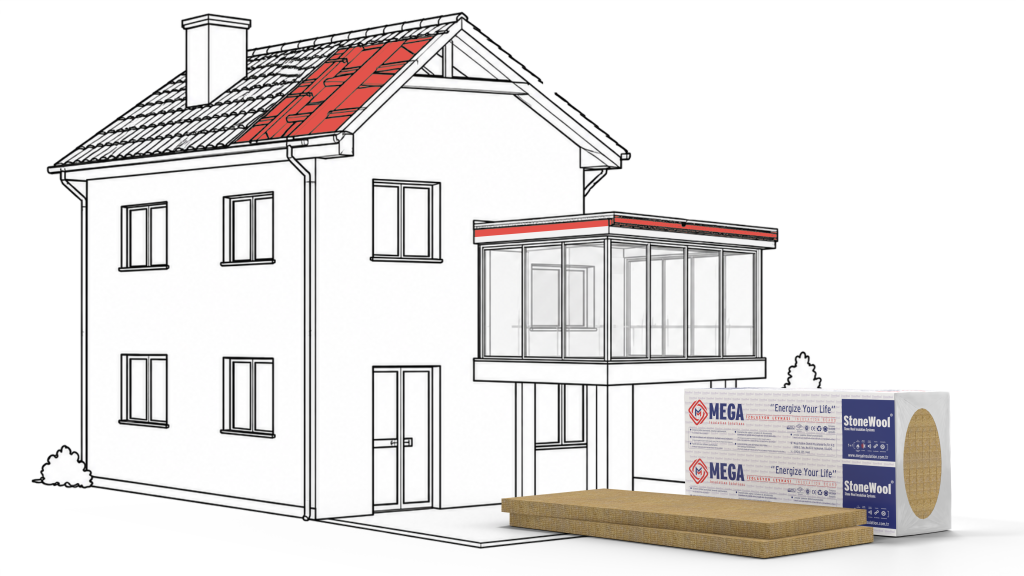
If the attic is not used, it is insulated on top of the top-floor ceiling, that is, on the attic floor. If the attic is used as a room, the insulation is applied along the roof slope, between or below the rafters. In both cases, air leaks in the attic floor are sealed first.
Because warm air rises, an uninsulated ceiling is one of the easiest escape routes for heat in detached houses and top-floor flats. If the attic is unheated, the surface to insulate is usually the ceiling floor, which forms the boundary of the heated space. The steps are as follows:
- Choose the surface: If the attic is not used, the insulation is laid on the floor; if it is used, or will be in future, it goes along the roof slope.
- Clean the floor and seal air leaks: According to the US Department of Energy (DOE) building science education resource, all holes and penetrations in the floor of a vented attic are sealed with sealant, one-part spray foam or rigid blocking before insulation is added. The floor must be clean so that the sealant adheres.
- Separate hot flues: The same resource calls for metal blocking and collars around hot flues.
- Lay the boards without gaps: Boards are butted tightly together. If two layers are applied, the joints of the top layer are staggered from those below.
- Insulate the attic hatch as well: The DOE installer job aid calls for weatherstripping the hatch so that no air passes when it is closed, insulating the hatch itself up to the level of the surrounding insulation, and building a sturdy dam around the opening to keep the insulation from falling through the hatch.
- Do not block roof ventilation: The attic above the insulated floor stays ventilated; vents at the eaves and ridge are not blocked with boards.
According to the product pages, the Mega range includes two boards that can be used in the attic: the stone wool terrace roof board for pitched metal and timber roofs, and the XPS flat board for the floor below the roof and beneath the rafters in pitched roofs.
| Product | Material and standard | Where it is used in the attic | λD (W/mK) | Thickness | Example thermal resistance | Reaction-to-fire class |
|---|---|---|---|---|---|---|
| Terrace roof board | Stone wool, TS EN 13162 | Pitched metal and timber roofs | ≤0.039 | 40–100 mm depending on type | 100 mm: at least 2.56 m²K/W | A1 |
| XPS flat board | XPS, TS EN 13164 | Floor below the roof and beneath the rafters in pitched roofs | 0.035 (T1500, T2000, T3000); 0.036 (T2500) | 20–120 mm depending on type | 100 mm MEGA XPS T3000: 2.85 m²K/W | E (combustible) |
Source: Mega data sheets (Terrace Roof Board 30–70 kPa, MEGA XPS T1500–T3000). Thermal resistance is the board thickness divided by its λD value; for the terrace roof board it is calculated with the upper λD limit and is therefore given as “at least”. Stone wool boards are vapour-permeable (water vapour diffusion resistance factor μ = 1); according to Mega XPS data sheets, the long-term water absorption of XPS boards is ≤0.7%. Whether a vapour control layer is needed and the order of the layers are set in the thermal insulation design. For other stone wool products, see the stone wool boards page.
4. How should a combi boiler be set and serviced to save gas?
To save gas with a combi boiler, the heating water temperature is not kept higher than necessary, the room temperature is controlled from the room thermostat and the boiler is serviced by an authorised service before every heating season. These settings do not reduce the home’s heat loss; they help heat to be produced more efficiently.
The temperature on the boiler panel is not the room temperature but the temperature of the water sent to the radiators. According to a study of condensing boilers by Nesta, a UK-based research and innovation organisation, the flow temperature of these boilers is often set to 70–80 °C by default, and at those temperatures the boiler cannot operate in condensing mode. When the water returning from the radiators to the boiler falls below about 54 °C, the boiler condenses more and its efficiency rises. The study excludes systems with a hot water tank. Before changing the setting, check whether your boiler is a condensing model and the range given in its user manual; if the home does not get warm enough, change the setting back.
- Annual servicing: An authorised service checks the burner, heat exchanger and combustion settings. Having the boiler serviced before the heating season reduces the chance of a fault occurring in midwinter.
- System pressure: Keep the water pressure on the boiler gauge within the range given in the user manual. If the pressure drops frequently, there may be a leak in the system.
- Bleed the radiators: A radiator that is cold at the top and warm at the bottom has trapped air; the air is released by opening the bleed valve.
- Keep the front of radiators clear: A sofa, cabinet or floor-length curtain in front of a radiator makes it harder for heat to spread into the room.
- Insulate pipes in unheated spaces: Turkey’s Regulation on Energy Performance in Buildings requires pipes, valves and fittings in heating systems to be insulated so as to minimise heat loss. For pipes running through basements, attics or open passages, Mega’s preformed pipe insulation products are offered with and without foil facing.
5. Does a smart thermostat save gas?
Yes, but not by reducing heat loss: it saves gas by running the heating only at the times and in the rooms where it is needed. A programmable or smart room thermostat lowers the temperature automatically at programmed times, such as when the home is empty and at night, while thermostatic radiator valves let you set the temperature of each room separately.
The heating controls factsheet published by the UK government on GOV.UK recommends three rules: keep the room thermostat between 18 and 21 °C, use a timer to heat the home only when needed, and use thermostatic valves to heat only the rooms in use. The same factsheet also corrects three common myths:
- Do not turn up the thermostat because it is cold outside: The thermostat’s job is to maintain the desired temperature whatever the weather.
- Turning up the thermostat does not heat the home faster: The thermostat only sets the temperature at which the heating switches off.
- Leaving the heating on low all the time is not more efficient: The home is then heated even when no one is there. The factsheet recommends a timer so that the heating is on when you are home and off when you are not.
Keep health in mind when lowering the temperature. England’s National Health Service (NHS) recommends keeping frequently used rooms such as the living room and bedroom at least at 18 °C if possible, and notes that this is particularly important for people with a health condition. Look for savings by lowering the temperature of unused rooms and of the hours when the home is empty.
How can tenants lower their gas bill?
Tenants can lower the bill through sealing, thermostat use and everyday habits that need no permanent changes to the building. Permanent work such as ETICS or window replacement has to be discussed with the landlord and the building management.
- Fit self-adhesive draught strips to windows and doors that can be removed when you move out.
- Turn the thermostatic valves in unused rooms to a low setting and keep their doors closed.
- If the home has no room thermostat, ask your landlord about installing one; it is fitted by a qualified heating engineer.
- Close heavy curtains in the evening and open the curtains of sunny windows during the day.
- Ventilate by opening windows fully for a short time several times a day rather than leaving them ajar all day.
- Read the meter regularly; we explain how to track consumption below.
- If the building has no ETICS or roof insulation, raise the matter with your landlord and the building management.
How do you track gas consumption on the meter?
Consumption is tracked by reading the meter at regular intervals and comparing it with the weather in the same period. The amount on the bill alone can be misleading: it is normal for consumption to rise in a cold month; what matters is whether less gas is used for the same level of cold.
The way to account for the weather is the heating degree day. The Turkish State Meteorological Service (MGM) defines the heating degree day as a value that describes the severity of cold over a given period, taking outdoor and room temperature into account. It is calculated daily: if the daily mean temperature is 15 °C or below, the daily mean is subtracted from 18 °C; on warmer days the value is taken as zero. In MGM’s example, the heating degree day for Ankara on a day with a mean temperature of 2.0 °C is 16. Monthly and yearly values are the sum of the daily values; MGM publishes them for provincial and district centres.
- Read the meter: Note the cubic metre reading on the meter on the same day each month, at the same time if possible. The difference between two readings is the consumption for that period.
- Find the degree days: Take the heating degree days for your province or district for the same month from MGM’s heating and cooling degree days page.
- Calculate the ratio: Divide consumption (m³) by the heating degree days. The result shows the gas used per unit of cold.
- Compare: Compare this ratio with the same month of the previous year, or with the months before a change you made (insulation, thermostat, boiler setting). If the ratio is falling, the change is working.
This method is no substitute for a detailed energy analysis; non-heating uses such as hot water and cooking also pass through the same meter. Even so, it is a more reliable indicator than the amount on the bill for seeing the effect of changes made in the same home.
Mega Insulation Solutions (Mega Yalıtım) is a Turkish manufacturer of insulation materials with its head office in Kavacık, Istanbul, and its factory in Elazığ; it offers the stone wool, XPS and EPS boards mentioned in this guide under the Mega brand. Insulation installed for winter also reduces the heat entering from outside in summer. We cover that side of the subject in our guide to keeping your home cool in summer.
Site note from MegaUsta: When working in the attic, keep your weight on the joists and on a sound floor; do not step on non-load-bearing surfaces such as suspended ceilings. If you also want to use the insulated floor for storage, do not place items directly on the boards; build a separate deck on top of the boards for walking and storage.
Frequently Asked Questions
How do you lower a natural gas bill?
A gas bill is lowered by reducing the home’s heat loss and by running the heating only as much as needed. External wall, roof and attic insulation and sealing around windows and doors provide the lasting effect. In the short term, it helps to keep the room thermostat between 18 and 21 °C, use a timer and thermostatic valves, have the boiler serviced before each season and track meter consumption against the weather.
What temperature should a combi boiler be set to?
The temperature on the boiler is that of the water going to the radiators; the room temperature is set on the room thermostat. The UK government’s heating controls factsheet recommends keeping the room thermostat between 18 and 21 °C. In condensing boilers, not keeping the water hotter than necessary improves efficiency; according to Nesta, condensing increases when the water returning to the boiler falls below about 54 °C. Follow the boiler’s user manual.
How does ETICS affect gas consumption?
ETICS reduces the heat escaping through external walls and thermal bridges such as columns and beams, so it lowers the heat demand the boiler has to meet. The size of the reduction cannot be given as a single percentage; it depends on the climate, the existing wall construction, the position of the flat and the board thickness. The right thickness is set by a thermal insulation design prepared by an authorised mechanical engineer using the TS 825 method.
How do you insulate an attic?
If the attic is not used, the insulation goes on top of the top-floor ceiling; if it is used, it goes along the roof slope between the rafters. First the floor is cleaned and holes and service penetrations are sealed; then the boards are laid without gaps. The attic hatch is also weatherstripped and insulated. From the Mega range, the stone wool terrace roof board is used on pitched roofs and the XPS flat board on the floor below the roof.
Sources
- Regulation on Energy Performance in Buildings, Official Gazette of Turkey, 5 December 2008, No. 27075 (Articles 10 and 11)
- Turkish State Meteorological Service (MGM), Heating and Cooling Degree Days
- UK government (GOV.UK), Keeping cosy and warm for less: How to set your heating for winter (heating controls factsheet)
- NHS (England), Keep warm, keep well
- Nesta, The impact of boiler optimisation on gas consumption and household comfort (12 October 2023)
- US Department of Energy (DOE), Building Science Education: Air Sealing Existing Attics
- US Department of Energy (DOE), Weatherization Job Aid 5-1: Dam, Seal, and Insulate an Attic Hatch
- Mega data sheet: Terrace Roof Board 40 kPa
- Mega data sheet: MEGA XPS T3000
- Mega data sheet: MEGA SW F150 ETICS Board
- Mega data sheet: MEGA EPS 50 (G), 60 (G), 70 (G)
- Mega Insulation certificates and technical documents
Once you have decided on the first step for your home, you can review suitable boards on the stone wool boards, XPS boards and EPS boards pages, and send project-specific questions to our technical team through the contact page.
Prepared by: Mega Insulation Technical Team. Technical values are taken from Mega data sheets and product pages, and regulatory information from the regulation text published in Turkey’s Official Gazette.