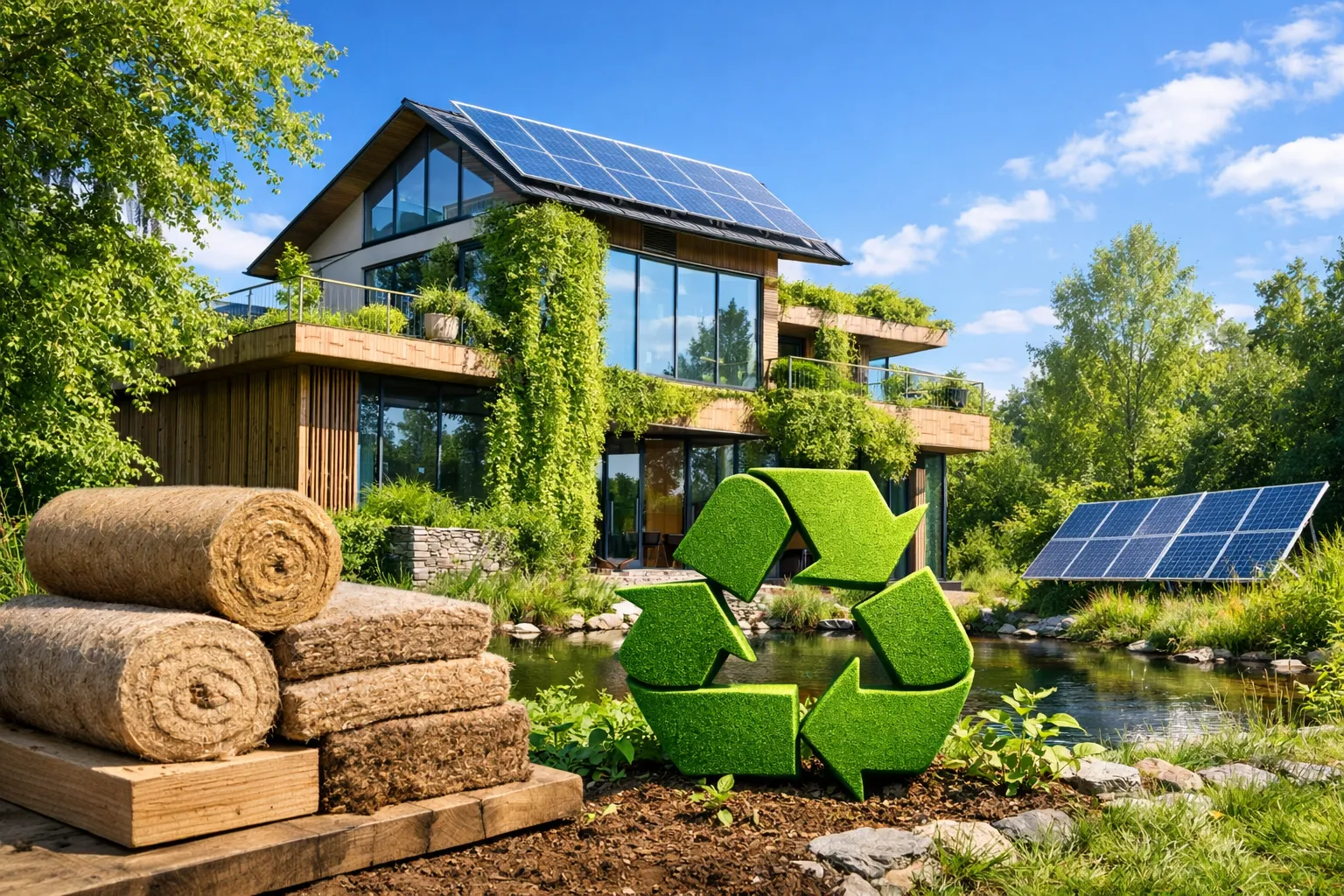
Insulation materials can be recycled, but how easily depends on the material and the waste’s condition. Stone wool, EPS and XPS can all be recovered, most easily as clean production and cutting waste. For boards removed from a building, the outcome depends on sorting by material, removing render and adhesive, and reaching a licensed facility that accepts the waste.
Insulation boards stay in service in a building for many years. The question of recycling usually comes up at two moments: when offcuts pile up on site, and when old insulation is removed during demolition or facade renewal. In both cases, the outcome depends on how clean and well separated the waste is. According to the European Commission, construction and demolition waste accounts for more than a third of all waste generated in the European Union. Insulation boards, being low in density, take up a lot of space relative to their weight, which makes collection and transport harder.
Are recycling, recovery and reuse the same thing?
No. Türkiye’s Waste Management Regulation defines the three terms separately, and this distinction explains which route a piece of insulation waste can take.
- Reuse: Using a product again for the purpose it was designed for. A board that comes out undamaged and is installed as insulation in another building is an example.
- Recycling: Reprocessing waste into products, materials or substances. The regulation does not count energy recovery, use as fuel or reprocessing for backfilling as recycling.
- Recovery: Making waste fit for a useful purpose so that it replaces another material used on the market or in a facility. It is a broader term that also covers recycling.
Under the regulation’s general principles, preventing and reducing waste comes first. For waste that cannot be avoided, the options listed are reuse, recycling, other processing to obtain secondary raw materials, energy recovery and disposal.
How do recycling routes differ for stone wool, EPS and XPS?
The three materials take different routes at the end of their life because their raw materials and structure differ: stone wool consists of mineral fibres made from rock, while EPS and XPS are polystyrene foams. The table below summarises when each can be recovered and what makes recovery harder.
| Material and product standard | Production and cutting waste | Material removed from buildings | What makes recovery harder |
|---|---|---|---|
| Stone wool (mineral wool, MW; TS EN 13162) | Can be ground, bonded with cement into briquettes and fed back to the melting furnace; edge trims return to the forming line | Can be sent to a recovery facility if separated clean and dry; EU-funded research records describe mineral wool in demolition waste as largely unrecyclable | Residues of render, adhesive, anchors and facings; moisture; large volume due to low density |
| EPS (expanded polystyrene; TS EN 13163) | Clean pieces can be ground and used in new products | Can be reused or recycled if not contaminated | Soil and chemical contamination; costly transport because of its bulk; brominated flame retardants in some older boards |
| XPS (extruded polystyrene; TS EN 13164) | Clean pieces can be used as polystyrene raw material | Can be recycled to the extent that it can be separated cleanly from soil, waterproofing layers and adhesive | Contact with soil and waterproofing on foundations, basement walls and flat roofs; possible HBCD in older boards |
Sources: for stone wool, the JRC reference document on glass and mineral wool manufacturing and the EU-funded WOOL2LOOP project; for EPS and XPS, a SINTEF research note and the Stockholm Convention; product standards from Mega technical data sheets.
How are stone wool production waste and removed boards recovered?
The most established route for recycling stone wool is returning production waste to the furnace: fibrous residues are ground, bonded with cement into briquettes and fed back to the melting furnace. For stone wool removed from buildings, recovery depends on separating the boards clean and dry and on having a system that accepts this waste.
According to the reference document of the European Commission’s Joint Research Centre (JRC) on glass and mineral wool manufacturing, stone wool is made by melting a rock, usually basalt, together with limestone or dolomite and sometimes blast furnace slag, and spinning the melt into fibres. The batch charged into the vertical furnace known as a cupola may also contain briquettes made from process and product waste. If loose fibrous material is charged as it is, the rising hot air can carry it out of the furnace and it disrupts the air flow; it is therefore ground and formed into briquettes of roughly the same size as the rock lumps, usually with cement as the binder. Edge trims, on the other hand, are usually shredded and returned directly to the forming line.
The document also notes that fibrous waste is recycled this way only if a briquetting system is in operation at the plant. Otherwise the waste goes to an external recycling facility or to landfill.
According to the note in their technical data sheets, the stone wool boards offered under the Mega brand are produced in conformity with TS EN 13162+A1 at the facilities of the group company Megataş A.Ş. Megataş A.Ş. holds a basic-level Zero Waste Certificate issued by the Elazığ Provincial Directorate of Environment, Urbanisation and Climate Change. You can read about the material in our guide on what stone wool is and find the product range in the stone wool category.
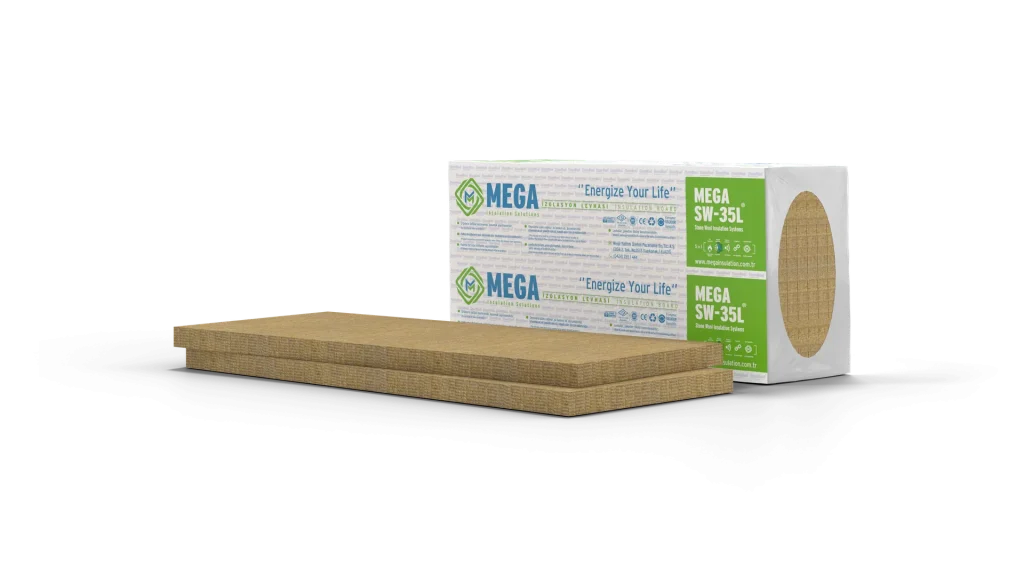
The picture is different for stone wool removed from buildings. The description of WOOL2LOOP, an EU-funded research project, states that mineral wool (stone wool and glass wool) in construction and demolition waste is considered largely unrecyclable and, because of its low density, takes up a disproportionately large amount of landfill space. The project aimed to sort and mill removed mineral wool and turn it into new building materials by alkali activation (geopolymerisation).
The most effective thing that can be done on site is to separate removed stone wool boards from render, adhesive, anchors and other waste and to keep them dry. Recovery options apply to waste that has been collected separately and kept clean.
How is EPS recycled?
EPS is a recyclable material: clean, dry EPS can be reused, ground and added to new products, or recycled as polystyrene raw material. The precondition is that the waste is uncontaminated and collected separately from other waste.
In a project coordinated by the Norwegian research institute SINTEF on reusing polystyrene insulation after demolition, it is noted that uncontaminated polystyrene can go straight into new insulation applications. The same work lists two obstacles for used EPS: it takes up a lot of space, which makes it expensive to transport, and it may be contaminated with soil or chemicals. A logistics system that compresses the waste to reduce its volume and separates out the contaminated part is therefore needed.
There is one more point for EPS from older buildings. SINTEF notes that some EPS used in the 1980s contains brominated flame retardants and that such material cannot be reused in new buildings. If the age and origin of the removed boards are known, this information should be passed on to the facility receiving the waste.
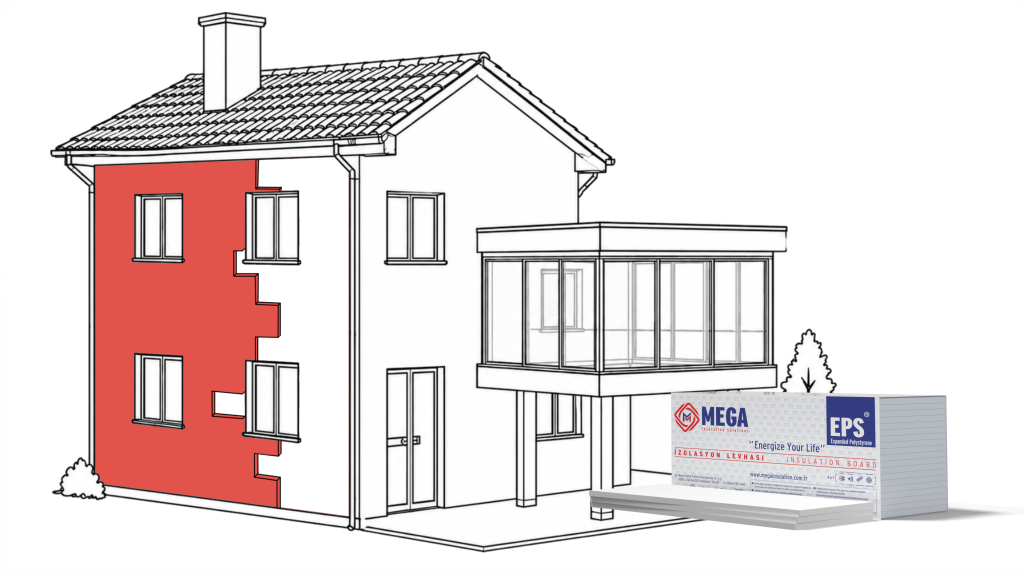
You can read about the properties and uses of EPS in our guide on what EPS is and find Mega’s white and grey ETICS boards on the EPS board page.
What makes XPS recycling difficult?
Being polystyrene-based, XPS can in principle also be recycled; the difficulty comes from where the board is used in the building. Thanks to its closed-cell structure and low water absorption, XPS stands out in damp, loaded areas such as foundations, basement walls and flat roofs. Boards removed from these areas are hard to separate cleanly from soil, waterproofing layers and adhesive residues.
According to Mega technical data sheets, XPS boards have a long-term water absorption by total immersion of ≤0.7%, and a compressive strength ranging from 150 kPa (MEGA XPS T1500) to 300 kPa (MEGA XPS T3000) depending on the type. These values are why XPS is chosen for damp, loaded locations; at the end of its life, however, what has to be removed is a load-bearing layer in contact with soil.
Older boards raise one more issue: HBCD (hexabromocyclododecane). In 2013 the Conference of the Parties to the Stockholm Convention on Persistent Organic Pollutants listed HBCD in Annex A of the Convention, with a specific exemption for EPS and XPS used in buildings. This means that EPS and XPS boards produced years ago may contain the substance. For older boards of unknown composition, follow the instructions of the facility receiving the waste.
You can read about the uses and technical properties of XPS in our guide on what XPS is and find the smooth and rough-surface grooved boards on the XPS board page.
How should insulation waste be managed on site?
On site, insulation waste is first reduced and then separated by type where it arises. Stone wool, EPS, XPS and packaging film collected separately can be sent to a recovery facility, whereas insulation waste mixed with rubble is classified as mixed construction and demolition waste, which narrows the options for recovery.
- Plan the cuts: A cutting plan based on board size reduces offcuts. According to Mega technical data sheets, the stone wool ETICS board and other stone wool boards measure 1200 x 600 mm, EPS boards 500 x 1000 mm and XPS boards 600 x 1200 mm.
- Store the boards under cover: A board that gets wet, crushed or damaged by sunlight turns straight into waste. The Mega XPS technical data sheet requires boards to be protected from sunlight and covered with a UV-blocking sheet when stored outdoors.
- Separate offcuts by type: Collect stone wool, EPS and XPS offcuts in separate bags or containers. Do not let light pieces get blown around by the wind.
- Make use of large pieces: Use sound, large offcuts wherever the installation rules allow; that way the waste never arises.
- Collect packaging separately: According to Mega technical data sheets, stone wool and EPS boards are packed in polyethylene (PE) film. This film is collected as plastic packaging waste, separately from board offcuts.
- Keep records and hand over to a licensed facility: Note how much of each type of waste arises and hand it over to a licensed recovery or disposal facility. Projects aiming for green building certification are also asked for these records.
Application note from MegaUsta: Put a separate, labelled bag for each material next to the cutting table. Dropping offcuts into the bag rather than onto the floor keeps the waste clean and makes clearing the area easier at the end of the job. Do not put pieces with render or adhesive on them in the same bag as clean offcuts.
Which waste codes apply to insulation waste?
In Türkiye, waste is classified with six-digit codes according to the waste list in Annex 4 of the Waste Management Regulation, and the regulation states that this list is also used for construction and demolition waste. Insulation materials are listed under heading 17 06.
| Waste code | Description in the list | Note |
|---|---|---|
| 17 06 04 | Insulation materials other than those mentioned in 17 06 01 and 17 06 03 | Insulation waste not containing hazardous substances |
| 17 06 03* | Other insulation materials consisting of or containing hazardous substances | Marked (M) in the list: whether it is hazardous is determined by analysis |
| 17 06 01* | Insulation materials containing asbestos | Hazardous waste; asbestos-containing work is removed before the main demolition |
| 15 01 02 | Plastic packaging | PE film packaging of the boards |
| 17 09 04 | Mixed construction and demolition wastes other than those mentioned in 17 09 01, 17 09 02 and 17 09 03 | Waste mixed with rubble without separation |
Source: Waste Management Regulation, Annex 4 waste list. Codes marked with an asterisk (*) are hazardous waste. The (M) mark indicates that the waste is possibly hazardous; the linked non-hazardous code may not be used until analysis has shown the waste to be non-hazardous.
Why are insulation materials removed separately during demolition?
Because the legislation requires it. Under Türkiye’s Regulation on the Demolition of Buildings, the main demolition cannot start until selective demolition has been carried out in line with the Regulation on the Control of Excavation Soil, Construction and Demolition Waste. In the regulation’s words, the aim of selective demolition is to ensure a high rate of recycling of demolition waste.
Among the materials to be separated during selective demolition, the regulation explicitly lists thermal insulation materials such as glass wool, stone wool, expanded polystyrene, extruded polystyrene and polyurethane, as well as removable waterproofing materials. Work containing asbestos and similar hazardous chemicals is removed before the main demolition. During demolition, waste is stored separately, collected without being mixed and sent to a recovery or disposal facility licensed under the Environmental Permit and Licence Regulation. The contractor is responsible for separating waste at source and for ensuring that it is reused first or, where that is not possible, recovered.
The European Commission likewise treats construction and demolition waste as a priority waste stream under the Waste Framework Directive and promotes selective demolition so that hazardous substances can be removed and handled safely.
How do green building certifications treat insulation waste?
In green building certification, insulation waste is assessed under construction and demolition waste management: the schemes look at how much waste is kept out of landfill and how it is sorted. Where a green building certificate is targeted, insulation offcuts collected separately on site can count as a material stream of their own in this calculation.
- LEED: In the construction and demolition waste management credit of the US Green Building Council (USGBC), recycled, salvaged, reused and donated materials count as diverted waste. Besides a minimum diversion rate, the credit requires at least three or four separate material streams; hazardous waste, land-clearing debris and soil are excluded.
- BREEAM: According to BRE’s BREEAM knowledge base, the credit for diverting resources from landfill under construction waste management (Wst 01) requires the key groups of non-hazardous waste to be monitored, recorded and sorted. A pre-demolition audit is carried out where existing structures are present on the site; where space is limited, off-site waste contractors or manufacturer take-back schemes can be used, provided segregation is documented.
- YeS-TR: YeS-TR, Türkiye’s national green certification system, is based on the Regulation on Green Certificates for Buildings and Settlements and is the system through which the Ministry of Environment, Urbanisation and Climate Change runs certification online. Obtaining a green certificate is voluntary; the assessment criteria are set out in the building and settlement guides annexed to the regulation.
In waste management credits, points are awarded on the basis of the project’s own records and documents. The score therefore depends less on the name of the material used than on how the waste was separated on site and where it was sent.
Where does recycling fit in the environmental assessment of insulation?
Recycling is the end-of-life side of an insulation material’s environmental assessment; on the other side are the years the material spends in the building. Insulation reduces the heat passing through walls, roofs and floors and so lowers heating and cooling demand. A board chosen to suit its location and installed correctly does this job for a long time.
We explain the basic concepts in our guide on what thermal insulation is and energy and carbon savings in our article on sustainable insulation. For the wider framework of the transformation expected in buildings, see our article on Türkiye’s 2053 net zero target.
Mega Insulation Solutions (Mega Yalıtım; trade name Mega Yalıtım Üretim Pazarlama Dış Ticaret A.Ş.) is a Turkish manufacturer of insulation materials with its head office in Kavacık, Istanbul, and its factory in Elazığ. Alongside stone wool, XPS and EPS thermal insulation boards, it offers MegaBlock, MegaLento, DesiWool, MegaTech construction chemicals and Fullback waterproofing products under the Mega brand.
Frequently Asked Questions
Can stone wool be recycled?
Yes, stone wool can be recovered, and this is easiest with production waste. According to the JRC reference document on glass and mineral wool manufacturing, fibrous residues from stone wool production can be ground, bonded with cement into briquettes and fed back to the melting furnace. Recovering boards removed from buildings depends on separating the material cleanly from render, adhesive and anchors, keeping it dry and finding a facility that accepts this waste.
How can EPS foam waste be put to use?
Clean, dry EPS waste that is collected separately and taken to a recovery facility can be reused, ground and added to new products, or recycled as polystyrene raw material. Pieces contaminated with render, adhesive or soil may not be suitable for this route. Because the material is light and bulky, collecting it in bags and compressing it for transport makes the job easier; brominated flame retardants found in some older boards are assessed separately.
Can XPS be recycled?
Yes, being polystyrene-based, XPS can in principle be recycled; the practical difficulty is how clean the removed board is. XPS used on foundations, basement walls and flat roofs works in contact with soil, waterproofing layers or adhesive, so it is hard to separate cleanly. Clean offcuts should be collected separately, and it should be kept in mind that older boards may contain HBCD, which is covered by the Stockholm Convention.
How is insulation waste disposed of?
Insulation waste is first separated by type and then sent to a licensed recovery or disposal facility. In the waste list of Türkiye’s Waste Management Regulation, non-hazardous insulation materials are coded 17 06 04, those containing asbestos 17 06 01* and those containing hazardous substances 17 06 03*. During demolition, insulation materials are separated through selective demolition, and the part that cannot be recovered is disposed of in line with the legislation.
Sources
- Waste Management Regulation (Official Gazette 02.04.2015, No. 29314): Articles 4 and 5, Annex 4 waste list
- Regulation on the Demolition of Buildings (Official Gazette 13.10.2021, No. 31627): Articles 5, 14 and 15
- Regulation on Green Certificates for Buildings and Settlements (Official Gazette 12.06.2022, No. 31864)
- European Commission: Construction and demolition waste
- European Commission Joint Research Centre (JRC): Best Available Techniques (BAT) Reference Document for the Manufacture of Glass (2013), mineral wool sections
- CORDIS: WOOL2LOOP, Mineral wool waste back to loop (EU-funded research project, 821000)
- Stockholm Convention: Hexabromocyclododecane (HBCD) overview
- SINTEF: The construction sector must learn to reuse plastic insulation after demolition (2023)
- USGBC: Construction and Demolition Waste Management (LEED credit)
- BREEAM Knowledge Base: Wst 01 Construction waste management
- Mega Insulation: MEGA SW F150 stone wool ETICS board technical data sheet (PDF)
- Mega Insulation: EPS 60W / 80W / 90W technical data sheet (PDF)
- Mega Insulation: MEGA XPS T1500 technical data sheet (PDF)
- Mega Insulation: MEGA XPS T3000 technical data sheet (PDF)
- Mega Insulation: Documents (technical data sheets and certificates)
Which insulation material to use, and at what thickness, is decided by assessing the location, the thermal insulation design and the technical data sheet values together. You can find the products’ technical data sheets on the Documents page and contact our technical team about products and packaging via our contact page.