
Türkiye’s 2053 net zero target means that greenhouse gas emissions peak by 2038 at the latest, are then reduced, and in 2053 the remaining emissions are balanced by sinks such as forests. The target was announced on 27 September 2021. According to the Long-Term Climate Strategy, buildings accounted for 11.5 percent of national emissions in 2022, so thermal insulation of the building envelope is one of the concrete steps towards the target.
Behind this green transition lies more than a quarter century of climate diplomacy: first the Kyoto Protocol, then the Paris Agreement. Türkiye joined this framework by ratifying the Paris Agreement in 2021 and passed its Climate Law in 2025. In this article we look, on the basis of official documents, at how these agreements have affected Türkiye, at the buildings sector’s share of emissions, and at the place of energy efficiency in buildings, especially thermal insulation, on the road to 2053.
How did climate diplomacy change from Kyoto to Paris?
The Kyoto Protocol set binding reduction targets only for industrialised countries, whereas the Paris Agreement moved to a system that covers all parties. This difference extended the responsibility for setting reduction targets from industrialised countries to all parties.
The Kyoto Protocol was adopted on 11 December 1997. Article 3 of the Protocol required the countries listed in Annex I of the UN Framework Convention on Climate Change to reduce their overall greenhouse gas emissions to at least 5 percent below 1990 levels in the 2008–2012 period. Developing countries had no quantified reduction obligation. This structure left many fast-growing emitters outside any reduction commitment.
The Paris Agreement was adopted at the COP21 conference in Paris on 12 December 2015 and entered into force on 4 November 2016. It aims to hold the global temperature increase well below 2 °C above pre-industrial levels and to pursue efforts to limit it to 1.5 °C. Every five years the parties submit a nationally determined contribution (NDC) that is more ambitious than the previous one. The United Nations encourages long-term strategies but does not make them mandatory.
Türkiye’s 2053 target is a product of this second phase. Under the Paris system each party sets its own national contribution; after becoming a party to the agreement, Türkiye announced 2053 as its net zero year and extended the target across all mitigation sectors, from energy and industry to transport and buildings.
How did the Paris Agreement shape Türkiye’s 2053 net zero target?
Türkiye ratified the Paris Agreement in 2021 and announced its net zero emissions target for 2053 on 27 September 2021. Becoming a party to the agreement brought time-bound, quantified targets into the country’s climate policy.
In the intended contribution it submitted in September 2015, Türkiye had foreseen a reduction of up to 21 percent by 2030 compared with a reference scenario. With the Updated First Nationally Determined Contribution submitted on 13 April 2023, this figure rose to 41 percent, with a projected emission level of 695 million tonnes of CO₂ equivalent in 2030. According to the Long-Term Climate Strategy, emissions are to peak by 2038 at the latest and then decline to net zero in 2053.
The strategy was adopted by the Climate Change and Adaptation Coordination Board on 4 November 2024. It contains a total of 89 strategies across 18 sectors and 4 cross-cutting areas. Buildings are one of the seven main sectors in its mitigation section.
What does the Climate Law introduce?
Climate Law No. 7552 is the law that gives the net zero emissions target a legal basis and establishes an emissions trading system. It was adopted on 2 July 2025 and published in the Official Gazette dated 9 July 2025.
Article 1 of the law defines its purpose as combating climate change in line with the green growth vision and the net zero emissions target. The law defines net zero emissions as no net increase in greenhouse gas emissions, achieved by reducing human-induced emissions through technology and other methods and/or balancing them through sinks. The timeline of the target, namely the 2038 peak and the 2053 net zero year, is set out in the Long-Term Climate Strategy.
One of the law’s key instruments is the emissions trading system (ETS). Based on the net zero target, the system caps total emissions and encourages reductions through the trading of emission allowances. Setting up the system, preparing the national allocation plan and distributing allowances are the duties of the Climate Change Presidency. The law also requires emission reductions to be carried out in line with the nationally determined contribution, the net zero target and the Presidency’s strategies and action plans.
What share of Türkiye’s emissions comes from buildings?
According to the Long-Term Climate Strategy, buildings were responsible for 11.5 percent of Türkiye’s greenhouse gas emissions in 2022. Emissions from housing amounted to 49.2 million tonnes and those from commercial and service buildings to 15 million tonnes of CO₂ equivalent.
In the same year the country’s total emissions, excluding land use and forestry, were 558.3 million tonnes of CO₂ equivalent. The inventory tracks electricity and heat generation as a separate item, so emissions from generating the electricity used in buildings are not included in the 11.5 percent share.
| Sector | Share of total emissions in 2022 |
|---|---|
| Energy: electricity and heat generation | 26.0% |
| Energy: transport | 16.5% |
| Energy: manufacturing industry | 11.7% |
| Energy: buildings (residential, commercial and services) | 11.5% |
| Energy: other | 6.1% |
| Agriculture | 12.8% |
| Industrial processes and product use | 12.5% |
| Waste | 2.9% |
Source: Türkiye’s 2053 Long-Term Climate Strategy, sectoral distribution of emissions in 2022. The size of the building stock shows the scale of the task: Türkiye has more than 9.5 million buildings and 41.3 million dwellings, and 86,654 new buildings were added to the stock in 2023. About 1.5 million buildings hold an energy performance certificate, which is 18.5 percent of the stock.
What targets are set for buildings on the road to 2053?
The strategy plans to cut building emissions first by lowering energy demand and then by meeting the remaining demand with on-site and renewable sources. It sets a phased performance timeline for new buildings and a renovation target for existing ones.
| Period | Target |
|---|---|
| 2023–2032 | New residential and non-residential buildings with a total construction area of 2,000 m² or more to be built as nearly zero energy buildings (nZEB) |
| After 2026 | New public buildings with a total construction area above 10,000 m² to hold a green building certificate |
| By 2030 | Energy efficiency target for public buildings required to appoint an energy manager raised from 15 percent to 30 percent |
| 2023–2043 | Buildings constructed between 2000 and 2010 upgraded to nZEB level through energy efficiency retrofits covering 5 percent of the existing stock each year |
| 2033–2042 | New buildings to achieve class A on the energy performance certificate |
| 2043–2053 | New buildings to be built as net zero operational carbon buildings that offset their annual operational carbon emissions with renewable energy |
| 2053 | Buildings sector emissions brought close to zero |
Source: Türkiye’s 2053 Long-Term Climate Strategy, buildings sector chapter and summary of targets. According to the Türkiye Building Sector Decarbonisation Roadmap cited in the strategy, these measures make a total reduction of 2,075 million tonnes of CO₂ equivalent possible over the 30 years from 2023 to 2053, which corresponds to a 32 percent reduction compared with the business-as-usual scenario.
The document also makes a point that refers directly to the building envelope: renovation work on existing buildings, such as improving transparent and opaque components, is expected to deliver large energy efficiency gains. Opaque components are the walls, roof and floors, in other words the surfaces where thermal insulation is applied. This envelope is also the common starting point of high-performance approaches such as nZEB and the passive house.
What does the 2053 target mean for your building?
The national target becomes concrete in individual buildings through the thermal insulation project, the energy performance certificate and the quality of workmanship. As the energy used for heating and cooling falls, so do the building’s emissions during use.
Article 10 of the Energy Performance of Buildings Regulation makes a thermal insulation project mandatory, prepared by an authorised mechanical engineer using the calculation method in the TS 825 standard; the project is required at the building permit stage. This calculation sets the insulation thickness according to the building’s region and the thermal conductivity (λ) of the chosen material. For a general introduction to materials and basic concepts, see our guide what is thermal insulation.
External wall insulation (ETICS) is used on outer walls, insulation boards on roofs and terraces, and low water absorption boards on foundations and basement walls in contact with the ground. Alongside thermal conductivity, the selection takes into account the area of use, compressive strength and moisture conditions. The table below shows some board types often used in the building envelope, taken from Mega technical data sheets.
| Product / type | Material | λD (W/mK) | Thickness (mm) | Typical area of use |
|---|---|---|---|---|
| MEGA SW F150 | Stone wool ETICS board | ≤0.037 | 40–120 | Rendered external wall insulation (ETICS) |
| MEGA SW-35L | Stone wool ETICS board | ≤0.035 | 50–120 | Rendered external wall insulation (ETICS) |
| EPS 50 (G) | Grey (carbon/graphite enhanced) EPS ETICS board | 0.032 | 10–100 | External wall insulation (ETICS) |
| MEGA XPS T3000 | XPS board | 0.035 | 20–120 | Flat roofs, foundations and below-ground basement walls |
Source: Mega technical data sheets; λD is the declared value at 10 °C. The lower the thermal conductivity, the higher the thermal resistance achieved at the same thickness. The exact thickness is determined by the calculation in the thermal insulation project.
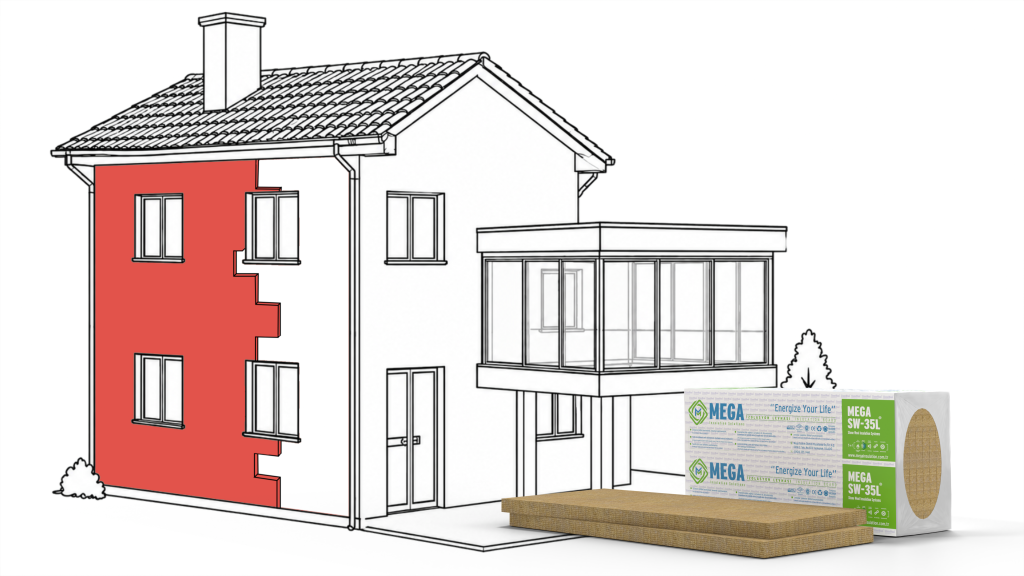
Application note from MegaUsta: Before deciding on insulation in an existing building, check the building’s energy performance certificate and, if there is one, its thermal insulation project. Choose the thickness according to the project, and insulate columns, beams and slab edges continuously together with the wall. Any gap left at these points creates a thermal bridge and reduces the benefit of the insulation.
What can the state, citizens and industry do in this transition?
Reaching the 2053 target depends on public policy, building owners’ decisions and industrial investment moving in the same direction. The strategy and the Climate Law define different instruments for each.
- The state: Gradually tightening building regulations (the nZEB requirement, higher energy certificate class targets), raising the energy efficiency target for public buildings to 30 percent, and operating the emissions trading system established by the Climate Law.
- Citizens: Asking for the energy performance certificate when buying a home, and putting wall, roof and floor insulation first when an existing building is renovated. Lower heating and cooling demand shows up both in energy bills and in emissions.
- Industry: Planning reductions under the emissions trading system. For building material manufacturers, life cycle assessment, environmental product declarations and digital product passports come to the fore; the strategy lists these practices among the tools for reducing emissions in the buildings sector.
Success does not depend on a single actor. When the rules set by the state, the renovation decisions of building owners and the investments of industry follow the same timeline, 2053 stops being a date on paper and becomes a plan put into practice.
How does Mega Yalıtım contribute to this transition?
Mega Yalıtım contributes by supplying insulation materials that reduce the energy demand of the building envelope, together with their technical data sheets. Mega Insulation Solutions (Mega Yalıtım) is a Turkish manufacturer of insulation materials headquartered in Kavacık, Istanbul, with its factory in Elazığ; alongside stone wool, XPS and EPS thermal insulation boards, it offers MegaBlock, MegaLento, DesiWool, MegaTech construction chemicals and Fullback waterproofing products under the Mega brand.
Mega Yalıtım’s XPS and EPS board production and the stone wool production of its group company Megataş are certified to the ISO 14001 environmental management system. We cover our sustainable insulation approach and the recycling of insulation materials in separate articles. Technical data sheets and certificates for the products are available on the Documents page.
Frequently Asked Questions
What is Türkiye’s 2053 net zero target?
Türkiye’s 2053 net zero target means that by 2053 there is no net increase in greenhouse gas emissions, achieved by reducing human-induced emissions and balancing the remainder with sinks such as forests. The target was announced on 27 September 2021. According to the Long-Term Climate Strategy, emissions are to peak by 2038 at the latest and then decline. The Climate Law passed in 2025 also writes the net zero emissions target into its purpose article.
What share of emissions are buildings responsible for?
According to Türkiye’s 2053 Long-Term Climate Strategy, buildings accounted for 11.5 percent of the country’s total greenhouse gas emissions in 2022. Of these emissions, 49.2 million tonnes came from housing and 15 million tonnes from commercial and service buildings. Emissions from generating the electricity used in buildings are counted separately under electricity and heat generation in the inventory, so they are not included in this share.
How does insulation reduce the carbon footprint?
Insulation slows the flow of heat through walls, roofs and floors and so lowers the energy used for heating and cooling. Fuel that is not burned and electricity that is not consumed also avoid the greenhouse gases that producing that energy would release. The saving recurs every year for as long as the insulation performs. The right thickness is set by a thermal insulation project prepared to TS 825, and installation should leave no thermal bridges.
Sources
- Climate Change Presidency of Türkiye: Türkiye’s 2053 Long-Term Climate Strategy (PDF, Turkish)
- Official Gazette of Türkiye: Climate Law No. 7552 (9 July 2025)
- Official Gazette of Türkiye: Energy Performance of Buildings Regulation (5 December 2008, issue 27075)
- United Nations: The Paris Agreement
- UNFCCC: Kyoto Protocol to the United Nations Framework Convention on Climate Change (PDF)
- Mega Yalıtım: MEGA SW F150 stone wool ETICS board technical data sheet (PDF)
- Mega Yalıtım: MEGA SW-35L stone wool ETICS board technical data sheet (PDF)
- Mega Yalıtım: EPS 50 / 60 / 70 (G) technical data sheet (PDF)
- Mega Yalıtım: MEGA XPS T3000 technical data sheet (PDF)
When choosing materials for wall, roof or foundation insulation, technical data sheet values are assessed together with the thermal insulation project. You can browse our stone wool products, the stone wool ETICS board range, or our EPS and XPS boards, and contact our technical team about your project.
Last updated: 30 October 2026