
Sustainable insulation is an approach that reduces the energy a building uses for heating and cooling over its service life while also accounting for the environmental impact of the material itself, from production to end of life. Energy and carbon savings come from a material suited to its location, a thickness set by the thermal insulation design, installation without thermal bridges and a product that keeps its performance for a long time.
According to the European Commission, around 40% of the energy consumed in the European Union is used in buildings, and roughly 80% of the energy used in EU homes goes to heating, cooling and hot water. Because heating and cooling demand is largely determined by the building envelope, that is, the walls, roof and floors, insulation is one of the first items examined in a building’s energy and carbon balance.
Protecting buildings against cold and heat is a very old pursuit, and the history of insulation shows how far back this search goes. What has changed is the scope of the assessment: alongside the energy a building consumes, the environmental footprint an insulation material leaves from production to end of life is now taken into account as well.
What is sustainable insulation?
Sustainable insulation is less a “green” label attached to a product and more an insulation decision that saves energy over the building’s service life and does so with as few resources as possible. The outcome depends as much on where, at what thickness and how the material is installed as on the type of material.
That is why there is no single right answer among environmentally friendly insulation materials that fits every application. A board that must withstand water and pressure in a foundation in contact with soil is not chosen by the same criteria as a board for a façade with demanding fire and acoustic requirements. The questions asked of sustainable building materials apply to insulation too: how much impact do the raw materials and production create, how long does the material last where it is installed, and what happens when its life ends?
We explain the role of insulation in reducing heat loss, along with the basic concepts, in our guide what is thermal insulation; a sustainability assessment builds on this core function.
How does insulation affect energy savings and the carbon footprint?
Insulation reduces the heat passing through walls, roofs and floors, so heating and cooling systems run less. Using less natural gas, coal or electricity means lower greenhouse gas emissions for the same comfort. The energy saved through insulation recurs every year for as long as the insulation does its job, so its effect on reducing the carbon footprint builds up over the years.
In Türkiye, the Regulation on Energy Performance in Buildings requires a thermal insulation design prepared according to the TS 825 calculation method at the building permit stage. Under the same regulation, a building’s energy performance certificate covers its energy demand, insulation properties and the efficiency of its heating and cooling systems, and rates annual energy consumption and greenhouse gas emissions in classes from A to G.
- Energy savings: As heat loss and heat gain fall, heating and cooling demand drops. The amount saved is calculated according to the building’s climate zone, its current condition and the thermal insulation design.
- Lower emissions: Every unit of energy not consumed also avoids the greenhouse gas that producing it would have released.
- Resource efficiency: Insulation that is chosen for its location and installed correctly does its job for a long time; because no early replacement is needed, no extra material or labour is spent.
The passive house approach, which aims to bring heating demand down to a very low level, and the transformation expected in buildings under Türkiye’s 2053 net zero target both start with a well-insulated building envelope.
How are operational energy and embodied carbon balanced?
A building’s carbon footprint comes from two sources. The first is operational emissions from the energy used for heating, cooling and lighting during use. The second is embodied carbon, which arises at the raw material, production, transport, installation and end-of-life stages of building materials.
An insulation material also carries embodied carbon from its production, and this burden occurs once. The operational savings that insulation delivers, by contrast, add up every year for as long as the building is in use. A sound assessment weighs both sides together, and the reliable way to compare embodied carbon between products is through independently verified environmental product declarations (EPDs).
How is the environmental performance of an insulation material assessed?
The environmental performance of an insulation material is assessed by looking together at its raw material and production impact, thermal performance, durability where it is installed, fire behaviour and end-of-life options. Most of this information can be found in the product’s technical data sheet (TDS) and its environmental product declaration.
| Criterion | What to look at | Where to check |
|---|---|---|
| Raw materials and production | Energy use and greenhouse gas emissions at the production stage (embodied carbon) | Environmental product declaration (EPD); the manufacturer’s environmental management system (e.g. ISO 14001) |
| Thermal performance | Declared thermal conductivity λD (W/mK) and thermal resistance RD by thickness (m²K/W) | Product technical data sheet (TDS) |
| Durability in use | Water absorption, compressive strength, dimensional stability, maximum service temperature | Product technical data sheet (TDS) |
| Fire behaviour | Reaction-to-fire class under TS EN 13501-1 (A1 to F) | Technical data sheet and declaration of performance |
| End of life | Reuse, recycling or disposal route for removed material | End-of-life scenario in the EPD and local waste management options |
| Application system | Compatibility of the board as a system with adhesive, anchors, mesh and render | System certificates and application instructions |
Comparisons should be based on the amount of material that provides the same thermal resistance, not on kilograms or cubic metres. Thermal resistance (RD) is found by dividing thickness by the λD value: a board with a λD of 0.035 W/mK gives a resistance of about 2.86 m²K/W at 100 mm, while a board with a λD of 0.040 W/mK reaches the same resistance at about 114 mm. In other words, the amount of material needed for the same performance depends on the product’s thermal conductivity.
Because end-of-life options differ markedly between materials, we cover recycling of insulation materials in a separate article.
What does an environmental product declaration (EPD) show, and what does it not show?
An environmental product declaration (EPD) is a Type III environmental declaration that reports a product’s environmental performance in line with ISO 14025 and is verified by an approved independent third party. The life cycle assessment behind it follows ISO 14040 and ISO 14044 and the product category rules (PCR) specific to the product group.
For construction products, the core rules are set out in EN 15804. The standard defines which stages of the life cycle are considered, which indicators are declared and the conditions under which construction products can be compared using EPD information. An EPD should not be read as an approval or a “green” label: it presents a product’s measured environmental data transparently, and meaningful comparisons are made between declarations prepared under the same rules.
How do stone wool, EPS and XPS perform in terms of sustainability?
Stone wool, EPS and XPS are sustainable options when they perform for a long time in the applications that suit them; it is not accurate to treat any one of them as superior in every situation. The table below uses values from Mega’s technical data sheets to bring together the properties that determine the service life and application area of the three materials.
| Property | Stone wool (MEGA SW F150 ETICS board) | EPS (white EPS 80W / grey EPS 70 (G)) | XPS (MEGA XPS T3000) |
|---|---|---|---|
| Material and product standard | Mineral wool (MW), TS EN 13162 | Expanded polystyrene, TS EN 13163 | Extruded polystyrene, TS EN 13164 |
| Thermal conductivity λD (W/mK) | ≤0.037 | 0.038 / 0.031 | 0.035 |
| Reaction-to-fire class (TS EN 13501-1) | A1 | E | E |
| Service temperature (TDS) | Up to +750 °C | -50 / +70 °C | -50 / +75 °C |
| Water absorption (TDS indicator) | Short-term WS ≤1 kg/m², long-term WL(P) ≤3 kg/m² | WL(T) 3% / 4% | WL(T) ≤0.7% |
| Main application areas | Façades with fire and acoustic requirements, rendered external wall insulation systems | External wall (ETICS), roof and floor insulation | Foundations, basement walls, flat roofs |
Source: Mega technical data sheets (MEGA SW F150, EPS 60W/80W/90W, EPS 50/60/70 G, MEGA XPS T3000). Values vary by type; for a project, the current technical data sheet of the relevant product applies.
Stone wool
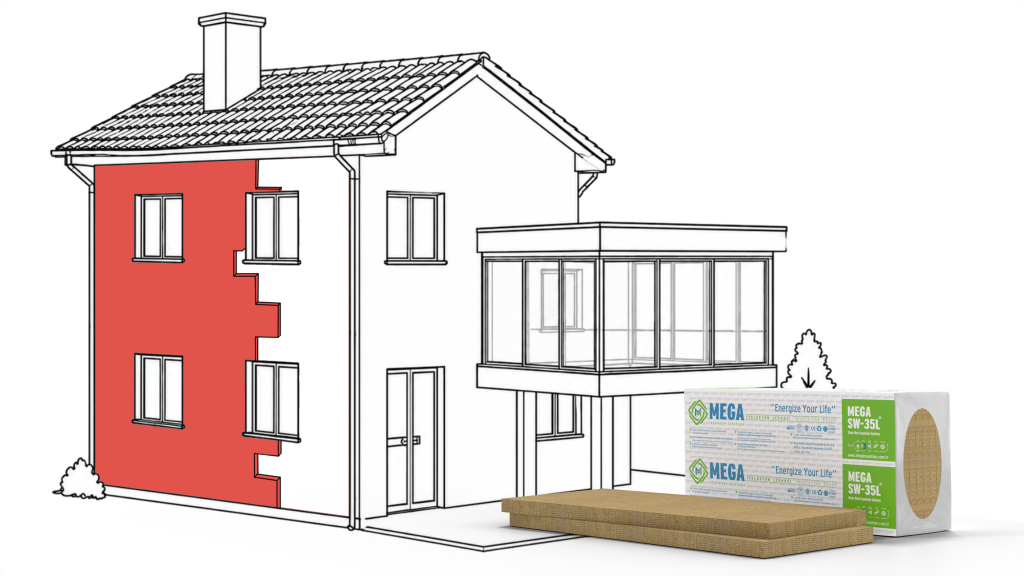
Stone wool is a mineral-based (MW) insulation material. The technical data sheets of Mega stone wool boards declare their reaction-to-fire class as A1; under Türkiye’s Regulation on the Fire Protection of Buildings, this class corresponds to “non-combustible”. Its maximum service temperature is +750 °C and its water vapour diffusion resistance is μ = 1, meaning the board lets vapour pass through. With these properties, the stone wool ETICS board stands out on façades with fire and acoustic requirements.
You can read about the material’s structure in our guide what is stone wool, and see the full product family in the stone wool category.
EPS
EPS (expanded polystyrene) is a lightweight foam board that can be cut to the required size and is used for external wall, roof and floor insulation. According to Mega’s technical data sheets, the λD value is 0.038 W/mK for white EPS 80W and 0.031 W/mK for carbon/graphite-enhanced grey EPS 70 (G); a lower λD means a thinner board for the same thermal resistance. The reaction-to-fire class of EPS boards is given as E in the data sheets, which means the material is combustible. You can see the options on the EPS boards page.
XPS
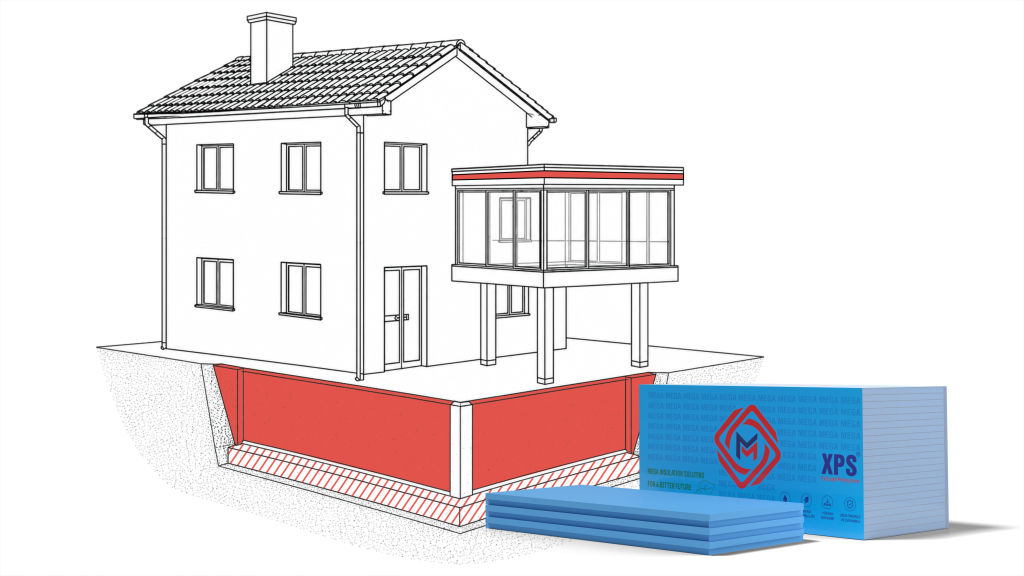
XPS (extruded polystyrene) is a board made for damp and load-bearing areas, thanks to its closed-cell structure and low water absorption. According to Mega’s XPS technical data sheets, long-term water absorption by total immersion is ≤0.7%, and compressive strength ranges from 150 to 300 kPa depending on the type. These values make XPS stand out in demanding conditions such as foundations, basement walls below ground and flat roofs; like EPS, its reaction-to-fire class is E. Flat and rough-surfaced grooved options are listed on the XPS boards page.
Because EPS and XPS are class E, regulatory requirements must be assessed project by project, especially on façades. You can find the details in our article on insulation material fire classes.
Application note from MegaUsta: Store boards on site in their packaging, in a place where they will not get wet or be exposed to direct sunlight; Mega’s XPS technical data sheet also requires boards to be protected from sunlight and covered with a UV-blocking sheet when stored outdoors. Planning cuts in advance to match the façade dimensions reduces offcut waste. Installing damaged boards wastes both the material and the labour.
Who is Mega Insulation, and which environmental management certificates does it hold?
Mega Insulation Solutions (Mega Yalıtım; trade name Mega Yalıtım Üretim Pazarlama Dış Ticaret A.Ş.) is a Turkish manufacturer of insulation materials, headquartered in Kavacık, Istanbul, with its factory in Elazığ. Alongside stone wool, XPS and EPS thermal insulation boards, it offers MegaBlock, MegaLento, DesiWool, MegaTech construction chemicals and Fullback waterproofing products under the Mega brand.
As stated on its corporate page, Mega Yalıtım operates on a site of 125,000 m², of which 52,000 m² is enclosed production space, and the company exports to more than 20 countries. You can find corporate information on the about Mega Yalıtım page.
- ISO 14001 environmental management system: Mega Yalıtım’s production of XPS and EPS thermal insulation boards and the production of Megataş A.Ş., the group company that manufactures the stone wool, are certified under ISO 14001.
- Zero Waste Certificate: Megataş A.Ş. holds a basic-level Zero Waste Certificate issued by the Elazığ Provincial Directorate of Environment, Urbanisation and Climate Change.
- Industry membership: Mega Yalıtım is a member of İZODER, the Turkish insulation industry association.
Technical data sheets and certificates for the products are available on the Documents page. We describe our environmental and R&D priorities on the our sustainability approach page.
Frequently Asked Questions
Which insulation material is more environmentally friendly?
No single insulation material is more environmentally friendly in every situation. From an environmental standpoint, the right choice is the material that suits its location, is installed correctly at the thickness calculated in the design and keeps its performance for a long time. To compare production impacts, look at EPDs prepared under the same rules; to check suitability for the location, look at the water absorption, compressive strength and fire class values in the technical data sheet.
How does insulation reduce carbon emissions?
Insulation lowers the energy spent on heating and cooling by reducing the heat that passes through walls, roofs and floors. Fuel and electricity that are not consumed also avoid the greenhouse gas emissions their production would cause. The embodied carbon from producing the material occurs once, whereas the savings from insulation recur every year for as long as the building is in use, so the benefit builds up over the years in which the insulation does its job.
What criteria are used to assess a sustainable insulation material?
A sustainable insulation material is assessed by the embodied carbon from its raw materials and production, its thermal conductivity (λD) and thermal resistance, its durability where it is installed, its reaction-to-fire class and its end-of-life options. Most of this information is found in the product’s technical data sheet and environmental product declaration. Recycling options at end of life vary with the material and with local waste management, so they should be checked separately.
What is an EPD (environmental product declaration)?
An EPD (environmental product declaration) is a Type III environmental declaration that reports a product’s environmental performance in line with ISO 14025, based on a life cycle assessment, and is verified by an independent third party. For construction products, the core rules are defined in EN 15804. An EPD is not an eco-label that approves a product, nor a claim of superiority; it presents measured data transparently and allows declarations prepared under the same rules to be compared.
Sources
- European Commission: Energy Performance of Buildings Directive (energy use in buildings)
- Official Gazette of Türkiye: Regulation on Energy Performance in Buildings (5 December 2008, No. 27075)
- The International EPD System: What is an EPD? (environmental product declarations under ISO 14025)
- SIS: EN 15804:2012+A2:2019, Sustainability of construction works, Environmental product declarations, Core rules
- Climate Change Presidency of Türkiye: Türkiye’s 2053 Long-Term Climate Strategy (PDF, in Turkish)
- Mega Yalıtım: MEGA SW F150 stone wool ETICS board technical data sheet (PDF)
- Mega Yalıtım: EPS 60W / 80W / 90W technical data sheet (PDF)
- Mega Yalıtım: EPS 50 / 60 / 70 G technical data sheet (PDF)
- Mega Yalıtım: MEGA XPS T3000 technical data sheet (PDF)
The choice of which insulation material to use in your project, and at what thickness, is made by assessing the thermal insulation design and the technical data sheet values together. To speak with our technical team, you can use our contact page.