
In short: There is no single answer to whether a thermal insulation block or ETICS is better: in an existing building ETICS is the one of the two that can be applied, in a new building whose walls are not yet built both are considered, and the thermal insulation project calculation decides. The insulation sits inside the wall with a block and on its outer face with ETICS. The technical data sheets give a U value of 0.36–0.19 W/m²K for a plastered MegaBlock Thermal wall, depending on the series.
We compare this product group, also searched for as “thermally insulated pumice block” or “thermal block”, with ETICS in terms of new and existing buildings, wall values, thermal bridges, order of work, sound and fire. You can read more about the product family in what is MegaBlock and about the facade system in what is ETICS.
What is the difference between a thermal insulation block and ETICS?
The main difference is where the insulation sits: in a thermal insulation block, the insulation layer comes inside the block and is in place as the wall is built, while in ETICS boards are applied to the outer face of the finished wall. Mega Insulation Solutions (Mega Yalıtım) offers products for both routes: the MegaBlock Thermal insulation block with stone wool layers, and stone wool ETICS Board for rendered external wall systems.
| Criterion | Thermal insulation block (MegaBlock Thermal) | ETICS (Mega stone wool ETICS Board) |
|---|---|---|
| Where the insulation sits | Inside the block, stone wool layers | On the outer face of the wall, as boards |
| Wall it applies to | A wall yet to be built | A new or existing wall |
| When it is applied | While the wall is being built | After the wall is finished, on the facade |
| Thickness | 145, 195, 245 or 295 mm block plus plaster | The wall itself, 40–120 mm board and plaster layers |
| In front of columns and beams | A separate detail with MegaBlock BC | Boards also pass in front of these faces |
| Thermal value in the data sheet | U and λ of the wall | λD and RD of the board; the wall’s U value is calculated in the project |
| Reaction to fire class | A1 (block data sheet) | A1 (board data sheet); the system is assessed separately |
Source: MegaBlock Thermal and ETICS Board technical data sheets; scope of EN 13500.
What are the U and λ values of a MegaBlock Thermal wall?
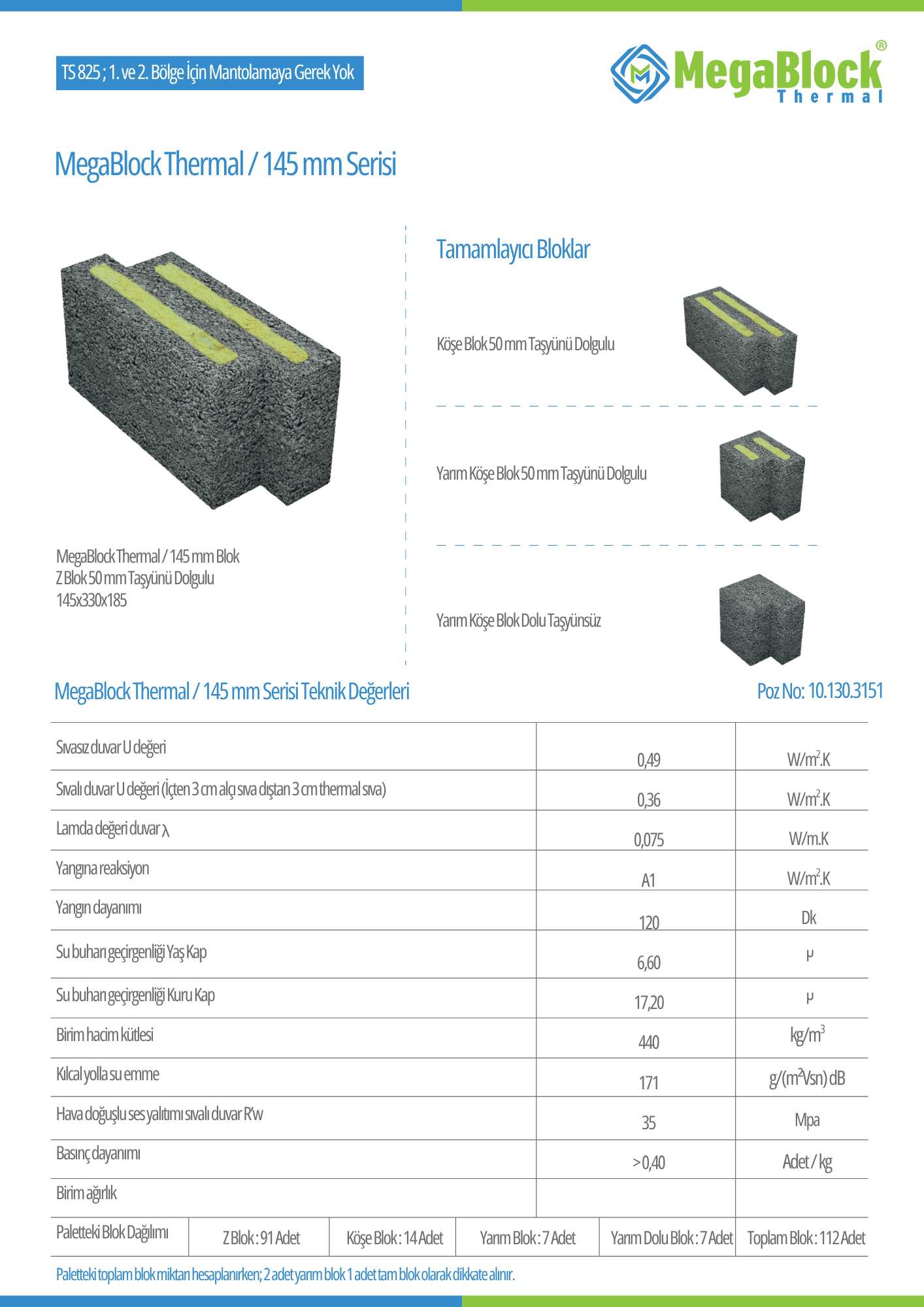
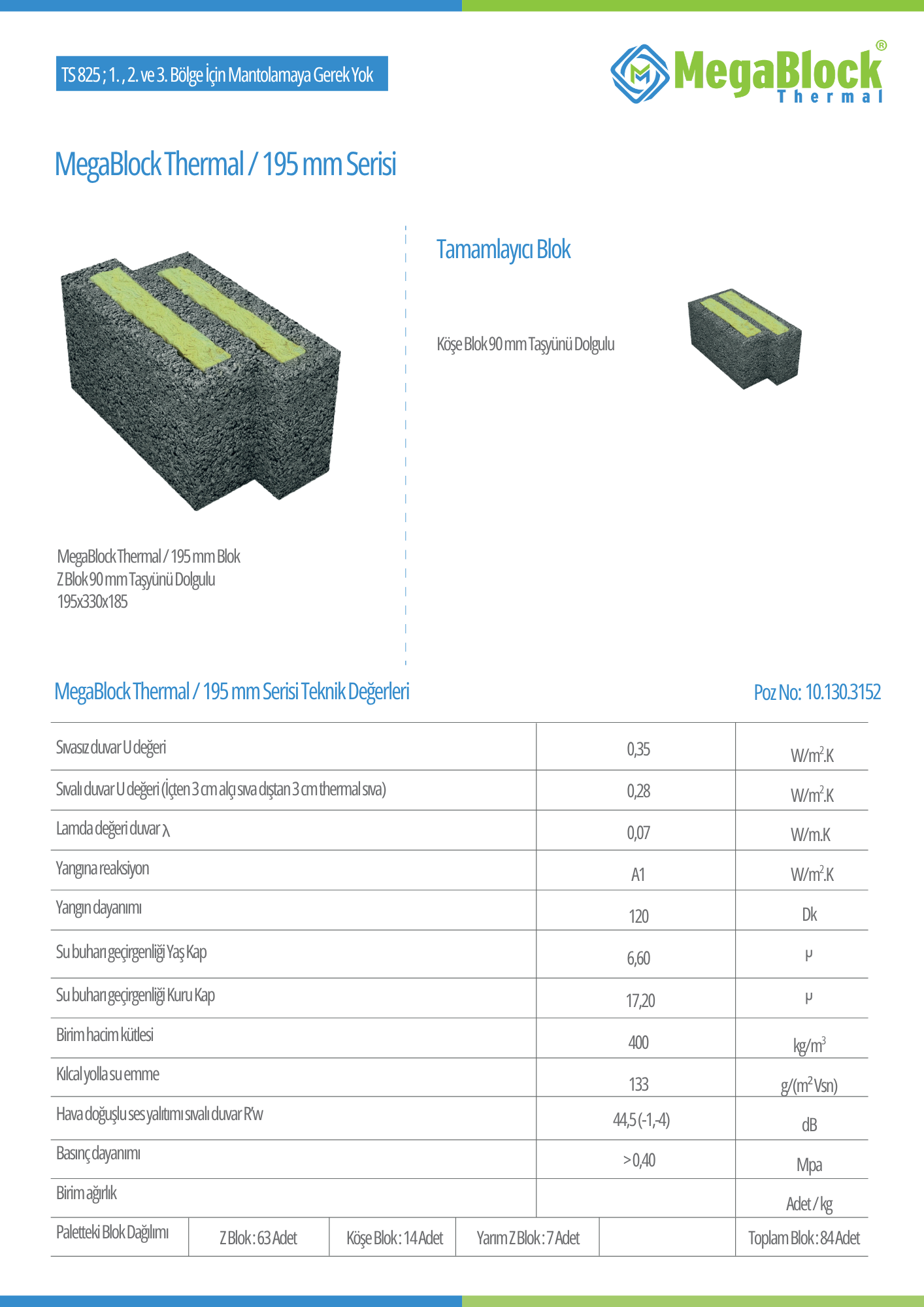
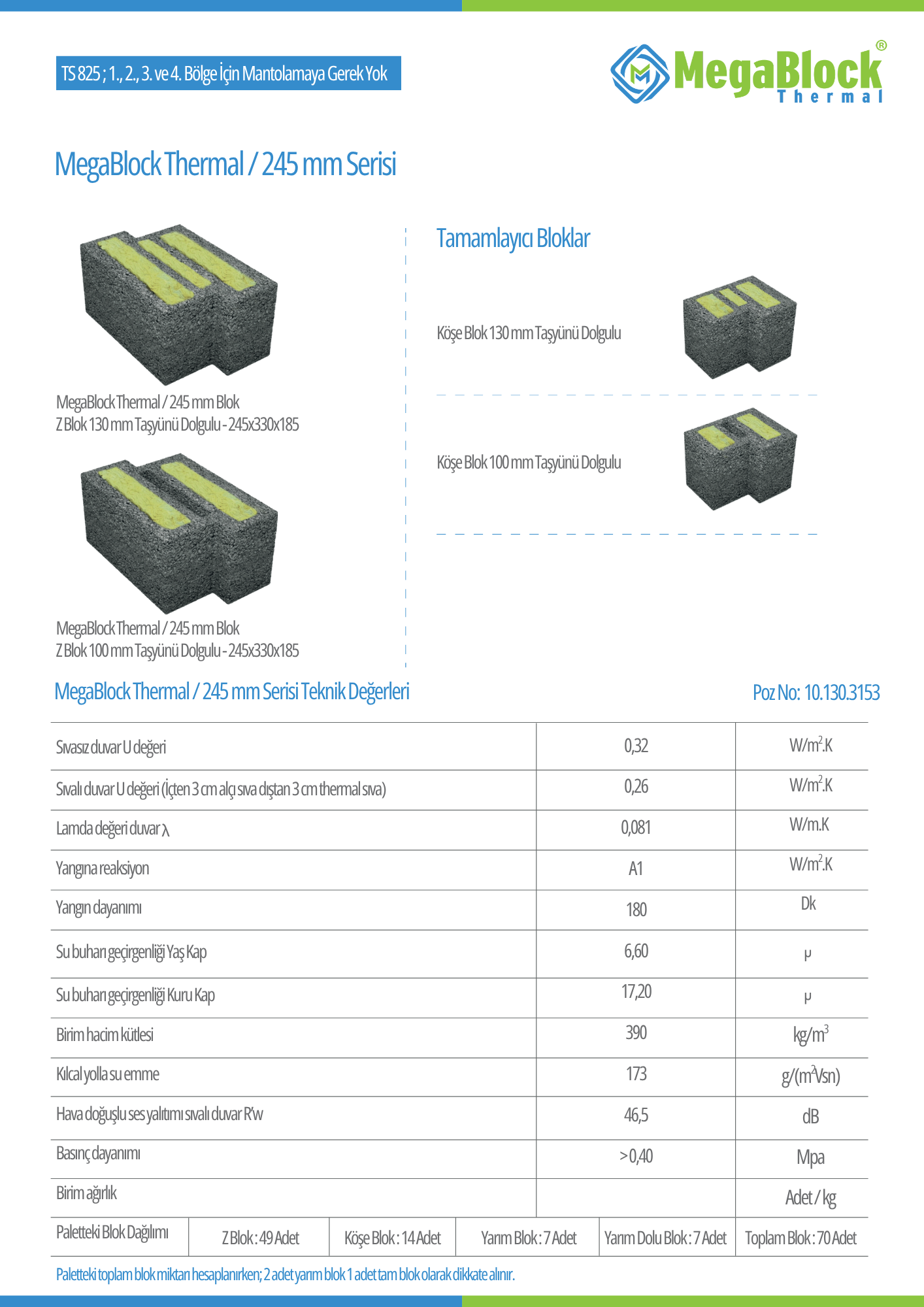
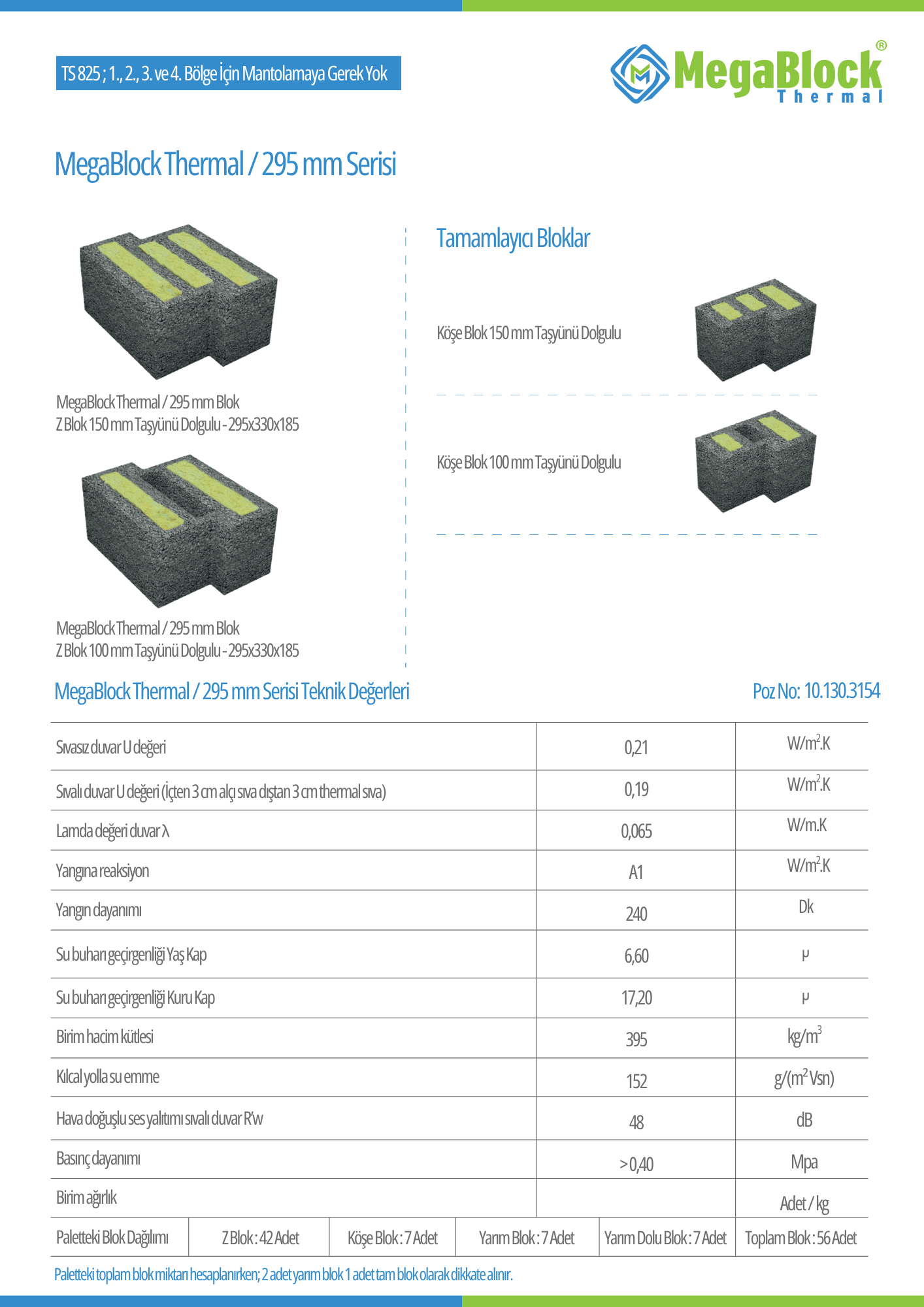
According to the MegaBlock Thermal technical data sheets, the U value of a plastered wall is 0.36 W/m²K in the 145 mm series and 0.19 W/m²K in the 295 mm series. The data sheets give thermal conductivity (λ) for the built wall rather than a single block.
| Series | Stone wool layer | U, unplastered (W/m²K) | U, plastered (W/m²K) | Wall λ, data sheet (W/mK) | Wall λ, thick joint (W/mK) | Unit volume mass (kg/m³) |
|---|---|---|---|---|---|---|
| 145/50SW | 50 mm | 0.49 | 0.36 | 0.075 | 0.092 | 440 |
| 195/90SW | 90 mm | 0.35 | 0.28 | 0.070 | 0.087 | 400 |
| 245 series | 100 or 130 mm | 0.32 | 0.26 | 0.081 | 0.098 | 390 |
| 295 series | 100 or 150 mm | 0.21 | 0.19 | 0.065 | 0.082 | 395 |
Source: MegaBlock Thermal technical data sheets and TSE National Technical Approval (UTO) documents. Plastered U values are for a wall with 3 cm of gypsum plaster inside and 3 cm of thermal plaster outside. In the 245 and 295 mm series, the data sheet gives one set of values for two stone wool arrangements and does not say which arrangement they belong to. The thick joint column is the UTO condition of 7 mm, 1,800 kg/m³ mortar.
The λ in the data sheet matches the design value in the UTO documents for an unplastered wall built with 3 mm of mortar at a density of 900 kg/m³. According to the same documents, the value rises with 7 mm of mortar at 1,800 kg/m³, meaning the choice of joint and mortar changes the wall’s thermal conductivity. Because λ rises with a thick joint, the wall’s U value also comes out higher than the data sheet value in the table. The UTO documents state that these design values are used in the thermal insulation project instead of the TS 825 table value.
MegaBlock Thermal is offered as a lightweight building element; the unit volume mass in the data sheets is 390–440 kg/m³, depending on the series.
In which λD values and thicknesses is the ETICS Board offered?
According to the technical data sheets for Mega stone wool ETICS Board, the MEGA SW F150, F120, PLUS and ULTRA types have λD ≤0.037 W/mK and 40–120 mm, and the MEGA SW-35L type has λD ≤0.035 W/mK and 50–120 mm. All types measure 1200 x 600 mm and have reaction to fire class A1.
| Type | Density (kg/m³) | Thickness (mm) | λD (W/mK) | Compressive strength (kPa) | Tensile strength perpendicular to surface (kPa) |
|---|---|---|---|---|---|
| MEGA SW F150 | 150 (±10%) | 40–120 | ≤0.037 | min 40 / 45 / 55 | min 10 |
| MEGA SW F120 | 120 (±10%) | 40–120 | ≤0.037 | min 30 | min 10 |
| MEGA SW PLUS | Not in data sheet | 40–120 | ≤0.037 | min 25 | min 7.5 |
| MEGA SW ULTRA | Not in data sheet | 40–120 | ≤0.037 | min 30 / 35 / 40 | min 7.5 |
| MEGA SW-35L | Not in data sheet | 50–120 | ≤0.035 | min 25 | min 7.5 |
Source: ETICS Board technical data sheets (MEGA SW F150, F120, PLUS, ULTRA, SW-35L).
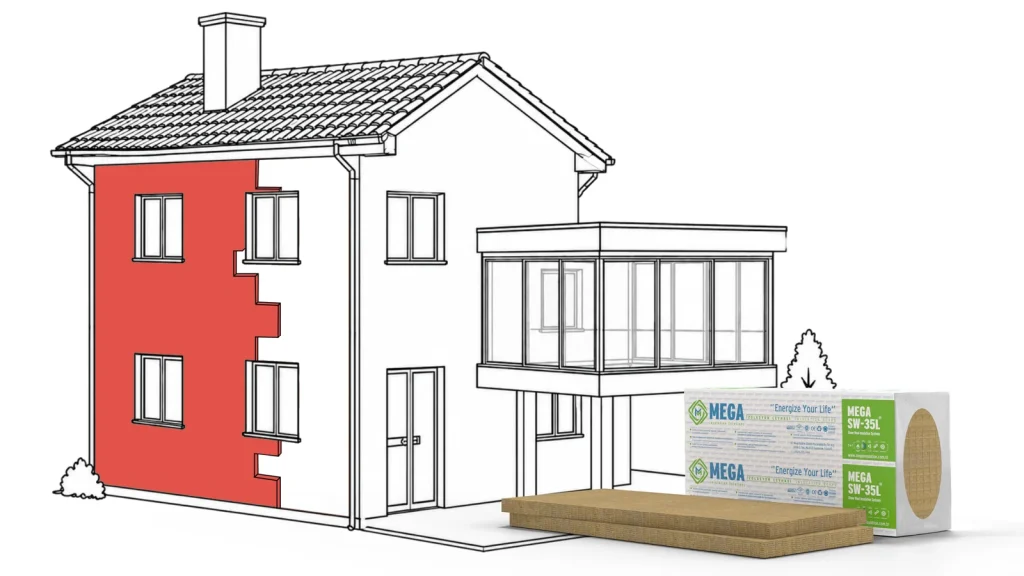
The MEGA SW F150 data sheet gives a thermal resistance (RD) of 1.35 m²K/W for 50 mm and 2.70 m²K/W for 100 mm. These are board values. The U value of a wall with ETICS depends on the material and thickness of the wall beneath and is calculated in the project. So do not compare the wall U value in a MegaBlock data sheet directly with the λD of a board; make the comparison for the same building and the same target U value.
Does a MegaBlock Thermal wall also need ETICS?
The building’s thermal insulation project calculation determines whether a MegaBlock Thermal wall also needs ETICS. According to the manufacturer’s TDS, the data sheet headings read “TS 825; No ETICS Needed for Zones 1 and 2” for the 145 mm series, “Zones 1, 2 and 3” for the 195 mm series, and “Zones 1, 2, 3 and 4” for the 245 and 295 mm series; the final decision is made by the thermal insulation project calculation.
A data sheet heading does not replace the building calculation. Türkiye’s Energy Performance of Buildings Regulation requires the thermal insulation project to be prepared using the calculation method set out in the TS 825 standard. The October 2024 edition of TS 825 replaced TS 825/May 2008 under a communiqué that took effect on 1 April 2025, and the Ministry announced that the number of zones rose from 4 to 6. The data sheet heading lists zones 1 to 4 and does not state which edition it was written for. So do not draw conclusions by matching its zone number against the current six-zone list; the project goes by the current edition and the building’s zone in that list.
If the calculation does not meet the target, a wider series can be chosen or further insulation added to the wall. Column, beam and lintel points are also handled separately in the calculation.
Which applies in a new building and which in an existing one?
In an existing building, ETICS is the one of these two solutions that can be applied; a thermal insulation block can only be used if the wall is being rebuilt. According to the scope of EN 13500, ETICS is applied to the external surfaces of new or existing walls. We describe the preliminary checks for existing buildings in ETICS on old buildings.
In a new building both options are open. These questions settle the decision:
- Target U value: The calculation shows which series or board thickness meets the value required in the project.
- Wall section: With MegaBlock Thermal, the block width and plaster set the thickness, and outward-facing walls are built at least 6 cm proud of the concrete face. With ETICS, board and plaster layers are added to the thickness of the wall itself. Which section ends up thinner depends on the chosen series, the wall and the board thickness.
- Amount of concrete surface: As column, beam and shear wall surfaces increase, so does the area needing a separate detail on the MegaBlock side. With ETICS, boards also pass over these surfaces.
- Use of interior walls: According to the product page, the layered structure of MegaBlock Thermal makes it easier to run services in the wall, and cabinets and built-in appliances can be mounted on it. The data sheets for the same product give a compressive strength of >0.40 MPa; plan the fixings for walls carrying heavy loads around this value.
How are thermal bridges at columns, beams and lintels handled?
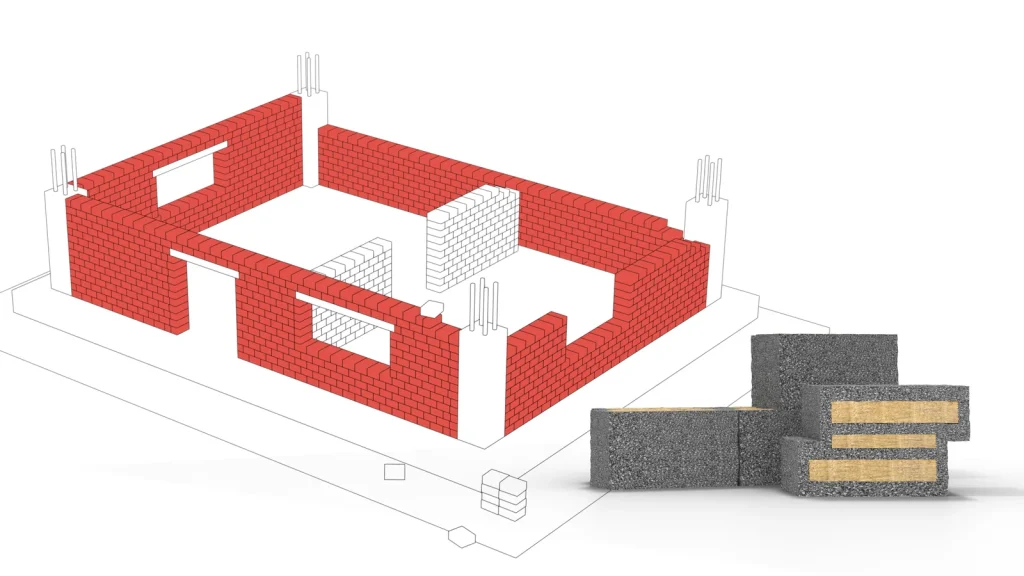
With ETICS, boards also pass in front of columns and beams, so these points are covered by the same layer; a MegaBlock Thermal wall needs a separate detail for concrete faces and the tops of openings. If the plain wall’s value is interrupted at these points, a thermal bridge can form.
According to the method in the Mega product catalogue, MegaBlock Thermal is built projecting outwards by at least 6 cm on outward-facing walls, so that reinforced concrete faces such as columns, beams, floor edges and shear walls stay set back. MegaBlock BC is bonded to these faces with a notched trowel of at least 5 mm. According to the product page, MegaBlock BC is stone wool with an acrylic plaster coating, at a density of 150 kg/m³, in sizes of 30 x 60 x 5 cm and 40 x 50 x 5 cm. MegaLento SW is used over door and window openings; according to its declaration of performance, the minimum bearing length is 150 mm per side.
ETICS needs details too. Türkiye’s MYK national qualification for Thermal Insulation Installers (Level 3) requires boards to be placed in one L-shaped piece at window and door edges, so that no joint forms there.
Application note from MegaUsta: When comparing the two solutions, level the scope of the quotes. On the block side, corner blocks, MegaBlock BC and lintels should be written in; on the ETICS side, corner, window and sill details as well. A comparison based only on plain wall quantities leaves out the part of the job that needs the most detail.
How does the order of work change?
With MegaBlock Thermal, the insulation is completed together with the wall; with ETICS, the wall is finished first and then the boards are bonded to the facade. The two sequences are as follows:
- MegaBlock Thermal: Laying the wall, MegaBlock BC on concrete faces, lintels at openings, then interior and exterior plaster.
- ETICS: Wall and surface preparation, bonding the boards, dowels, meshed base coat, top coat. According to the Mega MTA-3333 data sheet, dowels go in at least 24 hours later and plaster after 2 days; we give the details in how a thermal insulation board is bonded.
Weather also affects the schedule. MTA-3333 is applied between +5 °C and +35 °C. The MegaBlock Thermal product page describes providing insulation at the same time as laying the wall as a feature that reduces the difficulties of ETICS in very hot and very cold weather. On a block wall too, mortars and plasters are bound by the temperature limits in their own data sheets.
How do the two solutions differ on sound and fire?
The MegaBlock Thermal data sheets give sound insulation (R’w) and fire resistance values for a plastered wall; for ETICS, Mega documents give no dB value for sound, and the fire class varies with the chosen board.
| MegaBlock Thermal series | R’w, plastered wall (dB) | Fire resistance (minutes) | Reaction to fire class |
|---|---|---|---|
| 145/50SW | 35 | 120 | A1 |
| 195/90SW | 44.5 (-1,-4) | 120 | A1 |
| 245 series | 46.5 | 180 | A1 |
| 295 series | 48 | 240 | A1 |
Source: MegaBlock Thermal technical data sheets.
These are the values of the block wall itself. With ETICS, the wall’s sound insulation and fire resistance also depend on the wall beneath, so do not compare this table directly with a wall that has ETICS. Neither ETICS on the outer face nor MegaBlock Thermal in an external wall solves, on its own, sound passing through party walls and interior partition walls. For walls where sound is the priority, look at products such as MegaBlock Acoustic or DesiWool; we gather the options in wall sound insulation.
On fire, separate the board class from the system class. According to Mega technical data sheets, stone wool ETICS Board is class A1; the EPS and XPS boards also used in ETICS are class E, meaning combustible. A1 is the class of the board and does not describe the whole system. Article 27 of Türkiye’s Regulation on the Protection of Buildings from Fire requires the thermal insulation system to be certified by an accredited laboratory, and the facade to be made of low-combustibility material in buildings taller than 28.50 m and of at least low-flammability material in other buildings. See fire classes of insulation materials for details; an authorised engineer makes the project-specific assessment.
Frequently Asked Questions
Does using MegaBlock Thermal mean ETICS is not needed?
Choosing the block does not settle this on its own. According to the manufacturer’s TDS, the MegaBlock Thermal data sheet headings carry the phrase “No ETICS Needed” for certain TS 825 zones, depending on the series; the final decision is made by the thermal insulation project calculation. The project assesses the building’s zone and the wall, column and beam values together under the current TS 825 method.
Are thermally insulated pumice blocks and MegaBlock Thermal the same product?
“Thermally insulated pumice block” is a general search term and does not describe one product. MegaBlock Thermal is a specific product: according to its TSE National Technical Approval, it is a lightweight sandwich masonry unit made of pumice, cement and stone wool layers. When comparing it with another block, go by the U and λ values in that block’s data sheet rather than the product description.
Can a thermal insulation block be used in an old building?
Not to insulate a wall that stays in place; the block is a wall element and can only be used when a wall is being rebuilt. In an old building whose walls are kept, external insulation is done with ETICS. According to the scope of EN 13500, this system is applied to the external surfaces of new or existing walls. Check the suitability of the surface separately before application.
How are columns and beams insulated in a wall built with insulation blocks?
According to the method in the Mega product catalogue, a MegaBlock Thermal wall is built projecting outwards by at least 6 cm, so that reinforced concrete faces such as columns, beams and floor edges stay set back. MegaBlock BC boards are bonded to these faces with a notched trowel of at least 5 mm. If the concrete faces are left uninsulated, thermal bridges can form at these points.
Which documents should you ask an insulation block manufacturer for?
Ask for a technical data sheet by series and a document showing the wall’s design thermal conductivity. The MegaBlock Thermal data sheets give U, λ, reaction to fire and sound values series by series; the TSE National Technical Approvals show the wall’s design value with its mortar condition. These documents are on Mega Yalıtım’s product and Documents pages. Share the values with the engineer preparing the thermal insulation project.
Which is more economical, a thermal insulation block or ETICS?
There is no general answer, because the two solutions differ in scope: with a block, the wall and insulation come together, while with ETICS, the wall and the facade system are separate jobs. Make the comparison for the same building and the same target U value. Make sure quotes include column, beam and window details along with the wall, insulation, plaster and labour.
Sources
- Communiqué on the TS 825 Thermal Insulation Rules for Buildings standard (MHGM-2025/1), Official Gazette (in Turkish)
- Ministry of Environment, Urbanisation and Climate Change: thermal insulation standard for buildings updated by climate conditions (in Turkish)
- Energy Performance of Buildings Regulation, Official Gazette (in Turkish)
- Regulation on the Protection of Buildings from Fire, mevzuat.gov.tr (in Turkish)
- EN 13500, mineral wool ETICS standard, scope (EVS)
- MYK 12UY0057-3 national qualification for Thermal Insulation Installers (Level 3)
- MegaBlock Thermal 145/50SW technical data sheet
- MegaBlock Thermal 195/90SW technical data sheet
- MegaBlock Thermal 245 series technical data sheet
- MegaBlock Thermal 295 series technical data sheet
- MEGA SW F150 ETICS Board technical data sheet
- MEGA SW F120 ETICS Board technical data sheet
- MEGA SW PLUS ETICS Board technical data sheet
- MEGA SW ULTRA ETICS Board technical data sheet
- MEGA SW-35L technical data sheet
- MegaBlock documents (Mega Yalıtım Documents)
You can browse MegaBlock Thermal, Acoustic and BC in the MegaBlock wall systems category and reach our technical team through our contact page for the right solution for your project.