
In short: An insulation board is bonded by combing the mortar onto its back if the wall is even, and by applying the mortar in dabs if it is not. With Mega MTA-3333 board adhesive, use 5.5–6 L of water per 25 kg of powder and finish the mortar within 2 hours at most; wait at least 24 hours for dowels and 2 days for plaster over the boards.
This guide covers mixing the mortar, choosing between combing and dabbing, working times, consumption and differences by board type, using the MTA-3333 technical data sheet and MYK qualification criteria. You can read all the steps of the system in how ETICS is installed and the common mistakes in ETICS application mistakes.
How is a thermal insulation board bonded?
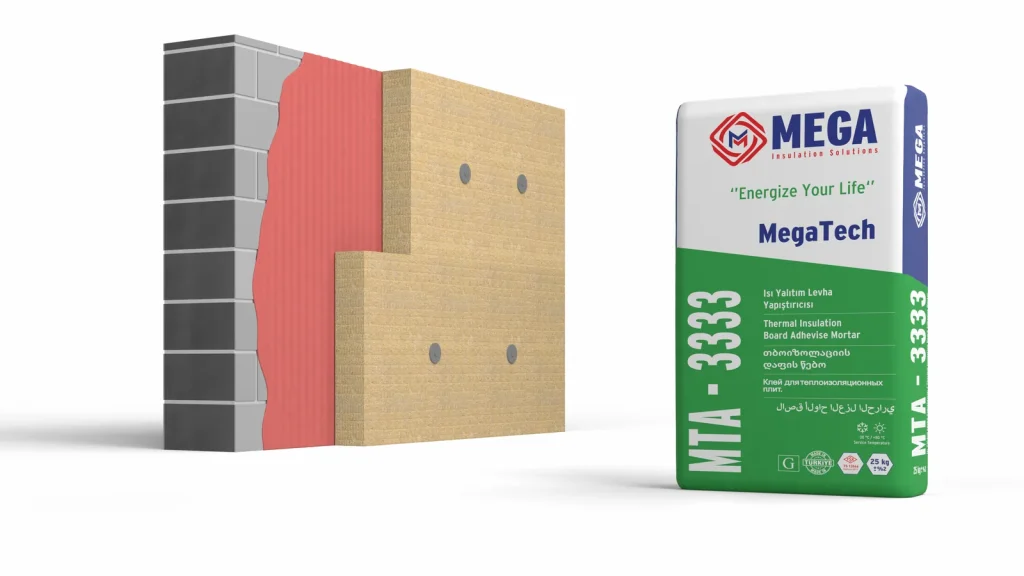
A thermal insulation board is bonded to a prepared surface with mortar applied by a method that suits the evenness of the wall, and its flatness is checked with a straightedge. Mega Insulation Solutions (Mega Yalıtım) offers MegaTech MTA-3333 thermal insulation board adhesive for this job within its product range. The order below follows the MTA-3333 data sheet, and the steps with measurements follow the national qualification for Thermal Insulation Installers (Level 3) from Türkiye’s Vocational Qualifications Authority (MYK); that document sets installer competence criteria and is not a Mega product instruction.
- Prepare the surface: According to the MTA-3333 data sheet, remove residues such as dust, dirt and grease, and correct defects with repair mortar. The surface must be sound and cured; wet it if it is porous.
- Measure the wall’s deviation: The MYK qualification requires deviation to be determined with a plumb line. This measurement decides the bonding method.
- Mix the mortar: Put the water in the container first, add the powder slowly, then let the mortar rest and remix it.
- Apply mortar to the back of the board: The MTA-3333 data sheet calls for combing on an even substrate and dabbing on an uneven one. The MYK qualification requires that adhesive does not spread onto the edges where boards meet.
- Place the board on the wall: According to the MYK qualification, boards are laid horizontally in a staggered pattern with no gaps between them. The MTA-3333 data sheet also lists a rubber mallet among its tools.
- Check flatness and bonding: According to the MTA-3333 data sheet, check with a straightedge or spirit level that the boards are at the same level. The MYK qualification also requires pulling a board off to verify that at least 40% of its surface has bonded to the wall.
- Observe the waiting times: According to the MTA-3333 data sheet, mechanical dowelling is done at least 24 hours later, and plaster over the boards after 2 days.
How is board adhesive mortar mixed?
Mega MTA-3333 board adhesive mortar is mixed by putting water into a clean container first, using 5.5–6 L of water per 25 kg of powder. The powder is added to the water slowly and mixed with a low-speed mixer until uniform.
The uniform mix is left to rest for 5–10 minutes so that it matures, then remixed for 1–2 minutes before use. After this point, do not add powder, water or anything else. The container must be free of residue from the previous mix, and the water must be clean.
Combing or dabbing?
The flatness of the wall decides: according to the Mega MTA-3333 data sheet, comb the back of the board if the substrate is even and use dabs if it is not. How ETICS adhesive is applied depends on this distinction. The data sheet gives no flatness figure; the numerical distinction is in Türkiye’s MYK national qualification for Thermal Insulation Installers (Level 3).
| Facade deviation | Method | How it is applied |
|---|---|---|
| 0.5 cm over 3 metres | Notched trowel (combing) | Adhesive is spread over the whole board surface with a 10×10 mm notched trowel. |
| 1 cm over 3 metres | Perimeter and dabs | A flat, blunt-nosed trowel is used to apply an unbroken perimeter on the back of the board along its edges, with dabs inside it placed to match the dowel points. |
| Greater | Correct first | The facade is levelled with base plaster before insulation starts. |
Source: MYK 12UY0057-3 national qualification for Thermal Insulation Installers (Level 3), unit A3 and glossary annex.
The ETICS guidance from the Yalova Provincial Directorate of Türkiye’s Ministry of Environment, Urbanisation and Climate Change describes the same layout: a perimeter along the board edges and spot adhesive in the middle. The EPS ETICS standard EN 13499, for its part, leaves the bond strength between the system and the building surface outside its scope.
How long can the mortar be used, and how long is the wait for dowels and plaster?
According to the Mega MTA-3333 data sheet, mixed mortar is used within 2 hours at most, and its working time is up to 10–15 minutes. Mechanical dowelling is done at least 24 hours later; plaster can go over the boards after 2 days.
| Stage | Value in the MTA-3333 data sheet |
|---|---|
| Mixing water | 5.5–6 L per 25 kg of powder |
| Resting | 5–10 minutes |
| Remixing | 1–2 minutes |
| Working time | Up to 10–15 minutes |
| Pot life | Up to 2 hours |
| Mechanical dowelling | At least 24 hours later; depends on ambient temperature and surface |
| Plaster over the boards | After 2 days |
| Ambient temperature | +5 / +35 °C |
| Consumption | 3–5 kg/m² |
Source: MegaTech MTA-3333 technical data sheet.
24 hours is the lower limit; the data sheet ties this time to ambient temperature and surface properties. The provincial directorate’s guidance also places dowelling about one day after the mortar dries. We cover the number and position of dowels in how many dowels ETICS needs. Protect the work from frost until it sets, and from rain and wetting until fully dry.
Application note from MegaUsta: Plan the mortar around two separate times. The limit for the mix in the container is 2 hours at most, so mix only what you will finish in that time. The data sheet does not define what its working time of up to 10–15 minutes covers. To be safe, treat it as the longest that mortar spread on a board may stay exposed: do not apply mortar to a board you cannot place straight away; seat the one you have coated on the wall, then move on to the next.
What is the consumption of board adhesive?
The Mega MTA-3333 data sheet gives a consumption of 3–5 kg/m², so one 25 kg bag bonds about 5–8.3 m² of board. A bag covers 5 m² at 5 kg/m² and about 8.3 m² at 3 kg/m².
For example, a 100 m² facade needs 300–500 kg, or 12–20 bags. This is a theoretical calculation; the data sheet gives no separate figures for combing and dabbing. Store the bags in a dry, enclosed area off the floor, stacked no more than 8 high; under these conditions the product keeps for 12 months from production.
What changes when bonding stone wool, EPS and XPS boards?
The Mega MTA-3333 data sheet gives the same mortar and the same mixing ratio for stone wool, EPS and XPS; what changes is the size and surface of the board and how it is protected on site.
| Board | Size | Surface | Before bonding |
|---|---|---|---|
| Stone wool: ETICS Board, MEGA SW F150 | 1200 x 600 mm | Unfaced | Density 150 kg/m³ (±10%); a 100 mm board works out at about 10.8 kg. According to the product page, protect it from water and sun. |
| EPS: EPSW white ETICS board | 500 x 1000 mm | Board cut from a block | According to the product page, if stacked outdoors, cover it without blocking airflow and protect it from water and sun. |
| XPS: XPS Rough Grooved | 600 x 1200 mm | Rough or rough-grooved; shiplap edge | According to the product page, protect it from long exposure to sun and do not use it with solvent-based materials. |
Source: MEGA SW F150, EPS and XPS technical data sheets and product pages. Board weight is calculated from the density in the data sheet.
Pay attention to the surface with XPS. According to Mega product pages, smooth-skinned XPS Flat is listed for uses such as unplastered facades and under siding, while rough and rough-grooved boards are listed for ETICS, and this surface shape is described as being for adhesion.
If the wall has not been built yet, handling the insulation inside the wall block instead of with boards is also an option; we compare the two routes in thermal insulation block or ETICS.
When should boards not be bonded?
Mega MTA-3333 is applied at an ambient temperature between +5 °C and +35 °C. According to the data sheet, do not apply it in the following conditions:
- On frozen or thawing surfaces, or where there is a risk of frost within 24 hours,
- In direct sun, rain or strong wind,
- On hot surfaces.
To plan the work schedule around these conditions, see our article on when ETICS should be installed.
Frequently Asked Questions
How many m² does 25 kg of board adhesive cover?
The data sheet for Mega MTA-3333 board adhesive gives a consumption of 3–5 kg/m², so one 25 kg bag bonds about 5–8.3 m² of board. A 100 m² facade needs 300–500 kg, or 12–20 bags. The data sheet does not give separate figures for combing and dabbing, so also run your take-off with the upper end of the range.
How much water goes into board adhesive?
According to the Mega MTA-3333 data sheet, use 5.5–6 litres of clean water per 25 kg of powder. Put the water in the container first, add the powder slowly and mix with a low-speed mixer until uniform. Let the mortar rest for 5–10 minutes and remix for 1–2 minutes before use. Do not add water, powder or anything else afterwards.
What size notched trowel is used for bonding boards?
Türkiye’s MYK national qualification for Thermal Insulation Installers (Level 3) defines the notched trowel method as applying adhesive over the whole board surface with a 10×10 mm notched trowel. The Mega MTA-3333 data sheet lists a notched steel trowel among its tools but gives no notch size. If deviation reaches 1 cm over 3 metres, MYK calls for the perimeter-and-dab method.
How long can mixed board adhesive stand?
According to the Mega MTA-3333 data sheet, the pot life of the mixed mortar is up to 2 hours. Discard crusted or expired mortar; do not revive it with water. The data sheet also gives a working time of up to 10–15 minutes but does not define the term. To be safe, mix only what you will use within 2 hours and apply mortar only to the boards you are about to place.
What percentage of the board should bond to the wall?
Türkiye’s MYK national qualification for Thermal Insulation Installers (Level 3) requires at least 40% of the board surface to be bonded to the wall. To check, place a board with adhesive on the wall, pull it off and look at the bonded area. This figure comes from the MYK qualification; the Mega MTA-3333 data sheet gives no bonding percentage.
Is the same adhesive used for XPS, EPS and stone wool boards?
For Mega MTA-3333, yes: according to its data sheet, this cement-based mortar is used to bond stone wool, XPS and EPS boards in ETICS. The mixing ratio and waiting times are not given separately by board type. What changes is the size and surface of the board; on the XPS side, rough and rough-grooved boards are the ones listed for ETICS.
Sources
- MYK 12UY0057-3 national qualification for Thermal Insulation Installers (Level 3)
- Yalova Provincial Directorate, Ministry of Environment, Urbanisation and Climate Change: How is ETICS installed? (in Turkish)
- EN 13499, EPS-based ETICS standard, scope (SIS)
- MegaTech MTA-3333 Thermal Insulation Board Adhesive technical data sheet (TDS)
- MEGA SW F150 ETICS Board technical data sheet (TDS)
- EPS 60W, 80W and 90W technical data sheet (TDS)
- MEGA XPS T3000 technical data sheet (TDS)
- Mega Yalıtım Documents page
You can browse Mega’s board adhesive in the Adhesive category and reach our technical team through our contact page for your project.