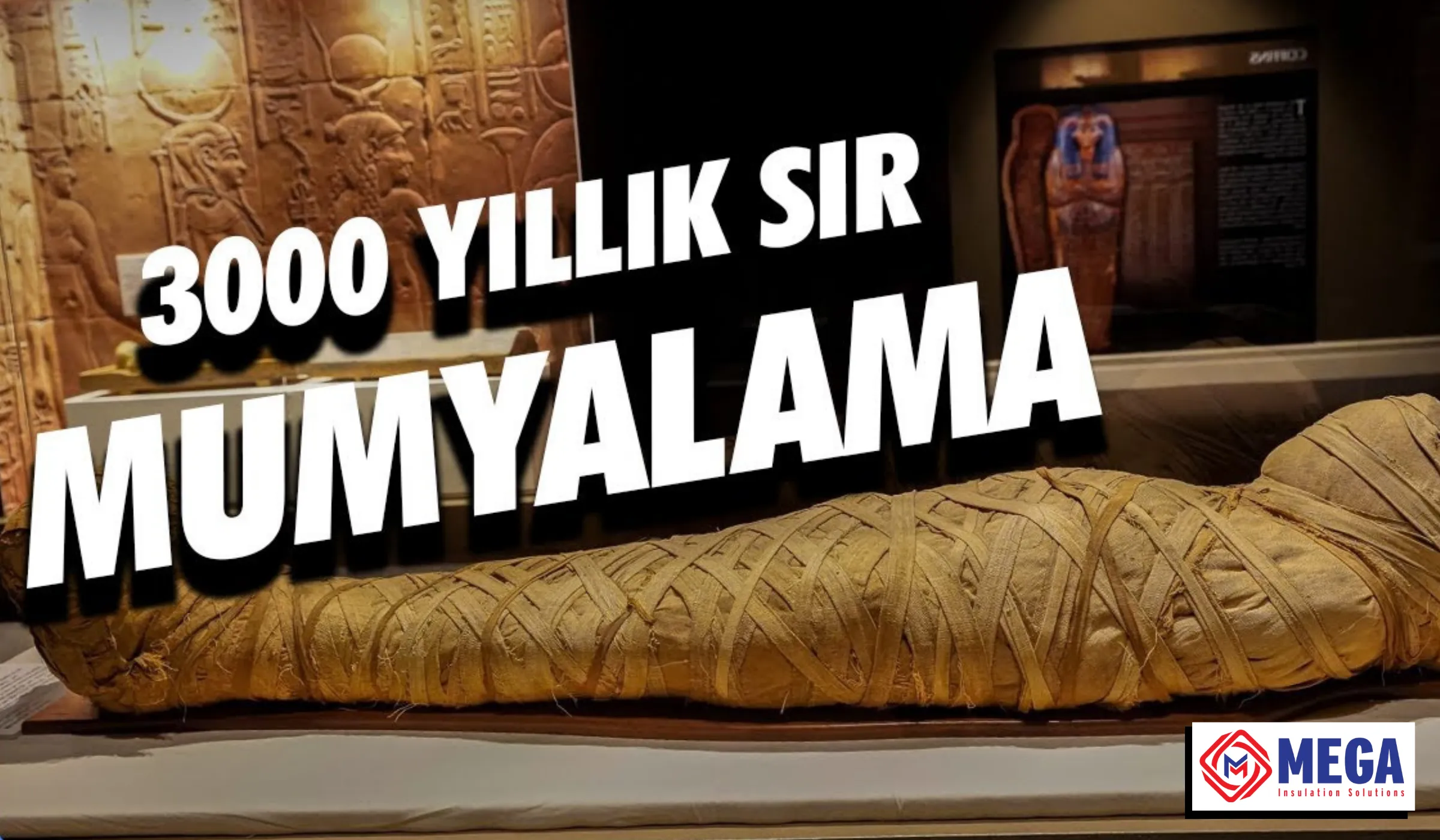
In ancient Egypt, mummification was carried out by removing the internal organs, drying the body with natron salt for about 40 days, anointing it with oils, filling its cavities with linen or resin, and wrapping it in layer upon layer of linen. The whole process took about 70 days. Its core idea was to draw out the moisture that starts decay and keep it from returning.
Some of the bodies mummified thousands of years ago are still studied in museums today. What made this possible was that Egyptian embalmers removed, step by step, the basic condition for decay: water. That is why mummification can also be seen as a kind of biological insulation: the body is separated from the moisture and external influences that cause deterioration. In this article we explain the steps of ancient Egyptian mummification, the materials used, and why the same principle still applies today when protecting buildings from moisture.
How was mummification done step by step in ancient Egypt?
Mummification was a process of about 70 days that began with washing and ended with wrapping and preparation for burial. The steps described by the Chau Chak Wing Museum at the University of Sydney and by Egypt’s Ministry of Tourism and Antiquities are as follows:
- Washing and purification: Because decomposition sets in quickly in the Egyptian heat, the body was washed and purified as soon as possible after death.
- Removing the brain: The brain was liquefied with a hooked metal rod and drained out through the nose; it was not preserved.
- Removing the internal organs: The lungs, liver, stomach and intestines were taken out through an incision of about 10 cm in the left side of the body, wrapped and stored in canopic jars. The heart, regarded as the centre of intellect, emotion and memory, was left in place.
- Drying with natron: The body cavity was filled with bags of natron and the body was covered with natron on the outside. When the natron was removed after 35 to 40 days, the body was dried and shrunken, but its skin and soft tissues remained intact.
- Anointing and filling: The dried body was rubbed with coniferous oils and perfumes; this had a ritual meaning, and the same treatment also softened the hardened skin. The skull and body cavities were filled with mud, linen or molten resin.
- Linen wrappings: The body was wrapped in layer upon layer of linen bandages, with protective amulets placed between them.
- Final preparation: The wrapped mummy was placed in a coffin or completed with a mask, as with Tutankhamun’s golden mask.
How was moisture controlled in mummification?
Embalmers controlled moisture in two stages: first they drew the water out of the body with natron, then they separated the body from its surroundings with resin and linen wrappings. The technical side of mummification rested largely on this moisture control.
The bacteria and fungi that drive decay need water to multiply. Once the water in the tissue is drawn out, the conditions these organisms need are gone. That was exactly natron’s job. And because decay sets in quickly in the Egyptian heat, work on the body began as soon as possible after death.
The way natron was used confirms this purpose. In their study, in which they repeated the ancient method in a modern experiment lasting 35 days in 1994, Bob Brier and Ronald S. Wade argue that embalmers used natron dry rather than dissolved in water. If the aim is to remove the body’s water, immersing it in a liquid would defeat that aim.
Drying was only the first half of the job. The cavities were then filled and the body was wrapped in many layers; these layers separated the dried body from its surroundings. First remove the moisture, then keep it out: it is this two-stage approach that makes mummification resemble biological insulation.
Materials used in mummification and their functions
The four basic materials of mummification were natron salt, scented oils, resin and linen wrappings. Each had its own task in the process.
- Natron salt: A naturally occurring compound of sodium carbonate and sodium bicarbonate. It was applied both inside and outside the body and drew the water out of the tissues.
- Scented oils: Applied to the body after drying; besides their ritual meaning, they softened the hardened skin.
- Resin: One of the materials, along with mud and linen, used to fill the cavities; it was poured molten into the skull and body cavities.
- Linen wrappings: Bandages wound in many layers formed the final layer separating the body from its surroundings.
| Material | Function in mummification | Protection principle |
|---|---|---|
| Natron salt | Dries the body inside and out | Removing moisture |
| Scented oils | Softens the dried skin, carries ritual meaning | Preserving the integrity of the tissue |
| Molten resin, linen, mud | Fills the skull and body cavities | Closing voids |
| Linen wrappings | Wraps the body in many layers | Creating a layered covering |
Source: Chau Chak Wing Museum, University of Sydney; for the composition of natron, Brier and Wade (1996).
This layered approach closely resembles the logic of today’s building assemblies. In a basement wall or a terrace slab, too, no single material does every job: waterproofing keeps water out, thermal insulation slows heat loss, and render and finishes protect the surface. When the layers complement each other, protection becomes stronger. You can read what the Egyptians did in their buildings to cope with the climate in our article on ancient Egyptian architecture, and about humanity’s search for protection over thousands of years in our article on the history of insulation.
How does the principle of keeping moisture out apply to buildings?
Protecting a building from moisture rests on the same idea as mummification, keeping moisture away from the structure: if the source of moisture is not cut off, even durable materials wear out over time. That is why protection against moisture is as much about waterproofing as it is about thermal insulation.
Why is moisture a problem in a building?
According to the World Health Organization’s (WHO) guidelines on dampness and mould in indoor air, hundreds of species of bacteria and fungi, particularly mould, multiply indoors when sufficient moisture is available. The guidelines list the most important health effects associated with dampness and biological agents as increased respiratory symptoms, allergies and asthma, as well as disturbances of the immune system. Their main recommendation is to prevent or minimise persistent dampness and microbial growth on interior surfaces and in building structures. We explain in detail how mould forms on walls in our article answering what causes mould on walls.
What embalmers did with natron cannot be done in a building; instead of trying to dry a wall afterwards, water must be kept from entering in the first place. Basement walls in contact with soil, wet rooms such as bathrooms, and balconies and terraces are the places that need the most care in this respect. For the causes of and solutions to basement damp, see our guide to basement damp problems, and for applications under showers and tiles, see our article on how to waterproof a bathroom. We look at how water affects a building from foundation to roof in our article on building lifespan.
Which Fullback product is used where?
The Fullback waterproofing products offered under the Mega brand fall into two groups: the cement- and acrylic-based, two-component Fullback Duo and the acrylic-based, single-component Fullback liquid waterproofing. The information below is based on Mega’s product pages.
| Product | Composition | Packaging | Areas of use |
|---|---|---|---|
| Fullback Duo Fully Elastic 20+10 | Cement- and acrylic-based, two-component, fully elastic | 20 kg powder + 10 kg liquid component | Horizontal and vertical surfaces indoors and outdoors, pools, water tanks, wet rooms, small terraces and balconies, foundations, basement and retaining walls |
| Fullback Duo UV Fully Elastic 20+10 | Cement- and acrylic-based, two-component, fully elastic; UV-resistant | 20 kg powder + 10 kg liquid component | Same areas of use as Fullback Duo |
| Fullback Duo Semi-Elastic 20+5 | Cement- and acrylic-based, two-component, semi-elastic | 20 kg powder + 5 kg liquid component | Same areas of use as Fullback Duo |
| Fullback Acrylic-Based Liquid Waterproofing (standard and UV) | Acrylic-based, single-component; the UV version is UV-resistant | 20 kg bucket | Pitched roofs and terraces, external facades; details such as cracks, eaves and chimney bases |
Source: Mega Yalıtım Fullback product pages.
In Fullback Duo fully elastic waterproofing, the powder component contains filler of a specific grain size and additives that improve watertightness, while the liquid component contains an emulsion polymer; the waterproofing forms when the two components are mixed together. It is applied to concrete, render and screed surfaces. You can find all options on our waterproofing material page, and Fullback’s place in the construction chemicals family in our article on what construction chemicals are.
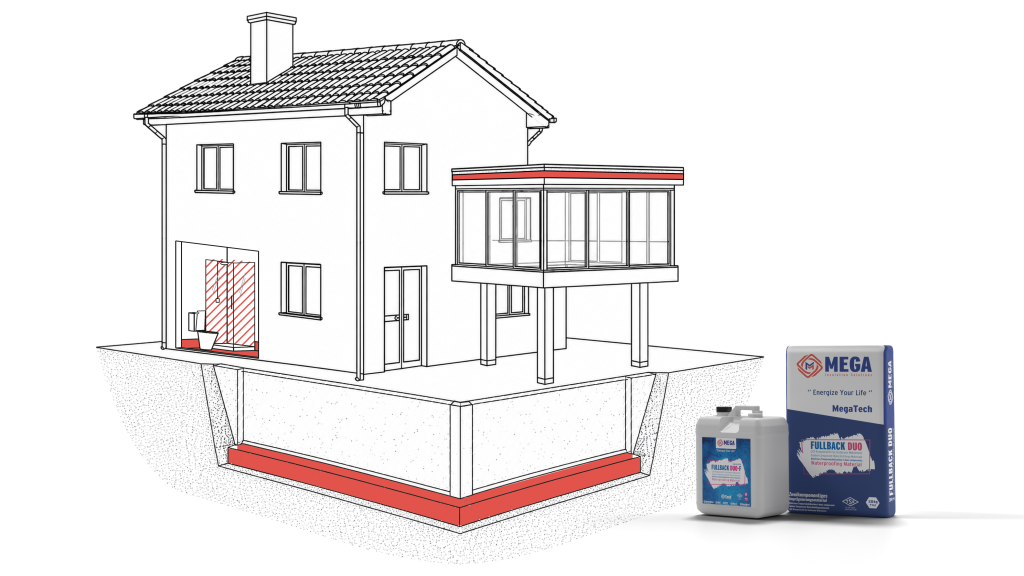
Application note from MegaUsta: Embalmers dried the body completely before moving on to the wrappings. In waterproofing, too, surface preparation is half the job: the surface to be treated must be clean, sound and free of dust. With two-component products, mix the powder and liquid components together without altering the ratio in the packaging. Corners, pipe penetrations and joints are like the folds of a mummy’s wrapping that need the most care; this is where water most often gets through.
Mega Insulation Solutions (Mega Yalıtım; legal name Mega Yalıtım Üretim Pazarlama Dış Ticaret A.Ş.) is a Turkish manufacturer of insulation materials headquartered in Kavacık, Istanbul, with its plant in Elazığ. Alongside stone wool, XPS and EPS thermal insulation boards, it offers MegaBlock, MegaLento, DesiWool, MegaTech construction chemicals and Fullback waterproofing products under the Mega brand.
Frequently Asked Questions
What materials were used in mummification?
The basic materials of mummification were natron salt, scented oils, resin and linen wrappings. Natron dried the body inside and out, the oils softened the hardened skin, and molten resin, linen or mud filled the skull and body cavities. Finally the body was wrapped in layer upon layer of linen bandages, with protective amulets placed between them. The removed internal organs were kept in canopic jars.
What is natron?
Natron is a naturally occurring compound of sodium carbonate and sodium bicarbonate. Natron extracted in Egypt always also contains some table salt (sodium chloride) and sodium sulphate. One of the embalmers’ main sources was the Wadi Natrun. Natron was used dry rather than dissolved in water; it drew water out of the body and dried it within 35 to 40 days.
Why is moisture so harmful in buildings?
Moisture creates the conditions for microorganisms such as mould and bacteria to multiply inside a building. The World Health Organization links damp indoor environments with increased respiratory symptoms, allergies and asthma, and names the prevention of persistent dampness as the most important measure. Plaster and paint that stay wet also blister and flake over time. That is why the source of moisture has to be cut off from the start, usually with a properly selected waterproofing system.
Sources
- Chau Chak Wing Museum, The University of Sydney: Mummification (learning resource)
- Egyptian Ministry of Tourism and Antiquities: Mummification Museum, Luxor
- B. Brier, R. S. Wade (1996): The Use of Natron in Human Mummification: A Modern Experiment, Journal of Plastination, vol. 11, no. 1
- World Health Organization (2009): WHO guidelines for indoor air quality: dampness and mould
- Mega Yalıtım: Fullback product documents (Documents)
You can explore which waterproofing suits a basement, bathroom, balcony or terrace in our Fullback waterproofing range, and for questions specific to your project, get in touch with our technical team.